Guide
What is actually in a homeopathic remedy?
Source substances, dilution, succussion, pellets, and labels: a plain-language tour of how homeopathic remedies are made and what the vial contains.
2026-07-05
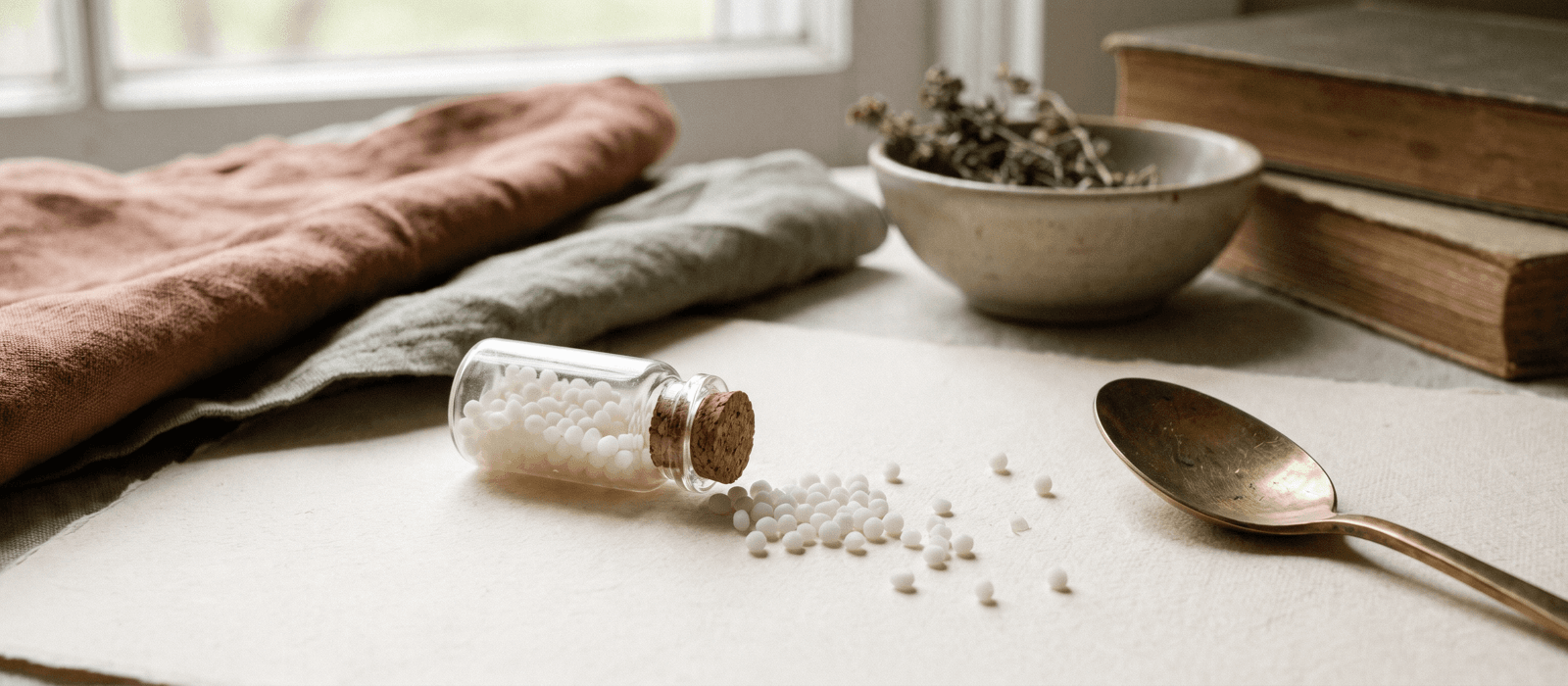
It is a fair question, asked constantly and answered clearly almost nowhere between two unhelpful poles — mystification from sellers, dismissal from critics. Here is the plain version.
The starting material
Remedies begin from a source substance: most commonly plants (arnica, chamomilla, pulsatilla), minerals (sulphur, natrum muriaticum — table salt), and animal-derived materials (apis, from the honeybee). Some sources are gentle; some, in raw form, are genuinely toxic plants like aconite or belladonna. The source is prepared into a "mother tincture" (typically an alcohol extraction) or, for insoluble minerals, ground finely before dilution.
The process: dilution and succussion
From the mother tincture, preparation proceeds in repeated steps: dilute (1:10 or 1:100 per step), then succuss — shake firmly against a resilient surface. The step count and ratio become the potency on the label, a system with its own guide.
The honest arithmetic from that guide bears repeating here: beyond roughly 12C, the dilution passes the point where any molecule of the source substance is likely to remain. A 30C vial is, chemically, sugar and water-or-alcohol. Homeopathic tradition holds that the structured preparation process itself is what matters; mainstream chemistry and medicine do not accept that claim. We lay out the research record separately in homeopathy and the evidence — a trustworthy answer to "what is in the vial" includes both sentences, so there they are.
One practical corollary: this is also why properly prepared high-potency remedies made from toxic sources are not a poisoning concern the way the raw plants would be. (Low-potency and mother-tincture products are a different matter — they can contain material amounts of the source, which is one of several reasons product quality and labeling matter.)
The delivery form
The liquid preparation is typically applied to small sucrose/lactose pellets — the little white spheres most people picture — or dispensed as liquid drops or tablets. So the physical contents of a standard remedy vial: sugar pellets carrying the final dilution. Anyone avoiding lactose or with sugar restrictions can ask about the base when ordering; that is a normal question.
What the label tells you
A typical label reads like Arnica montana 30C: the source in Latin, then the potency. In the United States, homeopathic products are regulated as drugs under the FD&C Act, with sources listed in the Homeopathic Pharmacopeia (HPUS); labeling and manufacturing quality are real and inspectable things, and reputable preparation matters for exactly that reason. None of this constitutes an efficacy claim — regulation of a category is not endorsement of it, and no remedy we prepare or discuss diagnoses, treats, cures, or prevents disease.
Why we tell you all of this
Because informed is the only kind of customer we want. Some people, knowing everything above, still value remedies — for the tradition, for the case-taking discipline that surrounds them, for their own reasons. Others conclude the vial is not for them. Both are correct responses to honest information, and the case-taking craft this site teaches is worth learning either way.
If you know what you want prepared, the custom single remedy page takes requests — remedy, potency, format — and we confirm everything by email before making anything.