Remedy profile
Kali carbonicum in Homeopathy: Uses, Picture and Limits
What homeopathic Kali carbonicum is made from, the weak, stitching, 3 a.m. picture homeopaths describe, what changes it, potencies sold, and its limits.
By Homeopathic BenefitsPublished 8 min read
Key takeaways
- Kali carbonicum is a constitutional picture, not an acute one. It is one of the classic polychrests, and none of our acute pages names it; classic texts describe a whole person rather than a passing complaint.
- Weakness, chill and stitching pains define it. Homeopathic literature describes a person who tires easily, sweats with little effort, feels the cold and has sharp, stitching pains that come at rest as well as on moving.
- The small hours are its time. Complaints that wake the person or peak between 2 and 4 a.m. are the detail homeopaths remember first.
- It comes from potash. Potassium carbonate is a caustic alkaline salt in raw form; potentised preparations are diluted far past the point where it remains.
- Chest and back symptoms have red flags. Chest pain, breathlessness, coughing blood, or back pain with numbness, leg weakness or bladder changes is a medical question first.
The short answer
Kali carbonicum is a homeopathic remedy prepared from potassium carbonate, the alkaline salt historically made from wood ashes and known as potash. In homeopathy it names a traditional constitutional picture rather than a treatment: a chilly, easily tired person with a weak back, stitching pains in the chest or back, bloating, puffiness of the upper eyelids, a tendency to startle at touch, and complaints that come or worsen between 2 and 4 in the morning. Hahnemann published it in The Chronic Diseases (1828–1830), and Kent's Lectures (1905) give it one of their longest and most vivid portraits. It is one of the remedies homeopaths think of for long-standing patterns rather than sudden ones. Nothing about the picture replaces medical care for chest, breathing or back symptoms.
| Latin name | Kali carbonicum |
|---|---|
| Abbreviation | Kali-c. |
| Common name | Potassium carbonate; potash |
| Source | Potassium carbonate, the alkaline salt historically leached from wood ashes, potentised (mineral kingdom) |
| Commonly sold potencies | 6C, 30C, 200C |
| First proving | Hahnemann, The Chronic Diseases (1828–1830) |
What is Kali carbonicum made from?
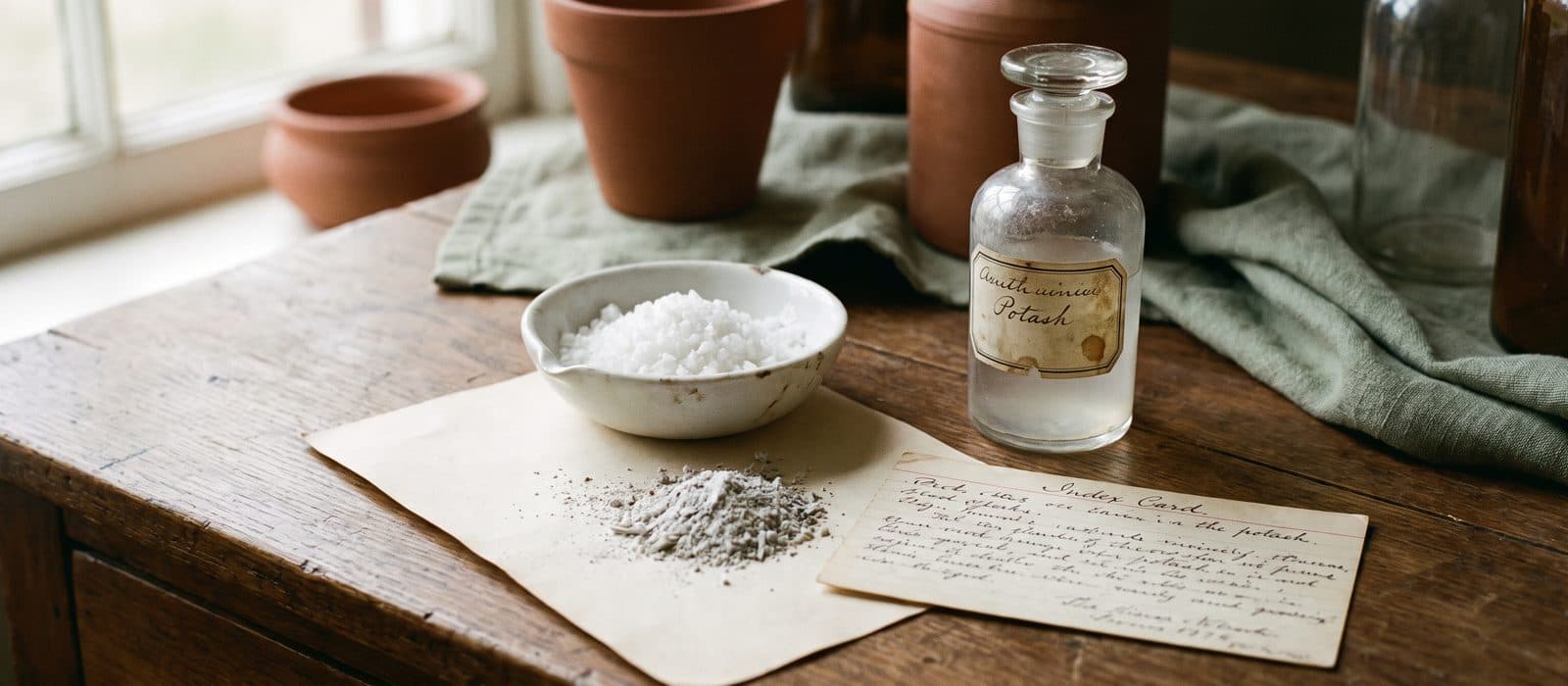
Kali carbonicum is prepared from potassium carbonate, a white, strongly alkaline salt. For most of history it was made by soaking wood ashes in water in large pots and boiling the liquid down, which is where the English word potash, and through it the element potassium, comes from. Kali comes from the Arabic for plant ash, the same root as alkali. The old chemists also called a purified form salt of tartar. It was used for centuries in soap-making, glass and bleaching.
The raw salt is caustic. It burns skin and eyes and is harmful if swallowed, and it is not something to prepare or handle at home. The homeopathic preparation carries it through dilution and succussion, with trituration in the first steps for some manufacturers, to the potency on the label. At the common potencies, the arithmetic says no molecule of the original salt remains; our potencies guide explains what that means and why it is also the reason mainstream science is sceptical. Our guide to reading Latin remedy names explains why the "Kali" remedies, from Kali bichromicum to Kali phosphoricum, all share a first name.
What is the Kali carbonicum picture?
The Kali carbonicum picture is a tired, chilly person who is awake at three in the morning. The back aches as if it would give way, the cough has come back, and there is nothing to do but sit up in bed, leaning forward with the elbows on the knees, until it eases. They are sweating, though they feel cold. In the day they want to lie down, startle when a door bangs, and jump if someone touches their feet.
Kent's Lectures (1905) draw the temperament sharply: a person who is irritable and hard to please, full of fears, who does not want to be alone yet is quarrelsome and difficult with the people who stay. Later homeopaths have added a picture of rigid propriety and a strong sense of duty, the person who keeps to the rules and expects others to do the same. That later reading is widely used, but it is interpretation layered on the classic texts rather than something Hahnemann recorded.
Physically, three keynotes carry most of the weight. The first is stitching pain, in the chest, the back or the joints, which, unlike the stitching pain of Bryonia, can come on at rest as well as on movement. The second is weakness: Boericke (1927) notes the weakness common to all the potassium salts, with sweat, backache and a feeling that the legs will give way. The third is the hours between 2 and 4 a.m., when cough, breathlessness, backache and wakefulness are all worse in the classic descriptions. Smaller signs complete the portrait: puffy, bag-like swelling of the upper eyelids, a stomach that fills with wind after eating, and great sensitivity to draughts.
Classic texts also discuss Kali carbonicum after childbirth and after loss of fluids, when weakness and backache are at their worst. Those are times when a clinician should assess any new symptoms first.
What makes it better or worse?
The traditional modalities centre on time, cold and position. Kali carbonicum is worse in the small hours, from cold and draughts and from lying on the painful side, and better from warmth and sitting up leaning forward.
| Modality | Worse | Better |
|---|---|---|
| Time | 2 to 4 a.m., especially around 3 a.m. | Daytime, in many descriptions |
| Temperature | Cold air, draughts, cold weather | Warmth, warm weather |
| Position | Lying on the left or painful side | Sitting up, leaning forward with elbows on the knees |
| Touch | Being touched, especially on the feet; startles easily | No consistent keynote |
| Exertion | Exertion, loss of fluids, after childbirth | Rest, lying down for the back |
The 3 a.m. timing is one of the best-known modalities in the materia medica; our guide to modalities, better and worse explains why timing carries so much weight in a case.
What is Kali carbonicum traditionally discussed for?
In homeopathic literature, Kali carbonicum is traditionally discussed as a constitutional picture, which means classic texts describe it for long-standing tendencies in a particular kind of person rather than for single complaints. It is not named as a pattern on any of our acute pages. The pages below discuss the complaints themselves, with their own red flags first; they are where the subjects overlap, not places where Kali carbonicum is presented.
Back
- The weak back that wants to lie down and gives out after exertion or childbirth. The nearest acute page is back strain after lifting, which sets out when back pain needs a doctor.
Chest and cough
- A dry, hard cough worse around 3 a.m. and better sitting forward, with stitching chest pains. Our pages on a wet, productive cough and a dry, tickly cough cover the red flags for coughs.
Digestion
- Bloating in which everything eaten seems to turn to wind, with weakness. See bloating after eating and gas pains and bloating.
General state
- Chilliness, sweat with little effort, puffy upper eyelids and waking in the small hours: the features that tie the picture together, and the reason it belongs in a full consultation. Our guide to acute versus chronic explains the difference.
What is Kali carbonicum not?
Kali carbonicum is not an acute first-aid remedy, and it is not a potassium supplement. The commonest misreading is to see "3 a.m. cough" or "weak back" in a list and match the name to the complaint. The tradition reads it as a whole-person picture, built from the chill, the startle, the timing, the weakness and the temperament together; one symptom from the list does not make the picture. Potentised potassium carbonate supplies no potassium, and potassium levels are a blood-test question for a doctor.
The complaints the picture touches have serious red flags. Chest pain, breathlessness at rest, wheezing, coughing up blood, a cough lasting more than three weeks, or night sweats with weight loss need medical assessment. Back pain with numbness around the groin or buttocks, weakness or numbness in the legs, new bladder or bowel problems, fever, or pain after a fall is urgent. New swelling of the eyelids or face, or exhaustion after childbirth with fever, heavy bleeding, chest pain or a swollen leg, needs a doctor or midwife. Our guide to red flags first sets these out.
Homeopaths separate Kali carbonicum from its neighbours like this:
| Picture | Where it sits | Defining feature | Key modality |
|---|---|---|---|
| Kali carbonicum | Weak, chilly, constitutional states | Stitching pains at rest; startles at touch; puffy upper eyelids | Worse 2 to 4 a.m. and cold; better sitting forward |
| Bryonia | Dry, stitching, irritable states | Stitching pains only on movement; wants to lie still | Worse any motion; better pressure and lying on the painful side |
| Arsenicum album | Anxious, weak, chilly states | Restless fear; wants company; burning pains | Worse after midnight, 1 to 2 a.m.; better warmth |
| Nux vomica | Excess, overwork, stimulants | Irritable and chilly; wakes at 3 to 4 a.m. with a busy mind | Worse morning and cold; better a short sleep |
| Calcarea carbonica | Chilly, sweaty, slow constitutions | Steady and easily tired rather than touchy and startled | Worse cold and damp and exertion; better dry weather |
What potencies is Kali carbonicum sold in?
Kali carbonicum is sold as single-remedy pellets, most often 30C, with 6C and 200C also available from homeopathic pharmacies. Because it is a constitutional remedy, it is less common in home acute kits than Arnica or Nux vomica. Potency describes the preparation process, not an amount of potassium carbonate: 30C means thirty successive 1:100 dilutions with succussion between them. Our potencies guide explains the scale and what remains in the vial.
This page deliberately gives no frequency or instructions for taking Kali carbonicum. That depends on a whole case, not a remedy name. Read the product label, and talk to a qualified practitioner about an individual situation.
What remedy lists don't tell you
Two things the short lists leave out:
- The startle is as telling as the cough. Lists reduce Kali carbonicum to "the 3 a.m. remedy" or "the remedy for a weak back". The classic portraits rest just as much on things a list rarely mentions: jumping when touched on the feet, the puffy upper eyelids, the sweat in a cold body, and the person who wants company and then argues with it. Our guide to how a homeopath takes a case shows how those details are gathered.
- Constitutional pictures are not self-selection territory. Hahnemann placed Kali carbonicum among the remedies for chronic, long-standing patterns, and later teachers warned that it was hard to recognise and easy to misjudge. A remedy whose picture depends on years of history, temperament and timing is the clearest case for a full consultation rather than a lookup, and for keeping the doctor involved in any chest, back or breathing symptom.
Not sure whether a picture fits?
A remedy profile describes a picture; it cannot tell you whether that picture matches what you are seeing. An acute consultation starts from the case itself: onset, sensations, what changes it, and the red flags.
Acute consultation · $45Frequently asked questions
- What is Kali carbonicum?
- Kali carbonicum is a homeopathic remedy prepared from potassium carbonate, the alkaline salt once made by soaking wood ashes in water. In homeopathy it names a traditional picture: a chilly, weak, easily startled person with stitching pains, a weak back, swelling of the upper eyelids, and complaints that are worst around 2 to 4 a.m. It is a description homeopaths use to compare cases, not evidence that it works for any condition.
- What is Kali carbonicum used for in homeopathy?
- Homeopathic literature traditionally discusses Kali carbonicum as a constitutional picture: weakness and backache that make the person want to lie down, a dry cough worse in the small hours and better sitting forward, bloating after eating, and stitching pains in the chest or back. The 3 a.m. timing, chilliness and startle define it. Chest pain, breathlessness, coughing blood, or back pain with leg weakness or numbness need medical care first.
- What is Kali carbonicum 30C used for?
- 30C is a common shelf potency of Kali carbonicum in single-remedy ranges, with 6C and 200C also sold, though it is less often in home kits than acute remedies. In the tradition the potency does not change the picture; Kali carbonicum 30C is discussed for the same weak, chilly, stitching picture as any other potency. Our potencies guide explains what 30C means as a dilution.
- How is Kali carbonicum taken?
- This page does not give instructions on how or how often to take any remedy, because that depends on a whole case rather than on a remedy name. The product label carries the manufacturer's directions, and a qualified practitioner can advise on an individual situation. Kali carbonicum is traditionally a constitutional remedy, which is the territory of a full consultation, and chest or back symptoms with red flags belong with a clinician first.
- Where can I buy Kali carbonicum?
- Pharmacies and homeopathic manufacturers sell Kali carbonicum as single-remedy pellets, most often in 30C, though general shops stock it less often than the common kit remedies. This site also prepares custom single remedies to order: you name the remedy and potency, and the details are confirmed by email before anything is made. The order form does not give advice on which remedy to choose.
- What is Kali carbonicum made from?
- Kali carbonicum is made from potassium carbonate, the white alkaline salt historically called potash or salt of tartar, once made by leaching wood ashes in pots. It is dissolved or triturated and then diluted and succussed to the labelled potency. The raw salt is caustic to skin, eyes and the gut and is not something to handle or swallow; potentised preparations are diluted far past the point where it remains.
This guide is educational only and is not medical advice or a personalized remedy recommendation. Acute symptoms can become urgent; when in doubt, seek professional evaluation.