Remedy profile
Bryonia alba in Homeopathy: Uses, Picture and Limits
What homeopathic Bryonia alba is made from, the dry, irritable, worse-from-motion picture homeopaths describe, what changes it, potencies sold, and its limits.
By Homeopathic BenefitsPublished 8 min read
Key takeaways
- Bryonia is the picture of a person who must keep still. The slightest movement, even of the eyes, makes the pain worse, so the person lies rigid and wants nobody to jostle the bed.
- Pressure helps, movement hurts. Classic texts describe lying on the painful side or holding the chest to cough, because firm pressure stops the part from moving.
- Dryness runs through it. Dry lips and mouth, a dry cough, dry hard stools, and a thirst for large drinks of cold water at long intervals.
- The temper is irritable and homeward. The person is cross when disturbed, worries about work and money, and in the old descriptions wants to go home even when at home.
- Pain on breathing comes with red flags. Chest pain, breathlessness, coughing blood, or back pain with numbness or bladder changes are medical questions before they are homeopathic ones.
The short answer
Bryonia alba is a homeopathic remedy prepared from the root of white bryony, a climbing plant of the gourd family that scrambles through European hedgerows. In homeopathy it names a traditional picture rather than a treatment: sharp, stitching pain that is worse from the slightest motion and better from firm pressure and lying still, with dryness everywhere and a thirst for long cold drinks. Classic materia medica describes an irritable person who wants to be left in peace, whose illness comes on slowly, and whose mind turns to business. Hahnemann documented it in his Materia Medica Pura, and Boericke (1927) and Kent both make the motion aggravation its signature. It is not a cough or back-pain remedy as such, and nothing about the picture replaces medical care for chest pain, breathlessness or a serious injury.
| Latin name | Bryonia alba |
|---|---|
| Abbreviation | Bry. |
| Common name | White bryony, wild hops |
| Source | Fresh root of white bryony, Bryonia alba, dug before flowering (Cucurbitaceae) (plant kingdom) |
| Commonly sold potencies | 6C, 30C, 200C |
| First proving | Hahnemann, Materia Medica Pura (1811–1821) |
What is Bryonia alba made from?
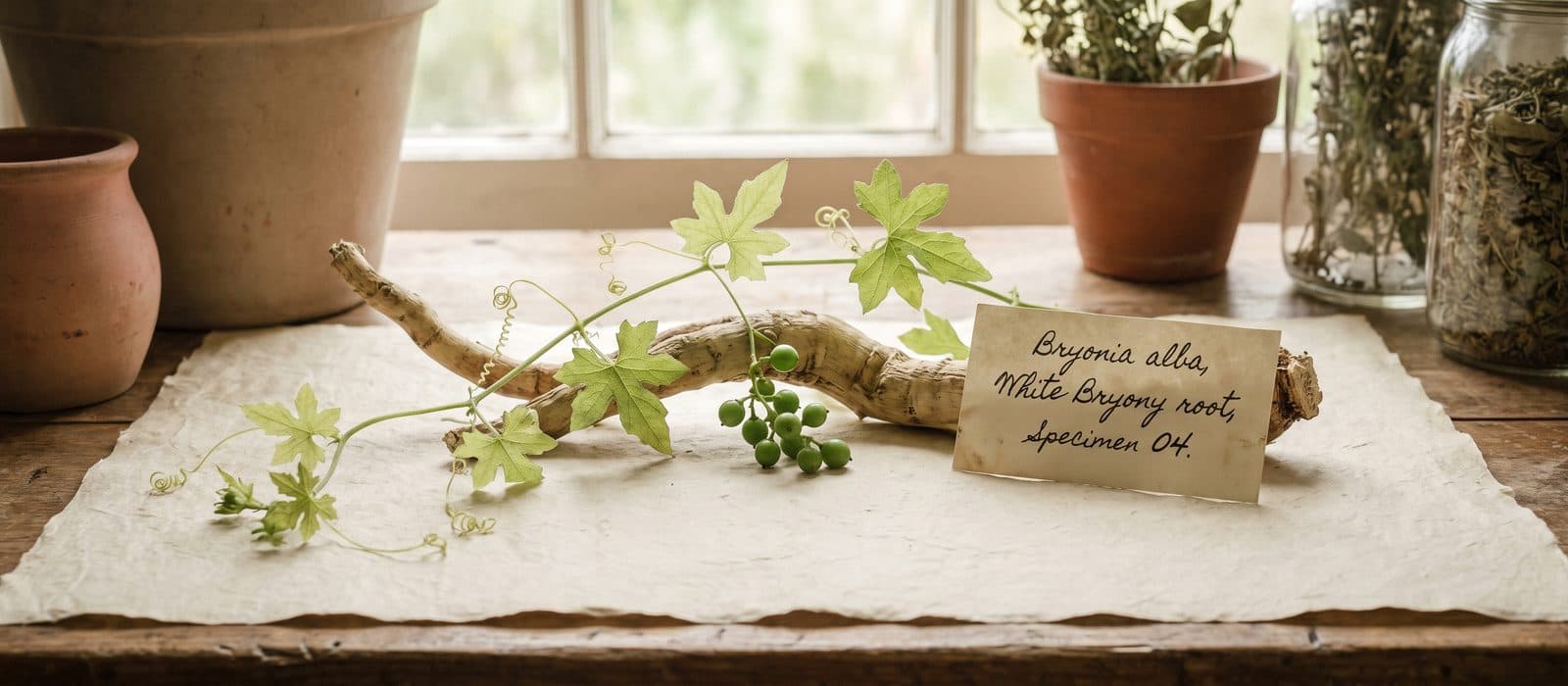
Homeopathic Bryonia is prepared from the fresh root of Bryonia alba, white bryony, dug in spring before the plant flowers. It is a perennial climber of the gourd family (Cucurbitaceae), related to cucumbers and squashes, that pulls itself through hedges and woodland edges with coiled tendrils. Above ground it has palmate leaves, small greenish-white flowers and, in this species, black berries. Below ground is the part homeopaths use: a huge, fleshy, pale tuberous root that can grow as thick as an arm and was once carved and sold as a fake mandrake.
The plant is poisonous. The root and berries contain bitter cucurbitacins and other irritant compounds; the root was used historically as a violent purgative, and eating it causes vomiting, severe diarrhoea and, in quantity, collapse. The berries are a risk to children. Raw bryony is never something to eat, brew or prepare at home. The homeopathic preparation makes a mother tincture of the root and carries it through repeated dilution and succussion to the potency on the label; at the common potencies the arithmetic says no molecule of the root remains. Our potencies guide sets out what that means and why it is also the reason science is sceptical.
What is the Bryonia picture?
The Bryonia picture is a person who has gone very still on purpose. Picture someone two days into a heavy cold that has moved to the chest. They lie on their back, not moving, because every cough stabs; when the cough comes they press both hands to the ribs to hold them. They ask for a large glass of cold water, drink it all, and do not ask again for an hour or more. Their lips are dry and cracked. Ask how they are and they answer shortly, without opening their eyes, and the question itself seems to annoy them.
Classic texts make the motion aggravation the centre of everything. Boericke (1927) describes all symptoms as worse from motion and better from rest, and gives the pains a stitching, tearing quality. Kent's Lectures (1905) describe a patient who dreads even being spoken to, because answering means stirring; the eyes hurt when moved, the headache bursts on stooping or coughing, and a strained joint is held rigid. Pressure is the paradoxical comfort: the person lies on the painful side, binds the aching part tightly, or holds the chest to cough, because pressure holds the part still.
The dryness is the second thread. The mucous membranes are dry, so the cough is dry and painful; the stools are large, hard and dry, as if burnt; the mouth is dry and the thirst is for long draughts of cold water. The illness tends to come on slowly, over a day or two, rather than suddenly. The mental state is irritable and anxious about practical matters; in feverish states the old texts describe a person who talks of business and wants to go home.
What makes it better or worse?
The traditional modalities centre on movement and pressure. Bryonia is worse from any motion and from warmth, and better from rest, firm pressure and cool air.
| Modality | Worse | Better |
|---|---|---|
| Motion | The slightest movement, coughing, deep breathing, moving the eyes, stooping | Lying completely still |
| Pressure and position | Light touch; sitting up from lying | Firm pressure; lying on the painful side |
| Temperature | Warm rooms, hot weather, warmth generally | Cool open air, cold drinks |
| Time | Morning on first moving; around 9 p.m. (Boericke) | No consistent keynote |
| Other | Eating; exertion; being disturbed | Quiet, being left alone |
Our guide to the symptoms alongside the symptom explains why a homeopath asks about thirst, temper and position before naming any picture; with Bryonia, those details are most of the description.
What is Bryonia alba traditionally discussed for?
In homeopathic literature, Bryonia is traditionally discussed for states shaped by stillness, dryness and pain on movement. Each of these appears on one of our acute pages, where the Bryonia-like pattern sits beside its neighbours and the red flags come first.
Strains and stiffness
- The back that catches with every movement after lifting: back pain after lifting.
- The neck that will not turn and wants to be held still: a stiff neck after sleeping awkwardly.
- The joint that wants to be kept still and firmly supported: a sprained ankle. Our guide to sprains, strains and overuse reads these cases side by side.
Coughs
- The dry, painful cough that hurts the chest and is worse from talking and deep breaths: a dry, tickly cough and a cough after dust exposure.
Heads
- The splitting, worse-from-moving headache of a long, irritable day: a tension headache during a stressful day.
Digestion
- Large, dry, hard stools with irritability: constipation after travel.
What is Bryonia alba not?
Bryonia is not "the cough remedy" or "the back remedy". The commonest misreading is to match it to a part of the body; the tradition matches it to a behaviour. A cough that is better for moving about, a back that loosens as the person walks, or a thirstless, chilly, droopy cold all point away from it, however painful they are. The motion aggravation, the comfort from pressure, the dryness and the irritable wish to be left alone are the picture. The second misreading is more serious. Stitching chest pain that is worse on breathing in can mean pleurisy, pneumonia or a clot in the lung. Chest pain, breathlessness, coughing blood, a high fever, a stiff neck with fever and headache, or back pain with numbness in the legs or saddle area, or with bladder or bowel changes, needs medical care first. Our guide to red flags first sets these out.
Homeopaths separate Bryonia from its neighbours like this:
| Picture | Where it sits | Defining feature | Key modality |
|---|---|---|---|
| Bryonia alba | Strains, dry coughs, slow-onset feverish colds | Lies rigid; dry, thirsty for long cold drinks, irritable | Worse any motion; better pressure and rest |
| Rhus toxicodendron | Strains and stiffness | Stiff on first moving, loosens with continued motion; restless | Better continued motion and warmth |
| Arnica montana | Bruising and overexertion | Sore, bruised, says they are fine; bed feels too hard | Worse touch and being approached |
| Gelsemium | Slow-onset feverish colds | Heavy, droopy, dull; thirstless | Worse exertion; better passing urine (Boericke) |
| Phosphorus | Coughs and chest colds | Open, wants company; craves cold drinks too | Worse lying on the left side |
| Kali carbonicum | Weak, chilly, constitutional states | Stitching pains even at rest; startles at touch; puffy upper eyelids | Worse 2 to 4 a.m. and cold; better sitting forward |
Bryonia and Rhus toxicodendron are the classic opposite pair for strains. The traditional distinction is what movement does: in Rhus tox the first movement hurts and continued movement eases; in Bryonia every movement hurts and stillness is the only comfort.
What potencies is Bryonia alba sold in?
Bryonia alba is sold most often as 30C pellets, the common shelf potency for single remedies, with 6C and 200C also widely available. Potency describes the preparation process, not an amount of root: 30C means thirty successive 1:100 dilutions with succussion between them. Our potencies guide explains the scale and what remains in the vial, and why low-potency products of toxic sources carry their own labelling.
This page deliberately gives no frequency or instructions for taking Bryonia alba. That depends on a whole case, not a remedy name. Read the product label, and talk to a qualified practitioner about an individual situation.
What remedy lists don't tell you
Two things the "remedies for a cough" lists leave out:
- The behaviour at the bedside is the description. You can see a Bryonia-like state from the doorway: the person lying flat and motionless, the hand pressed to the side, the glass of water drained, the short answer. Lists that say "dry cough" or "back pain" describe the complaint and leave out the stillness, which is what the classic authors found most characteristic.
- The same stitch that defines the picture is the one that needs a doctor. The old materia medica grew up describing pleurisy and pneumonia, illnesses that now need antibiotics, imaging or hospital care. A modern reader should take the Bryonia picture as a way of describing a reaction, and take a stabbing pain on breathing in as a reason to be examined. Our guide to the first colds of the school year sets out when a child's cold becomes urgent.
Where the Bryonia alba picture appears on this site
Acute pages that discuss this picture among their educational patterns, with the pattern name each page uses.
- What homeopathic remedy for a cough after dust exposure?Bryonia-like dry, stitching, motion-worse pattern
- What homeopathic remedy for a dry, tickling cough?Bryonia-like dry, stitching, motion-worse pattern
- What homeopathic remedy for a sprained ankle?Bryonia-like stillness pattern
- What homeopathic remedy for a stiff neck after sleeping awkwardly?Bryonia-like worse-motion stitching pattern
- What homeopathic remedy for a tension headache during a stressful day?Bryonia-like splitting worse-motion pattern
- What homeopathic remedy for back pain after lifting?Bryonia-like worse-motion stitching pattern
- What homeopathic remedy for constipation after travel?Bryonia-like dry, hard stool pattern
Not sure whether a picture fits?
A remedy profile describes a picture; it cannot tell you whether that picture matches what you are seeing. An acute consultation starts from the case itself: onset, sensations, what changes it, and the red flags.
Acute consultation · $45Frequently asked questions
- What is Bryonia alba?
- Bryonia alba is a homeopathic remedy prepared from the root of white bryony, a climbing plant of the gourd family found in European hedgerows. In homeopathy it names a traditional picture: sharp, stitching pain that is worse from the slightest movement, dryness of the lips, mouth and stools, great thirst for long cold drinks, and an irritable person who wants to lie still and be left alone. It is a description homeopaths use to compare cases, not a finding that it works for any condition.
- What is Bryonia used for in homeopathy?
- Homeopathic literature traditionally discusses Bryonia for states shaped by the need to keep still: a dry cough that hurts the chest, a strained back or neck where every movement catches, a headache worse from moving the eyes, and dry, hard constipation. The picture is defined by the motion aggravation, the dryness and the irritability, not by the complaint. Chest pain on breathing, breathlessness, a high fever, or back pain with numbness or bladder changes needs medical care first.
- What is Bryonia 30C used for?
- 30C is the common shelf potency of Bryonia, the one most single-remedy tubes and home kits carry. In the tradition the potency does not change the picture; Bryonia 30C is discussed for the same dry, still, worse-from-motion state as any other potency. What 30C means as a dilution is explained in our potencies guide.
- How is Bryonia alba taken?
- This page does not give instructions on how or how often to take any remedy, because that depends on a whole case rather than on a remedy name. The product label carries the manufacturer's directions, and a qualified practitioner can advise on an individual situation. A cough with chest pain or breathlessness, or a back injury with numbness, belongs with a clinician first.
- Where can I buy Bryonia alba?
- Pharmacies, health-food shops and homeopathic manufacturers sell Bryonia alba as single-remedy pellets, most often in 30C, and it is a standard item in home acute kits. This site also prepares custom single remedies to order: you name the remedy and potency, and the details are confirmed by email before anything is made. The order form does not give advice on which remedy to choose.
- What is Bryonia alba made from?
- Homeopathic Bryonia is prepared from the fresh root of white bryony, Bryonia alba, dug before the plant flowers, made into a mother tincture and then diluted and succussed step by step to the labelled potency. The raw root and the berries are poisonous and strongly irritant, which is why the plant appears on labels only in potentised form.
This guide is educational only and is not medical advice or a personalized remedy recommendation. Acute symptoms can become urgent; when in doubt, seek professional evaluation.