Remedy profile
Rhus toxicodendron in Homeopathy: Uses, Picture and Limits
What homeopathic Rhus toxicodendron is made from, the stiff, restless picture that limbers up with motion, what changes it, potencies sold, and its limits.
By Homeopathic BenefitsPublished 6 min read
Key takeaways
- Rhus tox is the rusty-gate picture. Stiffness and aching that are worst on the first movement, then ease as the joint keeps moving, and return after rest.
- Restlessness is part of the picture. The person cannot stay still in bed, keeps changing position, and feels worse the longer they keep still.
- Cold and damp aggravate; warmth comforts. Classic texts place the picture after getting chilled and wet, and describe a strong wish for warmth and hot bathing.
- It comes from poison ivy. The plant's urushiol causes the familiar blistering rash, and the materia medica describes a skin picture that mirrors it.
- Strains need red flags first. A joint that cannot bear weight, looks deformed, is hot and swollen, or comes with fever is a medical question before a homeopathic one.
The short answer
Rhus toxicodendron, usually called Rhus tox, is a homeopathic remedy prepared from the fresh leaves of poison ivy. In homeopathy it names a traditional picture rather than a treatment: stiffness and aching that are worst on first movement and ease as movement continues, in a restless person who cannot keep still and longs for warmth. Classic materia medica places the picture after overexertion, strains, and getting cold and wet, and also describes a red, intensely itchy, blistering skin picture that mirrors the plant's own rash. Samuel Hahnemann documented it in his Materia Medica Pura in 1816. It is not a general remedy for sore joints, and nothing about the picture replaces assessment of a strain or a swollen joint that might be serious.
| Latin name | Rhus toxicodendron |
|---|---|
| Abbreviation | Rhus-t. |
| Common name | Poison ivy, poison oak |
| Source | Fresh leaves of poison ivy, Toxicodendron radicans (Anacardiaceae) (plant kingdom) |
| Commonly sold potencies | 6C, 30C, 200C |
| First proving | Hahnemann, Materia Medica Pura, vol. 2 (1816) |
What is Rhus toxicodendron made from?
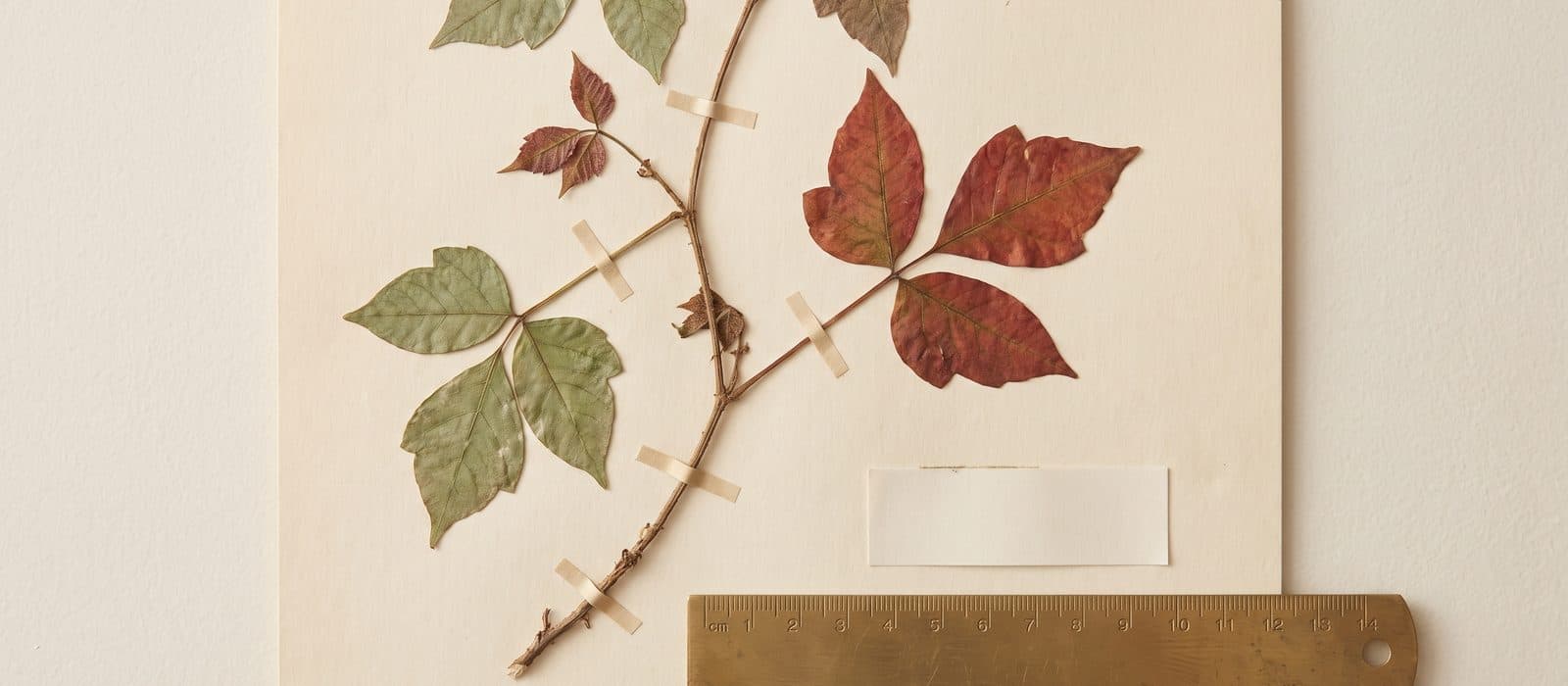
Homeopathic Rhus tox is prepared from the fresh leaves of poison ivy, today classified as Toxicodendron radicans and in older botany as Rhus toxicodendron or Rhus radicans. It is a North American vine or low shrub of woodland edges, with the famous three-leaflet leaves that turn brilliant red in autumn. Older texts sometimes mix in poison oak; the label name has outlived the botany.
The plant's notoriety is deserved. Every part of it carries urushiol, an oily resin that sets off an itchy, red, blistering rash in most people who touch it, and smoke from burning it can affect the lungs. Herbalists do not use it and nobody should handle it bare-handed. The homeopathic preparation makes a mother tincture from the fresh leaves and carries it through repeated dilution and succussion. At the common potencies the arithmetic says none of the original plant remains, which is also the reason the preparation is not a rash risk; our potencies guide sets out what that means and why science is sceptical.
The skin picture is the clearest example of homeopathy's founding idea of like for like: a remedy made from the plant that causes an itching, blistering rash is traditionally discussed for a similar-looking rash.
What is the Rhus tox picture?
The Rhus tox picture is the person who creaks into the morning and loosens up by lunchtime. They get out of bed stiff and sore, the first steps are painful, the back or the knee refuses to cooperate, and then, after walking about for a while, things ease. Sit down for an hour and the stiffness returns; stand up and they have to work through it again. The image homeopaths use is a rusty gate, hard to start and freer once it is swinging.
Restlessness runs through it. Classic texts describe a person who cannot stay in one position, tossing and turning in bed because lying still makes the aching worse, and who feels driven to move even when moving at first hurts. Boericke (1927) describes it as affecting fibrous tissue markedly: joints, tendons and their sheaths, with pain as if sprained. The mood that goes with it is low, restless and a little anxious, especially at night.
The picture typically follows overexertion, a strain from lifting, or getting chilled and soaked: the gardener caught in the rain, the hiker who sat on cold ground. The skin side of the picture is red, swollen and intensely itchy, with small blisters often in lines or clusters, and itching that hot water briefly eases. The same restlessness shows up here too: the person cannot leave the skin alone and cannot settle at night while it itches.
What makes it better or worse?
The traditional modalities centre on motion and temperature. Rhus tox is worse from first motion, rest and cold damp, and better from continued motion and warmth.
| Modality | Worse | Better |
|---|---|---|
| Motion | Beginning to move; after rest; overexertion | Continued gentle motion; changing position |
| Temperature | Cold, damp, rainy weather; getting soaked; uncovering | Warmth, warm applications, hot baths |
| Time | Night; on first rising in the morning | Later in the day, once limbered up |
| Position | Keeping still; lying on the painful side | Stretching out the limbs; rubbing |
| Weather | Before and during storms; wet weather | Warm, dry weather |
The first-motion-worse, continued-motion-better pairing is one of the textbook modalities; our guide to modalities, better and worse uses it to show why the same complaint can belong to opposite pictures.
What is Rhus toxicodendron traditionally discussed for?
In homeopathic literature, Rhus tox is traditionally discussed for stiffness after strain and exertion, and for itching, blistering skin. Each of these appears on one of our acute pages, where the Rhus-like pattern sits beside its neighbours and the red flags come first.
Strains and stiff joints
- The stiffness that eases with walking in a sprained ankle.
- A back strain after lifting and a stiff neck after sleeping awkwardly.
- The first-step stiffness of heel pain after standing.
Muscles after exertion
- The limber-with-motion soreness of sore muscles after a workout.
- Knee soreness after a hike and shin splints from running.
Skin
- The itching, blistering lines of a poison ivy rash.
What is Rhus tox not?
Rhus tox is not "the remedy for stiff joints". Plenty of stiff joints are worse for every movement, and those belong to an opposite picture. The defining feature is the direction of change: worse on starting, better as movement continues, worse again after rest. Without that, the name is just a familiar kit label. It is also not a reason to wait out a joint that is hot and swollen, a limb that cannot bear weight, a rash spreading to the eyes, mouth or genitals, or any rash with fever.
Homeopaths separate it from its neighbours like this:
| Picture | Where it sits | Defining feature | Key modality |
|---|---|---|---|
| Rhus toxicodendron | Joints, muscles, fibrous tissue; itchy blistering skin | Stiff on starting, limbers up; restless | Better continued motion and warmth |
| Bryonia | Joints, chest, head | Wants to lie absolutely still; irritable when disturbed | Worse any motion; better pressure and rest |
| Ruta graveolens | Tendons, ligaments, bone surfaces | Bruised, lame feeling from overuse | Worse lying on the part, cold and damp |
| Arnica montana | Bruised soreness after trauma | "I'm fine", bed feels too hard | Worse touch and jarring |
| Apis mellifica | Puffy, stinging skin swelling | Pink, shiny, waterlogged swelling | Better cold; worse heat |
What potencies is Rhus toxicodendron sold in?
Rhus toxicodendron is sold most often as 30C pellets, usually labelled Rhus tox 30C, with 6C and 200C also widely available. Potency describes the preparation process, not an amount of plant: 30C means thirty successive 1:100 dilutions with succussion between them. Our potencies guide explains the scale and what remains in the vial.
This page deliberately gives no frequency or instructions for taking Rhus tox. That depends on a whole case, not a remedy name. Read the product label, and talk to a qualified practitioner about an individual situation.
What remedy lists don't tell you
Two things the "remedies for stiffness" lists leave out:
- Rhus and Bryonia describe the same complaint with opposite rules. Two people with an identical back strain can sit at opposite ends of the materia medica: one who has to keep moving and one who will not move at all. A list that files both under "back pain" hides the single observation a homeopath would ask about first, which is what movement does.
- The skin picture and the joint picture rarely meet in one person. Lists often present Rhus tox as a joint remedy that also happens to cover rashes, as if the two came together. In the materia medica they are two separate expressions of the same plant's picture, linked by restlessness and the longing for warmth. Our guide to sprains, strains and overuse shows how a homeopath reads an injury before naming anything.
Where the Rhus toxicodendron picture appears on this site
Acute pages that discuss this picture among their educational patterns, with the pattern name each page uses.
- What homeopathic remedy for a poison ivy rash?Rhus toxicodendron-like itching, blister lines pattern
- What homeopathic remedy for a sprained ankle?Rhus tox-like stiffness pattern
- What homeopathic remedy for a stiff neck after sleeping awkwardly?Rhus toxicodendron-like stiff, better-motion pattern
- What homeopathic remedy for back pain after lifting?Rhus toxicodendron-like stiff, better-motion pattern
- What homeopathic remedy for heel pain after standing all day?Rhus toxicodendron-like first-step stiffness pattern
- What homeopathic remedy for knee soreness after a hike?Rhus toxicodendron-like stiff-then-limber knee pattern
- What homeopathic remedy for shin splints from running?Rhus toxicodendron-like stiff, better-motion pattern
- What homeopathic remedy for sore muscles after an unusual workout?Rhus toxicodendron-like limber-with-motion pattern
Not sure whether a picture fits?
A remedy profile describes a picture; it cannot tell you whether that picture matches what you are seeing. An acute consultation starts from the case itself: onset, sensations, what changes it, and the red flags.
Acute consultation · $45Frequently asked questions
- What is Rhus toxicodendron?
- Rhus toxicodendron, usually shortened to Rhus tox, is a homeopathic remedy prepared from the fresh leaves of poison ivy. In homeopathy it names a traditional picture: stiffness and aching that are worst on first movement and ease as movement continues, with a restlessness that keeps the person shifting. It is a description homeopaths use to compare cases, not a finding that it works for any condition.
- What is Rhus tox used for in homeopathy?
- Homeopathic literature traditionally discusses Rhus tox for the stiff, aching state after strain, overexertion or getting cold and wet, and for itchy, blistering skin eruptions like the poison ivy rash itself. The picture is defined by the stiffness that limbers up with motion, the restlessness and the longing for warmth, not by the name of an injury. Swelling, deformity, fever with joint pain or a spreading rash belong with a clinician first.
- What is Rhus tox 30C used for?
- 30C is the common shelf potency of Rhus tox, the one most single-remedy tubes and home kits carry. In the tradition the potency does not change the picture; Rhus tox 30C is discussed for the same stiff, better-with-motion state as any other potency. What 30C means as a dilution is explained in our potencies guide.
- How is Rhus toxicodendron taken?
- This page does not give instructions on how or how often to take any remedy, because that depends on a whole case rather than on a remedy name. The product label carries the manufacturer's directions, and a qualified practitioner can advise on an individual situation. A joint that is hot, badly swollen or cannot bear weight needs medical assessment first.
- Where can I buy Rhus toxicodendron?
- Pharmacies, health-food shops and homeopathic manufacturers sell Rhus toxicodendron as single-remedy pellets, most often labelled Rhus tox 30C, and it is a standard home-kit remedy. This site also prepares custom single remedies to order: you name the remedy and potency, and the details are confirmed by email before anything is made. The order form does not give advice on which remedy to choose.
- What is Rhus toxicodendron made from?
- Homeopathic Rhus tox is prepared from the fresh leaves of poison ivy (Toxicodendron radicans, formerly Rhus toxicodendron), a North American climbing vine. The leaves are made into a mother tincture, then diluted and succussed step by step to the labelled potency. The living plant carries urushiol, the oil behind the poison ivy rash, which is why the plant is handled with gloves and never touched bare-handed.
This guide is educational only and is not medical advice or a personalized remedy recommendation. Acute symptoms can become urgent; when in doubt, seek professional evaluation.