Remedy profile
Ledum palustre in Homeopathy: Uses, Picture and Limits
What homeopathic Ledum palustre is made from, the cold, puncture-wound picture homeopaths describe, what changes it, the potencies sold, and its limits.
By Homeopathic BenefitsPublished 8 min read
Key takeaways
- Ledum is the picture of the puncture wound. Bites, stings, needle sites, splinters and scratches that go in deep rather than spreading wide.
- The site is cold, yet cold comforts it. Classic texts describe a wound that is pale, bluish or mottled and cold to the touch, which the person still wants to cool, the paradox homeopaths remember.
- Lingering, discoloured bruising belongs to it too. The old texts add a bruise that stays purple and cold long after the first soreness has gone.
- It comes from a northern bog shrub. Marsh tea has a strong, resinous scent and an oil that is toxic in quantity; the remedy is diluted far past the point where the plant is a concern.
- Punctures, bites and stings have red flags first. Swelling of the face or throat, spreading redness or red streaks, fever, an expanding rash after a tick bite, or a question about tetanus are medical matters before homeopathic ones.
The short answer
Ledum palustre is a homeopathic remedy prepared from marsh tea, an aromatic evergreen shrub of the heather family that grows in the bogs and wet forests of northern Europe, Asia and North America. In homeopathy it names a traditional picture rather than a treatment: the puncture wound, sting or bite that goes in deep, where the site turns pale, bluish or mottled and feels cold to the touch, yet is soothed by cold applications rather than warmth. Classic materia medica extends the same picture to bruises that stay discoloured and cold, and to joint pains that start in the feet and move upwards. Hahnemann documented it in his Materia Medica Pura. It is not a substitute for cleaning a wound, checking tetanus immunisation, or emergency care after a sting.
| Latin name | Ledum palustre |
|---|---|
| Abbreviation | Led. |
| Common name | Marsh tea, wild rosemary |
| Source | Leafy twigs of marsh tea, Ledum palustre, now classified as Rhododendron tomentosum (Ericaceae) (plant kingdom) |
| Commonly sold potencies | 6C, 30C, 200C |
| First proving | Hahnemann, Materia Medica Pura (1811–1821) |
What is Ledum palustre made from?
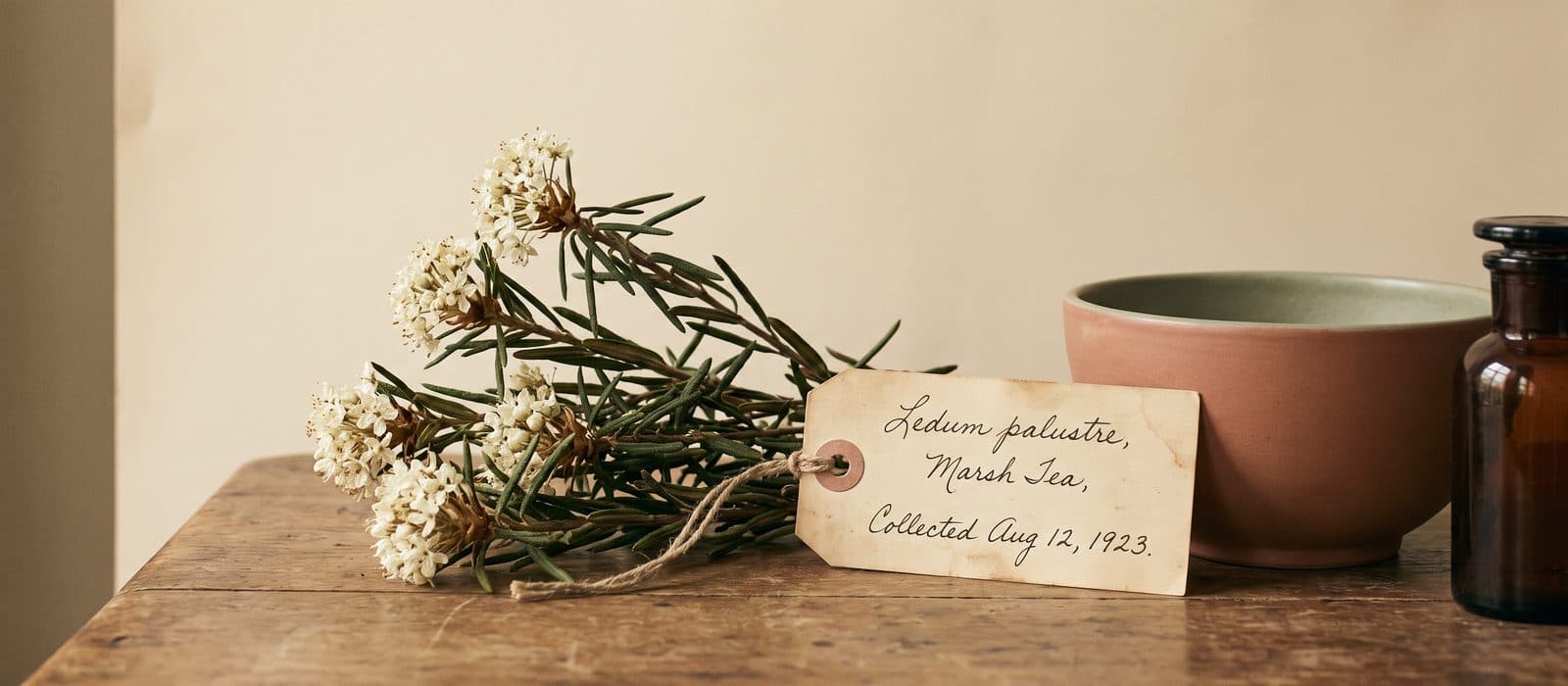
Homeopathic Ledum is prepared from the leafy twigs of Ledum palustre, known as marsh tea, marsh Labrador tea or wild rosemary. Botanists now place it in the rhododendron genus as Rhododendron tomentosum, but the old name has stayed on remedy labels; our guide to reading Latin remedy names explains why labels keep names that botany has moved on from. It is a low evergreen shrub of the heather family (Ericaceae) with narrow, leathery leaves rolled under at the edges and rusty-felted beneath, and small white flowers in clusters. It grows in sphagnum bogs and wet pine forest across the cold north.
The whole plant has a strong, resinous, camphor-like smell. Its aromatic oil contains ledol and related compounds, which are toxic in quantity: the plant was once added to beer in northern Europe to make it more intoxicating, and drinking strong infusions can cause headache, dizziness, vomiting and worse. In folk use it was also laid among stored clothes against moths. The raw plant is not something to brew or use at home.
The homeopathic preparation makes a tincture of the plant material and carries it through repeated dilution and succussion to the potency on the label. At the common potencies the arithmetic says no molecule of the plant remains; our potencies guide explains what that means, and why it is also the reason mainstream science is sceptical.
What is the Ledum picture?
The Ledum picture is a wound that goes in deep and stays cold. Picture a walker the morning after a tick bite on the calf, or someone a day after a blood test: the spot is small, but the skin around it has turned pale, bluish or purple, feels cold to a hand laid on it, and aches deeply rather than burning or itching. A cold flannel feels good; a hot bath makes it worse. That combination of a cold-looking, cold-feeling wound that still wants to be cooled is the core of the description.
Boericke (1927) names puncture wounds, insect bites and stings as the remedy's best-known territory, and describes parts that are cold to the touch, yet not subjectively cold to the patient, and relieved by cold. The same quality carries into bruising: the old texts describe a black eye or a bruised area that stays purple, cold and tender long after the first soreness of the injury, which homeopaths contrast with the fresh, sore, generalised bruising of Arnica. Kent's Lectures (1905) describe a person who lacks warmth in general, yet whose painful parts are made worse by the warmth of the bed.
A second, older strand in the materia medica concerns joints. Classic texts describe pains that begin in the feet and travel upwards, swollen, hot-feeling ankles and a painful big-toe joint, all eased by putting the feet in cold water and made worse by warmth and at night. The mental side is lightly drawn: a person who is discontented, withdrawn and would rather be left alone.
What makes it better or worse?
The traditional modalities centre on cold and the warmth of the bed. Ledum is worse from warmth and at night, and better from cold applications and cold water.
| Modality | Worse | Better |
|---|---|---|
| Temperature | Warmth, warm applications, the heat of the bed | Cold applications; putting the part in cold water |
| Time | Night | No consistent keynote |
| Motion | Moving the affected joint | Rest |
| Touch | Pressure on the wound or bruise | None listed |
| Direction | Joint pains that ascend from the feet (classic texts) | Not applicable |
Our guide to modalities, better and worse explains why a homeopath gives these details as much weight as the wound itself. With Ledum, the response to cold is most of what separates it from the neighbouring pictures.
What is Ledum palustre traditionally discussed for?
In homeopathic literature, Ledum is traditionally discussed for puncture-type injuries and for cold, lingering bruising. Each of these appears on one of our acute pages, where the Ledum-like pattern sits beside its neighbours and the red flags come first.
Bites and stings
- The cold, deep, bruised puncture of a sting or bite: a bee sting and a routine insect bite.
- The site that stays cold and puncture-like after a tick: a tick bite with local redness.
- The bruised, cold aftermath once the first reaction has passed: a jellyfish sting.
Punctures, scratches and small wounds
- A deep splinter or stepping on something sharp: a splinter or shallow puncture wound.
- The narrow, deep wound of a claw: redness after a cat scratch.
- A small cut that aches out of proportion to its size: a painful papercut.
Needles
- Bruising around a needle site: bruising after a blood draw.
- An injection site that feels cold, deep and bruised: a sore arm after a vaccine.
Bruising
- A deep bruise that feels cold: tailbone pain after a fall.
What is Ledum palustre not?
Ledum is not "the bite remedy", and it is not a substitute for basic wound care or for tetanus immunisation. The commonest misreading is to match it to the cause: a sting, therefore Ledum. The tradition's picture is the cold, pale or mottled puncture that is soothed by cold; a hot, puffy, rosy swelling or a burning, itching welt belongs to other descriptions. The more dangerous misreading is the old claim, repeated online, that it protects against tetanus. It does not prevent tetanus, and nothing in a remedy kit replaces cleaning a puncture wound and checking whether a tetanus booster is due.
Bites and punctures carry their own red flags. Swelling of the lips, tongue or throat, wheezing, dizziness or a spreading rash after a sting is anaphylaxis until proved otherwise and needs emergency care. A cat bite, a deep puncture through a shoe, a wound with soil or rust in it, spreading redness, red streaks, increasing pain, pus or fever needs medical care. After a tick bite, an expanding red rash or flu-like illness in the following weeks needs a doctor. Our guide to red flags first sets these out.
Homeopaths separate Ledum from its neighbours like this:
| Picture | Where it sits | Defining feature | Key modality |
|---|---|---|---|
| Ledum palustre | Punctures, bites, stings, lingering bruises | Site pale, bluish or mottled and cold to the touch | Better cold applications; worse warmth |
| Hypericum | Punctures in nerve-rich areas | Shooting pains running up from the wound | Worse touch and jarring |
| Apis mellifica | Stings and puffy swelling | Hot, rosy, shiny, waterlogged swelling; stinging pain | Better cold; worse heat and touch |
| Arnica montana | Fresh bruising and shock | Sore, beaten feeling; says they are fine | Worse touch and being approached |
| Urtica urens | Stinging, itching welts | Burning, prickling, nettle-like rash | Worse touch and cool bathing |
Ledum and Apis are the two sting pictures most often confused, because both are better from cold. The traditional distinction is the look of the site: Apis is hot, puffy and rosy; Ledum is cold, pale or mottled, and deep rather than swollen.
What potencies is Ledum palustre sold in?
Ledum palustre is sold most often as 30C pellets, the common shelf potency for single remedies, with 6C and 200C also widely available. Potency describes the preparation process, not an amount of plant: 30C means thirty successive 1:100 dilutions with succussion between them. Our potencies guide explains the scale and what remains in the vial.
This page deliberately gives no frequency or instructions for taking Ledum palustre. That depends on a whole case, not a remedy name. Read the product label, and talk to a qualified practitioner about an individual situation.
What remedy lists don't tell you
Two things the "remedies for bites" lists leave out:
- The temperature of the wound is the tell. Lists say "puncture wounds", which describes the injury and nothing more. What the classic authors found characteristic was that the area feels cold to someone else's hand yet the person wants it cooler still. Laying the back of a hand next to the wound, and asking whether a cold or a warm flannel feels better, separates this picture from its neighbours faster than any list.
- The puncture picture sits on top of real first aid, not instead of it. A Ledum-like site is still a wound: it needs cleaning, a tick needs removing whole with fine tweezers, and a puncture raises the tetanus question. Our guide to travel and acute patterns covers when a complaint on the road needs a doctor now, and our guide to stocking a home remedy kit shows how a reference card separates a cold, bruised puncture from a hot, puffy sting.
Where the Ledum palustre picture appears on this site
Acute pages that discuss this picture among their educational patterns, with the pattern name each page uses.
- What homeopathic remedy for a bee sting?Ledum-like puncture injury pattern
- What homeopathic remedy for a jellyfish sting?Ledum-like cold, puncture aftermath pattern
- What homeopathic remedy for a painful papercut?Ledum-like puncture wound pattern
- What homeopathic remedy for a routine insect bite?Ledum-like cold, puncture, bruised pattern
- What homeopathic remedy for a sore arm after a vaccine?Ledum-like cold puncture arm pattern
- What homeopathic remedy for a splinter or shallow puncture wound?Ledum-like deep puncture pattern
- What homeopathic remedy for a tick bite with local redness?Ledum-like puncture coldness pattern
- What homeopathic remedy for bruising after a blood draw?Ledum-like needle-puncture bruise pattern
- What homeopathic remedy for redness after a cat scratch?Ledum-like puncture wound pattern
- What homeopathic remedy for tailbone pain after a fall?Ledum-like cold bruise pattern
Not sure whether a picture fits?
A remedy profile describes a picture; it cannot tell you whether that picture matches what you are seeing. An acute consultation starts from the case itself: onset, sensations, what changes it, and the red flags.
Acute consultation · $45Frequently asked questions
- What is Ledum palustre?
- Ledum palustre is a homeopathic remedy prepared from marsh tea, an aromatic evergreen shrub of northern bogs. In homeopathy it names a traditional picture: a puncture wound, sting or bite where the site looks pale, bluish or mottled and feels cold to the touch, yet is better from cold applications. It is a description homeopaths use to compare cases, not a finding that it works for bites, stings or any other condition.
- What is Ledum used for in homeopathy?
- Homeopathic literature traditionally discusses Ledum for puncture-type injuries: insect bites and stings, a needle site, a splinter, a cat scratch or a tick bite, where the area feels cold, deep and bruised and is soothed by cold. The picture is defined by the puncture, the coldness and the relief from cold, not by what caused the wound. Swelling of the face or throat after a sting, spreading redness, red streaks, fever, or an expanding rash after a tick bite needs medical care first.
- What is Ledum 30C used for?
- 30C is the common shelf potency of Ledum, the one most single-remedy tubes and many home kits carry. In the tradition the potency does not change the picture; Ledum 30C is discussed for the same cold, puncture-wound state as any other potency. What 30C means as a dilution is explained in our potencies guide.
- How is Ledum palustre taken?
- This page does not give instructions on how or how often to take any remedy, because that depends on a whole case rather than on a remedy name. The product label carries the manufacturer's directions, and a qualified practitioner can advise on an individual situation. A puncture wound also raises the question of tetanus immunisation, which is one for a doctor or nurse.
- Where can I buy Ledum palustre?
- Pharmacies, health-food shops and homeopathic manufacturers sell Ledum palustre as single-remedy pellets, most often in 30C, and it is a common item in first-aid style home kits. This site also prepares custom single remedies to order: you name the remedy and potency, and the details are confirmed by email before anything is made. The order form does not give advice on which remedy to choose.
- What is Ledum palustre made from?
- Homeopathic Ledum is prepared from the leafy twigs of marsh tea, Ledum palustre, a shrub of the heather family now classified as Rhododendron tomentosum. The plant material is made into a tincture, then diluted and succussed step by step to the labelled potency. The raw plant contains an aromatic oil that is toxic in quantity, so it is not something to brew or use at home.
This guide is educational only and is not medical advice or a personalized remedy recommendation. Acute symptoms can become urgent; when in doubt, seek professional evaluation.