Remedy profile
Urtica urens in Homeopathy: Uses, Picture and Limits
What homeopathic Urtica urens is made from, the stinging, burning, nettle-rash picture homeopaths describe, what changes it, the potencies sold, and its limits.
By Homeopathic BenefitsPublished 7 min read
Key takeaways
- Urtica urens is the picture of a nettle sting. Raised, white or pink blotches with stinging, burning and itching, the sensation anyone who has brushed a nettle knows.
- The sensation, not the trigger, defines it. Classic texts carry the same stinging-burning quality to hives, prickly heat, contact stings and minor superficial burns.
- Touch, water and cool damp air aggravate. The materia medica describes itching that flares with bathing, touch and cool, moist air, and blotches that may return at the same season each year.
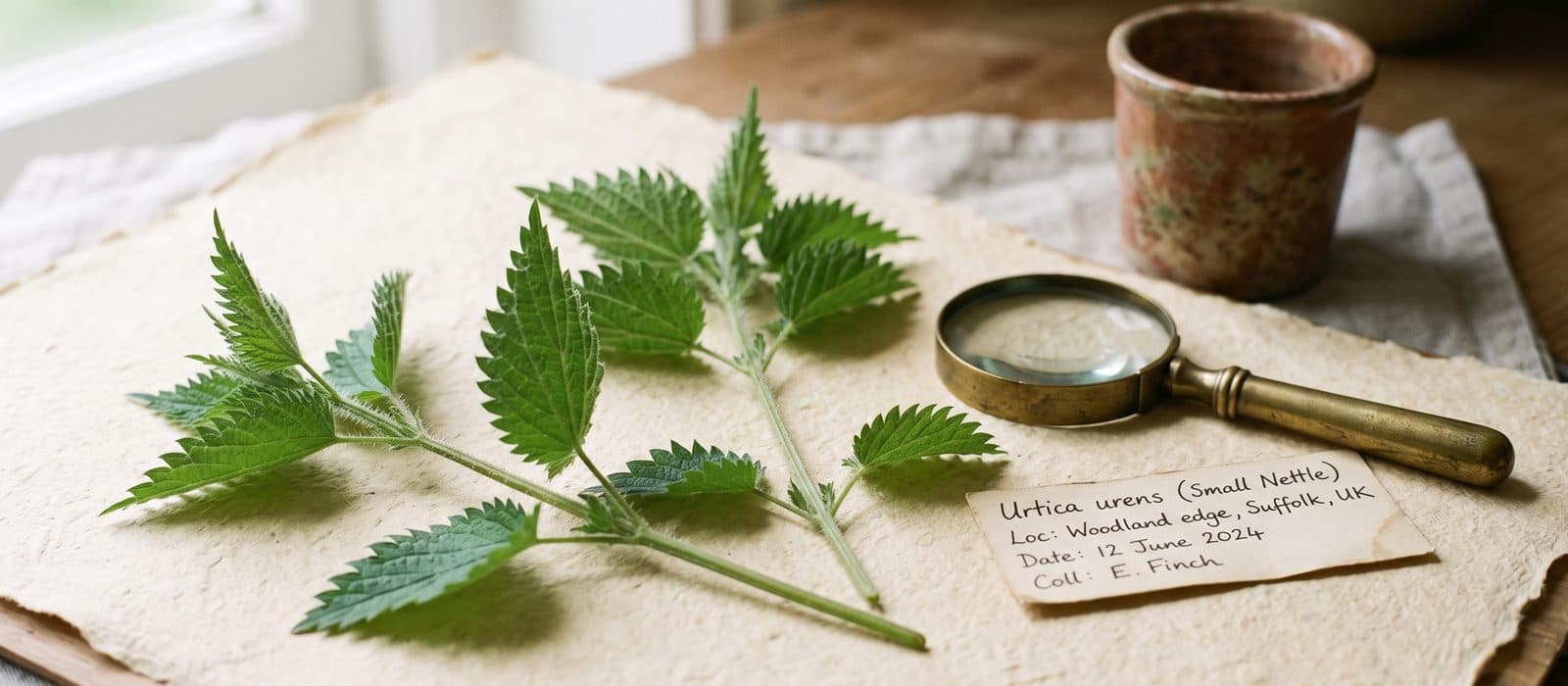
- It comes from the small stinging nettle. It is a common garden weed, not a poison, but its stinging hairs are the source of the picture.
- Hives and burns have red flags. Swelling of the face, lips, tongue or throat, wheezing or faintness is an emergency; so is any burn that is large, deep, blistered over a wide area, or on the face, hands, feet or genitals.
The short answer
Urtica urens is a homeopathic remedy prepared from the small stinging nettle. In homeopathy it names a traditional picture rather than a treatment: the raised, itching, stinging, burning blotches of nettle rash, worse from touch, water and cool damp air. Classic materia medica extends that sensation from the nettle sting itself to acute hives, prickly heat, contact stings such as jellyfish, and the stinging of a minor first-degree burn. It is described in Allen's Encyclopedia (1874–1879), Clarke's Dictionary (1900–1902) and Boericke (1927). It is not a substitute for emergency care, and hives with swelling of the lips, tongue or throat, wheezing or faintness need urgent medical help first.
| Latin name | Urtica urens |
|---|---|
| Abbreviation | Urt-u. |
| Common name | Small nettle, dwarf or annual stinging nettle |
| Source | Fresh flowering plant of the small stinging nettle, Urtica urens (Urticaceae) (plant kingdom) |
| Commonly sold potencies | 6C, 30C |
| First proving | Nineteenth-century provings and clinical records, collected in Allen's Encyclopedia (1874–1879) and Clarke's Dictionary (1900–1902) |
What is Urtica urens made from?
Homeopathic Urtica urens is prepared from the fresh flowering plant of Urtica urens, the small, dwarf or annual nettle. It is a low, bushy annual of gardens, farmyards and disturbed ground across Europe and now much of the world, shorter and fresher-green than the familiar perennial stinging nettle, Urtica dioica, and with a sting that many people find sharper. Urtica comes from the Latin urere, to burn, and urens means burning: the name describes the sting twice over. Our guide to reading Latin remedy names explains the convention.
The sting comes from fine hollow hairs on the leaves and stems. Each hair has a brittle tip that snaps off on contact and injects a small amount of fluid containing histamine and other irritant compounds into the skin, producing the raised white weals, the redness around them, and the burning itch that follows. Nettles are not poisonous in the sense that nightshade or tobacco are, and young nettles are cooked and eaten as a vegetable once the sting has been destroyed by heat. The homeopathic preparation, though, is a mother tincture of the fresh plant, carried through repeated dilution and succussion. At the common potencies the arithmetic says no molecule of the plant remains; our potencies guide explains what that means and why it is also the reason mainstream science is sceptical.
Urtica urens is one of the clearest examples of the tradition's like-for-like idea: the plant that raises a stinging, burning rash on contact is traditionally discussed for stinging, burning rashes.
What is the Urtica urens picture?
The Urtica urens picture is the child who has run through a nettle patch in shorts. The backs of the legs are covered in raised, white-topped blotches on a red base; they sting, burn and itch all at once, and rubbing makes it worse. A cool bath, which seems like the obvious answer, can set the itching off again. That sensation, more than the nettle, is what homeopaths carry to other situations.
Classic texts describe raised, itching, burning blotches as the centre of the picture, with the stinging-burning sensation that gives the remedy its name. Boericke (1927) describes it for nettle rash with burning heat, worse from bathing and from cool, moist air, and for burns of the first degree with stinging pain. The older literature also notes that the rash may return at the same season each year, and that it may alternate with rheumatic pains, particularly in the shoulders and joints.
Beyond the skin, the materia medica records a traditional interest in the breasts and the milk supply, and in gout and uric acid. Those parts of the picture belong to the classic texts and to a practitioner's case-taking rather than to any acute page here.
Emotionally the classic picture says little; the person is simply restless, irritable and itching, unable to leave the skin alone.
What makes it better or worse?
The traditional modalities centre on touch, water and cool damp air. Urtica urens is worse from touch, bathing and cool moist air, and better from lying down and rest.
| Modality | Worse | Better |
|---|---|---|
| Touch | Touch, rubbing, scratching | Leaving the skin alone |
| Water | Bathing, cool water, washing | No consistent keynote |
| Weather | Cool, moist air; snow air (Boericke) | No consistent keynote |
| Season | Same season each year in some cases | No consistent keynote |
| Position | No consistent keynote | Lying down |
The aggravation from water separates Urtica urens from neighbours that feel better for cold bathing; our guide to modalities, better and worse explains why that kind of detail outweighs the name of the rash.
What is Urtica urens traditionally discussed for?
In homeopathic literature, Urtica urens is traditionally discussed for stinging, burning, itching skin like a nettle sting. Each of these appears on one of our acute pages, where the Urtica-like pattern sits beside its neighbours and the red flags come first.
Hives and rashes
- The raised, stinging welts of an acute hive outbreak.
- The pinpoint, stinging prickle of prickly heat rash, flaring with each new wave of sweat.
Stings and burns
- The stinging lines and welts left by a jellyfish sting.
- The stinging, prickling sensation of a minor kitchen burn, in mild, superficial burns only.
Seasonal allergy
- Hay fever with itchy eyes, when the itching of the lids and skin is nettle-like.
- Seasonal sneezing fits that come with nettle-sting itching of the palate and skin.
Our guide to seasonal acute patterns follows the summer side of this picture, from pollen to heat rash.
What is Urtica urens not?
Urtica urens is not "the burns remedy" or "the hives remedy", and it is never an answer to an allergic emergency or a serious burn. Hives that come with swelling of the face, lips, tongue or throat, wheezing, a hoarse voice, faintness or vomiting are anaphylaxis until proved otherwise: that is a call for emergency services and, for anyone who carries one, an adrenaline auto-injector. Burns need cool running water first, and medical care for any burn larger than the person's palm, any deep or white, charred or leathery burn, burns on the face, hands, feet, joints or genitals, chemical and electrical burns, and burns in babies, young children and older people. Jellyfish stings with breathing difficulty, chest pain, widespread pain or a sting from a known dangerous species need emergency help. Our guide to red flags first explains the order.
Homeopaths separate it from its neighbours like this:
| Picture | Where it sits | Defining feature | Key modality |
|---|---|---|---|
| Urtica urens | Nettle rash, stings, minor burns | Raised, stinging, burning, itching blotches | Worse touch, bathing and cool damp air |
| Apis mellifica | Puffy, stinging swelling | Rosy, shiny, waterlogged; often thirstless | Better cold; worse heat and touch |
| Cantharis | Burns, burning urination | Violent, raw, scalding burning, blistering | Better cold applications; worse touch |
| Histaminum | Allergic itching and hives | Itch-led allergic reactions | No single classic modality |
| Rhus toxicodendron | Itchy, blistering skin | Restless itching with small blisters | Better hot water; worse cold and damp |
What potencies is Urtica urens sold in?
Urtica urens is sold most often as 6C or 30C pellets, and some manufacturers also use it in topical products and first-aid style kits. Potency describes the preparation process, not an amount of nettle: 30C means thirty successive 1:100 dilutions with succussion between them. Our potencies guide explains the scale and what remains in the vial.
This page deliberately gives no frequency or instructions for taking Urtica urens. That depends on a whole case, not a remedy name. Read the product label, and talk to a qualified practitioner about an individual situation.
What remedy lists don't tell you
Two things the "remedies for hives" lists leave out:
- What water does is the sorting question. Two people can have identical raised, itchy welts. The one whose rash flares in a cool shower and in damp air sits in the Urtica description; the one whose puffy, rosy swelling begs for cold water sits nearer Apis. Lists sorted by rash type rarely ask, and a homeopath asks early.
- A kit remedy's popularity is not a picture. Urtica urens turns up in many first-aid kits for burns and stings, which makes it tempting to pick by trigger. The tradition describes a sensation, not a trigger, and our guide to stocking a home remedy kit explains why a kit is a set of descriptions to compare rather than a set of answers.
Where the Urtica urens picture appears on this site
Acute pages that discuss this picture among their educational patterns, with the pattern name each page uses.
- What homeopathic remedy for a jellyfish sting?Urtica urens-like stinging wheals pattern
- What homeopathic remedy for a minor kitchen burn?Urtica urens-like stinging burn pattern
- What homeopathic remedy for an acute hive outbreak?Urtica urens-like stinging, nettle-like pattern
- What homeopathic remedy for hay fever with itchy eyes?Urtica urens-like itch-led eye pattern
- What homeopathic remedy for prickly heat rash?Urtica urens-like stinging prickle pattern
- What homeopathic remedy for seasonal sneezing fits?Urtica urens-like nettle-itch pattern
Not sure whether a picture fits?
A remedy profile describes a picture; it cannot tell you whether that picture matches what you are seeing. An acute consultation starts from the case itself: onset, sensations, what changes it, and the red flags.
Acute consultation · $45Frequently asked questions
- What is Urtica urens?
- Urtica urens is a homeopathic remedy prepared from the small stinging nettle. In homeopathy it names a traditional picture modelled on a nettle sting: raised, itching, stinging, burning blotches like nettle rash, worse from touch, water and cool damp air. It is a description homeopaths use to compare cases, not a finding that it works for hives, burns or any other condition.
- What is Urtica urens used for in homeopathy?
- Homeopathic literature traditionally discusses Urtica urens for stinging, burning, itchy skin that looks and feels like a nettle sting: acute hives, prickly heat, contact stings such as jellyfish, and the stinging of a minor superficial burn. The picture is defined by the stinging-burning-itching sensation, not by the name of the trigger. Swelling of the lips, tongue or throat, wheezing or faintness with hives is an emergency first.
- What is Urtica urens 30C used for?
- 30C is one of the potencies Urtica urens is most often sold in, alongside 6C, and it appears in some first-aid style home kits. In the tradition the potency does not change the picture; Urtica urens 30C is discussed for the same stinging, nettle-like burning and itching as any other potency. What 30C means as a dilution is explained in our potencies guide.
- How is Urtica urens taken?
- This page does not give instructions on how or how often to take any remedy, because that depends on a whole case rather than on a remedy name. The product label carries the manufacturer's directions, and a qualified practitioner can advise on an individual situation. Signs of a severe allergic reaction, or a burn that is large, deep or on the face, hands or genitals, need medical care first.
- Where can I buy Urtica urens?
- Pharmacies, health-food shops and homeopathic manufacturers sell Urtica urens as single-remedy pellets, usually in 6C or 30C, and some manufacturers also include it in topical products. This site also prepares custom single remedies to order: you name the remedy and potency, and the details are confirmed by email before anything is made. The order form does not give advice on which remedy to choose.
- What is Urtica urens made from?
- Homeopathic Urtica urens is prepared from the fresh flowering plant of the small stinging nettle, made into a mother tincture and then diluted and succussed step by step to the labelled potency. The living plant is covered in stinging hairs that inject histamine and other irritants into the skin, which is the familiar nettle rash. At the common potencies no trace of the plant remains.
This guide is educational only and is not medical advice or a personalized remedy recommendation. Acute symptoms can become urgent; when in doubt, seek professional evaluation.