Remedy profile
Causticum in Homeopathy: Uses, Picture and Limits
What homeopathic Causticum is made from, the raw, weakening, sympathetic picture homeopaths describe, what changes it, the potencies sold, and its limits.
By Homeopathic BenefitsPublished 7 min read
Key takeaways
- Causticum is the picture of rawness and slow weakening. Classic texts describe raw, scraped, burning soreness and a gradual loss of power in a single part, most famously the voice.
- The voice is worst in the morning. Hoarseness that is at its worst on waking, with a cough that cannot quite bring anything up and may leak a little urine.
- Damp weather is better, dry cold wind is worse. Unusually, the picture is eased by wet weather and aggravated by clear, dry, cold days.
- It is a substance Hahnemann invented. Causticum is a distillate of lime and potassium bisulphate made to his own recipe, unique to homeopathy.
- Rawness and weakness have red flags first. Hoarseness lasting more than three weeks, sudden facial drooping, difficulty swallowing or breathing, and serious burns need medical care before any pattern discussion.
The short answer
Causticum is a homeopathic remedy that Samuel Hahnemann devised himself: a distillate of freshly slaked lime and potassium bisulphate, named for its sharp, caustic taste and found nowhere outside homeopathy. In homeopathy it names a traditional picture rather than a treatment: raw, scraped, burning soreness, and a weakness that creeps up gradually in one part of the body, the voice, the bladder or the muscles of the face. Classic materia medica describes a hoarseness that is worst in the morning, a cough that leaks urine, raw soreness after burns, and a person with an acute sense of injustice and deep sympathy for others. It is not a remedy for laryngitis, burns or paralysis, and nothing about the picture replaces medical assessment of any of them.
| Latin name | Causticum |
|---|---|
| Abbreviation | Caust. |
| Common name | Hahnemann's causticum (Tinctura acris sine kali) |
| Source | Distillate of freshly slaked lime with potassium bisulphate, prepared to Hahnemann's method (mineral kingdom) |
| Commonly sold potencies | 6C, 30C, 200C |
| First proving | Hahnemann, Materia Medica Pura (1811–1821); expanded in The Chronic Diseases (1828–1830) |
What is Causticum made from?
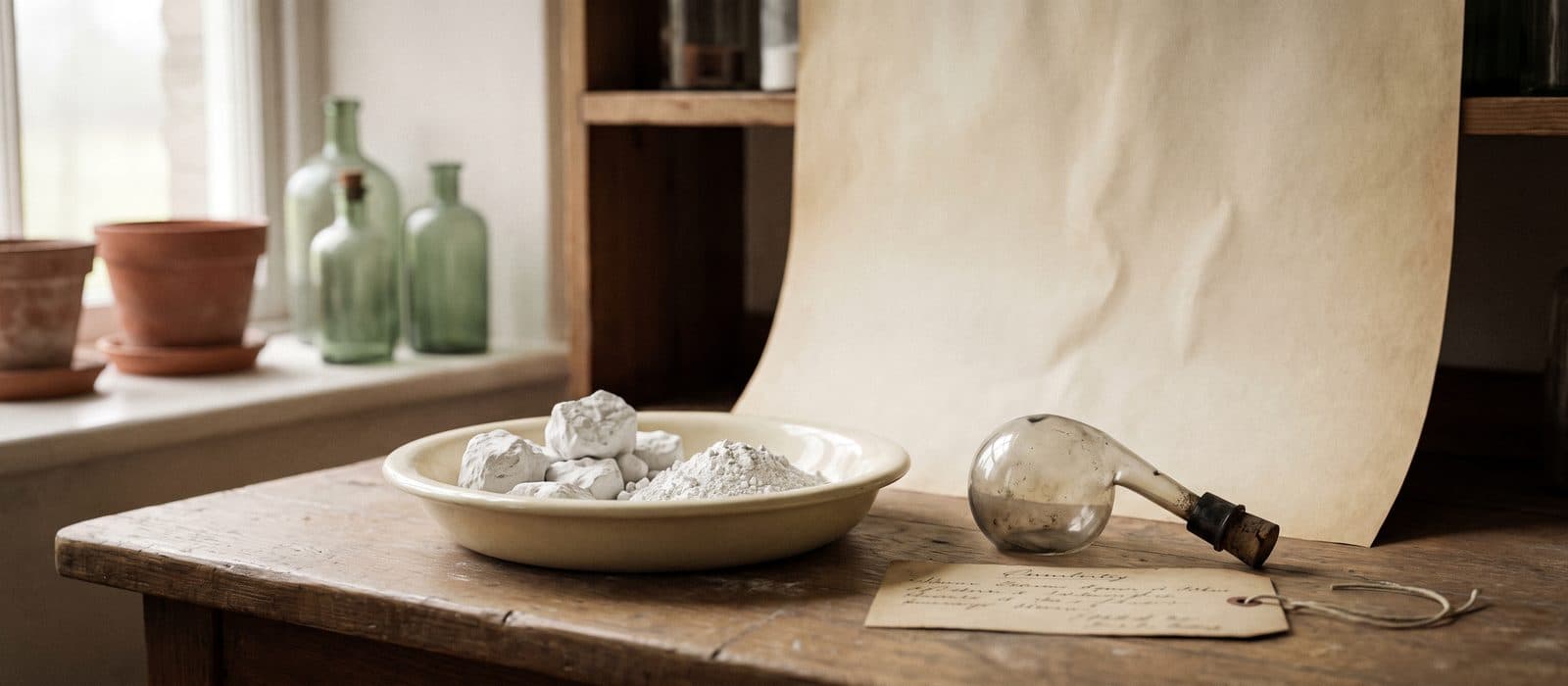
Causticum has no plant, animal or single mineral behind it. Hahnemann described its preparation in the Materia Medica Pura and again in The Chronic Diseases. Freshly burnt limestone (quicklime) is slaked by dipping it briefly in water, then ground into a paste with a hot solution of potassium bisulphate and distilled. The clear liquid that comes over is the Tinctura acris sine kali, "the sharp tincture without potash", which he called Causticum after its burning, astringent taste.
What exactly the distillate contains has been argued over since the nineteenth century. Chemists of Hahnemann's time doubted that his "causticum" principle existed, and later analyses have suggested a weak solution of potassium salts and other traces rather than any new substance. Homeopathic pharmacopoeias keep his recipe precisely because the remedy is defined by the method rather than by a formula. Our guide to what is in a homeopathic remedy explains how preparation standards work.
The starting materials are corrosive. Quicklime reacts violently with water and burns skin and eyes, and potassium bisulphate is an acid salt; the preparation is a pharmacy process, never a kitchen one. From the distillate, the remedy is diluted and succussed in the usual way to the potency on the label. At the common potencies the arithmetic says nothing of the original distillate remains; our potencies guide explains that honestly, including why it is also the reason mainstream science is sceptical.
What is the Causticum picture?
The Causticum picture has two halves that the classic authors held together: rawness and a slow failing of power. Imagine a teacher on the Friday of a week of shouting over a class, with a cold coming on: by the morning the voice is a whisper and the throat feels scraped raw, as if the lining had been rubbed off. The cough is hollow and tiring, the phlegm feels too deep to reach, and with a hard cough a little urine escapes. By evening the voice comes back somewhat. A sip of cold water eases the cough.
Boericke (1927) describes Causticum as acting on chronic weakness and gradual paralysis of single parts, alongside a raw, sore, burning feeling. In the classic texts the "single parts" are the vocal cords, the bladder, the upper eyelid and one side of the face, and the weakness comes on slowly rather than suddenly. The rawness shows on the skin as well: the soreness of an old or recent burn that feels raw and tight, and a sense of contraction, as if the tendons were too short.
The mental side is unusual in the materia medica for its warmth. Kent's Lectures (1905) describe a person intensely sympathetic to the suffering of others, upset by injustice, prone to taking up causes, and anxious in the evening and in the dark. The person is chilly, but feels the dry cold wind most of all.
What makes it better or worse?
The traditional modalities centre on weather and on the voice. Causticum is worse from dry, cold winds and clear weather and in the morning, and better from damp, wet weather, warmth and sips of cold water.
| Modality | Worse | Better |
|---|---|---|
| Weather | Dry, cold wind; clear, fine weather | Damp, wet weather |
| Time | Morning, especially the voice; evening for anxiety | Later in the day for the voice |
| Temperature | Cold air, draughts | Warmth, the warmth of bed |
| Drinks | No consistent keynote | A sip of cold water for the cough |
| Voice | Overuse, coughing, talking | Rest |
"Better in damp weather" is rare enough in the materia medica that homeopaths read it as a strong pointer; our guide to modalities, better and worse explains why.
What is Causticum traditionally discussed for?
In homeopathic literature, Causticum is traditionally discussed for raw, scraped soreness and for a voice that weakens. Each of these appears on one of our acute pages, where the Causticum-like pattern sits beside its neighbours and the red flags come first.
Voice and throat
- The raw, scraped throat and weak voice after overuse: hoarseness after yelling.
- The same rawness and voice loss arriving with a cold, with a cough that leaks a little urine: a raspy voice with a cold. Our guide to the first colds of the school year covers the colds that bring it on.
Skin after burns
- Raw, sore, contracting discomfort after a minor scald: a minor kitchen burn. Cooling the burn under running water and the size and site checks on that page come before any pattern.
What is Causticum not?
Causticum is not "the laryngitis remedy" or "the burn remedy", and it is not a remedy for paralysis, whatever the old books say about its "paralytic" weakness. The commonest misreading is to match the voice: hoarse, therefore Causticum. The tradition's picture is the rawness, the morning aggravation, the slow weakening and the better-in-damp-weather modality; without them the name is just a label. The picture also overlaps with states that need a doctor. Hoarseness lasting more than three weeks needs medical assessment, especially in a smoker. Sudden drooping of one side of the face, slurred speech or weakness in an arm is a possible stroke and an emergency; facial weakness without those signs still needs to be seen promptly. Leaking urine that is new, or difficulty passing it, belongs with a clinician. For burns, anything larger than the palm of the hand, on the face, hands, feet, joints or genitals, any chemical or electrical burn, and burns in babies and older people need medical care. Our guide to red flags first sets these out.
Homeopaths separate Causticum from its neighbours like this:
| Picture | Where it sits | Defining feature | Key modality |
|---|---|---|---|
| Causticum | Raw throat, failing voice, raw burns | Scraped rawness; gradual weakness; sympathetic temperament | Worse dry cold wind and morning; better damp weather |
| Phosphorus | Hoarseness with a cold | Painless or burning hoarseness; craves cold drinks; sociable | Worse evening; better cold drinks |
| Argentum metallicum | Voice overuse in speakers and singers | Raw throat and loss of voice from use, without the sympathetic picture | Worse using the voice |
| Cantharis | Burns and scalds | Intense, smarting, burning pain rather than raw tightness | Better cold applications |
| Urtica urens | Superficial burns and stinging | Prickling, stinging heat like a nettle rash | Worse touch and cool bathing |
What potencies is Causticum sold in?
Causticum is sold most often as 30C pellets, the common shelf potency for single remedies, with 6C and 200C also widely available. Potency describes the preparation process, not an amount of distillate: 30C means thirty successive 1:100 dilutions with succussion between them. Our potencies guide explains the scale and what remains in the vial.
This page deliberately gives no frequency or instructions for taking Causticum. That depends on a whole case, not a remedy name. Read the product label, and talk to a qualified practitioner about an individual situation.
What remedy lists don't tell you
Two things the "remedies for hoarseness" lists leave out:
- The time of day and the weather separate it. Most hoarse voices are worse after a day of talking. A voice that is worst on waking and recovers a little as the day goes on, in someone who feels better on a wet day and worse in a dry east wind, is the Causticum shape. Lists that say "hoarseness" without when and in what weather lose the detail homeopaths found most characteristic.
- The symptoms alongside the symptom are unusual here. A little leaking of urine with a hard cough is something people rarely mention unless asked, yet the classic texts count it among the clearest Causticum features. Our guide to the symptoms alongside the symptom explains why a homeopath asks about details that seem unrelated to the complaint.
Where the Causticum picture appears on this site
Acute pages that discuss this picture among their educational patterns, with the pattern name each page uses.
- What homeopathic remedy for a minor kitchen burn?Causticum-like rawness and contractive soreness pattern
- What homeopathic remedy for a raspy voice with a cold?Causticum-like raw throat voice loss pattern
- What homeopathic remedy for hoarseness after yelling?Causticum-like raw throat voice loss pattern
Not sure whether a picture fits?
A remedy profile describes a picture; it cannot tell you whether that picture matches what you are seeing. An acute consultation starts from the case itself: onset, sensations, what changes it, and the red flags.
Acute consultation · $45Frequently asked questions
- What is Causticum?
- Causticum is a homeopathic remedy that Samuel Hahnemann devised himself: a distillate made from freshly burnt lime and potassium bisulphate, with no exact equivalent in ordinary chemistry. In homeopathy it names a traditional picture of rawness and gradual weakness: a raw, scraped throat with a failing voice, raw soreness after burns, and a deep sympathy for other people's suffering. It is a description homeopaths use to compare cases, not evidence that it works for any condition.
- What is Causticum used for in homeopathy?
- Homeopathic literature traditionally discusses Causticum for raw, burning soreness and for weakness that comes on gradually in a single part: hoarseness and voice loss worse in the morning, a cough that leaks a little urine, and the raw, contracting soreness after a burn. The picture is defined by the rawness, the slow weakening and the modalities rather than by the name of a complaint. Hoarseness lasting more than three weeks, sudden weakness or drooping of the face, or a serious burn needs medical care first.
- What is Causticum 30C used for?
- 30C is the common shelf potency of Causticum, with 6C and 200C also widely sold. In the tradition the potency does not change the picture; Causticum 30C belongs to the same raw, weakening description as any other potency. Our potencies guide explains what 30C means as a dilution.
- How is Causticum taken?
- This page does not give instructions on how or how often to take any remedy, because that depends on a whole case rather than on a remedy name. The product label carries the manufacturer's directions, and a qualified practitioner can advise on an individual situation. A voice that stays hoarse for weeks, or any burn larger than the palm of the hand, belongs with a clinician first.
- Where can I buy Causticum?
- Pharmacies, health-food shops and homeopathic manufacturers sell Causticum as single-remedy pellets, most often in 30C. This site also prepares custom single remedies to order: you name the remedy and potency, and the details are confirmed by email before anything is made. The order form does not give advice on which remedy to choose.
- What is Causticum made from?
- Causticum is made by Hahnemann's own method: freshly burnt lime is slaked with water, mixed with a solution of potassium bisulphate and distilled, and the clear distillate becomes the mother tincture that is then diluted and succussed to the labelled potency. The starting materials are corrosive chemicals; the preparation belongs in a pharmacy, never a kitchen.
This guide is educational only and is not medical advice or a personalized remedy recommendation. Acute symptoms can become urgent; when in doubt, seek professional evaluation.