Remedy profile
Argentum metallicum in Homeopathy: Uses, Picture and Limits
What homeopathic Argentum metallicum is made from, the worn-out speaker's voice picture homeopaths describe, what changes it, potencies sold, and its limits.
By Homeopathic BenefitsPublished 7 min read
Key takeaways
- Argentum metallicum is the picture of the used-up voice. Classic texts describe the speaker or singer whose larynx feels raw and sore after long use, with hoarseness that comes on from talking itself.
- The larynx and the cartilages are its territory. Homeopathic literature places the metal's action in cartilage, ligaments and the voice box more than anywhere else.
- Its odd companions are what homeopaths remember. Laughing or talking sets off the cough, and mucus comes up easily, grey and starchy.
- It is metallic silver, not colloidal silver. The homeopathic remedy is triturated and potentised; colloidal silver supplements are a different product with documented harms.
- Hoarseness has red flags. Hoarseness lasting more than three weeks, difficulty breathing or swallowing, noisy breathing, or coughing blood are medical questions before they are homeopathic ones.
The short answer
Argentum metallicum is a homeopathic remedy prepared from pure metallic silver, ground with lactose and then diluted and succussed to the labelled potency. In homeopathy it names a traditional picture rather than a treatment: the professional voice user whose larynx feels raw and sore after talking or singing, whose voice tires and fades, and who raises easy, grey, starch-like mucus. Classic materia medica places the metal's action in the cartilages, joints and larynx, with a general sense of exhaustion and emptiness. Hahnemann documented silver in his Materia Medica Pura, and Boericke (1927) singled out the hoarseness of professional singers. It is not a general "lost voice" remedy, and nothing about the picture replaces a medical look at hoarseness that will not go away.
| Latin name | Argentum metallicum |
|---|---|
| Abbreviation | Arg-m. |
| Common name | Metallic silver |
| Source | Pure metallic silver (formerly silver leaf, Argentum foliatum), triturated and potentised (mineral kingdom) |
| Commonly sold potencies | 6C, 30C |
| First proving | Hahnemann, Materia Medica Pura (as Argentum, silver leaf); expanded in Allen's Encyclopedia (1874–1879) |
What is Argentum metallicum made from?
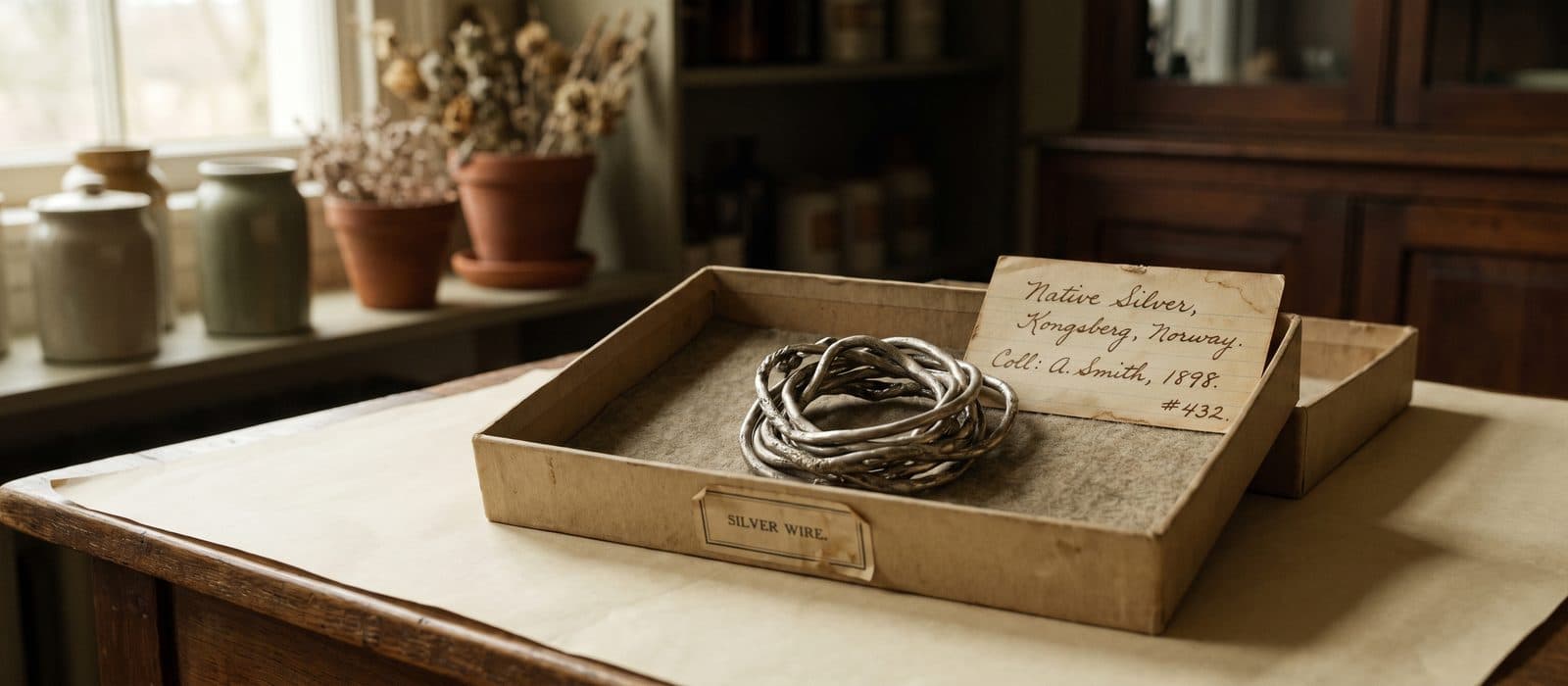
Homeopathic Argentum metallicum is prepared from pure metallic silver. Hahnemann's original preparation used silver leaf, the beaten foil gilders used, which is why older books call the remedy Argentum foliatum. Modern manufacturers start from finely divided silver of high purity.
Metal does not dissolve in water or alcohol, so the first potency steps are made by trituration: grinding the silver with lactose for long periods until it is dispersed through the sugar. From the third centesimal step onwards the preparation is carried into liquid and diluted and succussed in the usual way. At the common potencies the arithmetic says no atom of the original silver is expected to remain, which our potencies guide sets out honestly, along with why that is also the reason science is sceptical.
Metallic silver is not a poison in the way arsenic or strychnine are, but the label still deserves care. Argentum metallicum is not colloidal silver. Colloidal silver is sold as a supplement, contains real, measurable silver particles, and swallowing it over time can cause argyria, a permanent blue-grey discolouration of the skin. Nothing on this page refers to it. It is also not Argentum nitricum, silver nitrate, which is a separate remedy with a very different picture; our guide to reading Latin remedy names explains why two remedies can share a first word and little else.
What is the Argentum metallicum picture?
The Argentum metallicum picture is the person whose instrument is their voice and who has worn it thin. Picture a teacher at the end of a long term, or a singer after a week of rehearsals: the voice was fine in the morning, but by the afternoon it cracks, thins and drops away, and the larynx feels raw and sore, as if there were a single tender spot in it. Clearing the throat brings up mucus easily, grey and jelly-like, which classic texts compare to boiled starch. Laughing sets off a cough; so does talking, and singing high notes is out of the question.
Boericke (1927) describes the remedy's action as centred on the articular cartilages, ligaments and larynx, and lists the hoarseness and aphonia of professional singers among its keynotes. Kent's Lectures (1905) adds the general state behind the local one: a person who is weary and drained, with an empty, hollow feeling, and whose complaints come on from the very activity that wears them out. The tiredness is part of the picture, not an afterthought; this is the voice that fails because the person behind it is spent.
The cartilage theme shows up elsewhere in the materia medica too. Classic texts describe bruised, aching pains in joints, especially the elbows and knees, and a sense of weakness in the limbs. Those parts of the picture rarely appear on their own in acute questions, but they are why homeopaths describe silver as a remedy of the body's "framework" tissues rather than simply of the throat.
What makes it better or worse?
The traditional modalities centre on use of the voice. Argentum metallicum is worse from talking, singing and laughing, and is described in Boericke as worse from touch and towards noon, and better in the open air.
| Modality | Worse | Better |
|---|---|---|
| Voice use | Talking, singing, reading aloud, laughing | Resting the voice |
| Time | Towards noon; later in a day of speaking | Morning, before the voice is used |
| Touch | Pressure on the larynx; the sore spot is tender | Being left alone |
| Air | Stuffy, crowded rooms | Open air |
| Expectoration | Before mucus is raised | Coughing up the easy, grey mucus (Boericke) |
Those modalities are what separate one hoarse voice from another; our guide to modalities, better and worse explains why a homeopath asks about them before any remedy name.
What is Argentum metallicum traditionally discussed for?
In homeopathic literature, Argentum metallicum is traditionally discussed for voice fatigue and hoarseness in people who use their voices heavily. On this site it appears on two acute pages, where the pattern sits beside its neighbours and the red flags come first.
Voice and larynx
- Hoarseness after yelling: the singer-strain pattern, where the voice gives out from overuse at a match, a concert or a long day of teaching.
- A raspy voice with a cold: the same tired, raw-larynx pattern when a cold settles on a voice that is still being used for work.
Joints and cartilage (classic texts)
- Older materia medica also describes bruised, aching joint pains, especially of the elbows and knees. These have no acute page here, and joint pain with swelling, heat or fever is a medical question first.
What is Argentum metallicum not?
Argentum metallicum is not "the remedy for losing your voice". Hoarseness follows several traditional pictures. The hoarseness that is worst in the morning and comes with a weak, paralysed feeling belongs elsewhere; so does the raw larynx that hurts too much to speak, and the dry, sawing, croupy throat. Silver's version is the voice worn out by use, with a raw spot, easy grey mucus and a cough set off by laughing. Without that picture the name tells you very little.
It is also not a reason to keep talking through a voice that has gone for weeks. Hoarseness lasting more than three weeks, a lump in the neck, pain or difficulty swallowing, noisy or laboured breathing, coughing up blood, or hoarseness in a smoker are reasons for a medical examination of the larynx first.
Homeopaths separate it from its neighbours like this:
| Picture | Where it sits | Defining feature | Key modality |
|---|---|---|---|
| Argentum metallicum | Voice overuse in speakers and singers | Raw sore spot in the larynx; easy grey, starchy mucus; laughing sets off cough | Worse using the voice; better open air |
| Causticum | Hoarseness with weakness | Voice weak and paralysed-feeling; mucus hard to raise | Worse in the morning; better from sips of cold water |
| Phosphorus | Painful larynx with a cold | Larynx so painful the person cannot bear to talk | Worse in the evening; worse talking |
| Spongia | Dry, croupy throat | Dry, sawing, barking cough; throat feels like a dry sponge | Better warm drinks; worse before midnight |
What potencies is Argentum metallicum sold in?
Argentum metallicum is sold most often as 6C and 30C pellets, usually from homeopathic pharmacies rather than general shops. Potency describes the preparation process, not an amount of silver: 30C means thirty successive 1:100 dilutions with succussion between them, after the initial trituration. Our potencies guide explains the scale and what remains in the vial.
This page deliberately gives no frequency or instructions for taking Argentum metallicum. That depends on a whole case, not a remedy name. Read the product label, and talk to a qualified practitioner about an individual situation.
What remedy lists don't tell you
Two things the "remedies for a hoarse voice" lists leave out:
- The cause of the hoarseness matters as much as the hoarseness. A voice lost from shouting at a match and a voice lost to a heavy cold sound alike, but homeopaths ask how it was lost and what the person was doing when it went. Silver's picture is overuse by someone who depends on their voice; a list sorted by "hoarseness" cannot tell the difference.
- The small odd details carry the most weight. The cough that starts when the person laughs, the grey mucus that comes up without effort, the single sore spot: these are the details people leave out because they seem trivial, and they are exactly what our guide to the symptoms alongside the symptom asks you to write down.
Where the Argentum metallicum picture appears on this site
Acute pages that discuss this picture among their educational patterns, with the pattern name each page uses.
- What homeopathic remedy for a raspy voice with a cold?Argentum metallicum-like singer strain pattern
- What homeopathic remedy for hoarseness after yelling?Argentum metallicum-like singer strain pattern
Not sure whether a picture fits?
A remedy profile describes a picture; it cannot tell you whether that picture matches what you are seeing. An acute consultation starts from the case itself: onset, sensations, what changes it, and the red flags.
Acute consultation · $45Frequently asked questions
- What is Argentum metallicum?
- Argentum metallicum is a homeopathic remedy prepared from pure metallic silver, ground with milk sugar and then diluted and succussed to the labelled potency. In homeopathy it names a traditional picture: the voice that has been used until it gives out, with a raw spot in the larynx, easily raised grey mucus and a tired, emptied-out feeling. It is a description homeopaths use to compare cases, not a finding that it works for any condition.
- What is Argentum metallicum used for in homeopathy?
- Homeopathic literature traditionally discusses Argentum metallicum for hoarseness and voice fatigue in people who talk or sing for a living, especially when the larynx feels raw and sore and laughing or talking sets off a cough. Classic texts also describe it in joint and cartilage complaints. Hoarseness lasting more than three weeks, trouble breathing or swallowing, or coughing up blood needs medical care first.
- What is Argentum metallicum 30C used for?
- 30C is a commonly sold potency of Argentum metallicum, along with 6C, though it is a less common shelf item than the big acute remedies and is often bought from a homeopathic pharmacy rather than a general shop. In the tradition the potency does not change the picture; 30C is discussed for the same strained-voice state as any other potency. Our potencies guide explains what 30C means as a dilution.
- How is Argentum metallicum taken?
- This page does not give instructions on how or how often to take any remedy, because that depends on a whole case rather than on a remedy name. The product label carries the manufacturer's directions, and a qualified practitioner can advise on an individual situation. Hoarseness that lasts more than three weeks belongs with a clinician, whatever else is being considered.
- Where can I buy Argentum metallicum?
- Homeopathic pharmacies and manufacturers sell Argentum metallicum as single-remedy pellets, most often in 6C and 30C; it appears less often on general pharmacy shelves than the common kit remedies. This site also prepares custom single remedies to order: you name the remedy and potency, and the details are confirmed by email before anything is made. The order form does not give advice on which remedy to choose.
- What is Argentum metallicum made from?
- Argentum metallicum is made from pure metallic silver. Because metal does not dissolve in water or alcohol, the first potency steps are made by trituration, grinding finely divided silver with lactose for long periods, before the preparation is carried into liquid and diluted and succussed in the usual way. It is not the same product as colloidal silver, which is sold as a supplement and is not a homeopathic preparation.
This guide is educational only and is not medical advice or a personalized remedy recommendation. Acute symptoms can become urgent; when in doubt, seek professional evaluation.