Remedy profile
Drosera rotundifolia in Homeopathy: Uses, Picture and Limits
What homeopathic Drosera rotundifolia is made from, the spasmodic, tickling cough picture homeopaths describe, what changes it, potencies sold, and its limits.
By Homeopathic BenefitsPublished 7 min read
Key takeaways
- Drosera is the picture of the spasmodic, fit-like cough. One bout follows another so quickly that the person can hardly catch a breath between them.
- A tickle starts it. Classic texts describe a crawling, feathery tickle in the larynx that sets off each fit.
- It is worse after midnight and lying down. The cough is described as quiet by day and violent once the head touches the pillow, especially in the small hours.
- It comes from the sundew. A tiny insect-eating bog plant with glistening sticky leaves; it is not a poisonous source.
- Cough red flags come first. A whoop, fits that end in vomiting or turn the lips blue, pauses in breathing in a baby, difficulty breathing, coughing blood or a cough over three weeks needs medical care.
The short answer
Drosera rotundifolia is a homeopathic remedy prepared from the round-leaved sundew, a small carnivorous plant of bogs and wet heaths across the northern hemisphere. In homeopathy it names a traditional picture rather than a treatment: a violent, spasmodic cough that comes in fits. Classic materia medica describes a deep, barking cough set off by a tickle in the larynx, bouts that follow each other so rapidly that breath cannot be drawn, gagging or retching at the end of a fit, a hoarse voice, and a cough that is worse after midnight and on lying down. Hahnemann recorded it in Materia Medica Pura and connected it with whooping cough. It is not a general cough remedy, and nothing about the picture replaces medical care for a cough that whoops, frightens or will not go.
| Latin name | Drosera rotundifolia |
|---|---|
| Abbreviation | Dros. |
| Common name | Round-leaved sundew |
| Source | Whole fresh plant of Drosera rotundifolia at flowering (Droseraceae) (plant kingdom) |
| Commonly sold potencies | 6C, 30C |
| First proving | Hahnemann; recorded in Materia Medica Pura (1811–1821) |
What is Drosera made from?
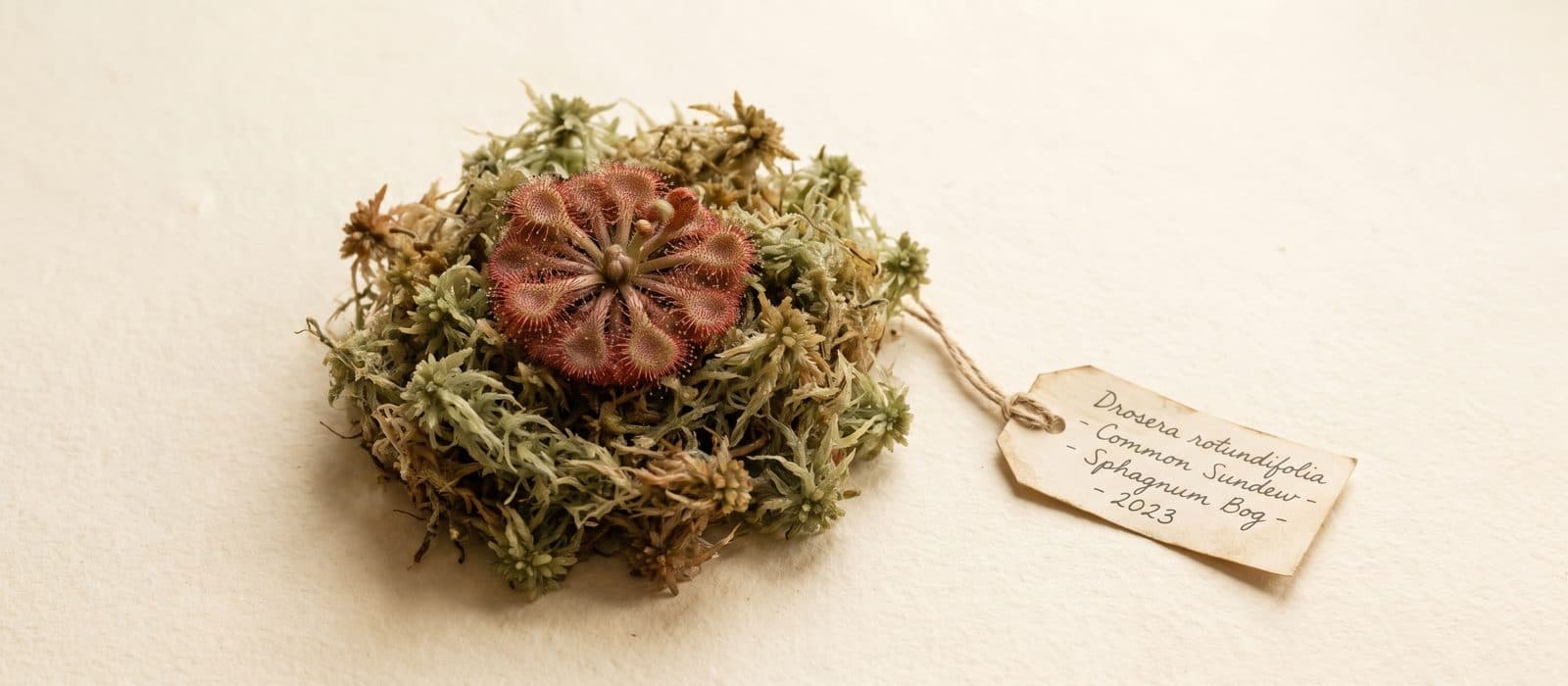
Homeopathic Drosera is prepared from the whole fresh plant of Drosera rotundifolia, the round-leaved sundew, gathered when it flowers in summer. It is a tiny plant, a flat rosette of round leaves no wider than a coin, growing in sphagnum bogs, wet heaths and moorland across Europe, northern Asia and North America. Each leaf is fringed with reddish hairs tipped with drops of sticky fluid that glisten like dew in the sun, which gives the plant its name. Small insects that land are held fast, and the hairs slowly curl inwards to digest them.
That curling, gripping action fascinated nineteenth-century naturalists; Charles Darwin devoted much of his book Insectivorous Plants (1875) to the sundews. Long before that, sundew was a familiar plant in European folk practice for coughs and chest complaints, which is part of why it appears in the older herbals.
Sundew is not a poisonous source in the way that many remedies are. It is, though, a slow-growing plant of fragile habitats and is protected in some countries, so it is not something to gather from the wild. Homeopathic manufacturers prepare a mother tincture of the fresh plant and then dilute and succuss it step by step to the labelled potency. At the common potencies the arithmetic says no molecule of the plant remains; our potencies guide explains what that means and why it is also the reason science is sceptical. Our guide to what is in a homeopathic remedy covers the rest of the process.
What is the Drosera picture?
The Drosera picture is a cough that seizes the person. Imagine a child who has gone to bed apparently settled, and an hour after midnight begins to cough: a deep, barking bout, then another before the first has finished, then another, so close together that there is no room to breathe in. The face reddens, the eyes water, the child clutches at the chest or the sides, and the fit ends in gagging or bringing up mucus. Then quiet, until the tickle in the throat starts again.
Classic texts build the picture from these features. Hahnemann's proving and Boericke's summary (1927) describe a spasmodic, dry, irritating cough with paroxysms following one another very rapidly, a tickle in the larynx as from a feather or crumbs, deep and hoarse barking, and retching or vomiting with the fits. The cough is described as worse after midnight and as soon as the head touches the pillow, worse from warmth, talking, singing, laughing and drinking. Pressing the hands against the chest or sides during a fit is a classic observation; the coughing hurts the chest and the person tries to hold it together.
Hoarseness runs through the picture too: a deep, rough voice that takes effort, with the sense that something in the larynx is catching. Some texts add nosebleeds with the cough and a chilliness through the body. The mental side of the picture is thin; the remedy's reputation rests on the shape of the cough.
What makes it better or worse?
The traditional modalities centre on lying down, the small hours and the use of the voice. Drosera is worse after midnight, on lying down and from talking, and better from pressure on the chest and from sitting up.
| Modality | Worse | Better |
|---|---|---|
| Time | After midnight | During the day |
| Position | Lying down; as soon as the head touches the pillow | Sitting up |
| Voice | Talking, singing, laughing | Keeping quiet |
| Temperature | Warmth, getting warm in bed | No consistent keynote |
| Pressure | No consistent keynote | Holding or pressing the chest during a fit |
Our guide to modalities, better and worse explains why a homeopath asks about these before any remedy name.
What is Drosera traditionally discussed for?
In homeopathic literature, Drosera is traditionally discussed for spasmodic, tickling coughs that come in fits. Each of these appears on one of our acute pages, where the Drosera-like pattern sits beside its neighbours and the red flags come first.
Coughs
- Spasmodic, barking or tickling coughs that come in fits and may feel worse lying down: a dry, tickling cough.
- The same fit-like, tickling pattern after an irritant: a cough after dust exposure. A cough that starts suddenly while a child is eating or playing with small objects may mean something has been inhaled, and needs urgent assessment.
Our guide to seasonal acute patterns places these coughs in the wider run of autumn and winter cases.
What is Drosera not?
Drosera is not "the whooping cough remedy", and it is especially important not to read it that way. Classic texts did associate the Drosera picture with whooping cough, but whooping cough (pertussis) is a serious bacterial infection, dangerous for babies, and a medical diagnosis. A cough that comes in long fits ending in a whoop, gagging or vomiting, or that has gone on for more than two weeks in fits, needs a doctor, and young babies can stop breathing with it rather than whoop. Our guide to observing a sick child covers what to watch.
More generally, a cough that comes with difficulty breathing, a high-pitched noise on breathing in, lips or face turning blue or grey, coughing blood, chest pain, a high fever, or one that lasts over three weeks needs medical care, whatever a remedy picture might suggest. Our guide to red flags first sets these out.
Homeopaths separate Drosera from its neighbours like this:
| Picture | Where it sits | Defining feature | Key modality |
|---|---|---|---|
| Drosera | Spasmodic fits | Bouts follow each other too fast to breathe; tickle in the larynx; retching | Worse after midnight and lying down |
| Spongia | Dry, croupy cough | Sawing, barking, "like a saw through wood"; dry airways | Better warm drinks and eating |
| Ipecacuanha | Cough with nausea | Rattling chest, constant nausea not eased by vomiting | Worse warm, damp weather and lying down |
| Bryonia | Dry, painful cough | Holds the chest because every cough hurts; irritable, thirsty | Worse any motion; better keeping still |
| Phosphorus | Tickling, hoarse cough | Tight, raw chest; hoarse voice; wants company and cold drinks | Worse talking and cold air |
Drosera and Bryonia are both described with the person holding the chest during a cough. The traditional distinction is the rhythm: Bryonia's cough is painful and made worse by any movement; Drosera's comes in fits that run together faster than breath can follow.
What potencies is Drosera sold in?
Homeopathic Drosera is sold as single-remedy pellets, usually in 6C and 30C, and the name also appears in some combination cough products. Potency describes the preparation process, not an amount of plant: 30C means thirty successive 1:100 dilutions with succussion between them. Our potencies guide explains the scale and what remains in the vial.
This page deliberately gives no frequency or instructions for taking Drosera. That depends on a whole case, not a remedy name. Read the product label, and talk to a qualified practitioner about an individual situation.
What remedy lists don't tell you
Two things the "remedies for a dry cough" lists leave out:
- The rhythm of the fit is the tell. Lists describe Drosera as a dry, tickling cough, which describes most coughs after a cold. What the classic authors found characteristic was the way the bouts run together without a breath between them, the barking depth, the retching at the end and the midnight timing. A tickly cough that comes as a single hack now and then reads as something else in the tradition.
- The fame comes from the frightening cases. Drosera's reputation was built on whooping cough in an age before vaccination and antibiotics. The same cough today is a reason for a doctor to listen to the chest and, in a baby, for urgent care. A homeopath reading a cough that comes in fits asks the red-flag questions first, and only then thinks about the picture.
Where the Drosera rotundifolia picture appears on this site
Acute pages that discuss this picture among their educational patterns, with the pattern name each page uses.
- What homeopathic remedy for a cough after dust exposure?Drosera-like spasmodic, tickling pattern
- What homeopathic remedy for a dry, tickling cough?Drosera-like spasmodic, tickling pattern
Not sure whether a picture fits?
A remedy profile describes a picture; it cannot tell you whether that picture matches what you are seeing. An acute consultation starts from the case itself: onset, sensations, what changes it, and the red flags.
Acute consultation · $45Frequently asked questions
- What is Drosera rotundifolia?
- Drosera rotundifolia is a homeopathic remedy prepared from the round-leaved sundew, a small insect-eating plant of bogs and wet heaths. In homeopathy it names a traditional picture: a violent, spasmodic cough that comes in fits, one bout following another so fast that breath is hard to catch, set off by a tickle in the throat and worse after midnight and lying down. It is a description homeopaths use to compare cases, not evidence that it works for coughs or anything else.
- What is Drosera used for in homeopathy?
- Homeopathic literature traditionally discusses Drosera for dry, tickling, barking or spasmodic coughs that come in fits, may end in gagging or retching, and are worse lying down and after midnight. The picture is defined by the spasmodic, rapid-fire quality of the bouts, not by the name of a complaint. A cough with a whoop, fits that turn the lips blue or end in vomiting, difficulty breathing, or a cough lasting over three weeks needs medical care first.
- What is Drosera 30C used for?
- 30C is one of the potencies Drosera is commonly sold in, alongside 6C. In the tradition the potency does not change the picture: Drosera 30C belongs to the same spasmodic, tickling cough description as any other potency. Our potencies guide explains what 30C means as a dilution.
- How is Drosera taken?
- This page does not give instructions on how or how often to take any remedy, because that depends on a whole case rather than on a remedy name. The product label carries the manufacturer's directions, and a qualified practitioner can advise on an individual situation. A cough that comes in fits with a whoop, or any cough in a young baby, belongs with a doctor first.
- Where can I buy Drosera?
- Pharmacies, health-food shops and homeopathic manufacturers sell homeopathic Drosera as single-remedy pellets, usually in 6C or 30C, and it appears in some combination cough products. This site also prepares custom single remedies to order: you name the remedy and potency, and the details are confirmed by email before anything is made. The order form does not give advice on which remedy to choose.
- What is Drosera made from?
- Homeopathic Drosera is prepared from the whole fresh plant of Drosera rotundifolia, the round-leaved sundew, gathered when it flowers in summer. It is steeped into a mother tincture and then diluted and succussed step by step to the labelled potency. Sundew is a protected plant in some countries, and it should not be gathered from the wild.
This guide is educational only and is not medical advice or a personalized remedy recommendation. Acute symptoms can become urgent; when in doubt, seek professional evaluation.