Remedy profile
Ipecacuanha in Homeopathy: Uses, Picture and Limits
What homeopathic Ipecacuanha is made from, the constant-nausea, clean-tongue picture homeopaths describe, what changes it, the potencies sold, and its limits.
By Homeopathic BenefitsPublished 7 min read
Key takeaways
- Ipecacuanha is the picture of nausea that will not let go. Constant, deathly sickness that vomiting does not relieve is its classic keynote.
- The clean tongue is the detail homeopaths remember. In most nausea the tongue is coated; in the Ipecacuanha picture it stays clean and moist, often with a mouth full of saliva.
- Its cough is loose, rattling and gagging. Classic texts describe a chest that sounds full of mucus, a cough that comes in fits, and retching at the end of it.
- It comes from the ipecac root. The raw root is a powerful emetic and harmful in quantity; potentised preparations are diluted far past the point where the root is a concern.
- Persistent vomiting and laboured breathing come first. Being unable to keep fluids down, vomiting blood, breathlessness or a baby struggling with a cough are medical questions before they are homeopathic ones.
The short answer
Ipecacuanha is a homeopathic remedy prepared from the dried root of the ipecac plant, Carapichea ipecacuanha, a small shrub of the Brazilian forest whose root was the source of the old syrup of ipecac. In homeopathy it names a traditional picture rather than a treatment: constant, overwhelming nausea that vomiting does not relieve, with a clean tongue and plenty of saliva. Classic materia medica extends the same picture to a loose, rattling cough that ends in gagging, and to bright-red bleeding accompanied by nausea. Hahnemann included it among his first documented remedies in 1805. It is not a general nausea or cough remedy, and nothing about the picture replaces medical care for vomiting that will not settle or a cough that makes breathing hard.
| Latin name | Ipecacuanha |
|---|---|
| Abbreviation | Ip. |
| Common name | Ipecac root |
| Source | Dried root of Carapichea ipecacuanha (syn. Cephaelis ipecacuanha), a small shrub of the coffee family (Rubiaceae) (plant kingdom) |
| Commonly sold potencies | 6C, 30C, 200C |
| First proving | Hahnemann, Fragmenta de viribus medicamentorum (1805); expanded in Materia Medica Pura |
What is Ipecacuanha made from?
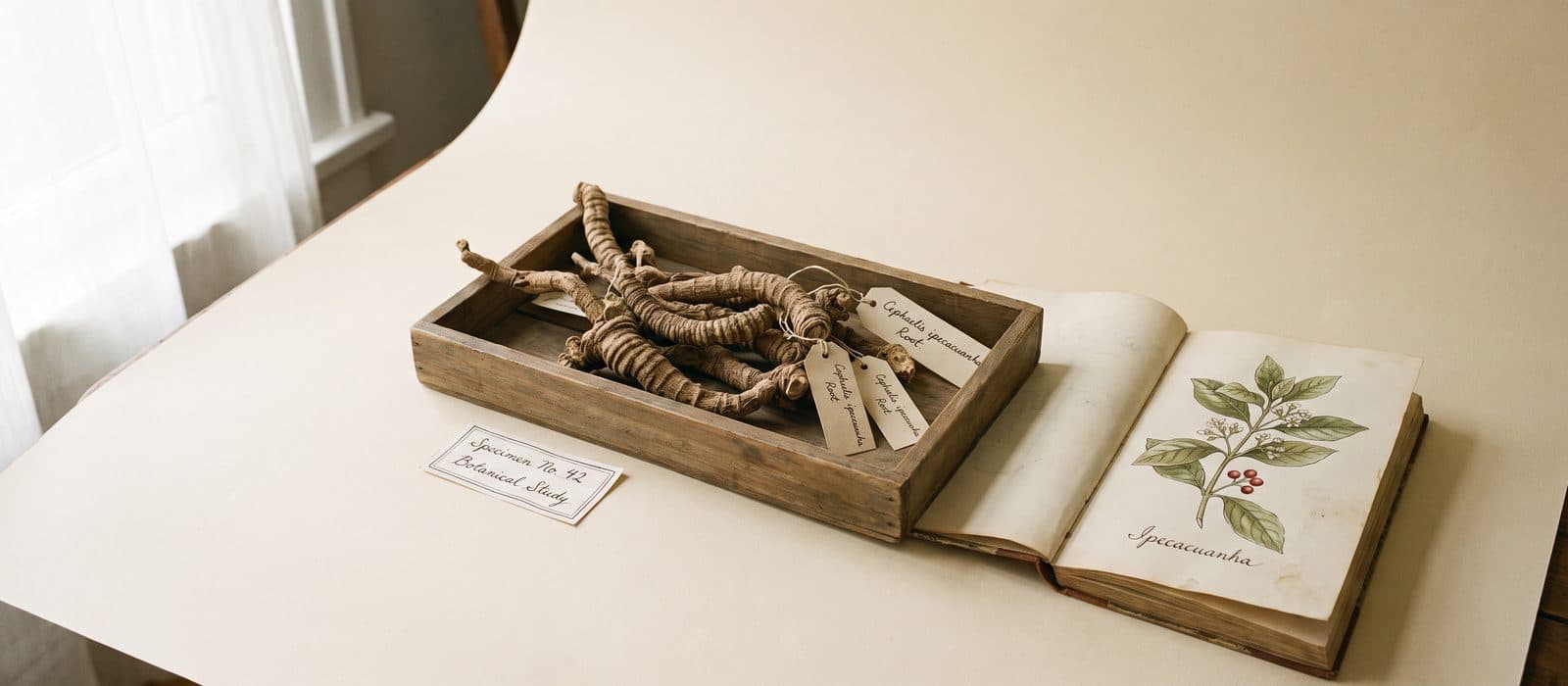
Homeopathic Ipecacuanha is prepared from the dried root of Carapichea ipecacuanha, also catalogued as Cephaelis or Psychotria ipecacuanha. It is a low, slow-growing shrub of the coffee family (Rubiaceae), native to the shaded understorey of the Brazilian rainforest and parts of Central America. The useful part is the root: slender, twisted and ringed, which is why older pharmacy books call it "annulated root". The name comes from a Tupi phrase for a plant that makes you sick.
That name is accurate. The raw root contains the alkaloids emetine and cephaeline, which act on the stomach and on the brain's vomiting centre. For two centuries it was the conventional emetic, and syrup of ipecac sat in household medicine cabinets for poisonings until poison-control services stopped recommending it in the early 2000s. In larger amounts emetine also affects the heart and muscles, and the raw root or old syrup is never something to use at home.
The homeopathic preparation grinds the dried root and carries it through repeated dilution and succussion to the potency on the label. At the common potencies, the arithmetic says no molecule of the root remains; our potencies guide sets out what that means and why it is also the reason mainstream science is sceptical. The overlap between what the raw root does and the homeopathic picture, nausea and retching above all, is the idea behind a proving, as our guide to what is in a homeopathic remedy explains.
What is the Ipecacuanha picture?
The Ipecacuanha picture is someone who feels sick all the time and gets nothing for it. Picture a person sitting very still on the edge of the bed with a bowl beside them, swallowing repeatedly because the mouth keeps filling with saliva. They vomit, and the nausea is exactly where it was a minute before. They are pale, perhaps with a bluish tinge around the lips, and too wretched to be interested in anything. Ask them to put out their tongue and it is clean and pink, which is the opposite of what most people expect in a sick stomach.
Classic texts make the persistence the centre of the description. Boericke (1927) opens his entry with the nausea: constant, and not relieved by vomiting. Nash (1898) singled out the clean tongue as the feature that separates Ipecacuanha from the many other nauseous pictures, and Clarke's Dictionary (1900–1902) adds the profuse saliva and the disgust at food, even its smell.
The chest repeats the stomach. The cough is loose and wet, the chest sounds full of rattling mucus, yet little comes up. The cough arrives in fits, sometimes so hard that the person gags or vomits at the end of a bout. In children the old texts describe a child who stiffens and goes pale or blue in a coughing fit, which in modern terms is a reason to have a clinician listen to the chest at once.
Bleeding is the third thread. The materia medica describes bright-red, gushing bleeding, from the nose or elsewhere, accompanied by nausea and faintness. The mood is irritable and hard to please: the person wants something but cannot say what, and nothing offered is right.
What makes it better or worse?
The traditional modalities are less dramatic than the nausea itself. Ipecacuanha is worse from motion, from stooping and periodically, and better from rest and fresh air.
| Modality | Worse | Better |
|---|---|---|
| Motion | Moving, stooping, being jolted | Keeping still |
| Vomiting | Nausea returns at once after vomiting | No relief from vomiting, the keynote |
| Food | Rich food, pastry, ice cream, the smell of food | No consistent keynote |
| Weather | Warm, damp weather and moist winds (Boericke) | Open air (some texts) |
| Time | Periodic returns; symptoms that recur at set intervals | No consistent keynote |
Most nauseous pictures share their complaint; what separates them is the detail around it. Our guide to modalities, better and worse explains why a homeopath reads these before reaching for any name.
What is Ipecacuanha traditionally discussed for?
In homeopathic literature, Ipecacuanha is traditionally discussed for states where nausea is constant and vomiting brings no relief. Each of these appears on one of our acute pages, where the Ipecacuanha-like pattern sits beside its neighbours and the red flags come first.
Digestion and pregnancy
- Persistent nausea with a clean tongue and no relief from vomiting: nausea in early pregnancy. Severe, unrelenting vomiting in pregnancy (hyperemesis gravidarum) is a medical condition in its own right, and that page sets out when to call a midwife or doctor.
Chest and cough
- A loose, rattling cough tied to nausea, gagging or retching: a wet, productive cough. Our guide to the symptoms alongside the symptom explains why the nausea, not the cough, is what points to this picture.
What is Ipecacuanha not?
Ipecacuanha is not "the nausea remedy", and that is the misreading most lists encourage. Nausea belongs to dozens of traditional pictures: the irritable, chilly person retching after excess, the anxious, burning, exhausted one after spoiled food, the deathly pale traveller who wants the window open. Ipecacuanha is the one whose sickness is constant, whose tongue is clean and whose vomiting changes nothing. Without that, the name is only a famous emetic on a label.
It is also not a reason to sit out red flags. In pregnancy, being unable to keep fluids down for a day, passing very little or dark urine, weight loss, or vomiting blood needs a midwife or doctor. With a cough, breathlessness, chest pain, coughing blood, a high fever, blue lips, or a baby or small child who struggles to breathe or stops breathing in a coughing fit needs urgent care. Our guide to red flags first covers what to check.
Homeopaths separate Ipecacuanha from its neighbours like this:
| Picture | Where it sits | Defining feature | Key modality |
|---|---|---|---|
| Ipecacuanha | Constant nausea; rattling, gagging cough | Clean tongue, profuse saliva, no relief from vomiting | Worse motion and stooping; vomiting changes nothing |
| Nux vomica | Nausea after excess | Irritable, chilly; retches but cannot vomit; coated tongue at the back | Worse morning; better after vomiting when it comes |
| Antimonium tartaricum | Rattling chest | Drowsy, weak, coated white tongue; too feeble to cough up the mucus | Worse lying down; better sitting up and bringing mucus up |
| Tabacum | Deathly nausea, often with motion | Icy cold, pale, sweating; sinking feeling in the stomach | Better uncovering the abdomen and fresh air |
| Drosera | Fits of cough | Barking, tickling cough in rapid bouts, may end in retching | Worse after midnight and lying down |
What potencies is Ipecacuanha sold in?
Ipecacuanha is sold most often as 30C pellets, the common shelf potency for single remedies, with 6C and 200C also available. Potency describes the preparation process, not an amount of root: 30C means thirty successive 1:100 dilutions with succussion between them. Our potencies guide explains the scale and what remains in the vial, and why low-potency products of strong-acting sources carry their own labelling.
This page deliberately gives no frequency or instructions for taking Ipecacuanha. That depends on a whole case, not a remedy name. Read the product label, and talk to a qualified practitioner about an individual situation, and in pregnancy a midwife or doctor as well.
What remedy lists don't tell you
Two things the "remedies for nausea" lists leave out:
- The tongue is a question anyone can answer. Lists sort remedies by complaint, and nausea is the complaint. What the classic authors found useful was a sign you can see: a clean, moist tongue in a person who feels desperately sick. It is quick to check, hard to imagine, and it separates Ipecacuanha from most of its neighbours at a glance.
- The cough and the stomach are one picture. The tradition does not keep a "cough Ipecacuanha" and a "stomach Ipecacuanha". The same constant nausea, gagging and lack of relief run through both, which is why the picture turns up on pages as different as early pregnancy and a chesty cold. A rattling cough without the nausea reads as something else, and our guide to reading Latin remedy names explains why the name on the label tells you less than the picture does.
Where the Ipecacuanha picture appears on this site
Acute pages that discuss this picture among their educational patterns, with the pattern name each page uses.
- What homeopathic remedy for a wet, productive cough?Ipecacuanha-like persistent nausea-with-cough pattern
- What homeopathic remedy for nausea in early pregnancy?Ipecacuanha-like constant nausea pattern
Not sure whether a picture fits?
A remedy profile describes a picture; it cannot tell you whether that picture matches what you are seeing. An acute consultation starts from the case itself: onset, sensations, what changes it, and the red flags.
Acute consultation · $45Frequently asked questions
- What is Ipecacuanha?
- Ipecacuanha is a homeopathic remedy prepared from the dried root of the ipecac plant, a small shrub of the Brazilian rainforest. In homeopathy it names a traditional picture: constant, overwhelming nausea that vomiting does not ease, with a tongue that stays surprisingly clean and a mouth full of saliva. It is a description homeopaths use to compare cases, not evidence that it works for nausea, coughs or anything else.
- What is Ipecacuanha used for in homeopathy?
- Homeopathic literature traditionally discusses Ipecacuanha for states where nausea dominates and will not lift: the persistent sickness of early pregnancy, and a loose, rattling cough that ends in gagging or retching. The picture is defined by the unrelenting nausea, the clean tongue and the lack of relief after vomiting, not by the name of the complaint. Being unable to keep fluids down, vomiting blood, or a cough with breathlessness needs medical care first.
- What is Ipecacuanha 30C used for?
- 30C is the common shelf potency of Ipecacuanha, the one most single-remedy tubes carry. In the tradition the potency does not change the picture; Ipecacuanha 30C is discussed for the same constant, unrelieved nausea as any other potency. What 30C means as a dilution is explained in our potencies guide.
- How is Ipecacuanha taken?
- This page does not give instructions on how or how often to take any remedy, because that depends on a whole case rather than on a remedy name. The product label carries the manufacturer's directions, and a qualified practitioner can advise on an individual situation. Nausea in pregnancy that stops you keeping fluids down belongs with a midwife or doctor first.
- Where can I buy Ipecacuanha?
- Pharmacies, health-food shops and homeopathic manufacturers sell Ipecacuanha as single-remedy pellets, most often in 30C, and it appears in some home kits. This site also prepares custom single remedies to order: you name the remedy and potency, and the details are confirmed by email before anything is made. The order form does not give advice on which remedy to choose.
- What is Ipecacuanha made from?
- Homeopathic Ipecacuanha is prepared from the dried root of Carapichea ipecacuanha, a low shrub native to the forests of Brazil and Central America. The root is ground and potentised, diluted and succussed step by step to the labelled potency. The raw root contains emetine and cephaeline, powerful emetics that are harmful in quantity, which is why it appears on labels only in potentised form.
This guide is educational only and is not medical advice or a personalized remedy recommendation. Acute symptoms can become urgent; when in doubt, seek professional evaluation.