Remedy profile
Tabacum in Homeopathy: Uses, Picture and Limits
What homeopathic Tabacum is made from, the deathly pale, cold-sweating nausea picture homeopaths describe, what changes it, potencies sold, and its limits.
By Homeopathic BenefitsPublished 7 min read
Key takeaways
- Tabacum is the picture of the first cigarette. Deathly nausea, a face gone pale and clammy, icy cold sweat, a sinking feeling in the stomach and a head that swims.
- Fresh air and uncovering define it. Classic texts describe a person who is icy cold yet wants the belly uncovered and the window open, and who feels a little better in the open air.
- Motion and opening the eyes make it worse. The old seasickness picture: worse from the slightest movement, better lying still with the eyes shut.
- It comes from tobacco leaves. Nicotine is seriously poisonous; potentised preparations are diluted far past the point where the leaf is a concern.
- Vertigo and vomiting have red flags. Sudden spinning with a severe headache, slurred speech, weakness, double vision or chest pain is an emergency; so is vomiting that will not let anyone keep fluids down.
The short answer
Tabacum is a homeopathic remedy prepared from the leaves of the tobacco plant, Nicotiana tabacum. In homeopathy it names a traditional picture rather than a treatment: deathly nausea with a pale, cold, sweating face, a sinking, faint feeling in the pit of the stomach, giddiness worse on opening the eyes, and a craving for cold fresh air. The picture closely mirrors what tobacco does to someone unused to it, which is the logic of a homeopathic proving. The records collected in Allen's Encyclopedia (1874–1879) and the later summaries of Boericke (1927) made it a classic seasickness picture. It is not a substitute for medical care, and sudden vertigo with any neurological sign needs emergency help first.
| Latin name | Tabacum |
|---|---|
| Abbreviation | Tab. |
| Common name | Tobacco |
| Source | Fresh leaves of the tobacco plant, Nicotiana tabacum (Solanaceae) (plant kingdom) |
| Commonly sold potencies | 6C, 30C |
| First proving | Nineteenth-century provings and records of tobacco poisoning, collected in Allen's Encyclopedia of Pure Materia Medica (1874–1879) |
What is Tabacum made from?
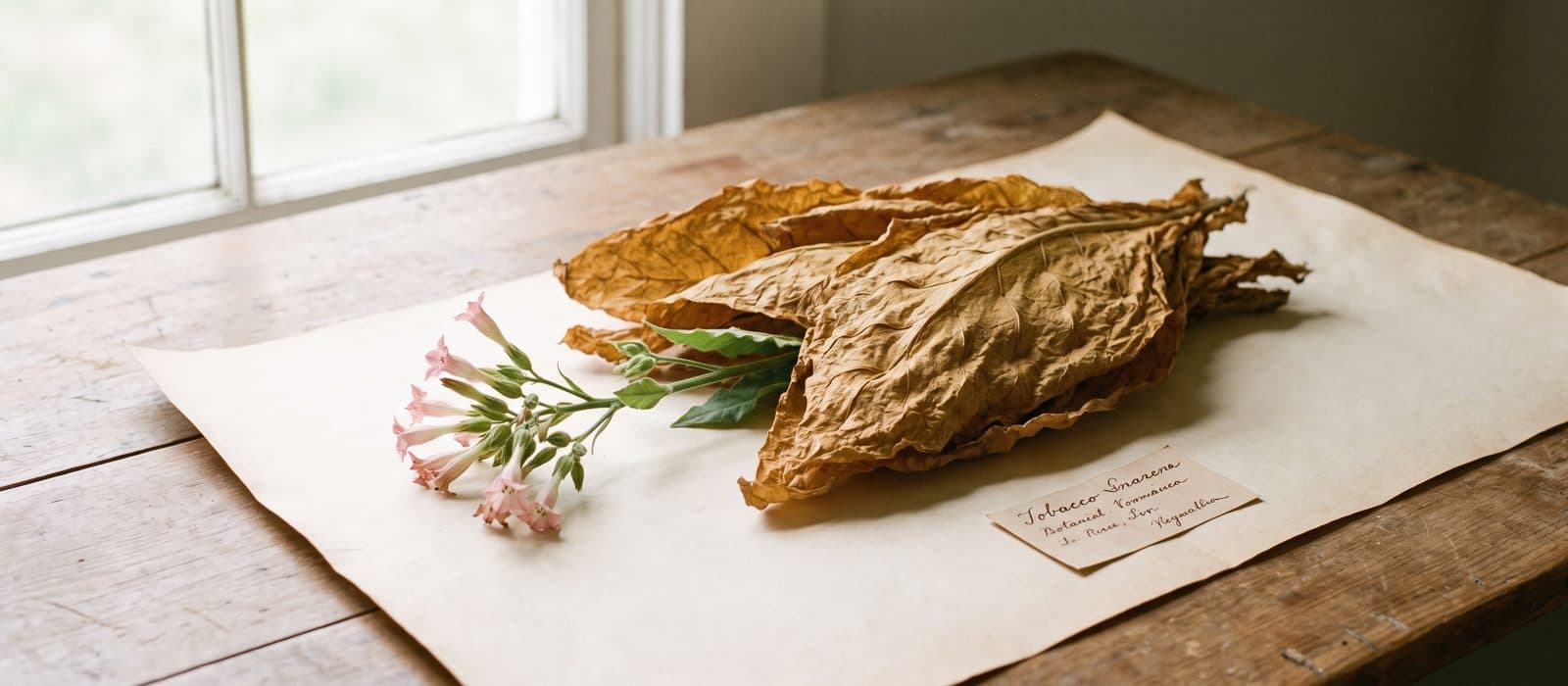
Homeopathic Tabacum is prepared from the leaves of Nicotiana tabacum, cultivated tobacco, a tall annual of the nightshade family (Solanaceae) with broad, sticky leaves and pink trumpet flowers. The plant is native to the Americas, and the Latin name on the label is simply the old pharmacy name for tobacco; our guide to reading Latin remedy names explains the convention.
The source deserves to be stated plainly. Tobacco leaf contains nicotine, an alkaloid that is seriously poisonous in quantity. Nicotine poisoning, from swallowed tobacco, concentrated liquid or long contact with wet leaves during the harvest, brings on nausea, vomiting, pallor, sweating, giddiness and a slow or irregular pulse, and children are especially at risk from swallowed cigarettes or refill liquid. The raw leaf is never something to prepare, brew or use at home. The homeopathic preparation makes a mother tincture of the leaf and carries it through repeated dilution and succussion; at the common potencies the arithmetic says no molecule of the leaf remains. Our potencies guide explains what that means and why it is also the reason mainstream science is sceptical.
The overlap between the poisoning and the remedy picture is deliberate. Much of the Tabacum entry in the materia medica comes from observations of people overcome by tobacco, recorded alongside formal provings.
What is the Tabacum picture?
The Tabacum picture is the person on the ferry who has gone grey. They are slumped against the rail, the face pale and pinched, the forehead beaded with cold sweat, and they feel as though they might die and would not much mind. Every lurch of the deck brings a fresh wave of nausea. They cannot bear the stuffy cabin; they want the cold wind on them and their coat open, even though their hands are icy.
Classic texts describe this deathly nausea as the centre of the picture, with incessant sickness, vomiting on the least motion, and a dreadful sinking, relaxed feeling at the pit of the stomach. Boericke (1927) describes the face as pale, blue and pinched, with icy coldness and cold sweat, and notes that the person feels better with the abdomen uncovered and in the fresh, cold air. Giddiness is the companion: the room spins, worse on opening the eyes and on rising, so the person lies still with the eyes shut.
The materia medica extends the same state beyond travel. It records weak, intermittent palpitation and anxious oppression around the heart, cold extremities, and a general collapse that looks frightening and in real life often is. That is one reason homeopaths stress that a Tabacum-like state on dry land, without an obvious cause such as a boat or a car, deserves a clinician before it deserves a remedy name.
Emotionally the classic picture is quiet: despondent, wretched, wanting to be left alone in the cold air, too sick to complain much.
What makes it better or worse?
The traditional modalities centre on motion and air. Tabacum is worse from motion, opening the eyes and warm rooms, and better in cold, fresh air with the abdomen uncovered.
| Modality | Worse | Better |
|---|---|---|
| Motion | Least motion, riding on boats or in cars | Lying still |
| Eyes | Opening the eyes, looking at moving things | Closing the eyes |
| Air | Warm, stuffy rooms, tobacco smoke | Cold fresh air, open windows |
| Covering | Tight clothing around the belly | Uncovering the abdomen |
| Time | No consistent keynote | Evening (Boericke) |
The pairing of icy coldness with a wish for cold air is the modality that matters most here; our guide to modalities, better and worse shows why a contradiction like that is often more telling than the complaint itself.
What is Tabacum traditionally discussed for?
In homeopathic literature, Tabacum is traditionally discussed for deathly nausea and giddiness, chiefly from motion. Each of these appears on one of our acute pages, where the Tabacum-like pattern sits beside its neighbours and the red flags come first.
Motion and travel
- Motion sickness on a trip, the classic seasickness picture of pallor, cold sweat and a craving for fresh air.
Balance and giddiness
- A spinning vertigo episode, where the giddiness is drowned in the same deathly nausea, sometimes described as seasickness on dry land.
The wider context for both, including what to organise before and during a journey, is in our guide to travel and acute patterns.
What is Tabacum not?
Tabacum is not "the seasickness remedy", and it is never a reason to sit out a dangerous kind of giddiness. Sudden vertigo that comes with a severe or unusual headache, slurred speech, facial drooping, weakness or numbness on one side, double vision, trouble walking or chest pain is an emergency until proved otherwise; call emergency services. Vomiting that stops someone keeping fluids down, signs of dehydration, a baby or older person who is vomiting repeatedly, or vertigo with new hearing loss all belong with a clinician first. Our guide to red flags first explains why that comes before any pattern.
It is also, plainly, not a link to smoking. The picture describes what tobacco does to someone who is not used to it; nothing about it suggests that tobacco in any form is a good idea.
Homeopaths separate it from its neighbours like this:
| Picture | Where it sits | Defining feature | Key modality |
|---|---|---|---|
| Tabacum | Seasickness, giddiness | Deathly pale, icy cold sweat, sinking stomach | Better cold fresh air and uncovering the belly |
| Cocculus | Motion sickness, lost sleep | Hollow, exhausted, giddy; nausea at the thought of food | Worse riding and the sight of motion; must lie down |
| Petroleum | Car and carriage sickness | Nausea with an empty, hungry stomach; heavy back of the head | Worse riding; eating may settle it |
| Ipecacuanha | Persistent nausea | Constant nausea not eased by vomiting; clean tongue | Worse motion and stooping |
| Veratrum album | Collapse with fluid loss | Profuse vomiting and purging with cold sweat on the forehead | Worse least motion; wants icy drinks |
What potencies is Tabacum sold in?
Tabacum is sold most often as 6C or 30C pellets, mainly through homeopathic pharmacies and manufacturers rather than general shops. Potency describes the preparation process, not an amount of leaf: 30C means thirty successive 1:100 dilutions with succussion between them. Our potencies guide explains the scale and what remains in the vial.
This page deliberately gives no frequency or instructions for taking Tabacum. That depends on a whole case, not a remedy name. Read the product label, and talk to a qualified practitioner about an individual situation.
What remedy lists don't tell you
Two things the "remedies for travel sickness" lists leave out:
- The face tells you more than the stomach. Three people can be equally sick on the same boat. The grey, sweating one who wants the wind on their bare belly fits the Tabacum description; the one who is giddy, hollow and exhausted from a night without sleep fits another; the one whose stomach feels empty and wants a biscuit fits a third. Lists sorted by the trigger hand all three the same name. Our guide to the symptoms alongside the symptom explains why the companions decide it.
- The source explains the picture, and the picture explains the caution. Tabacum's description is close to tobacco poisoning, and real tobacco poisoning is a medical emergency. When the deathly, cold-sweating collapse appears without a boat, a car or a known cause, the honest reading is that something needs medical attention, not that the materia medica has a match.
Where the Tabacum picture appears on this site
Acute pages that discuss this picture among their educational patterns, with the pattern name each page uses.
- What homeopathic remedy for a spinning vertigo episode?Tabacum-like deathly-nausea vertigo pattern
- What homeopathic remedy for motion sickness on a trip?Tabacum-like deathly nausea pattern
Not sure whether a picture fits?
A remedy profile describes a picture; it cannot tell you whether that picture matches what you are seeing. An acute consultation starts from the case itself: onset, sensations, what changes it, and the red flags.
Acute consultation · $45Frequently asked questions
- What is Tabacum?
- Tabacum is a homeopathic remedy prepared from the leaves of the tobacco plant, Nicotiana tabacum. In homeopathy it names a traditional picture modelled closely on the first cigarette: deathly nausea with a pale, cold, sweating face, a sinking feeling in the stomach, giddiness, and a craving for cold fresh air. It is a description homeopaths use to compare cases, not a finding that it works for seasickness or any other condition.
- What is Tabacum used for in homeopathy?
- Homeopathic literature traditionally discusses Tabacum for overwhelming nausea from motion, at sea or in a car, and for spinning giddiness drowned in the same deathly sickness. The picture is defined by the pallor, the icy cold sweat and the wish to uncover the belly and get into fresh air, not by the name of the complaint. Vertigo with a severe headache, slurred speech, weakness, double vision or chest pain needs emergency care first.
- What is Tabacum 30C used for?
- 30C is one of the two potencies Tabacum is most often sold in, alongside 6C, mainly through homeopathic pharmacies rather than general shops. In the tradition the potency does not change the picture; Tabacum 30C is discussed for the same pale, cold-sweating, deathly nauseated state as any other potency. What 30C means as a dilution is explained in our potencies guide.
- How is Tabacum taken?
- This page does not give instructions on how or how often to take any remedy, because that depends on a whole case rather than on a remedy name. The product label carries the manufacturer's directions, and a qualified practitioner can advise on an individual situation. Sudden vertigo with any neurological sign, or vomiting that stops someone keeping fluids down, belongs with a clinician first.
- Where can I buy Tabacum?
- Homeopathic pharmacies and manufacturers sell Tabacum as single-remedy pellets, usually in 6C or 30C; it is less often found on general shop shelves than the common kit remedies. This site also prepares custom single remedies to order: you name the remedy and potency, and the details are confirmed by email before anything is made. The order form does not give advice on which remedy to choose.
- What is Tabacum made from?
- Homeopathic Tabacum is prepared from the leaves of the cultivated tobacco plant, Nicotiana tabacum, made into a mother tincture and then diluted and succussed step by step to the labelled potency. Tobacco leaf contains nicotine, which is seriously poisonous in quantity; even handling wet green leaves can make people ill. The raw leaf is never something to prepare or use at home, which is why it appears on labels only in potentised form.
This guide is educational only and is not medical advice or a personalized remedy recommendation. Acute symptoms can become urgent; when in doubt, seek professional evaluation.