Remedy profile
Cocculus indicus in Homeopathy: Uses, Picture and Limits
What homeopathic Cocculus indicus is made from, the sleepless, dizzy, travel-sick picture homeopaths describe, what changes it, potencies sold, and its limits.
By Homeopathic BenefitsPublished 7 min read
Key takeaways
- Cocculus is the picture of exhaustion from lost sleep. Night after night of broken rest, often while nursing someone or travelling, leaves the person hollow, slow, dizzy and nauseated.
- Motion and moving things set it off. Riding in a car, boat or plane, or even watching moving objects, brings on vertigo and nausea in the traditional picture.
- The stomach turns at the smell of food. Classic texts describe nausea rising at the thought or smell of food, with a hollow, empty feeling in the body.
- It comes from a poisonous berry. The raw seeds contain picrotoxin, a convulsant; potentised preparations are diluted far past the point where the berry is a concern.
- Vertigo red flags come first. Dizziness with a severe headache, double vision, slurred speech, facial droop, weakness, numbness or inability to walk is an emergency.
The short answer
Cocculus indicus is a homeopathic remedy prepared from the seeds of Anamirta cocculus, a woody climbing vine of India and South-East Asia whose bitter berries were once thrown into water to stun fish. In homeopathy it names a traditional picture rather than a treatment: the worn-through exhaustion of lost sleep, with vertigo and nausea that motion makes worse. Classic materia medica describes a hollow, empty feeling, slowness of thought and speech, a weak neck that can hardly hold the head up, and nausea at the smell of food, often in someone who has been caring for others at night. Hahnemann recorded it in Materia Medica Pura. It is not a general motion-sickness or vertigo remedy, and nothing about the picture replaces medical care for dizziness that is new, severe or comes with neurological signs.
| Latin name | Cocculus indicus |
|---|---|
| Abbreviation | Cocc. |
| Common name | Indian cockle, fishberry |
| Source | Seeds (dried fruit) of Anamirta cocculus (Menispermaceae) (plant kingdom) |
| Commonly sold potencies | 6C, 30C, 200C |
| First proving | Hahnemann; recorded in Materia Medica Pura (1811–1821) |
What is Cocculus indicus made from?
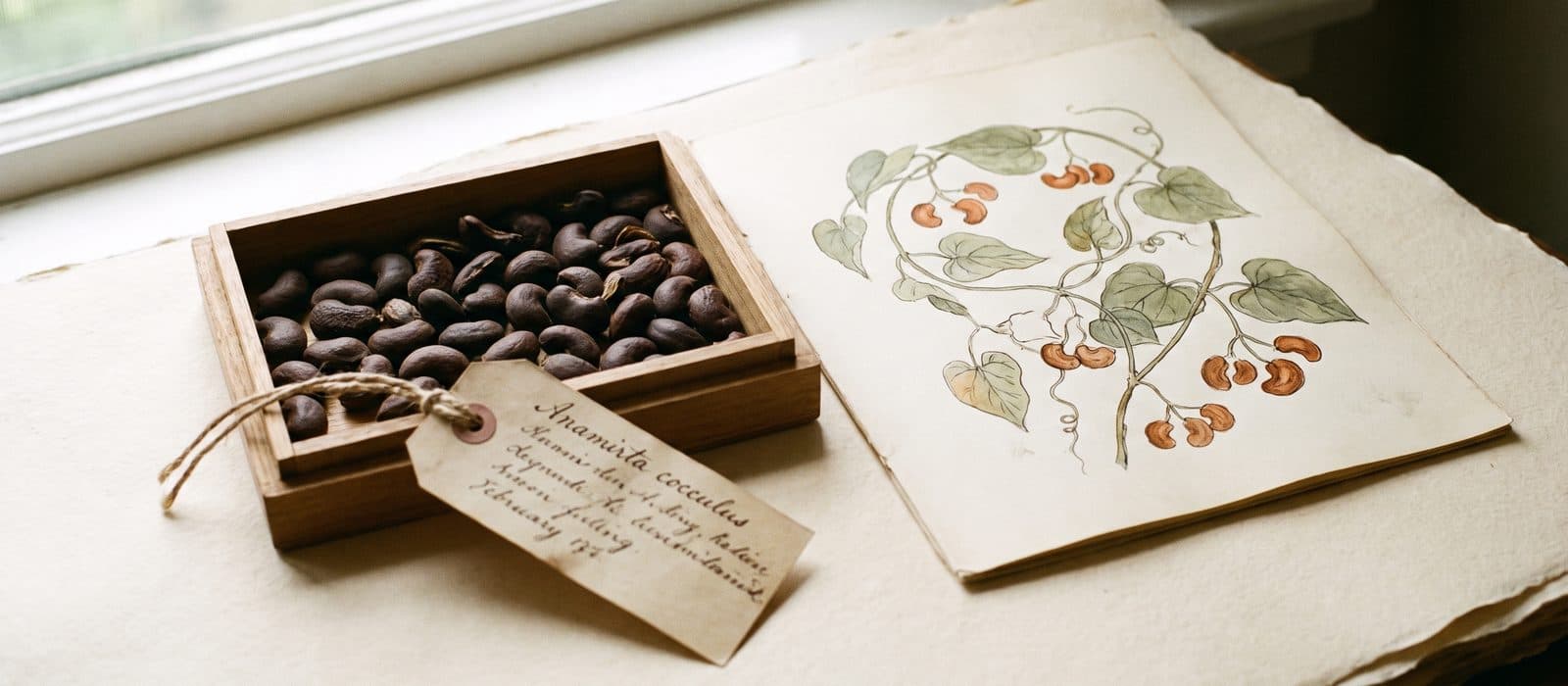
Homeopathic Cocculus is prepared from the dried fruit of Anamirta cocculus, a large climbing shrub of the moonseed family (Menispermaceae) that grows in the forests of India, Sri Lanka and South-East Asia. It bears hanging clusters of small berries that dry to a dark, wrinkled, kidney-shaped seed about the size of a pea. The old trade names, Indian cockle and fishberry, record what the berries were best known for: crushed and thrown into rivers and ponds, they stunned fish so that they floated to the surface.
The name on the label is honest about the source. The seeds contain picrotoxin, a bitter compound that acts on the nervous system and causes vomiting, staggering, convulsions and, in large enough amounts, death. In the past the berries were also used to adulterate beer to make it seem stronger, a practice that was eventually outlawed. The berries are never something to eat, brew or prepare at home.
The homeopathic preparation grinds the seed and carries it through repeated dilution and succussion to the potency on the label. At the common potencies the arithmetic says no molecule of the seed remains; our potencies guide sets out what that means and why it is also the reason mainstream science is sceptical. The guide to reading Latin remedy names explains why a poison appears on a remedy label at all.
The poisoning picture and the homeopathic picture are close mirrors: giddiness, staggering, nausea, weakness and a slowed, dazed mind. That overlap is the idea behind a proving.
What is the Cocculus picture?
The Cocculus picture is the person who has run out of sleep. Imagine a parent on the third night of sitting up with a sick child, or a traveller who has crossed six time zones on a night flight and then driven for two hours. They are past tired: everything feels hollow and far away, the head is heavy and empty at once, and the neck aches as if it can barely hold it up. Thoughts arrive slowly and words take effort. The car journey makes the room swim, and the smell of breakfast is enough to turn the stomach.
Classic texts build the picture from these features. Hahnemann's proving and Boericke's summary (1927) describe the effects of lost sleep and night-watching, a slowness of comprehension, and a sense that time passes too quickly. They describe vertigo with nausea, worse from riding in a carriage or on a boat, worse from sitting up and from looking at moving things, and a hollow, empty sensation in the head, chest or abdomen. The nausea is set off by the smell or even the thought of food, and by motion.
There is weakness too, described in classic texts as a paralytic, trembling weakness: the knees give, the hands tremble, the limbs go numb. Later teachers placed Cocculus among the remedies of the nurse and the carer, the person who has spent their reserves on someone else and now cannot stand the jolting of the journey home. The mood is sad and anxious about others, with a slowed, dazed quality rather than agitation.
What makes it better or worse?
The traditional modalities centre on motion, lost sleep and the smell of food. Cocculus is worse from riding in vehicles, from loss of sleep and from food smells, and better from lying quietly.
| Modality | Worse | Better |
|---|---|---|
| Motion | Riding in a car, boat or plane; watching moving things | Lying still |
| Sleep | Loss of sleep, night-watching | Sleep, when it comes |
| Food | The smell or thought of food; eating | No consistent keynote |
| Position | Sitting up, rising from lying | Lying quietly |
| Senses and air | Noise, touch, jarring; open air and cold | A warm, quiet room |
Our guide to modalities, better and worse explains why a homeopath asks about these before any remedy name.
What is Cocculus traditionally discussed for?
In homeopathic literature, Cocculus is traditionally discussed for the combination of lost sleep, motion and depletion. Each of these appears on one of our acute pages, where the Cocculus-like pattern sits beside its neighbours and the red flags come first.
Travel
- Nausea and dizziness worse from motion, sleep loss and caring for others while depleted: motion sickness on a trip.
- Exhaustion from lost sleep plus travel, with hollow, dizzy, worn-through fatigue where even food smells turn the stomach: jet lag with exhaustion. Chest pain, breathlessness or a swollen, painful calf after a long flight needs urgent care.
Vertigo
- Spinning with hollow weakness and nausea, worse from motion, loss of sleep and riding in vehicles: a spinning vertigo episode. That page sets out the neurological red flags before any pattern.
Our guide to travel and acute patterns explains how a homeopath reads the travel cases where Cocculus is most often named.
What is Cocculus not?
Cocculus is not "the travel sickness remedy". Lists put it in every travel kit, but the picture is the depletion behind the nausea: the lost sleep, the hollow weakness, the slowness and the food smells. A child who is cheerful and well-rested but gets carsick on winding roads, or a traveller whose nausea comes with icy sweat and deathly pallor, reads as something else in the tradition.
It is also not a reason to sit out vertigo that could be serious. Dizziness with a sudden severe headache, double vision, slurred speech, a drooping face, weakness or numbness on one side, difficulty walking, or loss of consciousness is a medical emergency. So is vertigo after a head injury, or with chest pain or palpitations. New or recurring vertigo, and vomiting that stops someone keeping fluids down, should be assessed. Our guide to red flags first sets these out.
Homeopaths separate Cocculus from its neighbours like this:
| Picture | Where it sits | Defining feature | Key modality |
|---|---|---|---|
| Cocculus | Sleep loss with motion | Hollow, slowed, exhausted; nausea at the smell of food | Worse riding and lost sleep; better lying quietly |
| Tabacum | Deathly motion sickness | Icy cold sweat, deathly pallor, sinking feeling in the stomach | Better fresh cold air and uncovering the abdomen |
| Petroleum | Nausea with hunger | Nausea in vehicles, yet an empty stomach wants food | Better eating |
| Conium | Positional vertigo | Spinning on turning the head or rolling over in bed | Worse lying down and turning; better keeping still |
| Nux vomica | Overdone, irritable traveller | Chilly, impatient, retching without result | Worse morning and cold; better a nap |
Cocculus and Nux vomica both turn up after late nights and long journeys. The traditional distinction is the temper: Nux is irritable and driven, while Cocculus is slowed, hollow and quietly worn out.
What potencies is Cocculus sold in?
Homeopathic Cocculus is sold most often as 30C pellets, the common shelf potency for single remedies, with 6C and 200C also available. Potency describes the preparation process, not an amount of seed: 30C means thirty successive 1:100 dilutions with succussion between them. Our potencies guide explains the scale, what remains in the vial, and why low-potency products of toxic sources carry their own labelling.
This page deliberately gives no frequency or instructions for taking Cocculus. That depends on a whole case, not a remedy name. Read the product label, and talk to a qualified practitioner about an individual situation.
What remedy lists don't tell you
Two things the "remedies for motion sickness" lists leave out:
- The sleep debt decides it more than the motion. Two passengers on the same ferry can both feel sick. The one who has been up three nights nursing a parent, who feels hollow and slow and cannot face the smell from the café, fits the Cocculus picture; the one who is pale, icy and sweating does not. Our guide to sleeplessness as a pattern explains why lost sleep is read as part of the case, not background.
- Positional vertigo is a different picture. Lists often name Cocculus for any dizziness. The classic texts tie it to motion, exhaustion and nausea together. Spinning that comes on purely from rolling over in bed or tipping the head back is described under other pictures, and it is also the kind of vertigo a doctor can often identify and address directly.
Where the Cocculus indicus picture appears on this site
Acute pages that discuss this picture among their educational patterns, with the pattern name each page uses.
- What homeopathic remedy for a spinning vertigo episode?Cocculus-like weak travel-sick vertigo pattern
- What homeopathic remedy for jet lag with exhaustion?Cocculus-like sleep-loss travel exhaustion pattern
- What homeopathic remedy for motion sickness on a trip?Cocculus-like exhaustion-with-motion pattern
Not sure whether a picture fits?
A remedy profile describes a picture; it cannot tell you whether that picture matches what you are seeing. An acute consultation starts from the case itself: onset, sensations, what changes it, and the red flags.
Acute consultation · $45Frequently asked questions
- What is Cocculus indicus?
- Cocculus indicus is a homeopathic remedy prepared from the seeds of Anamirta cocculus, a climbing vine of South and South-East Asia whose poisonous berries were once used to stun fish. In homeopathy it names a traditional picture: the hollow, dizzy, slowed-down exhaustion of someone who has lost sleep, often while travelling or caring for others, with nausea and vertigo worse from motion. It is a description homeopaths use to compare cases, not evidence that it works for any condition.
- What is Cocculus used for in homeopathy?
- Homeopathic literature traditionally discusses Cocculus for travel sickness, jet lag and vertigo that come wrapped in exhaustion from lost sleep: a hollow, empty weakness, dizziness worse from riding in vehicles or watching moving things, and nausea at the very smell of food. The picture is defined by the sleep loss and depletion, not by the name of a complaint. Vertigo with a severe headache, double vision, slurred speech, weakness or numbness needs emergency care.
- What is Cocculus 30C used for?
- 30C is the common shelf potency for Cocculus, the one most single-remedy tubes and travel kits carry. In the tradition the potency does not change the picture: Cocculus 30C belongs to the same sleepless, dizzy, travel-sick description as any other potency. Our potencies guide explains what 30C means as a dilution.
- How is Cocculus taken?
- This page does not give instructions on how or how often to take any remedy, because that depends on a whole case rather than on a remedy name. The product label carries the manufacturer's directions, and a qualified practitioner can advise on an individual situation. New, severe or recurring vertigo belongs with a clinician first.
- Where can I buy Cocculus?
- Pharmacies, health-food shops and homeopathic manufacturers sell homeopathic Cocculus as single-remedy pellets, most often in 30C, and it appears in many travel kits. This site also prepares custom single remedies to order: you name the remedy and potency, and the details are confirmed by email before anything is made. The order form does not give advice on which remedy to choose.
- What is Cocculus made from?
- Homeopathic Cocculus is prepared from the dried seeds of Anamirta cocculus, ground and steeped, then diluted and succussed step by step to the labelled potency. The raw berries contain picrotoxin, a convulsant poison, and are dangerous; they are never something to eat, brew or prepare at home. That is why the source appears on labels only in potentised form.
This guide is educational only and is not medical advice or a personalized remedy recommendation. Acute symptoms can become urgent; when in doubt, seek professional evaluation.