Remedy profile
Conium maculatum in Homeopathy: Uses, Picture and Limits
What homeopathic Conium maculatum is made from, the slow, heavy, positional picture homeopaths describe, what changes it, potencies sold, and its limits.
By Homeopathic BenefitsPublished 7 min read
Key takeaways
- Conium is the picture of slowness, heaviness and hardening. Weakness that creeps upwards, a slowed mind, and glands that feel hard, heavy and bruised are its classic keynotes.
- Its vertigo is positional. Classic texts describe spinning set off by lying down, turning the head or rolling over in bed, and quieting when perfectly still.
- Breast tenderness before a period belongs to the picture. The traditional description is of hard, heavy, sore breasts, worse from jarring and walking.
- It comes from poison hemlock. The raw plant is deadly; potentised preparations are diluted far past the point where the plant is a concern.
- Lumps and vertigo come with clear red flags. Any new breast lump, nipple or skin change, and any vertigo with a severe headache, speech or vision change, or weakness, needs medical care first.
The short answer
Conium maculatum is a homeopathic remedy prepared from poison hemlock, a tall, white-flowered plant of the carrot family and one of the most famous poisons of the ancient world. In homeopathy it names a traditional picture rather than a treatment: slowness, heaviness and hardening. Classic materia medica describes a weakness that rises from the legs upwards, a slowed and dulled mind, vertigo set off by lying down or turning the head in bed, and glands, especially the breasts, that feel hard, heavy and bruised. Hahnemann recorded it in The Chronic Diseases, building on hemlock experiments of the previous century. It is not a remedy for lumps or for dizziness, and nothing about the picture replaces medical assessment of a new lump or of vertigo.
| Latin name | Conium maculatum |
|---|---|
| Abbreviation | Con. |
| Common name | Poison hemlock |
| Source | Fresh plant of Conium maculatum at flowering (Apiaceae) (plant kingdom) |
| Commonly sold potencies | 6C, 30C, 200C |
| First proving | Hahnemann; recorded in The Chronic Diseases (1828–1830), after Störck's eighteenth-century hemlock experiments |
What is Conium made from?
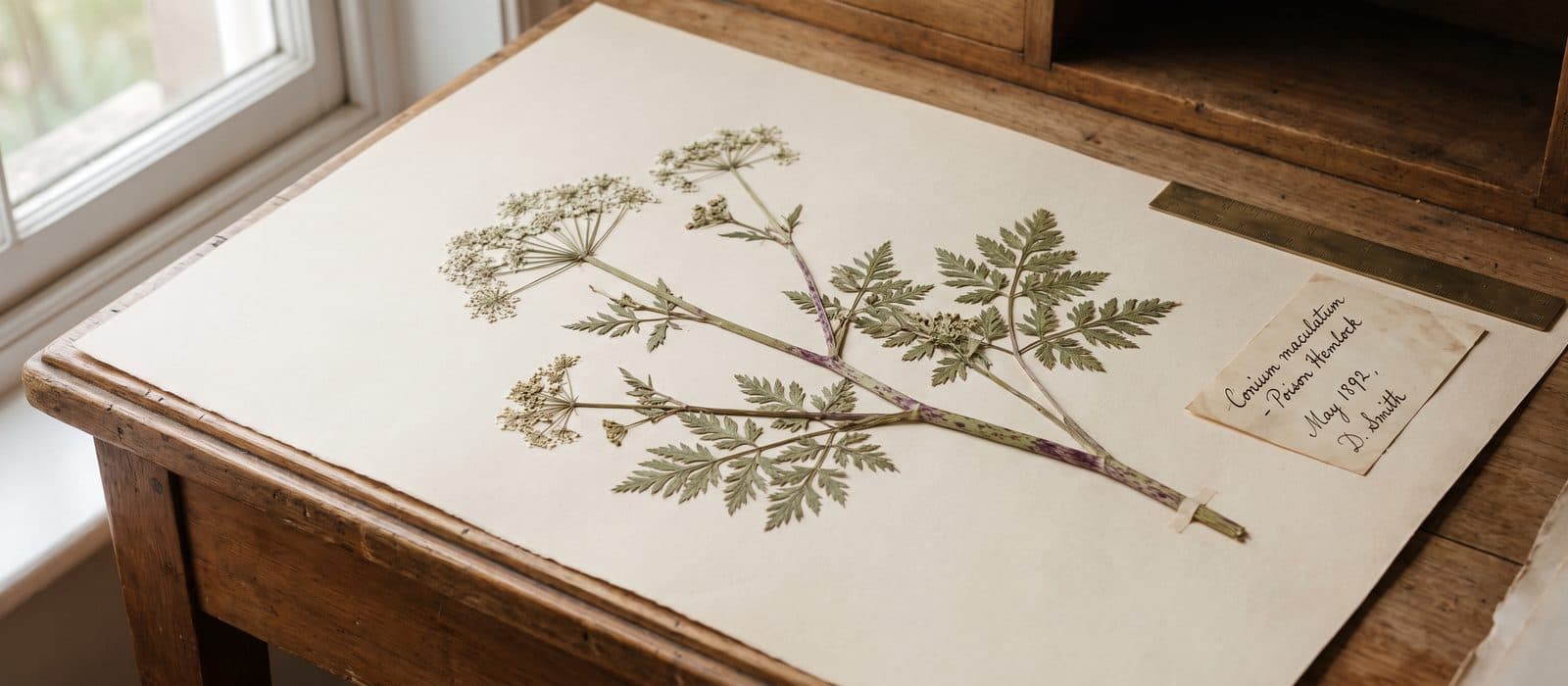
Homeopathic Conium is prepared from the fresh flowering plant of Conium maculatum, poison hemlock. It is a tall biennial of the carrot and parsley family (Apiaceae), reaching two metres or more, with finely divided fern-like leaves, umbrellas of small white flowers, and a smooth hollow stem marked with purple blotches, the maculatum, "spotted", of its name. Crushed, it gives off an unpleasant mousy smell. It grows on waste ground, roadsides and riverbanks across Europe and has spread to North America and elsewhere.
The name on the label is honest about the source. Every part of hemlock contains coniine and related alkaloids, which paralyse the nerves to the muscles. The most famous account of hemlock poisoning is Plato's description of the death of Socrates in 399 BC: heaviness in the legs, numbness creeping upwards from the feet, and death as the paralysis reaches the chest. Hemlock is still a cause of accidental poisoning today, because it is easily mistaken for wild parsley, cow parsley or wild carrot. It is never something to pick, eat or prepare at home.
In the 1760s the Viennese physician Anton von Störck published experiments with hemlock extract on himself and his patients, and Hahnemann later proved it and recorded it in The Chronic Diseases (1828–1830). The homeopathic preparation starts from a mother tincture of the fresh plant, then dilutes and succusses it step by step to the labelled potency. At the common potencies the arithmetic says no molecule of the plant remains. Our potencies guide explains that honestly, including why it is also the reason mainstream science is sceptical, and the guide to reading Latin remedy names explains why a poison appears on a label at all.
The poisoning picture and the homeopathic picture are close mirrors: ascending heaviness and weakness, slowness, and giddiness. That overlap is the idea behind a proving.
What is the Conium picture?
The Conium picture is a slowing down. Imagine someone who lies down in bed at night and, as the head meets the pillow, the room starts to turn. They roll onto their side and it spins again. Lying perfectly still, it settles. In the morning, sitting up brings a brief swirl, and turning the head quickly to look over a shoulder does the same. They feel heavy and slow, their thoughts sluggish, and less interested in things than usual.
Classic texts build the picture from these features. Boericke (1927) describes an ascending paralysis echoing the hemlock poisoning, with trembling weakness, a dull, slow mind, and vertigo when lying down and turning over in bed, when turning the head or moving the eyes. Kent's Lectures (1905) describe the slowness spreading through body and mind alike, and Boericke records a person averse to company who yet dreads being alone. A curious keynote in the texts is sweating as soon as the eyes are closed for sleep.
Hardening is the other half of the picture. The materia medica describes glands that become hard, heavy and tender after a bruise or without one, and breasts that are enlarged, hard and painful before a period, worse from every step and every jar, so that the person holds them while walking down stairs. Classic texts also linked Conium with older people, with a slowed, stiffened body and a mind to match.
What makes it better or worse?
The traditional modalities centre on position, jarring and the period. Conium is worse lying down, turning in bed and before a period, and better from keeping still, letting the limbs hang down and in the dark.
| Modality | Worse | Better |
|---|---|---|
| Position | Lying down, turning over in bed, turning the head, rising | Keeping perfectly still; letting the limbs hang down |
| Motion | Jarring, walking, going down stairs (breasts) | Gentle motion for the limbs (Boericke) |
| Cycle | Before and during a period | No consistent keynote |
| Senses | Bright light | In the dark |
| Other | Exertion, cold | Pressure on the sore part |
Our guide to modalities, better and worse explains why a homeopath asks about these before any remedy name.
What is Conium traditionally discussed for?
In homeopathic literature, Conium is traditionally discussed for positional vertigo and for hard, heavy, tender glands. Each of these appears on one of our acute pages, where the Conium-like pattern sits beside its neighbours and the red flags come first.
Vertigo
- The older literature's positional picture, spinning set off by turning the head, lying down or rolling over in bed, quieting when perfectly still: a spinning vertigo episode. That page sets out the neurological red flags before any pattern.
Breasts
- Hard, heavy, bruised sensations with a glandular stiffness before a period: cyclical breast tenderness. Tenderness that follows the cycle is common; a lump, or tenderness that does not follow the cycle, is a different question and needs a doctor.
What is Conium not?
Conium is not a remedy for lumps, and this is the most important limit on the page. The classic texts discussed it for hard, indurated glands and for tumours, because hardness is part of the picture, and some remedy lists still repeat that. A new lump in the breast or anywhere else, skin dimpling or puckering, a change in the nipple, nipple discharge, swelling in the armpit, or a lump that stays after a period needs prompt medical assessment, and no remedy picture is a reason to wait for it. Homeopathy, where people use it, sits alongside conventional care, never in place of a diagnosis.
It is also not "the vertigo remedy". Positional vertigo is common and often has a clear cause that a doctor can identify and address directly. Vertigo with a sudden severe headache, double vision, slurred speech, facial droop, weakness or numbness on one side, difficulty walking, hearing loss, or after a head injury is an emergency. Our guide to red flags first sets these out.
Homeopaths separate Conium from its neighbours like this:
| Picture | Where it sits | Defining feature | Key modality |
|---|---|---|---|
| Conium | Slow, heavy, hardened | Positional vertigo; hard, heavy, sore glands; ascending weakness | Worse lying down and turning in bed; better keeping still |
| Cocculus | Vertigo with exhaustion | Hollow, slowed, sleep-deprived; nausea at the smell of food | Worse riding and lost sleep |
| Bryonia | Pain on any movement | Hard, hot, heavy breasts; irritable, thirsty | Worse least motion; better firm pressure |
| Lac caninum | Breast tenderness that alternates | Pain shifting from one side to the other | Worse jar and touch; better cold |
| Pulsatilla | Changeable, weepy states | Mild, wants company and fresh air; symptoms shift | Better open air; worse warm rooms |
Conium and Cocculus sit side by side on vertigo pages. The traditional distinction is the trigger: Cocculus spins with travel and exhaustion, while Conium spins with a change of position, even lying in bed.
What potencies is Conium sold in?
Homeopathic Conium is sold most often as 30C pellets, the common shelf potency for single remedies, with 6C and 200C also available. Potency describes the preparation process, not an amount of plant: 30C means thirty successive 1:100 dilutions with succussion between them. Our potencies guide explains the scale, what remains in the vial, and why low-potency products of toxic sources carry their own labelling.
This page deliberately gives no frequency or instructions for taking Conium. That depends on a whole case, not a remedy name. Read the product label, and talk to a qualified practitioner about an individual situation.
What remedy lists don't tell you
Two things the "remedies for dizziness" lists leave out:
- The trigger is the tell. Lists describe Conium as vertigo, which describes a large share of people over fifty at some point. What the classic authors found characteristic was the specific trigger, lying down or turning over in bed, together with the slowness, heaviness and indifference of the whole person. Without that, the tradition reads the case as something else.
- A picture built on hardness needs the clearest limits. Conium's place in the older literature came partly from glands and tumours, at a time when there was little else to offer. Today a hard lump is first a question for imaging and a clinician. A homeopath reading a case that involves a lump asks about diagnosis before anything else, and only then thinks about the picture.
Where the Conium maculatum picture appears on this site
Acute pages that discuss this picture among their educational patterns, with the pattern name each page uses.
- What homeopathic remedy for a spinning vertigo episode?Conium-like position-triggered vertigo pattern
- What homeopathic remedy for cyclical breast tenderness?Conium-like hard, heavy tenderness pattern
Not sure whether a picture fits?
A remedy profile describes a picture; it cannot tell you whether that picture matches what you are seeing. An acute consultation starts from the case itself: onset, sensations, what changes it, and the red flags.
Acute consultation · $45Frequently asked questions
- What is Conium maculatum?
- Conium maculatum is a homeopathic remedy prepared from poison hemlock, the plant used to execute Socrates. In homeopathy it names a traditional picture: slowness and heaviness, a weakness that seems to creep upwards, vertigo set off by turning the head or rolling over in bed, and glands that feel hard, heavy and bruised. It is a description homeopaths use to compare cases, not evidence that it works for any condition.
- What is Conium used for in homeopathy?
- Homeopathic literature traditionally discusses Conium for positional vertigo, spinning set off by lying down, turning the head or rolling over in bed, and for hard, heavy, tender glands, including breast tenderness before a period. The picture is defined by that slowness, heaviness and positional quality, not by the name of a complaint. Any new breast lump, and any vertigo with a severe headache, double vision, slurred speech or weakness, needs medical care first.
- What is Conium 30C used for?
- 30C is a common shelf potency for Conium, and the one most single-remedy tubes carry. In the tradition the potency does not change the picture: Conium 30C belongs to the same slow, heavy, positional description as any other potency. Our potencies guide explains what 30C means as a dilution.
- How is Conium taken?
- This page does not give instructions on how or how often to take any remedy, because that depends on a whole case rather than on a remedy name. The product label carries the manufacturer's directions, and a qualified practitioner can advise on an individual situation. A breast lump or new vertigo belongs with a doctor first.
- Where can I buy Conium?
- Pharmacies, health-food shops and homeopathic manufacturers sell homeopathic Conium as single-remedy pellets, most often in 30C. This site also prepares custom single remedies to order: you name the remedy and potency, and the details are confirmed by email before anything is made. The order form does not give advice on which remedy to choose.
- What is Conium made from?
- Homeopathic Conium is prepared from the fresh flowering plant of Conium maculatum, poison hemlock, steeped into a mother tincture and then diluted and succussed step by step to the labelled potency. Raw hemlock contains coniine and related alkaloids and is deadly; it is easily mistaken for wild parsley or cow parsley, and it should never be picked, eaten or handled carelessly.
This guide is educational only and is not medical advice or a personalized remedy recommendation. Acute symptoms can become urgent; when in doubt, seek professional evaluation.