Remedy profile
Pulsatilla in Homeopathy: Uses, Picture and Limits
What homeopathic Pulsatilla is made from, the gentle, weepy, changeable picture homeopaths describe, what changes it, the potencies sold, and its limits.
By Homeopathic BenefitsPublished 7 min read
Key takeaways
- The mood leads the picture. Homeopathic literature describes a gentle, tearful person who wants company and is comforted by it, the opposite of the patient who wants to be left alone.
- Changeability is itself a symptom. Pains wander, moods shift, and no two hours look quite the same; the old texts call the picture as changeable as the wind flower it comes from.
- Open air is the defining modality. Worse in a warm, stuffy room and better outdoors or by an open window, often with surprisingly little thirst.
- Discharges are thick, yellow-green and bland. Mucus from the nose, eyes or ears that does not burn the skin is a classic Pulsatilla keynote.
- Red flags come before the picture. Ear pain with high fever, eye pain with changed vision, or a child who is listless and hard to rouse is a medical question first.
The short answer
Pulsatilla is a homeopathic remedy prepared from the pasque flower, a purple, silky-haired spring anemone of dry European grasslands. In homeopathy it names a traditional picture rather than a treatment: a gentle, weepy person who wants comfort and company, whose symptoms keep changing, who has little thirst, and who feels worse in a warm stuffy room and better in cool open air. Classic materia medica pairs that mood with thick, yellow-green, bland discharges and with heaviness after rich, fatty food. Samuel Hahnemann included it among his first provings in 1805, and it became one of the most often described pictures in children's and family homeopathy. It is not a remedy for colds, eyes or digestion as categories, and nothing about the picture replaces medical care for a child or adult who is getting worse.
| Latin name | Pulsatilla |
|---|---|
| Abbreviation | Puls. |
| Common name | Pasque flower, meadow anemone, wind flower |
| Source | Whole fresh flowering plant of the small pasque flower, Pulsatilla pratensis (syn. P. nigricans, Anemone pratensis), Ranunculaceae (plant kingdom) |
| Commonly sold potencies | 6C, 30C, 200C |
| First proving | Hahnemann, Fragmenta de viribus medicamentorum (1805); expanded in Materia Medica Pura (1811–1821) |
What is Pulsatilla made from?
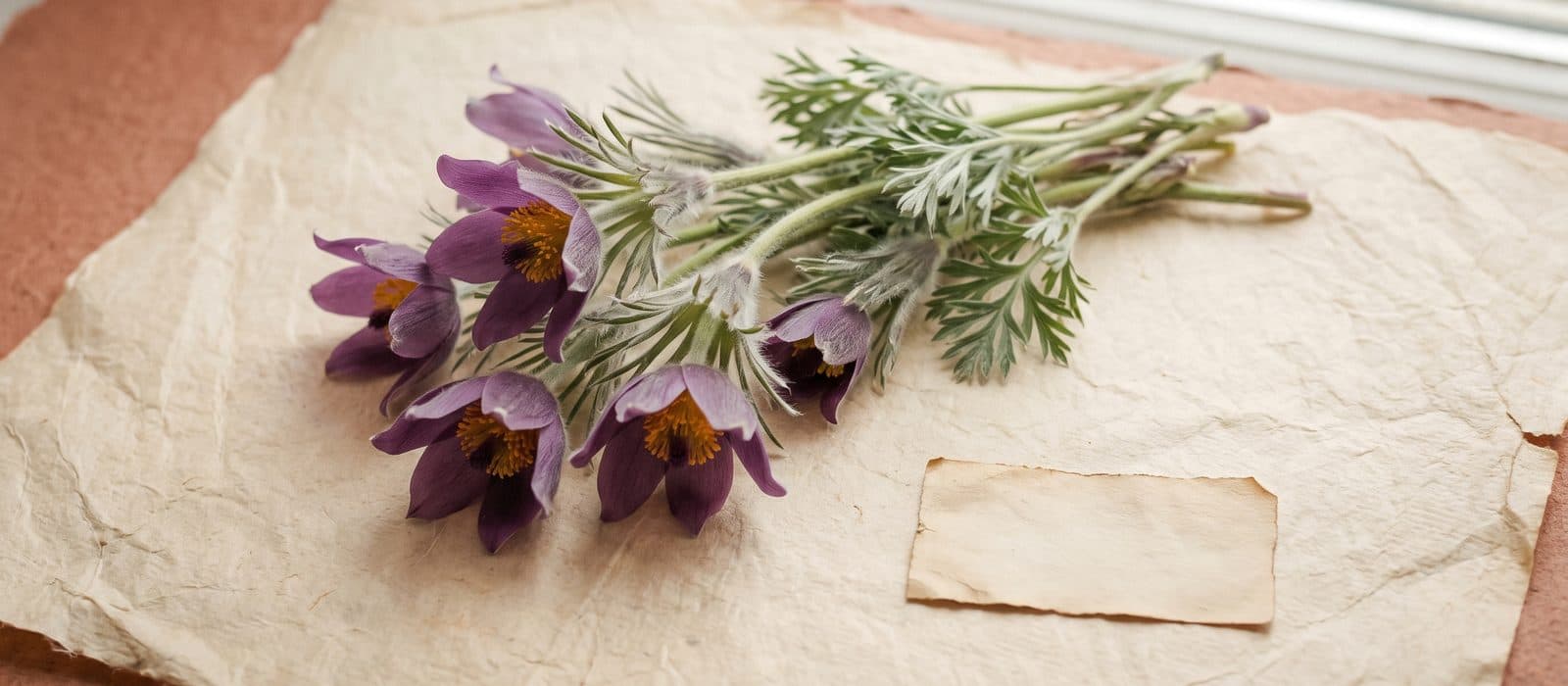
Homeopathic Pulsatilla is prepared from the whole fresh flowering plant of the small pasque flower, Pulsatilla pratensis, listed in older texts as Pulsatilla nigricans or Anemone pratensis. It is a low perennial of the buttercup family (Ranunculaceae) that flowers around Easter, hence pasque, on dry, chalky grassland in central and northern Europe. The nodding, bell-shaped flowers are dark purple, and the stems and feathery leaves are covered in fine silver hairs that catch the light. The Latin name comes from pulsare, to beat or shake, after the way the flowers move in the wind.
The fresh plant is steeped in alcohol to make a mother tincture, then diluted and succussed step by step to the potency on the label. Our potencies guide explains what that process leaves in the vial and why mainstream science is sceptical of the method.
Like many buttercups, the fresh pasque flower is an irritant. Bruising the plant releases protoanemonin, which can redden and blister skin and upset the gut if swallowed; drying the plant largely breaks it down. That is one reason the herb is not a garden snack and why wild pasque flowers, protected in several countries, are better left where they grow.
What is the Pulsatilla picture?
The Pulsatilla picture is a person who wants to be held. A child with a cold climbs into a lap and stays there, weeps easily, and brightens as soon as someone sits with them. An adult with a heavy stomach after a rich dinner feels sorry for themselves and says so, and feels better for being listened to. The tears are soft rather than angry, and consolation helps, which is exactly the opposite of pictures where sympathy makes things worse.
The second thread is changeability. Boericke (1927) describes symptoms that are ever changing, pains that wander from joint to joint, and a mood that shifts from tears to smiles. No two chills look alike; the discharge is thick in the morning and different by evening. Homeopaths read that inconstancy as a characteristic in its own right, not as noise.
The physical picture follows the same logic. The person is chilly yet cannot bear a hot, closed room, and wants the window open and a walk in cool air. Thirst is low even with a fever. Discharges are thick, yellow or yellow-green, and bland, not burning the skin they touch: in the nose, in a productive cough, around the eyes, from the ears. Digestion is upset by rich, fatty food, pork and pastry, with a slow, heavy, repeating fullness rather than sharp pain.
What makes it better or worse?
The traditional modalities centre on air, warmth and company. Pulsatilla is worse in a warm, stuffy room and after rich food, and better in cool open air and with consolation.
| Modality | Worse | Better |
|---|---|---|
| Air and temperature | Warm, stuffy rooms; heat; warm applications | Cool open air, an open window, cold applications |
| Motion | Lying still in a warm bed; beginning to move | Gentle, slow motion outdoors |
| Food | Rich, fatty food, pork, pastry, ice cream | No consistent keynote |
| Time | Evening and twilight | No consistent keynote |
| Company | Being alone | Consolation, sympathy, being held |
The thirstless fever and the open-window preference are exactly the kind of detail our guide to modalities, better and worse explains how to observe.
What is Pulsatilla traditionally discussed for?
In homeopathic literature, Pulsatilla is traditionally discussed for acute states that carry its mood and modalities, across several body systems. Each of these appears on one of our acute pages, where the Pulsatilla-like pattern sits beside its neighbours and the red flags come first.
Colds, sinuses and coughs
- A nose that blocks in a warm bedroom and clears outdoors: nighttime nasal congestion.
- The milder, weepy, open-air version of a cold in the face: sinus pressure during a cold and a sinus pressure headache.
- Thick, bland mucus and a changeable cough: a wet, productive cough and a cough from postnasal drip.
Ears
- The gentle, weepy child with ear pain during a mild illness: an earache during a mild illness.
- Thick discharge after water in the ear: swimmer's ear irritation.
Eyes
- Thick discharge with a weepy mood: pink, irritated eyes and gritty allergy eyes.
- Lid bumps that keep returning: a stye on the eyelid.
Digestion
- Slow, heavy fullness after rich food: nausea after rich food and heartburn after a large meal.
Children, cycles and skin
- The clingy, tearful toddler: a fussy teething day. Our guide to observing a sick child covers what to watch.
- Weepy, tender days in the cycle: cyclical breast tenderness.
- Chilblains that are worse from heat: painful, itchy toes after cold.
What is Pulsatilla not?
Pulsatilla is not a "women's remedy" or a "children's remedy", though it is often filed as both. The old texts described it most often in women and children, and lists have turned that observation into a category. The picture is the mood, the changeability, the open-air modality and the bland discharges, in anyone. It is also not a reason to wait on an ear that is very painful with a high fever, an eye with pain or changed vision, or a child who is unusually drowsy, floppy or hard to rouse.
Homeopaths separate Pulsatilla from its neighbours like this:
| Picture | Where it sits | Defining feature | Key modality |
|---|---|---|---|
| Pulsatilla | Gentle, weepy, changeable states | Wants consolation; thick bland discharge; little thirst | Worse warm room; better open air |
| Natrum muriaticum | Grief and reserve | Weeps alone; consolation makes it worse | Worse sympathy; worse sun and heat |
| Chamomilla | Pain that seems unbearable, often in children | Angry and demanding rather than tearful | Better being carried; worse at night |
| Kali bichromicum | Sinuses and stubborn mucus | Thick, stringy, ropy mucus; pain in small spots | Worse cold, damp; better warmth |
| Nux vomica | After rich food, alcohol or overwork | Irritable, impatient, chilly | Worse early morning; wants to be left alone |
What potencies is Pulsatilla sold in?
Pulsatilla is sold most often as 30C pellets, the common shelf potency for single remedies, with 6C and 200C also widely available. Potency describes the preparation process, not an amount of plant: 30C means thirty successive 1:100 dilutions with succussion between them. Our potencies guide explains the scale and what remains in the vial.
This page deliberately gives no frequency or instructions for taking Pulsatilla. That depends on a whole case, not a remedy name. Read the product label, and talk to a qualified practitioner about an individual situation, especially for a child.
What remedy lists don't tell you
Two things the symptom lists leave out:
- The question that decides it is about comfort, not mucus. Many colds produce thick yellow discharge. What homeopaths look for first is whether the sick person wants company and is soothed by it, and whether they feel better with the window open. A tearful, clingy child who perks up outdoors is a different case from a tearful child who pushes everyone away, even with the same nose.
- Thirstlessness is easy to miss and unusually telling. Most people with a fever are thirsty. A feverish person who barely drinks and has to be reminded is the kind of odd, specific detail that the tradition weights heavily, and the kind of thing worth writing down before anyone names a remedy. Our guide to the symptoms alongside the symptom explains why.
Where the Pulsatilla picture appears on this site
Acute pages that discuss this picture among their educational patterns, with the pattern name each page uses.
- What homeopathic remedy for a cough from postnasal drip?Pulsatilla-like bland discharge pattern
- What homeopathic remedy for a fussy teething day in a toddler?Pulsatilla-like clingy weepy pattern
- What homeopathic remedy for a sinus pressure headache?Pulsatilla-like open-air-relieved face pressure pattern
- What homeopathic remedy for a stye on the eyelid?Pulsatilla-like recurring lid-bump pattern
- What homeopathic remedy for a wet, productive cough?Pulsatilla-like changeable, bland discharge pattern
- What homeopathic remedy for an earache during an otherwise mild illness?Pulsatilla-like gentle, weepy, changeable pattern
- What homeopathic remedy for cyclical breast tenderness?Pulsatilla-like weepy cyclical tenderness pattern
- What homeopathic remedy for gritty, irritated eyes from allergies?Pulsatilla-like weepy thick-discharge pattern
- What homeopathic remedy for heartburn after a large meal?Pulsatilla-like rich-food heaviness pattern
- What homeopathic remedy for nausea after rich food?Pulsatilla-like rich-food nausea pattern
- What homeopathic remedy for nighttime nasal congestion?Pulsatilla-like warm-room blockage pattern
- What homeopathic remedy for painful, itchy toes after cold exposure?Pulsatilla-like heat-intolerant chilblain pattern
- What homeopathic remedy for pink, irritated eyes with discharge?Pulsatilla-like thick discharge, weepy pattern
- What homeopathic remedy for sinus pressure during a cold?Pulsatilla-like milder, weepy, open-air pattern
- What homeopathic remedy for swimmer’s ear irritation?Pulsatilla-like thick discharge ear pattern
Not sure whether a picture fits?
A remedy profile describes a picture; it cannot tell you whether that picture matches what you are seeing. An acute consultation starts from the case itself: onset, sensations, what changes it, and the red flags.
Acute consultation · $45Frequently asked questions
- What is Pulsatilla?
- Pulsatilla is a homeopathic remedy prepared from the pasque flower, a silky-haired, purple spring anemone of European grasslands. In homeopathy it names a traditional picture: a gentle, weepy person who wants comfort and company, with symptoms that keep changing, thick bland discharges, little thirst, and a strong preference for cool open air. It is a description homeopaths use to compare cases, not evidence that it works for any condition.
- What is Pulsatilla used for in homeopathy?
- Homeopathic literature traditionally discusses Pulsatilla for acute states with a recognisable mood and modality: tearful, clingy and consolable, worse in a warm stuffy room, better outdoors, often with thick yellow-green bland discharges or heaviness after rich food. The picture is defined by that combination rather than by a complaint's name. Ear pain with high fever, eye pain with changed vision, or a child who is listless and hard to rouse needs medical care first.
- What is Pulsatilla 30C used for?
- 30C is the common shelf potency for Pulsatilla, the one most single-remedy tubes and home kits carry. In the tradition, the potency does not change the picture the remedy belongs to; Pulsatilla 30C is discussed for the same gentle, changeable, open-air picture as any other potency. Our potencies guide explains what 30C means as a dilution.
- How is Pulsatilla taken?
- This page does not give instructions on how or how often to take any remedy, because that depends on a whole case rather than on a remedy name. The product label carries the manufacturer's directions, and a qualified practitioner can advise on an individual situation, particularly for children. Symptoms that are severe or getting worse need medical care first.
- Where can I buy Pulsatilla?
- Pharmacies, health-food shops and homeopathic manufacturers sell Pulsatilla as single-remedy pellets, most often in 30C, and it is a standard item in family home kits. This site also prepares custom single remedies to order: you name the remedy and potency, and the details are confirmed by email before anything is made. The order form does not give advice on which remedy to choose.
- What is Pulsatilla made from?
- Homeopathic Pulsatilla is prepared from the whole fresh flowering plant of the small pasque flower, Pulsatilla pratensis, a member of the buttercup family that blooms around Easter on dry European grasslands. The plant is steeped to make a mother tincture, then diluted and succussed to the labelled potency. The fresh plant is a skin and gut irritant, like many buttercups, so the raw herb is not something to handle carelessly or eat.
This guide is educational only and is not medical advice or a personalized remedy recommendation. Acute symptoms can become urgent; when in doubt, seek professional evaluation.