Remedy profile
Chamomilla in Homeopathy: Uses, Picture and Limits
What homeopathic Chamomilla is made from, the angry, inconsolable, pain-intolerant picture homeopaths describe, what changes it, potencies sold, and its limits.
By Homeopathic BenefitsPublished 8 min read
Key takeaways
- Chamomilla is the picture of pain that cannot be borne. The person, classically a teething child, is beside themselves with it, and the reaction looks out of all proportion to the cause.
- Anger defines it more than the pain does. Classic texts describe a child who screams, hits out, asks for something and then throws it away, and is quiet only while being carried.
- One red cheek and one pale cheek is the famous keynote. Homeopaths also note hot sweat on the head, and a worse time in the evening and at night.
- It comes from German chamomile, the tea plant. The homeopathic picture is the opposite of the tea's reputation for calm, which is the like-for-like idea behind the proving.
- Babies and ears have red flags first. Any fever in a baby under three months, a floppy or hard-to-wake child, or an earache with discharge, swelling behind the ear or a stiff neck needs medical care before any pattern discussion.
The short answer
Chamomilla is a homeopathic remedy prepared from German chamomile, Matricaria chamomilla, the daisy-like herb dried for chamomile tea. In homeopathy it names a traditional picture rather than a treatment: pain that feels unbearable, in a person who is angry, impatient and impossible to console. Classic materia medica describes the teething or earachy child who screams, wants to be carried and rocked, demands a toy and then flings it away, with one cheek flushed red and the other pale. Hahnemann documented it among his first remedies, in 1805, and it has been a fixture of family and children's homeopathy ever since. It is not a teething remedy as such, and nothing about the picture replaces medical care for a child with a high temperature, an ear discharge, or any sign of being seriously unwell.
| Latin name | Chamomilla |
|---|---|
| Abbreviation | Cham. |
| Common name | German chamomile |
| Source | Whole fresh flowering plant of German chamomile, Matricaria chamomilla (Asteraceae) (plant kingdom) |
| Commonly sold potencies | 6C, 30C, 200C |
| First proving | Hahnemann, Fragmenta de viribus medicamentorum (1805); expanded in Materia Medica Pura (1811–1821) |
What is Chamomilla made from?
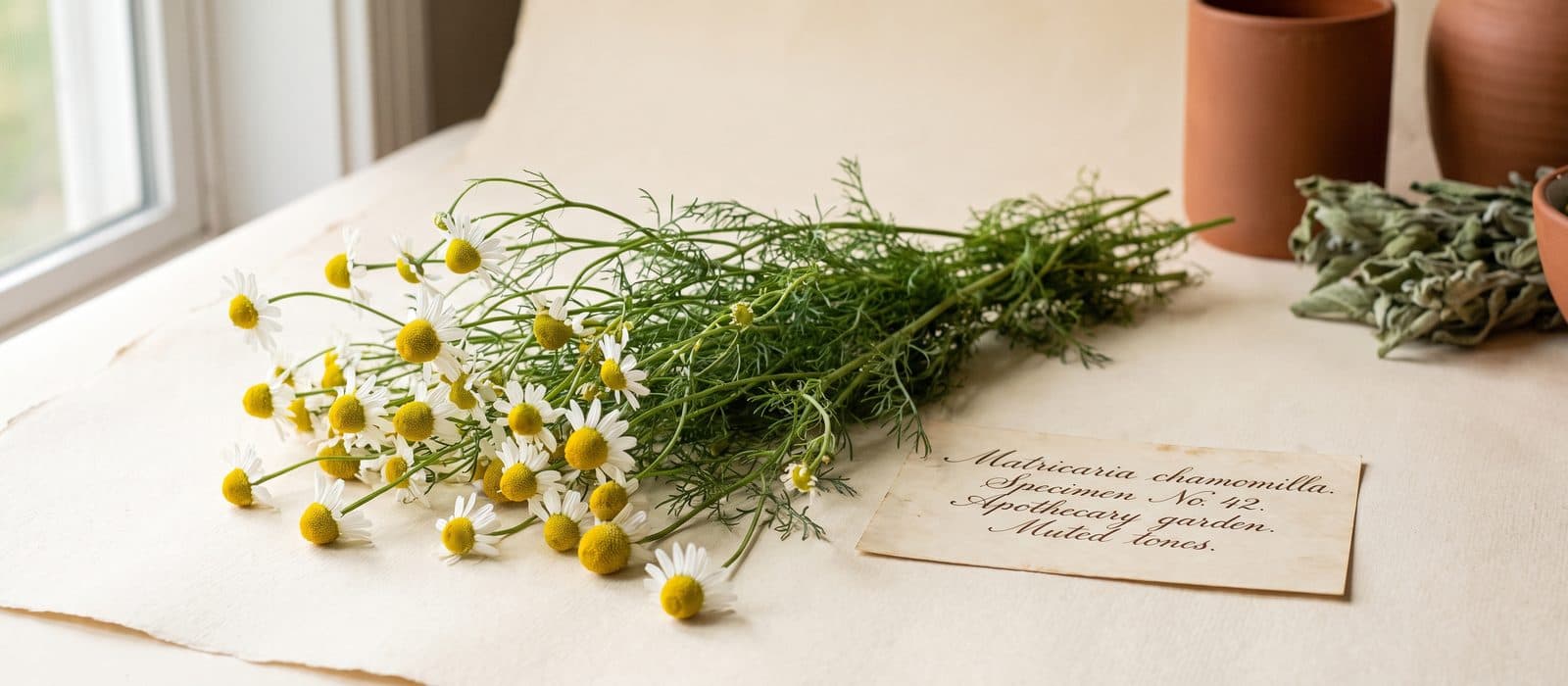
Homeopathic Chamomilla is prepared from the whole fresh plant of German chamomile, Matricaria chamomilla (also catalogued as Matricaria recutita), gathered when it is in flower. It is an annual of the daisy family (Asteraceae) that grows on field margins, waste ground and roadsides across Europe and western Asia, with feathery leaves and small white-rayed flowers around a hollow, cone-shaped yellow centre. The hollow centre is the easy way to tell it from Roman chamomile and from the scentless mayweed that grows beside it.
The plant itself is gentle by herbal standards. It is not poisonous, although people allergic to ragweed and other members of the daisy family can react to the herb, the tea or the cream. The homeopathic preparation starts from a mother tincture of the flowering plant and carries it through repeated dilution and succussion to the potency on the label. At the common potencies the arithmetic says no molecule of the plant remains; our potencies guide explains what that means, and why it is also the reason mainstream science is sceptical.
The name on the label is the old pharmacy name for the plant. Our guide to reading Latin remedy names explains why the labels keep those names, and why "Chamomilla" on a tube of pellets and "chamomile" on a box of tea are not the same product.
What is the Chamomilla picture?
The Chamomilla picture is a person who has run out of patience with pain. Picture a toddler at nine in the evening, cutting a back tooth. One cheek is hot and scarlet, the other pale. The child screams, arches, pushes away the cup they asked for, points at the toy on the shelf and hurls it the moment it is handed over. Put down, they rage; carried round the room, they quieten; stop walking, and it starts again. Nothing pleases for long, and the parent is exhausted by midnight.
Classic texts describe the same temperament in adults, without the carrying. The person in pain is snappish, uncivil and cannot answer a question politely; the pain seems to them more than anyone could stand, and they say so. Kent's Lectures (1905) put that oversensitivity to pain as the heart of the remedy: the pain is accompanied by an anger and an intolerance that seem out of proportion to what is causing it. Boericke (1927) lists the mental state first, describing a person who is peevish, impatient and hard to please, and a child who is quieted only by being carried.
The body follows the temper. Heat and sweat gather on the head; the cheeks are unequal in colour. Toothache is worse from warm food and drink and at night in bed. Earache is described as stitching and maddening, driving the person frantic. In teething babies the old texts add loose, greenish stools, which they compared to chopped egg and spinach. Women's cramping pains, labour pains and the aftermath of anger or too much coffee all appear in the classic entries in the same key: intense, intolerable, and met with fury.
What makes it better or worse?
The traditional modalities centre on night, heat in the teeth, and movement of the whole person. Chamomilla is worse at night and from anger, and better from being carried or driven about.
| Modality | Worse | Better |
|---|---|---|
| Time | Evening and night, around 9 p.m. (Boericke) | No consistent keynote |
| Motion | Being put down; keeping still in bed | Being carried, rocked or driven about |
| Temperature | Warm food and drink (for toothache); heat of the bed; cold wind on the ear | Warm, wet weather (Boericke) |
| Emotion | Anger, being contradicted or looked at | Being left alone once settled |
| Stimulants | Coffee | None listed |
Our guide to modalities, better and worse explains why a homeopath gives these details as much weight as the complaint itself. For Chamomilla, the carrying and the night-time worsening often matter more than which tooth or which ear is involved.
What is Chamomilla traditionally discussed for?
In homeopathic literature, Chamomilla is traditionally discussed for painful states met with anger and intolerance. Each of these appears on one of our acute pages, where the Chamomilla-like pattern sits beside its neighbours and the red flags come first.
Teething
- The screaming, carried-about, one-red-cheek child: teething.
- The toddler who cannot be pleased all day: a fussy teething day. Our guide to observing a sick child covers what to watch for, because teething does not cause a high temperature.
Ears
- Sharp ear pain that seems unbearable during an ordinary cold: an earache during a mild illness.
- The same intolerance after time in the water: swimmer's ear irritation.
Teeth
- Dental pain made worse by warmth and met with irritability: a sudden toothache flare. Toothache still needs a dentist; the pattern describes the reaction, not the cause.
What is Chamomilla not?
Chamomilla is not "the teething remedy", and it is not a sedative. The commonest misreading is to equate the remedy with the tea: chamomile calms, so Chamomilla must soothe a fractious baby. The tradition's picture is the reverse. It is the angry, inconsolable, pain-intolerant state; a teething baby who is merely clingy, or quietly miserable, or sleepy, does not fit it. The second misreading is that teething explains a fever. It does not. A baby under three months with any fever, a child who is floppy, hard to wake, not feeding or producing fewer wet nappies, an earache with discharge, swelling or redness behind the ear, a stiff neck, or a toothache with facial swelling all need medical or dental care first. Our guide to red flags first sets these out.
Homeopaths separate Chamomilla from its neighbours like this:
| Picture | Where it sits | Defining feature | Key modality |
|---|---|---|---|
| Chamomilla | Teething, earache, toothache | Furious, inconsolable, pain feels unbearable; one red cheek | Worse at night; better being carried |
| Belladonna | Sudden, hot, throbbing states | Scarlet face, wide pupils, heat leads rather than anger | Worse jar, light and noise |
| Pulsatilla | Earache, catarrh, the clingy child | Weepy and wants comfort; easily consoled | Better open air; worse warm rooms |
| Coffea cruda | Toothache, sleeplessness | Overexcited and wakeful rather than angry | Toothache better ice-cold water |
| Calcarea phosphorica | Slow, drawn-out teething | Peevish and whiny rather than raging; slow development | Worse cold and damp |
Chamomilla and Pulsatilla are the two classic children's pictures that parents confuse. The traditional distinction is how the child responds to comfort: the Pulsatilla child melts into a cuddle and stops crying; the Chamomilla child pushes the cuddle away and wants to be walked instead.
What potencies is Chamomilla sold in?
Chamomilla is sold most often as 30C and 6C pellets, with 200C also available from specialist manufacturers. Potency describes the preparation process, not an amount of plant: 30C means thirty successive 1:100 dilutions with succussion between them. Our potencies guide explains the scale and what remains in the vial. Chamomilla is also an ingredient in many combination teething products, which are a separate category from the single remedy this page describes.
This page deliberately gives no frequency or instructions for taking Chamomilla. That depends on a whole case, not a remedy name. Read the product label, and talk to a qualified practitioner about an individual situation, especially for a baby.
What remedy lists don't tell you
Two things the "remedies for teething" lists leave out:
- The temperament is the picture; the tooth is incidental. Two babies can cut the same tooth on the same night. The one who screams, hits out and quietens only on the move fits the Chamomilla description; the one who wants to be held close and cries softly does not. Lists sorted by complaint keep the tooth and lose the temper, which is the half of the description the classic authors found characteristic.
- Teething products have a regulatory history worth knowing. In 2016 the US Food and Drug Administration warned parents against homeopathic teething tablets and gels, and in 2017 reported that some tablets contained inconsistent amounts of belladonna. Those were combination products, not single-remedy Chamomilla, but the episode is a reason to read every label, to know exactly what a product contains, and to keep any unwell baby in front of a clinician rather than a kit.
Where the Chamomilla picture appears on this site
Acute pages that discuss this picture among their educational patterns, with the pattern name each page uses.
- What homeopathic remedy for a fussy teething day in a toddler?Chamomilla-like unbearable irritability pattern
- What homeopathic remedy for a sudden toothache flare?Chamomilla-like unbearable dental pain pattern
- What homeopathic remedy for an earache during an otherwise mild illness?Chamomilla-like unbearable, irritable pattern
- What homeopathic remedy for swimmer’s ear irritation?Chamomilla-like unbearable ear pain pattern
- What homeopathic remedy for teething?Chamomilla-like irritability pattern
Not sure whether a picture fits?
A remedy profile describes a picture; it cannot tell you whether that picture matches what you are seeing. An acute consultation starts from the case itself: onset, sensations, what changes it, and the red flags.
Acute consultation · $45Frequently asked questions
- What is Chamomilla?
- Chamomilla is a homeopathic remedy prepared from German chamomile, Matricaria chamomilla, the same plant that is dried for chamomile tea. In homeopathy it names a traditional picture that is almost the opposite of the tea's calm: pain that feels unbearable, in a person, very often a teething or earachy child, who is furious, inconsolable and only quiet while being carried. It is a description homeopaths use to compare cases, not a finding that it works for teething or any other condition.
- What is Chamomilla used for in homeopathy?
- Homeopathic literature traditionally discusses Chamomilla for pain that drives a person to distraction: teething, earache and toothache are the classic settings, especially when the child screams, demands things and throws them away, and settles only while being carried. The picture is defined by that oversensitivity to pain and the anger, not by the complaint. A fever in a baby under three months, an earache with discharge or swelling behind the ear, or a child who is floppy or hard to wake needs medical care first.
- What is Chamomilla 30C used for?
- 30C is a common shelf potency of Chamomilla, carried in most single-remedy ranges and home kits, alongside 6C. In the tradition the potency does not change the picture; Chamomilla 30C is discussed for the same angry, pain-intolerant state as any other potency. What 30C means as a dilution is explained in our potencies guide.
- How is Chamomilla taken?
- This page does not give instructions on how or how often to take any remedy, because that depends on a whole case rather than on a remedy name. The product label carries the manufacturer's directions, and a qualified practitioner can advise on an individual situation. A baby or young child who is unwell, feverish or not feeding belongs with a doctor or nurse first.
- Where can I buy Chamomilla?
- Pharmacies, health-food shops and homeopathic manufacturers sell Chamomilla as single-remedy pellets, most often in 6C or 30C, and it appears in many home kits. This site also prepares custom single remedies to order: you name the remedy and potency, and the details are confirmed by email before anything is made. The order form does not give advice on which remedy to choose.
- What is Chamomilla made from?
- Homeopathic Chamomilla is prepared from the whole fresh flowering plant of German chamomile, Matricaria chamomilla, made into a mother tincture and then diluted and succussed step by step to the labelled potency. The plant is not poisonous, though people allergic to the daisy family can react to the herb itself. The potentised remedy and chamomile tea are different products with different purposes.
This guide is educational only and is not medical advice or a personalized remedy recommendation. Acute symptoms can become urgent; when in doubt, seek professional evaluation.