Remedy profile
Belladonna in Homeopathy: Uses, Picture and Limits
What homeopathic Belladonna is made from, the sudden hot, red, throbbing picture homeopaths describe, what changes it, the potencies sold, and its limits.
By Homeopathic BenefitsPublished 7 min read
Key takeaways
- Belladonna is the picture of sudden heat, redness and throbbing. A flushed hot face, wide glaring pupils, a pounding pulse and pain that comes and goes suddenly are its classic keynotes.
- Suddenness and intensity matter more than the complaint. The same picture is described for a throat, a head, a patch of skin or a fever; what unites them is how fast and how hot.
- The senses are on edge. Light, noise, touch and jarring are unbearable in the traditional picture.
- It comes from one of Europe's most poisonous plants. Deadly nightshade contains atropine and scopolamine; homeopathic potencies are diluted far past the point where the raw plant is a concern.
- Hot, sudden states carry the most red flags. High fever in a baby, a stiff neck, a non-fading rash, confusion or difficulty breathing needs urgent medical care.
The short answer
Belladonna is a homeopathic remedy prepared from deadly nightshade, Atropa belladonna, a poisonous plant of the potato family that grows wild in European woodland. In homeopathy it names a traditional picture rather than a treatment: a state that arrives suddenly and violently with heat, redness and throbbing. Classic materia medica describes a hot, flushed face, wide pupils and glaring eyes, a pounding head, dry burning skin, and senses so heightened that light, noise and the least jar are unbearable. Hahnemann documented it among his first remedies, in 1805, and it is in almost every home kit. It is not a fever remedy, and the hot, sudden states it describes are exactly the ones that most often need a doctor.
| Latin name | Belladonna |
|---|---|
| Abbreviation | Bell. |
| Common name | Deadly nightshade |
| Source | Whole fresh plant of Atropa belladonna at flowering (Solanaceae) (plant kingdom) |
| Commonly sold potencies | 6C, 30C, 200C |
| First proving | Hahnemann, Fragmenta de viribus medicamentorum (1805); expanded in Materia Medica Pura (1811–1821) |
What is Belladonna made from?
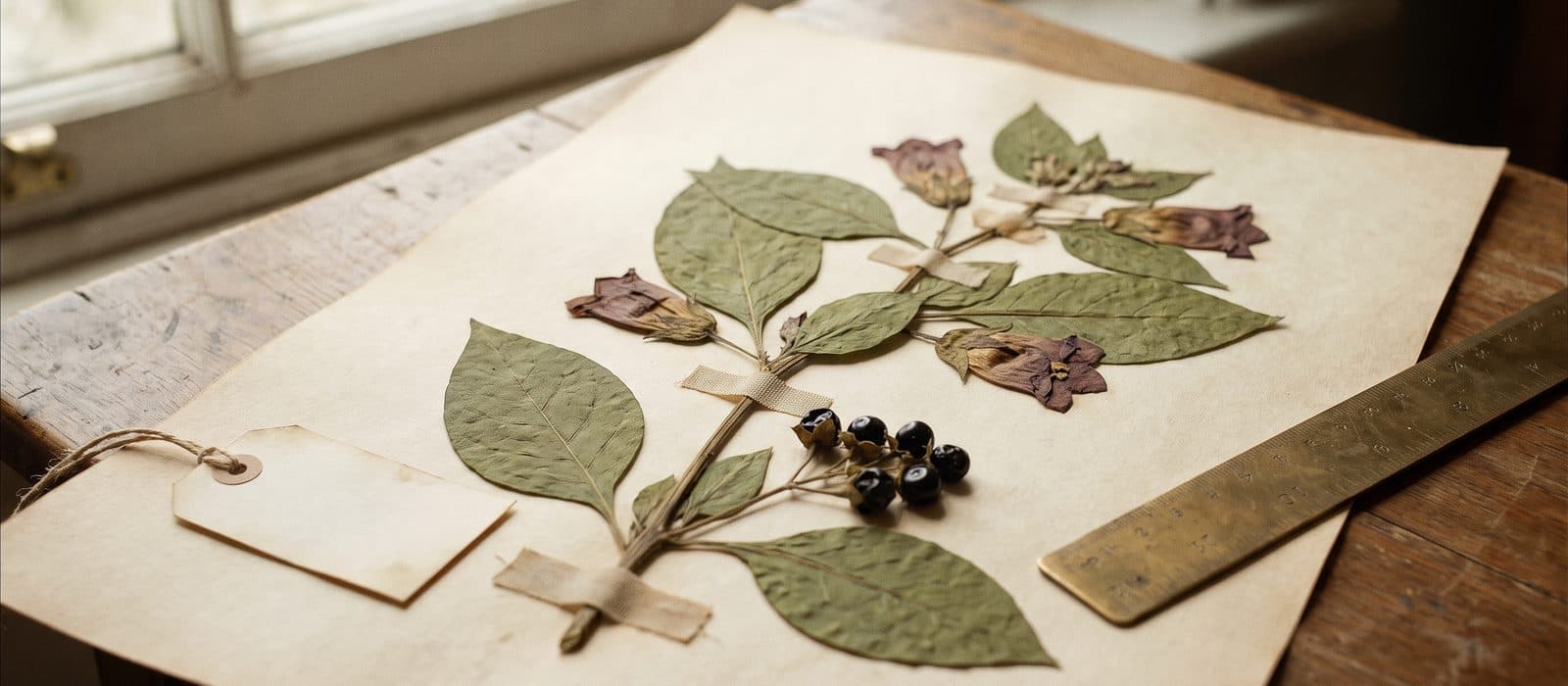
Homeopathic Belladonna is prepared from the whole fresh plant of Atropa belladonna, deadly nightshade, gathered when it begins to flower. It is a bushy perennial of the nightshade family (Solanaceae), the same family as potatoes and tomatoes, growing in shady woodland and on chalky ground across Europe and western Asia. It has dull purple-brown bell-shaped flowers and glossy black berries the size of a cherry.
It is one of the most poisonous plants in Europe. Every part contains atropine, scopolamine and hyoscyamine, which block parts of the nervous system; poisoning causes a hot, dry, flushed skin, dilated pupils, a racing heart, agitation and delirium, and can be fatal. The sweet-looking berries are especially dangerous to children. The name says it plainly: Atropa after Atropos, the Fate who cut the thread of life, and bella donna, "beautiful lady", after the Renaissance fashion of using the juice to widen the pupils. Our guide to reading Latin remedy names explains why names like this appear on labels at all.
The homeopathic preparation starts from a mother tincture of the plant, then dilutes and succusses it step by step to the labelled potency. At the common potencies the arithmetic says no molecule of the original plant remains. Our potencies guide explains that honestly, including why it is also the reason mainstream science is sceptical.
The poisoning picture and the homeopathic picture are close mirrors: heat, redness, dryness, wide pupils, throbbing and excitement. That overlap is the idea behind a homeopathic proving.
What is the Belladonna picture?
The Belladonna picture comes on like a switch being thrown. One hour the child is playing; the next the face is scarlet and burning, the pupils wide, the eyes glassy and staring, the head hot while the hands and feet may stay cool. Boericke (1927) sums it up in four words, "heat, redness, throbbing and burning", and adds that the pains "come and go suddenly".
Everything is intense. The pulse can be seen pounding in the neck. A headache throbs with each heartbeat and is worse from the least jar, a footstep on the stairs or a light switched on. A sore throat is bright red, dry and burning, often worse on the right side, with swallowing that feels like a spasm. Skin that is hot and red radiates heat you can feel with a hand held above it, and is dry rather than sweaty. The senses are heightened: light, noise and touch are all too much.
The mental side is vivid too. Classic texts describe excitement, restlessness, and in high fevers a dreamy or delirious quality, startling and jerking in sleep. The person, often a child in these descriptions, may be irritable and want the room dark and quiet. There is often little thirst despite the heat, or a wish for lemon or sour drinks.
What makes it better or worse?
The traditional modalities centre on the senses and on jarring. Belladonna is worse from touch, jar, light and noise, and better sitting semi-upright and kept still.
| Modality | Worse | Better |
|---|---|---|
| Senses | Light, noise, being touched | Dark, quiet room |
| Motion | Jarring, a footstep, being moved | Keeping still |
| Position | Lying down (Boericke) | Sitting semi-upright |
| Temperature | Draughts, uncovering the head; getting the head cold or wet | Warmth and being wrapped |
| Time and side | Afternoon, around 3 p.m.; right side more often than left | No consistent keynote |
Our guide to modalities, better and worse explains why a homeopath asks about these before anything else.
What is Belladonna traditionally discussed for?
In homeopathic literature, Belladonna is traditionally discussed for sudden, hot, red, throbbing states. Each of these appears on one of our acute pages, where the Belladonna-like pattern sits beside its neighbours and the red flags come first.
Throats
- The hot, bright-red, dry throat of the first hours: the first day of a sore throat and a sore throat from dry air.
Heads
- Violent, one-sided throbbing around the eye: sudden one-sided head pain around the eye. A new, severe or "worst ever" headache is a medical emergency; that page sets out the red flags.
Skin heat
- Skin that is hot, red and radiating: a mild sunburn.
- A hot, red, sudden local reaction: a sore arm after a vaccine.
Children
- The flushed, hot, intense child: teething. Teething is not a cause of a high temperature, so a fever in a teething child needs to be considered on its own; our guide to observing a sick child covers what to watch.
What is Belladonna not?
Belladonna is not "the fever remedy", and the commonest misreading is to reach for it because a temperature is high. The picture is the suddenness, the scarlet heat, the wide pupils and the throbbing; many fevers look nothing like it. More importantly, the sudden, hot, intense states the picture describes are exactly the states where a doctor matters most. A baby under three months with any fever, a child who is floppy, hard to wake or unusually drowsy, a rash that does not fade under a pressed glass, a stiff neck, or difficulty breathing needs urgent care, whatever a remedy picture might suggest. Our guide to red flags first sets these out.
Homeopaths separate Belladonna from its neighbours like this:
| Picture | Where it sits | Defining feature | Key modality |
|---|---|---|---|
| Belladonna | Sudden, intense heat | Scarlet hot face, wide pupils, throbbing, heightened senses | Worse jar, light and noise; better semi-upright |
| Aconite | Sudden onset after cold wind or fright | Fear and restlessness lead; skin hot and dry, great thirst | Worse at night; better open air |
| Ferrum phosphoricum | Early, milder feverish states | Flushed but less intense, without a strong stand-out symptom | Worse motion and at night; better cold applications |
| Apis mellifica | Puffy, stinging heat | Swollen, shiny, rosy-pink and stinging rather than throbbing; no thirst | Worse heat and touch; better cold applications |
| Stramonium | Terror and violent agitation | Fear of the dark and of being alone; visions; painless, jerky states | Worse dark and alone; better light and company |
Belladonna and Aconite are the two classic "sudden" pictures and are often confused. The traditional distinction is what leads: in Aconite, fear and restless anxiety come first; in Belladonna, the heat, redness and throbbing.
What potencies is Belladonna sold in?
Homeopathic Belladonna is sold most often as 30C pellets, the common shelf potency for single remedies, with 6C and 200C also widely available. Potency describes the preparation process, not an amount of plant: 30C means thirty successive 1:100 dilutions with succussion between them. Our potencies guide explains the scale and what remains in the vial, and why low-potency products of toxic sources carry their own labelling.
This page deliberately gives no frequency or instructions for taking Belladonna. That depends on a whole case, not a remedy name. Read the product label, and talk to a qualified practitioner about an individual situation.
What remedy lists don't tell you
Two things the "remedies for fever" lists leave out:
- The pupils and the speed are the tell. Lists describe Belladonna as fever and redness, which describes half of all childhood illness. What the classic authors found characteristic was how fast it arrived, the wide, glaring pupils, the throbbing that can be seen in the neck, and the radiating dry heat. Without that intensity, the tradition reads the case as something else.
- The hottest pictures need the clearest safety thinking. Belladonna's fame comes from the sudden, dramatic states that frighten parents, which is precisely why it sits in so many kits. But a picture that looks dramatic is also the one most likely to be something a clinician must see. A homeopath reading a hot, sudden case asks the red-flag questions first, and only then thinks about the picture.
Where the Belladonna picture appears on this site
Acute pages that discuss this picture among their educational patterns, with the pattern name each page uses.
- What homeopathic remedy for a mild sunburn?Belladonna-like sudden hot redness pattern
- What homeopathic remedy for a sore arm after a vaccine?Belladonna-like hot red sudden pattern
- What homeopathic remedy for a sore throat from dry air?Belladonna-like hot, red, throbbing pattern
- What homeopathic remedy for a sudden one-sided head pain around the eye?Belladonna-like violent one-sided throbbing pattern
- What homeopathic remedy for teething?Belladonna-like heat and intensity pattern
- What homeopathic remedy for the first day of a sore throat?Belladonna-like hot, red, throbbing pattern
Not sure whether a picture fits?
A remedy profile describes a picture; it cannot tell you whether that picture matches what you are seeing. An acute consultation starts from the case itself: onset, sensations, what changes it, and the red flags.
Acute consultation · $45Frequently asked questions
- What is Belladonna?
- Belladonna is a homeopathic remedy prepared from deadly nightshade, Atropa belladonna, one of the most poisonous plants in Europe. In homeopathy it names a traditional picture of sudden heat, redness and throbbing: a hot, flushed face, glaring wide pupils, pounding pain, and senses that cannot bear light, noise or jarring. It is a description homeopaths use to compare cases, not evidence that it works for fevers or anything else.
- What is Belladonna used for in homeopathy?
- Homeopathic literature traditionally discusses Belladonna for intense states that arrive suddenly with heat, redness and throbbing: the first hours of a burning sore throat, a pounding headache, a hot red patch of skin, or a flushed, feverish child. The picture is defined by suddenness and intensity, not by the name of the complaint. High fever in a baby, a stiff neck, a rash that does not fade, confusion or difficulty breathing needs urgent medical care.
- What is Belladonna 30C used for?
- 30C is the common shelf potency for Belladonna, the one most single-remedy tubes and home kits carry. In the tradition, the potency does not change the picture: Belladonna 30C belongs to the same hot, red, throbbing description as any other Belladonna. Our potencies guide explains what 30C means as a dilution.
- How is Belladonna taken?
- This page does not give instructions on how or how often to take any remedy, because that depends on a whole case rather than on a remedy name. The product label carries the manufacturer's directions, and a qualified practitioner can advise on an individual situation. A high fever, especially in a baby or young child, is a reason to contact a doctor first.
- Where can I buy Belladonna?
- Pharmacies, health-food shops and homeopathic manufacturers sell homeopathic Belladonna as single-remedy pellets, most often in 30C. This site also prepares custom single remedies to order: you name the remedy and potency, and the details are confirmed by email before anything is made. The order form does not give advice on which remedy to choose.
- What is Belladonna made from?
- Homeopathic Belladonna is prepared from the whole fresh plant of Atropa belladonna, deadly nightshade, gathered as it begins to flower, steeped into a mother tincture and then diluted and succussed step by step to the labelled potency. The raw plant contains atropine and scopolamine and is highly poisonous; its glossy black berries are especially dangerous to children. It should never be eaten, brewed or handled carelessly.
This guide is educational only and is not medical advice or a personalized remedy recommendation. Acute symptoms can become urgent; when in doubt, seek professional evaluation.