Remedy profile
Aconitum napellus in Homeopathy: Uses, Picture and Limits
What homeopathic Aconite is made from, the sudden, fearful, after-a-cold-wind picture homeopaths describe, what changes it, potencies sold, and its limits.
By Homeopathic BenefitsPublished 8 min read
Key takeaways
- Aconite is the picture of sudden onset. A state that arrives like a storm, within an hour or two, often after a dry, cold wind or a shock, and is at its height from the start.
- Fear leads the picture. Classic texts describe intense anxiety, restlessness and a conviction that something terrible is happening, with great thirst for cold water.
- Timing is the whole point. The tradition places it at the very beginning of a state; once a cold has settled in, the picture has usually moved on.
- It comes from monkshood, one of Europe's most poisonous plants. Potentised preparations are diluted far past the point where the raw plant is a concern.
- Fear with physical symptoms is a medical question first. Chest pain, breathlessness, a struggling child or a high fever in a baby needs urgent care, whatever the picture.
The short answer
Aconite is a homeopathic remedy prepared from monkshood, Aconitum napellus, a tall, blue-flowered and highly poisonous plant of European mountain meadows. In homeopathy it names a traditional picture rather than a treatment: a state that comes on suddenly and violently, often after exposure to a dry, cold wind or after a fright. Classic materia medica describes fear and restlessness out of proportion, a hot, dry skin, a strong thirst for cold water, and everything worse in the evening and around midnight. Hahnemann documented it in 1805, and it is in almost every home kit as the remedy name of first hours. It is not a general cold or anxiety remedy, and fear with chest pain or breathlessness always needs a doctor before a picture.
| Latin name | Aconitum napellus |
|---|---|
| Abbreviation | Acon. |
| Common name | Monkshood, wolfsbane |
| Source | Whole fresh plant of Aconitum napellus at flowering (Ranunculaceae) (plant kingdom) |
| Commonly sold potencies | 6C, 30C, 200C |
| First proving | Hahnemann, Fragmenta de viribus medicamentorum (1805); expanded in Materia Medica Pura (1811–1821) |
What is Aconite made from?
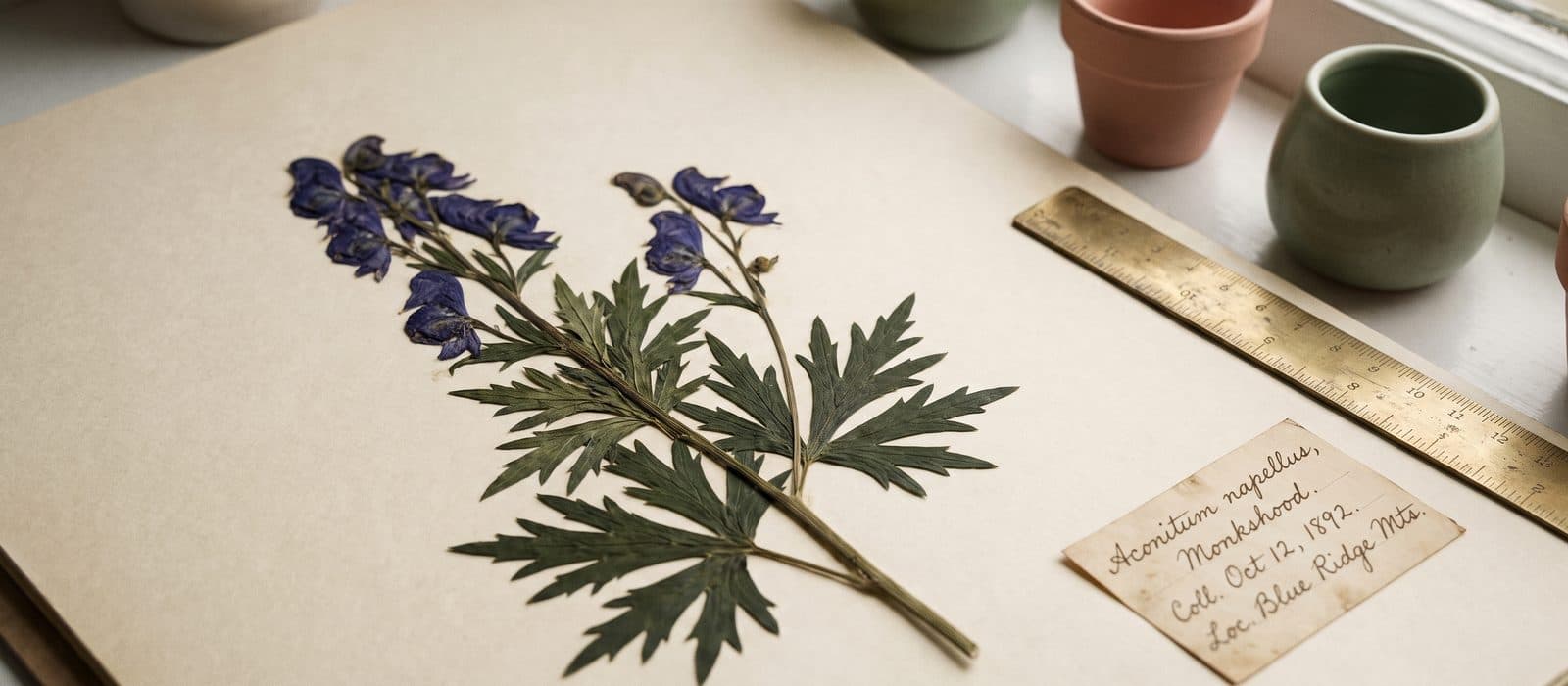
Homeopathic Aconite is prepared from the whole fresh plant of Aconitum napellus, monkshood, gathered when it begins to flower. It is a perennial of the buttercup family (Ranunculaceae), growing in damp mountain meadows and woodland edges across Europe and widely planted in gardens for its tall spikes of deep blue, hooded flowers. The hood, shaped like a monk's cowl or a helmet, gives the plant its English name; wolfsbane is the older one, from its use as a poison bait.
The name on the label is honest about the source. Every part of the plant contains aconitine and related alkaloids, which act on the heart and nerves. Poisoning causes tingling and numbness of the mouth and skin, vomiting, a dangerously irregular heartbeat and collapse, and it can be fatal in small amounts; even handling the root without gloves has caused symptoms. The raw plant is never something to eat, brew or prepare at home.
The homeopathic preparation starts from a mother tincture of the plant, then dilutes and succusses it step by step to the labelled potency. At the common potencies the arithmetic says no molecule of the original plant remains. Our potencies guide explains that honestly, including why it is also the reason mainstream science is sceptical, and the guide to reading Latin remedy names explains why a name like this appears on labels at all.
The poisoning picture and the homeopathic picture overlap: numbness and tingling, a pounding heart, and acute fear. That overlap is the idea behind a homeopathic proving.
What is the Aconite picture?
The Aconite picture is a storm that blows up out of a clear sky. A child goes to bed well after an afternoon in a bitter, dry east wind and wakes before midnight hot, dry-skinned, frightened and tossing, asking for cold water. An adult has a near miss in the car, gets home shaking, and cannot stop the pounding heart, the restlessness or the certainty that something terrible is about to happen. Kent's Lectures (1905) describe it as a state that comes on suddenly, rises fast and passes quickly, like a great storm.
Fear is the centre of it. Boericke (1927) puts fear, anxiety and anguish of mind and body first, and the classic texts describe a person who is convinced they are seriously ill, may fear dying, and cannot keep still. The restlessness is driven by fear rather than by pain. The senses are sharp; noise and music are hard to bear.
The body matches the speed. The skin is hot and dry, with no sweat; the pulse is full and fast; there is a great thirst for cold drinks. Classic descriptions include a face that is red lying down and turns pale on sitting up, and tingling or numbness in the fingers or face. Pains are described as intolerable and accompanied by the same fear. Most of all, Aconite belongs to the first hours. The texts are clear that once sweating breaks out or a cold settles into a slower, heavier state, the picture has changed.
What makes it better or worse?
The traditional modalities centre on time of day, warmth and cold wind. Aconite is worse in the evening and at night and in a warm room, and better in the open air.
| Modality | Worse | Better |
|---|---|---|
| Cause | Dry, cold wind; a chill; a sudden fright or shock | No consistent keynote |
| Time | Evening and night, especially around midnight | Daytime |
| Temperature | A warm, close room (despite the chill that started it) | Open air |
| Position | Lying on the affected side; rising from lying | Rest, once the fear settles |
| Senses | Noise, music, tobacco smoke, being touched | Quiet |
Our guide to modalities, better and worse explains why a homeopath reads these before any remedy name.
What is Aconite traditionally discussed for?
In homeopathic literature, Aconite is traditionally discussed for states that arrive suddenly, especially after cold wind or fright. Each of these appears on one of our acute pages, where the Aconite-like pattern sits beside its neighbours and the red flags come first.
Colds and chills
- The abrupt start after a cold, dry wind, with restlessness and a sense that it came on fast: the very beginning of a common cold. Our guide to first colds of the school year reads that first day in more detail.
Fright and shock
- Pounding fear and restlessness that follow a sudden fright: nightmares after a fright.
- The shocked, agitated state that can come with bad news: exhaustion after bad news, where the Aconite-like pattern sits beside slower, quieter grief pictures.
Older texts also discuss Aconite at the outset of feverish states in children and in croupy coughs that begin suddenly in the night after a cold, dry day. Those are exactly the situations where a doctor's view matters most, and our guide to observing a sick child sets out what to watch.
What is Aconite not?
Aconite is not "the remedy for the start of a cold", and it is not a calming remedy for panic. Most colds begin slowly, with a scratchy throat over a day or two; the tradition reserves Aconite for the cold that arrives within hours after a bitter wind, with fear and thirst. Anxiety without the suddenness, heat and restlessness reads as a different picture. More importantly, fear with a pounding heart, chest pain, breathlessness, numbness on one side, or fainting can be a heart attack, a stroke or another emergency, and must be checked before anyone calls it panic. A child struggling to breathe with a barking cough, a baby under three months with any fever, or a fever with a rash that does not fade needs urgent care. Our guide to red flags first sets these out.
Homeopaths separate it from its neighbours like this:
| Picture | Where it sits | Defining feature | Key modality |
|---|---|---|---|
| Aconite | Sudden onset after cold wind or fright | Fear and restlessness lead; hot, dry skin; great thirst | Worse evening, midnight and warm rooms; better open air |
| Belladonna | Sudden, intense heat | Heat, redness and throbbing lead; wide pupils; little thirst | Worse jar, light and noise |
| Ferrum phosphoricum | Early, milder feverish states | Flushed but calm, without a strong stand-out symptom | Worse motion and at night |
| Gelsemium | Slow onset, mild weather | Heavy, drowsy, trembling; thirstless; wants to be left alone | Worse anticipation; better passing urine |
| Arsenicum album | Anxious exhaustion | Anxious and restless but weak and chilly; sips of water | Worse after midnight; better warmth |
Aconite and Gelsemium make the clearest pair. Both can begin a cold; Aconite comes on in hours, frightened, hot and thirsty, while Gelsemium creeps in over days, heavy, dull and wanting no drink at all.
What potencies is Aconite sold in?
Aconite is sold most often as 30C pellets, the common shelf potency for single remedies, with 6C and 200C also widely available; labels usually read Aconitum napellus. Potency describes the preparation process, not an amount of plant: 30C means thirty successive 1:100 dilutions with succussion between them. Our potencies guide explains the scale, what remains in the vial, and why low-potency products of toxic sources carry their own labelling.
This page deliberately gives no frequency or instructions for taking Aconite. That depends on a whole case, not a remedy name. Read the product label, and talk to a qualified practitioner about an individual situation.
What remedy lists don't tell you
Two things the "remedies for the first sign of a cold" lists leave out:
- The clock matters as much as the symptoms. Classic authors tied Aconite to the first hours of a state, not the first days. A cold that has crept in over two days with a dull head and no thirst does not become an Aconite case because it is "early". What the texts describe is speed: well at teatime, frightened and burning by midnight.
- Fear is a symptom to take seriously, not just a keynote. Lists describe Aconite as "fear of death" as if it were a quirk. A person who suddenly believes they are dying, with a racing heart and numbness, may be having a panic attack, or may be having a heart attack; from the outside the first hour can look the same. A homeopath reading an Aconite-like state asks the medical questions first, and only then thinks about the picture.
Where the Aconitum napellus picture appears on this site
Acute pages that discuss this picture among their educational patterns, with the pattern name each page uses.
- What homeopathic remedy for exhaustion after bad news?Aconite-like shock-after-fright pattern
- What homeopathic remedy for nightmares after a fright?Aconite-like shock-after-fright pattern
- What homeopathic remedy for the very beginning of a common cold?Aconite-like sudden onset pattern
Not sure whether a picture fits?
A remedy profile describes a picture; it cannot tell you whether that picture matches what you are seeing. An acute consultation starts from the case itself: onset, sensations, what changes it, and the red flags.
Acute consultation · $45Frequently asked questions
- What is Aconite?
- Aconite is a homeopathic remedy prepared from monkshood, Aconitum napellus, a highly poisonous flowering plant of European mountains. In homeopathy it names a traditional picture: a state that arrives suddenly and violently, often after exposure to a dry, cold wind or a fright, with fear, restlessness and great thirst. It is a description homeopaths use to compare cases, not a finding that it works for any condition.
- What is Aconite used for in homeopathy?
- Homeopathic literature traditionally discusses Aconite for the first hours of states that come on fast: a cold or chill that starts abruptly after a cold wind, and the pounding fear and restlessness that can follow a sudden fright. The picture is defined by suddenness, fear and restlessness, not by the name of a complaint. Chest pain, difficulty breathing, a high fever in a baby, or panic with physical symptoms that have not been checked needs medical care first.
- What is Aconite 30C used for?
- 30C is the common shelf potency of Aconite, the one most single-remedy tubes and home kits carry. In the tradition the potency does not change the picture; Aconite 30C is discussed for the same sudden, fearful, restless state as any other potency. What 30C means as a dilution is explained in our potencies guide.
- How is Aconite taken?
- This page does not give instructions on how or how often to take any remedy, because that depends on a whole case rather than on a remedy name. The product label carries the manufacturer's directions, and a qualified practitioner can advise on an individual situation. Sudden chest pain, breathlessness or a frightened child struggling to breathe needs emergency care, not a remedy.
- Where can I buy Aconite?
- Pharmacies, health-food shops and homeopathic manufacturers sell Aconite as single-remedy pellets, most often in 30C, usually labelled Aconitum napellus, and it is a common home-kit remedy. This site also prepares custom single remedies to order: you name the remedy and potency, and the details are confirmed by email before anything is made. The order form does not give advice on which remedy to choose.
- What is Aconite made from?
- Homeopathic Aconite is prepared from the whole fresh plant of Aconitum napellus, monkshood, gathered as it flowers. It is made into a mother tincture, then diluted and succussed step by step to the labelled potency. The raw plant contains aconitine and is one of the most poisonous plants in Europe; it should never be eaten, brewed or handled carelessly.
This guide is educational only and is not medical advice or a personalized remedy recommendation. Acute symptoms can become urgent; when in doubt, seek professional evaluation.