Remedy profile
Stramonium in Homeopathy: Uses, Picture and Limits
What homeopathic Stramonium is made from, the terror-of-the-dark, night-fright picture homeopaths describe, what changes it, potencies sold, and its limits.
By Homeopathic BenefitsPublished 7 min read
Key takeaways
- Stramonium is the picture of terror. Violent fear, especially of the dark and of being alone, with wild agitation and a desperate wish for light and company.
- Night terrors are its classic setting. The child who wakes screaming, does not seem to know their parents, and cannot settle until the light is on.
- Intensity and lack of pain set it apart. Classic texts describe violent states that are strikingly painless, with spasms and jerky movement.
- It comes from thorn apple, a seriously poisonous weed. Its seeds still cause poisonings; potentised preparations are diluted far past the point where the plant is a concern.
- Confusion and hallucinations are emergencies first. Delirium, a seizure, a sudden change in behaviour or a child who cannot be woken needs urgent medical care, whatever the picture.
The short answer
Stramonium is a homeopathic remedy prepared from thorn apple, Datura stramonium, a poisonous weed of the nightshade family found on waste ground across much of the world. In homeopathy it names a traditional picture rather than a treatment: a state of terror and violent agitation, worst in the dark and when alone, eased by light and company. Classic materia medica describes night terrors, frightening visions, stammering, spasms and jerking movements, and states that are violent yet strangely free of pain. Hahnemann recorded it in his Materia Medica Pura, and Kent's Lectures (1905) made it the classic remedy name for night terrors in children. It is not a remedy for anxiety or bad dreams in general, and the states it describes overlap with medical emergencies that need a doctor first.
| Latin name | Stramonium |
|---|---|
| Abbreviation | Stram. |
| Common name | Thorn apple, jimsonweed |
| Source | Fresh plant of Datura stramonium, gathered in flower and fruit (Solanaceae) (plant kingdom) |
| Commonly sold potencies | 6C, 30C, 200C |
| First proving | Hahnemann, Materia Medica Pura (1811–1821) |
What is Stramonium made from?
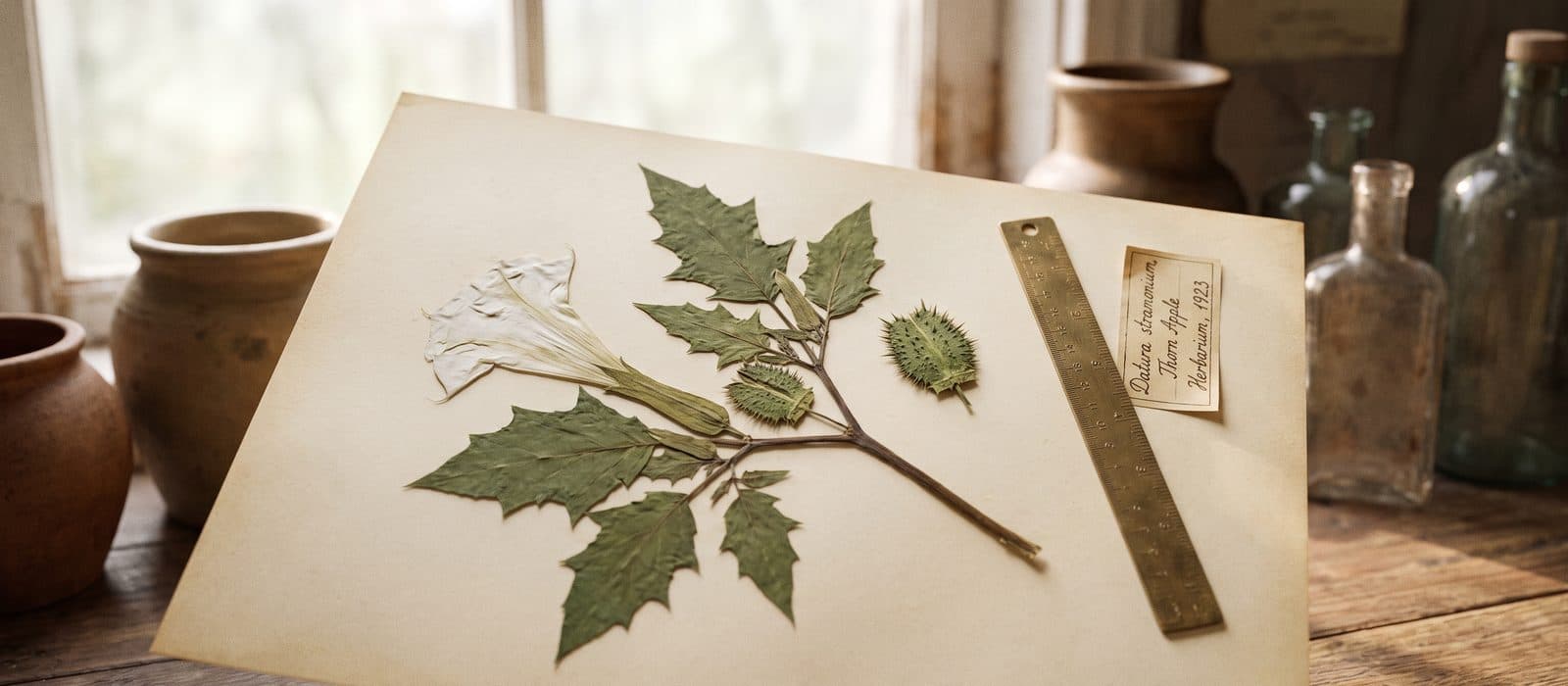
Homeopathic Stramonium is prepared from Datura stramonium, thorn apple or jimsonweed, a coarse, strong-smelling annual of the nightshade family (Solanaceae). It grows on waste ground, field edges and roadsides through the Americas, Europe and Asia. It has large white or pale violet trumpet-shaped flowers that open in the evening, and spiny, walnut-sized seed pods full of small black seeds. The English name jimsonweed is a contraction of "Jamestown weed": in 1676 soldiers at Jamestown, Virginia, ate the plant boiled as greens and spent days in a state of bizarre, foolish delirium, an episode recorded by the colonial historian Robert Beverley.
The name on the label is honest about the source. Every part of the plant, and above all the seeds, contains atropine, scopolamine and hyoscyamine, the same alkaloids found in deadly nightshade. Poisoning causes a hot, dry, flushed skin, wide pupils, a racing heart, confusion and vivid hallucinations, and can be fatal; emergency departments still see it in people who eat the seeds or brew the leaves for a "natural high". It is never something to eat, smoke, brew or prepare at home. In the US, the Poison Help line is 1-800-222-1222.
The homeopathic preparation starts from a mother tincture of the plant, then dilutes and succusses it step by step to the labelled potency. At the common potencies the arithmetic says no molecule of the original plant remains. Our potencies guide explains that honestly, including why it is also the reason mainstream science is sceptical, and the guide to reading Latin remedy names explains why poisonous sources appear on labels at all.
The poisoning picture and the homeopathic picture are close mirrors: terror, hallucination, wide pupils, flushed heat and wild movement. That overlap is the idea behind a homeopathic proving.
What is the Stramonium picture?
The Stramonium picture is a child who wakes in the night screaming in terror. They sit bolt upright, eyes wide, and do not seem to recognise the parent who comes in; they cling, or strike out, or point at something in the corner that is not there. Nothing calms them in the dark. When the light goes on and someone stays close, the terror slowly loosens. In the morning they may remember none of it.
Classic texts build the picture around fear and violence. Kent's Lectures (1905) describe the dread of darkness and of being alone, the craving for light and company, and a mind full of frightening images: animals, faces, things springing out of corners. Boericke (1927) adds the striking keynote that the violent states are painless, and describes a body in constant jerking, twitching or graceful, rhythmic movement. Speech can falter into stammering. Shining objects and the sight of water are described as provoking spasm or fear.
The physical side mirrors the poisoning: a flushed, hot face, wide pupils, great thirst, and a dry mouth. Older texts discuss the picture in high fevers with delirium, after a severe fright, and in children whose fears grow fixed and violent. The thread is the same throughout: terror, intensity, and the need for light and people.
What makes it better or worse?
The traditional modalities centre on darkness, solitude and shining things. Stramonium is worse in the dark and alone, and better for light and company.
| Modality | Worse | Better |
|---|---|---|
| Light | Darkness; a dark room on waking | Bright light; a lamp left on |
| Company | Being alone | Company; someone close by |
| Senses | Shining or glittering objects; the sight of water | No consistent keynote |
| Time | Night; after sleep | Daytime |
| Temperature | Cold (Boericke) | Warmth |
Our guide to modalities, better and worse explains why a homeopath reads these before any remedy name.
What is Stramonium traditionally discussed for?
In homeopathic literature, Stramonium is traditionally discussed for states dominated by terror and violent agitation. None of our acute pages names a Stramonium-like pattern yet, because the states it describes rarely belong in a self-help article; the groups below follow the classic texts.
Sleep and night fears
- Night terrors in children, with screaming, failure to recognise parents and a demand for light. Our page on nightmares after a fright covers the gentler end of this ground, with the Aconite-like shock pattern and its red flags; Stramonium sits at the far, more violent end.
After fright
- Fears that follow a severe fright and become fixed: of the dark, of being alone, of animals or water. Kent describes these lasting long after the original shock.
Fever with delirium
- Older texts discuss the picture in high fevers with wild delirium, visions and jerking. That is a medical emergency in any modern reading; our guide to observing a sick child explains what to watch and when to call.
Speech and movement
- Stammering, twitching and rhythmic, involuntary movements are classic keynotes, discussed in the materia medica as part of the wider picture rather than as complaints on their own.
What is Stramonium not?
Stramonium is not a remedy for "anxiety" or "bad dreams". Most frightened children and most nightmares fit gentler pictures or none at all; the tradition reserves Stramonium for terror that is violent, dark-dependent and out of all proportion. Nor is it a picture to read into confusion, delirium or hallucinations, because those are medical signs first. A person who is suddenly confused, seeing things that are not there, having a seizure, very hot and drowsy, or a child who is floppy or cannot be properly woken needs urgent care. Suspected poisoning, including from Datura itself, needs a poison centre or an emergency department. Night terrors that are frequent, start in an older child or adult, or come with daytime sleepiness, snoring pauses or new behaviour belong with a doctor. Our guide to red flags first sets these out.
Homeopaths separate it from its neighbours like this:
| Picture | Where it sits | Defining feature | Key modality |
|---|---|---|---|
| Stramonium | Terror and violent agitation | Fear of dark and solitude; visions; painless, jerky states | Worse dark and alone; better light and company |
| Belladonna | Sudden, intense heat | Heat, redness and throbbing lead; senses on edge | Worse jar, light and noise |
| Aconite | Sudden fright or chill | Fear and restlessness; hot, dry skin; great thirst | Worse at night; better open air |
| Phosphorus | Open, sensitive, easily frightened | Fear of the dark and of being alone, but sociable and easily reassured | Better company and reassurance |
Stramonium, Belladonna and Hyoscyamus are the three nightshade pictures of the materia medica. Classic texts place Stramonium as the most violent and terrified of the three, Belladonna as the hottest, and Hyoscyamus as the most suspicious and talkative.
What potencies is Stramonium sold in?
Stramonium is sold in 30C by homeopathic pharmacies and manufacturers, with 6C and 200C also available; it is less often found on general pharmacy shelves or in home kits than Aconite or Belladonna. Potency describes the preparation process, not an amount of plant: 30C means thirty successive 1:100 dilutions with succussion between them. Our potencies guide explains the scale, what remains in the vial, and why low-potency products of toxic sources carry their own labelling.
This page deliberately gives no frequency or instructions for taking Stramonium. That depends on a whole case, not a remedy name. Read the product label, and talk to a qualified practitioner about an individual situation.
What remedy lists don't tell you
Two things the "remedies for night terrors" lists leave out:
- The light switch is the most useful observation. Lists describe Stramonium as "fear", which describes most frightened children. What the classic authors found characteristic was how completely the state depended on darkness and solitude, and how it loosened with a lamp and a person nearby. A parent who notices that, and notices whether the child recognised them at all, has recorded more than any list can offer.
- Most of its classic material is chronic, and some of it is medical. Kent and Clarke (Dictionary, 1900–1902) discuss Stramonium largely in long-standing fears and in delirious fevers. The first belongs with a practitioner over time, as our guide to acute versus chronic explains; the second belongs with a doctor now. That leaves little room for a self-help reading, which is the honest reason Stramonium appears on so few acute pages, here or anywhere.
Not sure whether a picture fits?
A remedy profile describes a picture; it cannot tell you whether that picture matches what you are seeing. An acute consultation starts from the case itself: onset, sensations, what changes it, and the red flags.
Acute consultation · $45Frequently asked questions
- What is Stramonium?
- Stramonium is a homeopathic remedy prepared from thorn apple, Datura stramonium, a highly poisonous plant of the nightshade family. In homeopathy it names a traditional picture of terror: violent fear of the dark and of being alone, night terrors, wild agitation, and a strong wish for light and company. It is a description homeopaths use to compare cases, not a finding that it works for fears, sleep problems or any other condition.
- What is Stramonium used for in homeopathy?
- Homeopathic literature traditionally discusses Stramonium for states dominated by terror and violent agitation, classically the child who wakes screaming from night terrors, does not recognise anyone, and must have the light on. The picture is defined by the terror, the craving for light and company, and the intensity, not by the name of a complaint. Confusion, hallucinations, a sudden change in behaviour, a seizure or a child who cannot be roused is a medical emergency first.
- What is Stramonium 30C used for?
- 30C is a commonly sold potency of Stramonium, though it is found less often on general shelves than kit remedies such as Aconite or Belladonna and is more often ordered from homeopathic pharmacies. In the tradition the potency does not change the picture; Stramonium 30C is discussed for the same terrified, light-seeking state as any other potency. Our potencies guide explains what 30C means as a dilution.
- How is Stramonium taken?
- This page does not give instructions on how or how often to take any remedy, because that depends on a whole case rather than on a remedy name. The product label carries the manufacturer's directions, and a qualified practitioner can advise on an individual situation. Night terrors that are frequent, new in an older child or adult, or come with daytime symptoms belong with a doctor.
- Where can I buy Stramonium?
- Homeopathic pharmacies and manufacturers sell Stramonium as single-remedy pellets, commonly in 30C; it is less often stocked in general pharmacies or home kits. This site also prepares custom single remedies to order: you name the remedy and potency, and the details are confirmed by email before anything is made. The order form does not give advice on which remedy to choose.
- What is Stramonium made from?
- Homeopathic Stramonium is prepared from Datura stramonium, the thorn apple or jimsonweed, a weed of the nightshade family. The fresh plant is made into a mother tincture, then diluted and succussed step by step to the labelled potency. The raw plant, and especially its seeds, contains atropine, scopolamine and hyoscyamine and is seriously poisonous; poisonings still happen when people eat the seeds or brew the leaves.
This guide is educational only and is not medical advice or a personalized remedy recommendation. Acute symptoms can become urgent; when in doubt, seek professional evaluation.