Remedy profile
Magnesia phosphorica in Homeopathy: Uses, Picture and Limits
What homeopathic Magnesia phosphorica is made from, the cramping, warmth-eased picture homeopaths describe, what changes it, potencies sold, and its limits.
By Homeopathic BenefitsPublished 7 min read
Key takeaways
- Magnesia phosphorica is the picture of cramp eased by heat. Homeopathic literature describes spasmodic, shooting or colicky pain that is far better from warmth, firm pressure and bending double.
- The modality matters more than the place. The same picture is described for a calf, a stomach, a womb, a tooth or a nerve; what unites them is the spasm and the relief from heat.
- It is a Schüssler tissue salt as well as a homeopathic remedy. It is sold as 6X tablets in that tradition and as 30C pellets in single-remedy ranges, under the names Magnesia phosphorica, Magnesium phosphoricum and Mag phos.
- It is not a magnesium supplement. Potentised magnesium phosphate supplies no meaningful magnesium, and low magnesium is a blood-test question for a doctor.
- Cramp has red flags. A swollen, hot or red calf, cramps with confusion after heat, severe abdominal pain or period pain that is new and severe are medical questions first.
The short answer
Magnesia phosphorica is a homeopathic remedy and Schüssler tissue salt prepared from magnesium phosphate, also sold as Magnesium phosphoricum and widely known as Mag phos. In homeopathy it names a traditional picture rather than a treatment: cramping, spasmodic, shooting pain that is strikingly better from warmth, firm pressure and bending double, and worse from cold and draughts. Classic materia medica describes it in muscle cramps, colic, period cramps, toothache and nerve pains, always with the same relief from heat. Wilhelm Schüssler introduced it as one of his twelve tissue salts in 1873, and Boericke (1927) gave it a full entry as a remedy for spasm. It is not a cramp remedy or a supplement, and nothing about the picture replaces medical care for cramp that is severe, persistent or comes with warning signs.
| Latin name | Magnesia phosphorica |
|---|---|
| Abbreviation | Mag-p. |
| Common name | Phosphate of magnesia; Mag phos; tissue salt no. 8 |
| Source | Magnesium phosphate (dibasic magnesium phosphate), a white mineral salt, triturated and potentised (mineral kingdom) |
| Commonly sold potencies | 6X, 6C, 30C |
| First proving | Introduced by Wilhelm Schüssler as a tissue salt (1873); later proved by American homeopaths and summarised in Boericke (1927) |
What is Magnesia phosphorica made from?
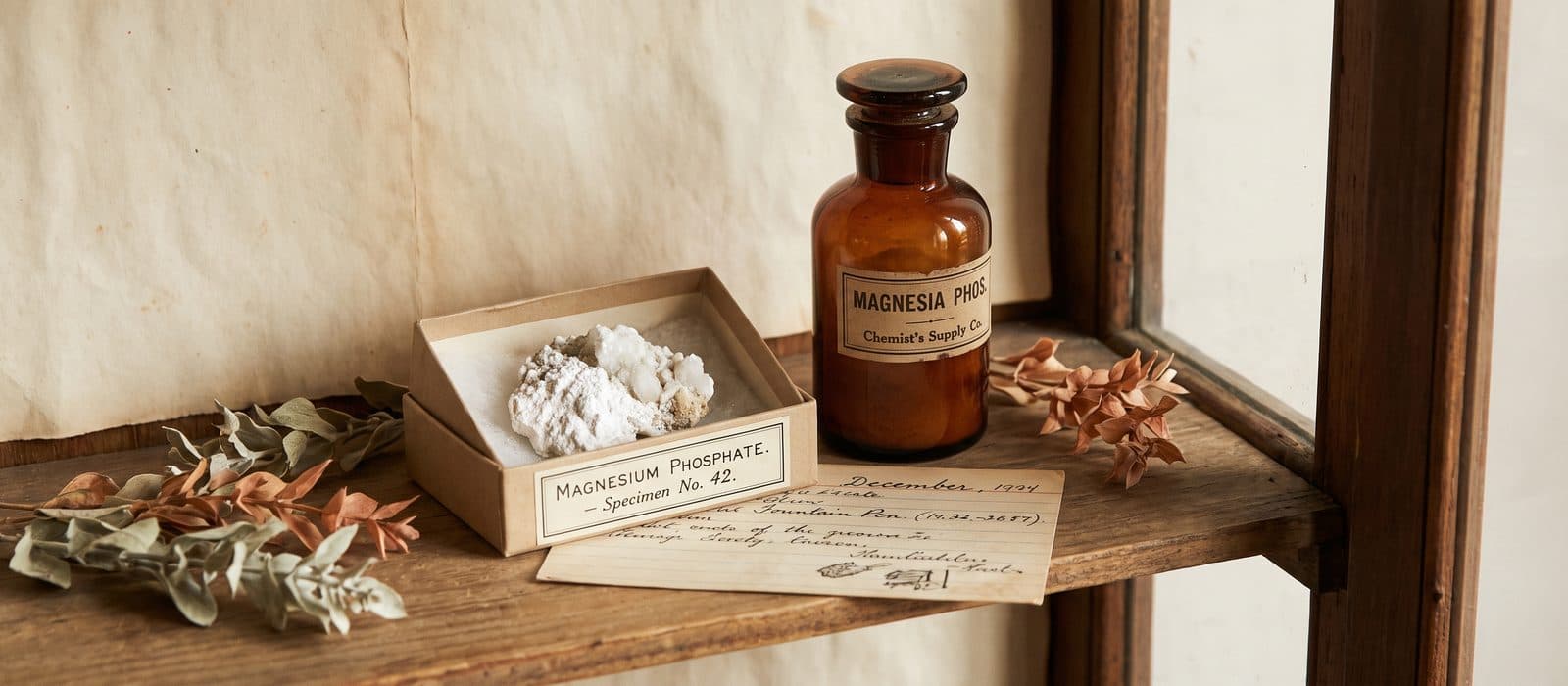
Magnesia phosphorica is prepared from magnesium phosphate, a white, chalky mineral salt that dissolves only poorly in water. Magnesium and phosphate are both found throughout the body, in bone and in muscle and nerve tissue, and the compound itself is an everyday food additive and supplement ingredient. Two names appear on labels for the same remedy: Magnesia phosphorica, the older homeopathic Latin, and Magnesium phosphoricum, the form many tissue-salt ranges use. Mag phos is the shorthand for both, and our acute pages use either name.
Because the starting salt barely dissolves, the first steps are made by trituration: grinding it with lactose for long periods. The 6X tissue salt is the product of that grinding, a one-in-a-million dilution by weight in milk sugar. The C potencies carry it further, through liquid dilution and succussion. Our guide to what is in a homeopathic remedy explains the carriers and the steps.
Magnesium phosphate is not toxic in the way Belladonna or Arsenicum are, so the honest framing here runs the other way. Because the source is a nutrient, people sometimes assume the remedy is a way of topping up magnesium. It is not. A 6X tablet contains a trace of the salt and a 30C pellet none that the arithmetic says should remain; our potencies guide works through the numbers, and also explains why mainstream science is sceptical of the method. Real magnesium deficiency is a question for a doctor and a blood test.
What is the Magnesia phosphorica picture?
The Magnesia phosphorica picture is someone curled around a hot water bottle. The pain comes in spasms: a calf that knots without warning at night, a stomach that gripes in waves, a period cramp that doubles the person over, a tooth or a nerve in the face that shoots like lightning. Between spasms they may feel fairly well. During them they want heat and pressure, and they want them at once: a hand pressed hard into the belly, a warm compress on the face, knees drawn up, bent forward.
Boericke (1927) puts it at the head of his entry as the great antispasmodic of the materia medica, and describes pains that are sharp, cutting, shooting, stabbing or lightning-like, coming and going quickly, and changing place. Cramping of muscles with radiating pain is the core of it. The classic texts note that the right side is affected more often than the left, and that the pains tend to be worse at night.
The temperament is not the loud part of this picture. Classic descriptions add tiredness, a languid, exhausted state, and in some accounts a person who complains of the pain constantly, but the remedy is identified chiefly by the physical keynotes. That makes it unusual among the remedies on this site. With Nux vomica or Pulsatilla, the person's mood often decides it; with Mag phos, the hot water bottle does.
The schoolbook comparison is with Colocynth, which also bends double and presses hard into colic. Homeopaths separate them by what set it off and by warmth: Colocynth's colic classically follows anger or indignation and is less defined by heat, while Mag phos is the cramp that a hot water bottle transforms.
What makes it better or worse?
The traditional modalities centre on temperature and pressure. Magnesia phosphorica is worse from cold, draughts and light touch, and better from heat, firm pressure and bending double.
| Modality | Worse | Better |
|---|---|---|
| Temperature | Cold air, cold water, draughts, uncovering | Heat, warm applications, warm drinks |
| Touch and pressure | Light touch | Firm pressure, rubbing |
| Position | Stretching out flat during a spasm | Bending double, drawing the knees up |
| Time | Night | No consistent keynote |
| Side | Right side more often than left | No consistent keynote |
Light touch worse but firm pressure better is the detail homeopaths find most useful, because it is the opposite of a bruised, tender picture. Our guide to modalities, better and worse explains why a homeopath asks about these before anything else.
What is Magnesia phosphorica traditionally discussed for?
In homeopathic literature, Magnesia phosphorica is traditionally discussed for spasmodic and cramping pain eased by warmth. Each of these appears on one of our acute pages, where the Mag phos-like pattern sits beside its neighbours and the red flags come first.
Muscles
- The calf or foot cramp that eases with heat and stretching: a charley horse muscle cramp.
- Night-time cramping in the legs: restless legs at night. Restless legs and cramp are not the same thing, and that page explains the difference.
Digestion
- Colicky cramping better from gentle heat and rubbing: sharp stomach cramping and stomach flu cramps.
Periods
- Cramps relieved by warmth and pressure over the lower abdomen: menstrual cramps.
Teeth and nerves
- Sharp, neuralgic zings that warm drinks ease: teeth sensitive to cold. A tooth that is sensitive to cold also needs a dentist to look for the cause.
What is Magnesia phosphorica not?
Magnesia phosphorica is not "the cramp remedy", and it is not magnesium. The commonest misreading is to match the name to the complaint: cramp, therefore Mag phos. In the tradition, a cramp that is better from cold, or worse from pressure, or that comes with a furious, restless temper, belongs to a different picture. The second misreading is nutritional: the tissue-salt tablets are sometimes sold beside magnesium supplements, but they are not a source of magnesium.
Cramp also has causes that need a clinician. A calf that is swollen, warm, red or painful to walk on can be a blood clot rather than a cramp. Cramps with confusion, a very high temperature or stopped sweating after heat or exertion can be heat illness. Sudden severe abdominal pain, pain with a high fever or vomiting, period pain that is new, one-sided and severe, or pain in pregnancy needs medical care. Frequent cramps can be a side effect of medication or a sign of a mineral imbalance, which a blood test can check.
Homeopaths separate Magnesia phosphorica from its neighbours like this:
| Picture | Where it sits | Defining feature | Key modality |
|---|---|---|---|
| Magnesia phosphorica | Cramp, colic, neuralgia | Spasmodic, shooting pain; few mental keynotes | Better heat, firm pressure, bending double |
| Colocynth | Colic after anger or indignation | Cutting pain that doubles the person up; irritable | Better hard pressure; worse after anger |
| Cuprum metallicum | Violent cramp and spasm | Cramps start in fingers and toes; thumbs clenched; intense | Better cold drinks; worse touch |
| Chamomilla | Unbearable pain, often in children | Pain out of all proportion; angry, inconsolable | Better being carried; worse at night and from anger |
What potencies is Magnesia phosphorica sold in?
Magnesia phosphorica is sold in two traditions. As a Schüssler tissue salt it comes as 6X tablets, often labelled Magnesium phosphoricum or "no. 8". As a homeopathic single remedy it comes as pellets, most often 30C, with 6C also available. Potency describes the preparation process, not an amount of magnesium: 6X is six 1:10 steps, 30C thirty 1:100 steps. Our potencies guide explains both scales and what remains in the vial.
This page deliberately gives no frequency or instructions for taking Magnesia phosphorica. That depends on a whole case, not a remedy name. Read the product label, and talk to a qualified practitioner about an individual situation.
What remedy lists don't tell you
Two things the "remedies for cramp" lists leave out:
- Firm pressure and light touch point in opposite directions. Many cramping people want the spot pressed; fewer flinch from a light touch yet welcome a hard one. That combination, with heat as the main relief, is what classic authors meant by the Mag phos picture. Lists that say "cramps better from warmth" keep half the detail.
- Two traditions share one name. The tissue-salt tradition, from Schüssler's 1873 book, did without provings: it chose its twelve salts from the mineral make-up of the body. Homeopathy proper added provings and modalities later. Both sell "Mag phos", but they reach it by different reasoning, and our guide to the symptoms alongside the symptom explains why homeopaths lean on the modalities rather than the chemistry.
Where the Magnesia phosphorica picture appears on this site
Acute pages that discuss this picture among their educational patterns, with the pattern name each page uses.
- What homeopathic remedy for a charley horse muscle cramp?Magnesium phosphoricum-like cramp better warmth pattern
- What homeopathic remedy for menstrual cramps?Magnesium phosphoricum-like cramp better heat pattern
- What homeopathic remedy for restless legs at night?Magnesium phosphoricum-like cramp better warmth pattern
- What homeopathic remedy for sharp stomach cramping?Magnesium phosphoricum-like cramping better warmth pattern
- What homeopathic remedy for stomach flu cramps?Magnesium phosphoricum-like cramping better warmth pattern
- What homeopathic remedy for teeth sensitive to cold?Magnesia phosphorica-like warmth-eased zing pattern
Not sure whether a picture fits?
A remedy profile describes a picture; it cannot tell you whether that picture matches what you are seeing. An acute consultation starts from the case itself: onset, sensations, what changes it, and the red flags.
Acute consultation · $45Frequently asked questions
- What is Magnesia phosphorica?
- Magnesia phosphorica, also sold as Magnesium phosphoricum or Mag phos, is a homeopathic remedy and Schüssler tissue salt prepared from magnesium phosphate. In homeopathy it names a traditional picture: cramping, shooting or spasmodic pain that is strikingly better from warmth, firm pressure and bending double. It is a description homeopaths use to compare cases, not evidence that it works for cramps or any other condition.
- What is Magnesia phosphorica used for in homeopathy?
- Homeopathic literature traditionally discusses Magnesia phosphorica for cramping states with a particular shape: muscle cramps, colicky stomach pain, period cramps and sharp nerve pains that come in spasms and are eased by heat and pressure. The warmth and pressure modality defines the picture more than the location. Severe or worsening abdominal pain, a swollen, hot or red calf, or cramps with confusion after heat exposure need medical care first.
- What is Magnesia phosphorica 30C used for?
- 30C is one of the common shelf potencies of Magnesia phosphorica in single-remedy tubes, alongside the 6X tablets sold in the tissue-salt tradition. In homeopathic tradition the potency does not change the picture; 30C is discussed for the same warmth-eased cramping picture as 6X or any other potency. Our potencies guide explains what the C and X scales mean.
- How is Magnesia phosphorica taken?
- This page does not give instructions on how or how often to take any remedy, because that depends on a whole case rather than on a remedy name. The product label carries the manufacturer's directions, and a qualified practitioner can advise on an individual situation. Cramps that are severe, keep returning or come with swelling, weakness or fever belong with a clinician first.
- Where can I buy Magnesia phosphorica?
- Pharmacies, health-food shops and homeopathic manufacturers sell Magnesia phosphorica as 6X tissue-salt tablets and as single-remedy pellets, most often in 30C. This site also prepares custom single remedies to order: you name the remedy and potency, and the details are confirmed by email before anything is made. The order form does not give advice on which remedy to choose.
- What is Magnesia phosphorica made from?
- Magnesia phosphorica is made from magnesium phosphate, a white, poorly soluble mineral salt. It is ground with milk sugar (trituration) through the first potency steps, which is how the 6X tissue salt is made, and then diluted and succussed further for the C potencies. The same compound is an ordinary food additive and supplement ingredient; the remedy is not a magnesium supplement.
This guide is educational only and is not medical advice or a personalized remedy recommendation. Acute symptoms can become urgent; when in doubt, seek professional evaluation.