Remedy profile
Colocynthis in Homeopathy: Uses, Picture and Limits
What homeopathic Colocynthis is made from, the violent cramping, bent-double picture homeopaths describe, what changes it, the potencies sold, and its limits.
By Homeopathic BenefitsPublished 7 min read
Key takeaways
- Colocynthis is the picture of violent cramp eased by hard pressure. The person doubles up, presses a fist or the edge of a table into the pain, and cannot keep still.
- Anger often comes first. Classic texts tie the cramps to indignation, vexation or being crossed, with irritability during the pain.
- The posture is the tell. Bending double, drawing the knees up and pressing hard define the picture far more than where the cramp is.
- It comes from a poisonous desert gourd. The raw bitter apple is a violent purgative; potentised preparations are diluted far past the point where it remains.
- Abdominal red flags come first. Constant or worsening pain, a rigid belly, blood, fever, fainting, possible pregnancy or a hot, swollen calf is a medical question before a homeopathic one.
The short answer
Colocynthis, usually shortened to Colocynth, is a homeopathic remedy prepared from the bitter apple, Citrullus colocynthis, a trailing desert gourd of North Africa, the Middle East and western Asia. In homeopathy it names a traditional picture rather than a treatment: sudden, violent, cutting or gripping cramps that drive the person to bend double and press hard into the pain. Classic materia medica describes the cramps arriving in waves, often after anger or indignation, in a person who is restless and irritable while they last. Hahnemann recorded it in his Materia Medica Pura, and Boericke (1927) gives the bent-double, better-from-pressure posture as its centre. It is not a general remedy for stomach ache or period pain, and severe abdominal pain is one of the clearest reasons to see a doctor first.
| Latin name | Colocynthis |
|---|---|
| Abbreviation | Coloc. |
| Common name | Bitter apple, bitter cucumber, colocynth |
| Source | Dried fruit pulp of Citrullus colocynthis, freed of seeds (Cucurbitaceae) (plant kingdom) |
| Commonly sold potencies | 6C, 30C, 200C |
| First proving | Hahnemann, recorded in Materia Medica Pura; later entries in Allen's Encyclopedia (1874–1879) and Boericke (1927) |
What is Colocynthis made from?
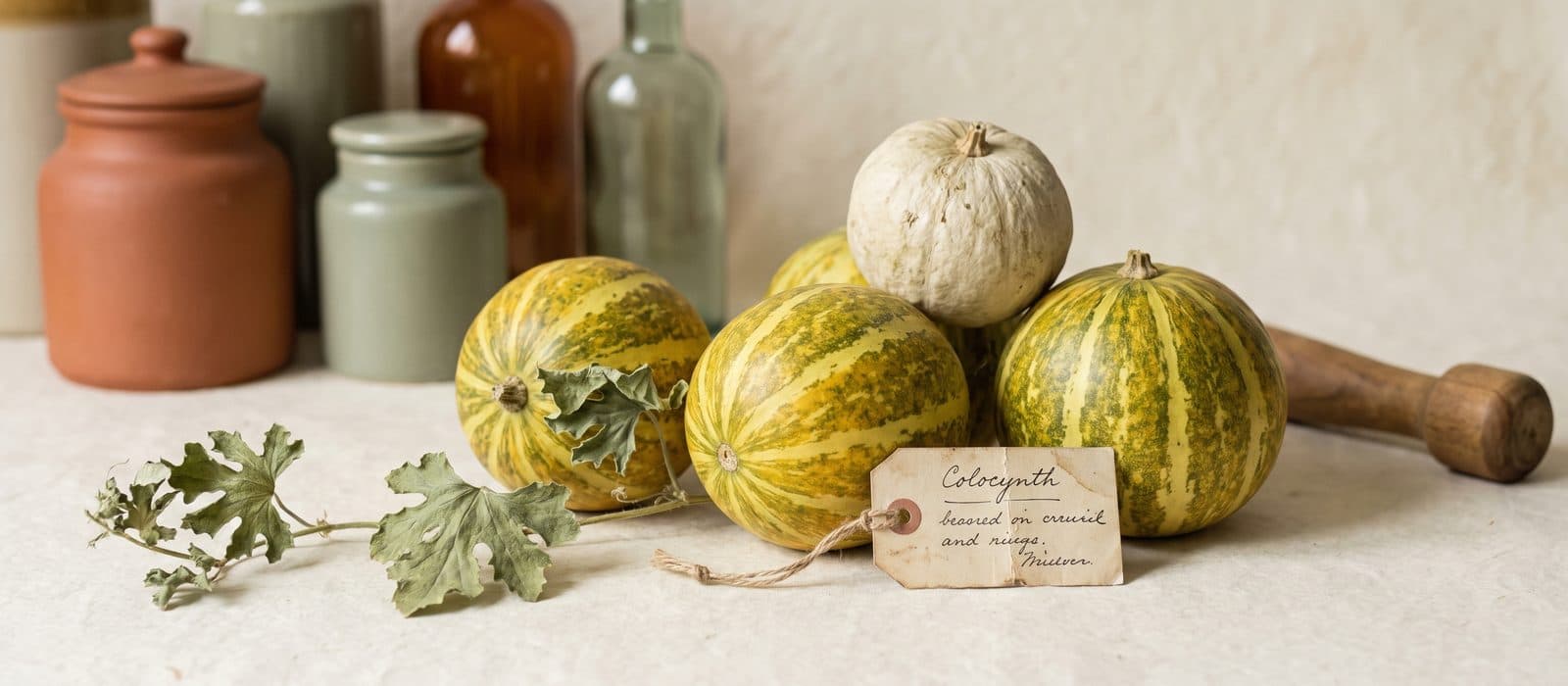
Homeopathic Colocynthis is prepared from the dried fruit pulp of Citrullus colocynthis, the bitter apple or bitter cucumber. It is a trailing vine of the gourd family (Cucurbitaceae), a close relative of the watermelon, that grows wild in sandy deserts from the Sahara to India. Its fruits are round, hard-rinded and about the size of an orange, green and striped at first, yellow when ripe; inside, the pale, spongy pulp is among the bitterest substances in the plant world.
The source is a genuine poison. Colocynth pulp was used for centuries as a drastic purgative, and the old herbals warned about it even then. Taken raw it inflames the gut and causes violent, cramping, often bloody diarrhoea; serious poisonings, including deaths, are recorded. It is never something to eat, brew or prepare at home, and the seeds are removed before the pulp is used at all. Our guide to reading Latin remedy names explains why poisonous sources appear on labels.
The homeopathic preparation grinds or steeps the dried pulp and carries it through repeated dilution and succussion to the potency on the label. At the common potencies the arithmetic says no molecule of the fruit remains; our potencies guide sets out what that means and why it is also the reason science is sceptical.
The poisoning picture and the homeopathic one meet in the cramp: gripping, cutting colic that bends a person over. That overlap is the logic of a homeopathic proving.
What is the Colocynthis picture?
The Colocynthis picture is a person folded in half. Imagine someone who has had a furious row at work, swallowed their anger, and an hour later is gripped by cramps so violent that they cannot sit upright. They bend double over the back of a chair, press their fists into the belly, lie on the floor with their knees drawn up and a cushion jammed against the pain. The cramps come in waves, cutting or gripping, as though the bowel were being squeezed between stones. Between waves they are restless; during them they want pressure, hard and steady, and warmth.
Classic texts describe a person who is irritable, easily offended and inclined to anger, and whose complaints follow indignation or vexation, particularly anger that was not expressed. Boericke (1927) puts the posture at the centre: pains that make the person bend double, eased by hard pressure, and cramps that may bring on diarrhoea or vomiting. While in pain they do not want to talk or be questioned, and they can be short with those trying to help.
The same pattern of violent, cramping, gripping pain eased by pressure turns up outside the abdomen. Classic texts describe cramps in the calf or thigh, and nerve pains along the face or down the left hip and leg, that the person eases by pressing hard against the part or lying on it. Wherever it appears, the shape is the same: a cramp so strong that the body folds or presses against it.
What makes it better or worse?
The traditional modalities centre on pressure, posture and anger. Colocynthis is worse from anger and indignation, and better from bending double, hard pressure and warmth.
| Modality | Worse | Better |
|---|---|---|
| Emotion | Anger, indignation, vexation, being questioned | Being left alone |
| Pressure | Light touch | Hard pressure, pressing a fist or object into the pain |
| Position | Standing upright, stretching out | Bending double, knees drawn up; lying with the head bent forward (Boericke) |
| Temperature | Cold | Warmth |
| Side | Left hip and leg, left side of the face, more often than the right | Lying on the painful side, pressing against it |
Our guide to modalities, better and worse explains why a homeopath reads these before any remedy name.
What is Colocynthis traditionally discussed for?
In homeopathic literature, Colocynthis is traditionally discussed for violent cramping eased by hard pressure and bending double. Each of these appears on one of our acute pages, where the Colocynth-like pattern sits beside its neighbours and the red flags come first.
Abdominal cramping
- Sharp, gripping spells that fold a person over: stomach cramping spells.
- Waves of cramp with a stomach bug: stomach flu cramps. Signs of dehydration, blood or a high fever come first on that page.
Period pain
- Violent cramping eased by bending forward and pressing hard: menstrual cramps. Pain that is new, much worse than usual, or comes with a missed period needs a clinician.
Muscle cramps and the legs
- A cramp in the calf or thigh that wants hard pressure: a charley horse muscle cramp.
- Cramping discomfort in the legs at night, eased by pressing on them: restless legs at night.
What is Colocynthis not?
Colocynthis is not "the colic remedy", and it is not a reason to sit out abdominal pain. The picture depends on the posture and the pressure: a cramp that comes in waves and is eased by doubling up and pressing hard. Pain that is constant rather than cramping, that settles in one place (especially low on the right), that makes the belly rigid or makes the person lie absolutely still because any movement hurts, is a different matter and may be appendicitis, a twisted bowel or something else surgical. Blood in vomit or stool, a high fever, fainting, pain in pregnancy or with a possible pregnancy, and severe pain in a child all need urgent care. A calf cramp that leaves the leg swollen, hot or tender can be a clot rather than a cramp. Our guide to red flags first sets these out.
Homeopaths separate it from its neighbours like this:
| Picture | Where it sits | Defining feature | Key modality |
|---|---|---|---|
| Colocynthis | Violent cutting, gripping cramps | Bends double, presses hard; often after anger | Better hard pressure, doubling up, warmth |
| Magnesia phosphorica | Spasmodic, shifting cramps | Milder temper; wants warmth above all | Better heat, gentle rubbing and pressure |
| Chamomilla | Pain that seems unbearable | Angry, snappish, inconsolable; one cheek red | Worse at night; better being carried |
| Cuprum metallicum | Violent spasm and cramp in calves and fingers | Knotting cramps, often with exhaustion | Better a cold drink; worse at night |
Colocynthis and Magnesia phosphorica are the two classic "better from pressure" cramp pictures and are often confused. The traditional distinction is in the person and the pressure: Colocynthis is angry and presses hard, Magnesia phosphorica is milder and wants warmth and gentle rubbing.
What potencies is Colocynthis sold in?
Colocynthis is sold most often as 30C pellets, the common shelf potency for single remedies, with 6C and 200C also available. Potency describes the preparation process, not an amount of fruit: 30C means thirty successive 1:100 dilutions with succussion between them. Our potencies guide explains the scale and what remains in the vial, and why low potencies of toxic sources carry their own labelling.
This page deliberately gives no frequency or instructions for taking Colocynthis. That depends on a whole case, not a remedy name. Read the product label, and talk to a qualified practitioner about an individual situation.
What remedy lists don't tell you
Two things the "remedies for cramps" lists leave out:
- What the person does with their body decides it. Two people with identical cramps can sit very differently. The one who folds over, drives a fist into the belly and wants it harder fits the Colocynthis picture; the one who lies dead still because any movement hurts does not, and that stillness is also a warning sign. Our guide to the symptoms alongside the symptom explains why a homeopath watches posture before naming anything.
- The trigger is often emotional, and lists drop it. Classic texts were specific that Colocynthis cramps tend to follow anger, indignation or humiliation that was held in. That is why a homeopath taking a cramping case asks what happened in the hours before, not only what was eaten, as our guide on how a homeopath takes a case describes.
Where the Colocynthis picture appears on this site
Acute pages that discuss this picture among their educational patterns, with the pattern name each page uses.
- What homeopathic remedy for a charley horse muscle cramp?Colocynth-like cramp better pressure pattern
- What homeopathic remedy for menstrual cramps?Colocynth-like cramp better bending double pattern
- What homeopathic remedy for restless legs at night?Colocynth-like cramp better pressure pattern
- What homeopathic remedy for sharp stomach cramping?Colocynth-like cramping better pressure pattern
- What homeopathic remedy for stomach flu cramps?Colocynth-like cramping better pressure pattern
Not sure whether a picture fits?
A remedy profile describes a picture; it cannot tell you whether that picture matches what you are seeing. An acute consultation starts from the case itself: onset, sensations, what changes it, and the red flags.
Acute consultation · $45Frequently asked questions
- What is Colocynthis?
- Colocynthis, usually called Colocynth, is a homeopathic remedy prepared from the bitter apple, Citrullus colocynthis, a desert gourd related to the watermelon whose pulp is a violent purgative. In homeopathy it names a traditional picture: sudden, violent, cutting or gripping cramps that force the person to bend double and press hard into the pain, often after anger or indignation. It is a description homeopaths use to compare cases, not evidence that it works for cramps or anything else.
- What is Colocynthis used for in homeopathy?
- Homeopathic literature traditionally discusses Colocynthis for violent cramping that is eased by hard pressure and bending double: stomach cramps, period cramps and muscle cramps, especially when anger or vexation came first. The picture is defined by that posture and that pressure, not by the name of the complaint. Constant or worsening abdominal pain, a rigid belly, blood, fever, possible pregnancy or a swollen, hot calf needs medical care first.
- What is Colocynthis 30C used for?
- 30C is the common shelf potency of Colocynthis, and it appears in many cramp-focused kits. In the tradition the potency does not change the picture: Colocynthis 30C belongs to the same violent, bent-double, better-from-pressure description as any other potency. Our potencies guide explains what 30C means as a dilution.
- How is Colocynthis taken?
- This page does not give instructions on how or how often to take any remedy, because that depends on a whole case rather than on a remedy name. The product label carries the manufacturer's directions, and a qualified practitioner can advise on an individual situation. Severe, constant or unexplained abdominal pain belongs with a clinician first.
- Where can I buy Colocynthis?
- Pharmacies, health-food shops and homeopathic manufacturers sell Colocynthis as single-remedy pellets, most often in 30C, often labelled Colocynthis or Colocynth. This site also prepares custom single remedies to order: you name the remedy and potency, and the details are confirmed by email before anything is made. The order form does not give advice on which remedy to choose.
- What is Colocynthis made from?
- Homeopathic Colocynthis is prepared from the dried pulp of the bitter apple, Citrullus colocynthis, with the seeds removed. The pulp is steeped or ground and then diluted and succussed step by step to the labelled potency. The raw fruit is intensely bitter and poisonous, causing severe, bloody diarrhoea, and is never something to eat or prepare at home.
This guide is educational only and is not medical advice or a personalized remedy recommendation. Acute symptoms can become urgent; when in doubt, seek professional evaluation.