Remedy profile
Staphysagria in Homeopathy: Uses, Picture and Limits
What homeopathic Staphysagria is made from, the swallowed-indignation, recurring-stye picture homeopaths describe, what changes it, potencies sold, and limits.
By Homeopathic BenefitsPublished 7 min read
Key takeaways
- Staphysagria is the picture of swallowed indignation. Classic texts describe a sensitive, polite person who has been insulted, humiliated or wronged and has kept the anger in.
- The body carries the grievance. Recurring styes and lid lumps, smarting cut-like pains, and urinary burning after intercourse or catheterisation are among its classic physical keynotes.
- Its stye picture is about recurrence. The older literature describes one stye after another over months, a lid tendency rather than a one-off blockage.
- It comes from a poisonous seed. Stavesacre seeds contain toxic alkaloids; potentised preparations are diluted far past the point where they remain.
- Eyes, wounds and urine have red flags. A spreading, swollen red lid, eye pain or changed vision, a hot discharging wound, or urinary burning with fever needs medical care first.
The short answer
Staphysagria is a homeopathic remedy prepared from the seeds of stavesacre, Delphinium staphisagria, a poisonous Mediterranean larkspur once ground into ointments to kill lice. In homeopathy it names a traditional picture rather than a treatment: the sensitive, outwardly mild person who has swallowed an insult, a humiliation or an injustice, and whose suppressed indignation shows up in the body. Classic materia medica links that picture to recurring styes and lid nodules, to smarting pain in clean cuts and surgical incisions, and to urinary burning after intercourse. Hahnemann proved it and published it in his Materia Medica Pura. It is not a stye or wound remedy in any reliable sense, and an eye or wound that looks infected needs a doctor.
| Latin name | Staphysagria |
|---|---|
| Abbreviation | Staph. |
| Common name | Stavesacre, lousewort |
| Source | Seeds of stavesacre, Delphinium staphisagria (Ranunculaceae) (plant kingdom) |
| Commonly sold potencies | 6C, 30C, 200C |
| First proving | Hahnemann, Materia Medica Pura (1811–1821) |
What is Staphysagria made from?
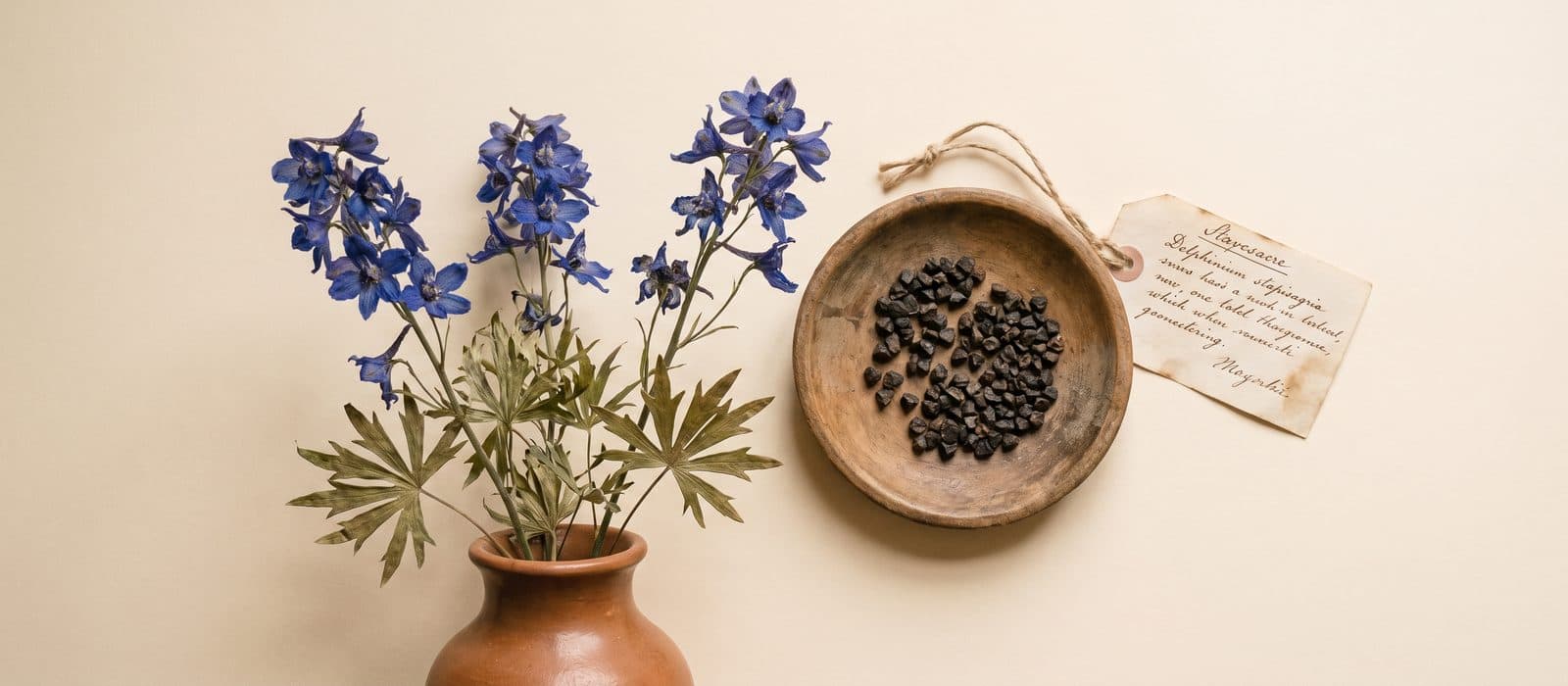
Homeopathic Staphysagria is prepared from the seeds of stavesacre, Delphinium staphisagria (some botanists now place it in its own genus, as Staphisagria macrosperma), a member of the buttercup family (Ranunculaceae). It is a stout, hairy larkspur of rocky ground around the Mediterranean, with deeply lobed leaves, spikes of dark blue flowers and large, rough, angular brown seeds. The name comes from the Greek for "wild raisin", after the look of its seed heads. Our guide to reading Latin remedy names explains why the old spellings persist on labels.
The seeds are poisonous. They contain delphinine and related alkaloids, which affect the heart and nervous system, and stavesacre's long history is as a parasite poison: crushed seeds were rubbed into hair and clothing to kill lice, which gave it the English name lousewort. That use is long abandoned, and the seed is never something to prepare or use at home. The homeopathic preparation grinds the seeds and carries them through repeated dilution and succussion to the labelled potency. At the common potencies the arithmetic says no molecule of the seed remains. Our potencies guide explains what that means, and why it is also the reason science is sceptical.
What is the Staphysagria picture?
The Staphysagria picture is anger that was never allowed out. Imagine someone passed over at work in favour of a colleague who took credit for their project. They said nothing, smiled at the meeting, went home and replayed it all night. They are sweet, conscientious and easily wounded; they keep the peace, and they keep a ledger. Kent's Lectures (1905) and the older literature describe a person sensitive to the least word or slight, who is outwardly controlled and inwardly seething, and who may shake or lose their voice when the feeling finally breaks through.
Hahnemann recorded the remedy's physical picture in Materia Medica Pura, and Boericke (1927) gathers its keynotes. The eyelids are a recurring site: styes one after another, hard lumps on the lid margins, itching lids. Cuts and incisions are another: Boericke describes the smarting, stinging pain of clean-cut wounds and surgical incisions, the kind made by a knife rather than a blow. The urinary tract is a third, with burning in the urethra when not urinating and a picture the old texts tie to intercourse, childbirth or catheterisation. The teeth decay easily and are sensitive; the person is often worn and sallow, sleepy by day and wakeful by night.
Homeopaths read these as one picture because the classic authors kept finding them in people with the same emotional history. The stye matters, but the story of the swallowed insult is what makes it Staphysagria rather than one of a dozen stye pictures.
What makes it better or worse?
The traditional modalities centre on emotion and touch. Staphysagria is worse from anger, indignation and humiliation and from the least touch on the affected part, and better from warmth and rest.
| Modality | Worse | Better |
|---|---|---|
| Emotion | Anger, indignation, humiliation, grief, being reproached | No consistent keynote |
| Touch | The least touch on the affected part | Leaving it alone |
| Temperature | Cold | Warmth |
| Time | No consistent keynote | After breakfast; rest at night (Boericke) |
| Other | Tobacco; loss of fluids (Boericke) | Rest |
Worse from indignation is unusual among modalities, and it is the one homeopaths weigh most here; our guide to modalities, better and worse explains how they are read.
What is Staphysagria traditionally discussed for?
In homeopathic literature, Staphysagria is traditionally discussed for recurring lid lumps, smarting cut pain, and the physical after-effects of suppressed anger. One of our acute pages carries the Staphysagria-like pattern beside its neighbours, with the red flags first.
Eyes and lids
- One stye after another over months, discussed as a lid tendency rather than a one-off blockage: a stye on the eyelid. That page sets out when a lid lump needs a doctor.
Nearby pages that discuss other pictures
- Burning urination compares the violent urinary pictures; the classic texts add Staphysagria for burning that follows intercourse or catheterisation.
- A painful papercut discusses small, sharp cuts; the older literature describes Staphysagria's smarting, cut-like pain in the same territory.
Because the recurring stye is a pattern over time, our guide to acute versus chronic is relevant: the tradition reads a repeating complaint as a constitutional question for a practitioner, not a one-off acute.
What is Staphysagria not?
Staphysagria is not "the remedy for after surgery" or "the remedy for resentment", and the commonest misreading is to pick it from either half of the picture alone. A recurring stye without the emotional background reads as another picture in the tradition; suppressed anger without the physical keynotes is a description of half the population. It is also never a reason to sit out a medical problem. A stye with redness or swelling spreading across the lid or around the eye, pain in the eye itself, changed vision or fever needs prompt medical care, and lid lumps that keep returning deserve an eye examination. A surgical wound that becomes hot, red, swollen or discharging, or a fever after an operation, needs the surgical team. Urinary burning with fever, back pain or blood needs a doctor. Our guide to red flags first sets these out, and lasting distress after humiliation or mistreatment deserves real support, not only a remedy picture.
Homeopaths separate it from its neighbours like this:
| Picture | Where it sits | Defining feature | Key modality |
|---|---|---|---|
| Staphysagria | Recurring styes, clean cuts, suppressed anger | Polite, sensitive, swallowed indignation; smarting pains | Worse anger and touch; better warmth and rest |
| Pulsatilla | Styes, especially upper lid | Mild, weepy, wants company; thick bland discharge | Better open air; worse warm rooms |
| Hepar sulphuris | Styes and lid lumps that come to a head | Very sensitive to touch and cold; irritable | Better warmth; worse cold draughts |
| Ignatia amara | Grief and disappointment | Sighing, changeable, contradictory; grief held in | Worse consolation; better being alone |
| Cantharis | Violent urinary burning | Raw, scalding burning; constant urge | Worse touch and urinating |
The traditional distinction with Ignatia is the emotion held in: Ignatia is grief and disappointment, Staphysagria indignation and humiliation.
What potencies is Staphysagria sold in?
Staphysagria is sold most often as 30C pellets, with 6C and 200C also widely available. Potency describes the preparation process, not an amount of seed: 30C means thirty successive 1:100 dilutions with succussion between them. Our potencies guide explains the scale and what remains in the vial, and why low-potency products of toxic sources carry their own labelling.
This page deliberately gives no frequency or instructions for taking Staphysagria. That depends on a whole case, not a remedy name. Read the product label, and talk to a qualified practitioner about an individual situation.
What remedy lists don't tell you
Two things the "remedies for styes" lists leave out:
- The history is the symptom. A homeopath who suspects Staphysagria will ask about the months before the styes started: an argument, a humiliation, something unfair that was swallowed. Lists sorted by complaint cannot hold that, and it is the half of the picture the classic authors cared about most. Our guide to how a homeopath takes a case shows how that kind of history is gathered.
- A recurring complaint is not an acute one. One stye is an acute event. A stye every few weeks is a pattern, and the tradition regards patterns as constitutional work for a practitioner rather than something to match from a page. The same recurrence is also a good reason for a conventional eye examination.
Where the Staphysagria picture appears on this site
Acute pages that discuss this picture among their educational patterns, with the pattern name each page uses.
- What homeopathic remedy for a stye on the eyelid?Staphysagria-like stye-after-stye pattern
Not sure whether a picture fits?
A remedy profile describes a picture; it cannot tell you whether that picture matches what you are seeing. An acute consultation starts from the case itself: onset, sensations, what changes it, and the red flags.
Acute consultation · $45Frequently asked questions
- What is Staphysagria?
- Staphysagria is a homeopathic remedy prepared from the seeds of stavesacre, a poisonous Mediterranean larkspur once used to kill lice. In homeopathy it names a traditional picture of swallowed indignation: a sensitive, outwardly polite person who has suffered an insult or humiliation and kept the anger in, with physical keynotes such as recurring styes and smarting, cut-like pains. It is a description homeopaths use to compare cases, not a finding that it works for any condition.
- What is Staphysagria used for in homeopathy?
- Homeopathic literature traditionally discusses Staphysagria for recurring styes and lid lumps, for the smarting pain of clean cuts and surgical incisions, for urinary burning after intercourse or catheterisation, and for the after-effects of suppressed anger and humiliation. The picture is defined by that emotional background as much as by the complaint. A stye with spreading redness or swelling of the lid, eye pain or changed vision, or a wound that is hot, red and discharging, needs medical care first.
- What is Staphysagria 30C used for?
- 30C is the common shelf potency of Staphysagria, the one most single-remedy tubes carry. In the tradition the potency does not change the picture; Staphysagria 30C is discussed for the same indignant, sensitive, stye-prone state as any other potency. What 30C means as a dilution is explained in our potencies guide.
- How is Staphysagria taken?
- This page does not give instructions on how or how often to take any remedy, because that depends on a whole case rather than on a remedy name. The product label carries the manufacturer's directions, and a qualified practitioner can advise on an individual situation. Recurring styes, and anything after surgery that looks infected, belong with a clinician first.
- Where can I buy Staphysagria?
- Pharmacies, health-food shops and homeopathic manufacturers sell Staphysagria as single-remedy pellets, most often in 30C, with 6C and 200C also available. This site also prepares custom single remedies to order: you name the remedy and potency, and the details are confirmed by email before anything is made. The order form does not give advice on which remedy to choose.
- What is Staphysagria made from?
- Homeopathic Staphysagria is prepared from the seeds of stavesacre, Delphinium staphisagria, a larkspur of southern Europe and the Mediterranean. The seeds contain delphinine and related alkaloids and are poisonous; they were once crushed into ointments to kill lice. They are never something to prepare or use at home. The seeds are potentised step by step, and potentised preparations are diluted far past the point where the alkaloids remain.
This guide is educational only and is not medical advice or a personalized remedy recommendation. Acute symptoms can become urgent; when in doubt, seek professional evaluation.