Remedy profile
Calendula officinalis in Homeopathy: Uses, Picture and Limits
What homeopathic Calendula is made from, the clean raw wound picture homeopaths describe, what changes it, the potencies and forms sold, and its limits.
By Homeopathic BenefitsPublished 8 min read
Key takeaways
- Calendula is the picture of the clean, raw surface wound. Grazes, scratches, papercuts, split lips, torn blister roofs and small mouth wounds are the territory classic texts describe.
- Pain out of proportion to the wound is the keynote. Boericke (1927) notes that the pain can seem far greater than the injury looks.
- It comes from the garden marigold. Unlike Arnica, Belladonna or Nux vomica, the source plant is not poisonous, and it is sold as much as a cream or tincture as a potentised pellet.
- A cream on the shelf is often a herbal product, not a homeopathic dilution. The label tells you which, and the two are different things.
- Wound red flags come first. A deep, gaping or dirty wound, an animal or human bite, spreading redness, red streaks, pus, fever or a wound that will not close is a medical question before a homeopathic one.
The short answer
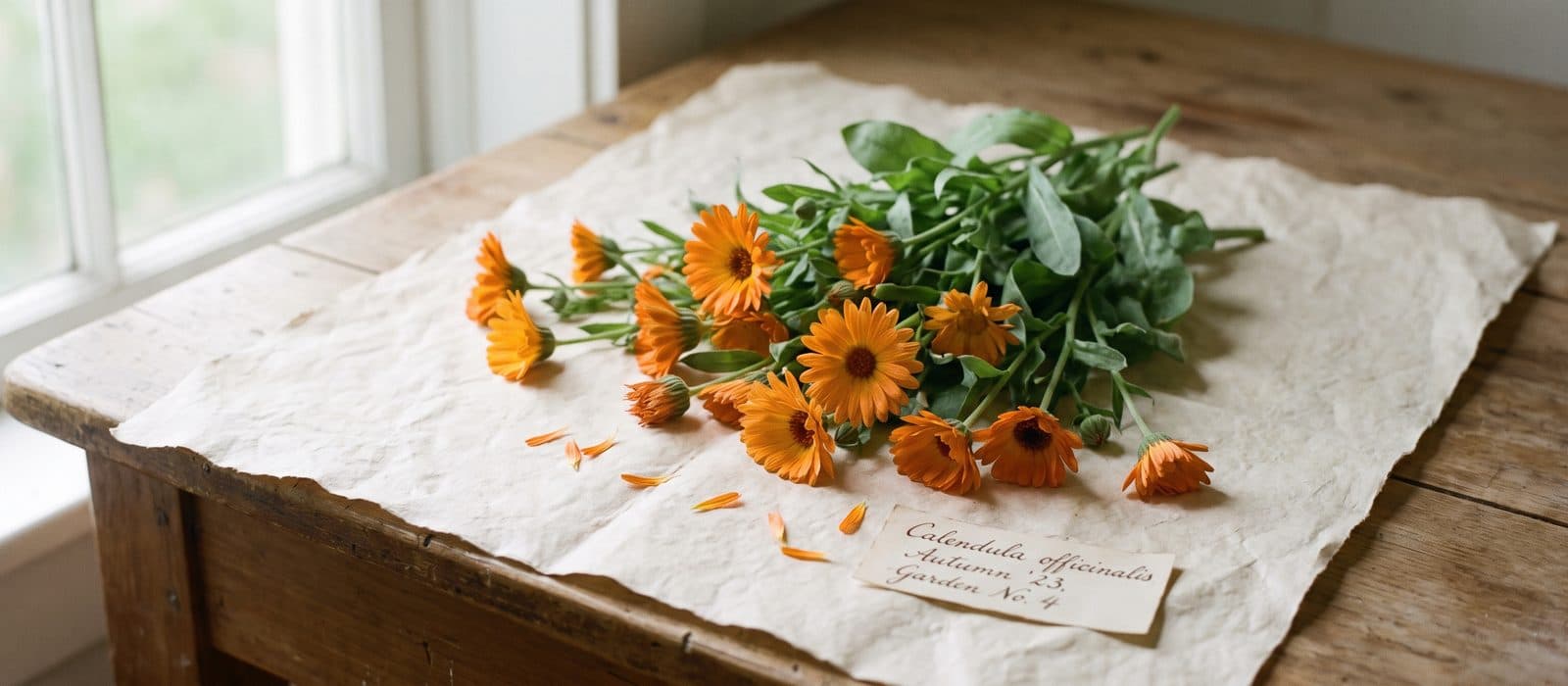
Calendula is a homeopathic remedy prepared from the pot marigold, Calendula officinalis, a bright orange flower of the daisy family grown in gardens across Europe and beyond. In homeopathy it names a traditional picture rather than a treatment: the clean, raw, open surface wound, such as a graze, a scratch, a split lip or a torn blister, where the soreness seems greater than the wound looks. Classic materia medica, Boericke (1927) above all, gives it a long entry for torn and lacerated surfaces and describes it as much as a local application as a remedy taken by mouth. It is sold as pellets, as a mother tincture and in many creams and gels. It is not a remedy for infected, deep or dirty wounds, and nothing about the picture replaces medical care when a wound shows warning signs.
| Latin name | Calendula officinalis |
|---|---|
| Abbreviation | Calen. |
| Common name | Pot marigold, garden marigold |
| Source | Fresh flowering tops and leaves of Calendula officinalis (Asteraceae) (plant kingdom) |
| Commonly sold potencies | Mother tincture (Ø), 6C, 30C |
| First proving | Proved in the nineteenth century and recorded in Allen's Encyclopedia of Pure Materia Medica (1874–1879); long entry in Boericke (1927) |
What is Calendula made from?
Homeopathic Calendula is prepared from the fresh flowering tops and leaves of Calendula officinalis, the pot marigold. It is an easy annual of the daisy family (Asteraceae) with sticky, aromatic leaves and flat orange or yellow flower heads that open in the sun and close in the evening and in dull weather. The Latin name comes from calendae, the first day of the Roman month, after its habit of flowering through almost every month of the year. It is not the same plant as the French and African marigolds of bedding schemes, which belong to a different genus, Tagetes.
The plant is steeped in alcohol to make a mother tincture. That tincture is the starting point for two quite different kinds of product. For homeopathic pellets it is diluted and succussed step by step to the labelled potency; at 30C the arithmetic says no molecule of the flower remains, which our potencies guide explains honestly, including why it is the reason science is sceptical. For topical products, the tincture or a herbal extract of the flowers goes into creams, ointments, gels and washes, often undiluted in the homeopathic sense.
Calendula is one of the gentler sources in the kit. The pot marigold is not poisonous, and its petals have long been used to colour food. The one caution that runs through herbal references is allergy: people sensitive to the daisy family, which includes ragweed, chrysanthemums and chamomile, can react to calendula on the skin.
What is the Calendula picture?
The Calendula picture is less a person than a wound. Picture the cyclist who comes off on gravel: a wide graze on the forearm, raw and weeping, flecked with grit until it is washed out, stinging out of all proportion to how deep it is. Or the cook who catches a knuckle on the grater, the walker whose heel blister has torn and left a red, raw floor, the child who has bitten their tongue at dinner. These are the scenes classic texts gather under Calendula: clean, open, superficial injuries to skin and mucous membrane, with the surface torn rather than crushed.
Boericke (1927) gives Calendula one of his more enthusiastic entries. He describes it for open wounds and lacerated surfaces, for parts that are slow to close, and for the stage when a wound is raw and granulating. He notes that the pain can be excessive for the size of the injury, and that the person can be unusually sensitive to open air and inclined to take a chill in damp weather.
There is very little mental picture in the older literature, and homeopaths do not pretend there is. Calendula belongs to a small group of remedies, alongside Arnica and Hypericum, that the tradition reads mostly from the kind of injury and the sensations around it rather than from temperament. What matters is the surface: torn, raw, clean, and sore.
What makes it better or worse?
The traditional modalities are sparse for Calendula, which is typical of a remedy read mainly from the wound. Boericke records the weather and the open air; later teachers add the touch and exposure of the raw surface.
| Modality | Worse | Better |
|---|---|---|
| Weather | Damp, heavy, cloudy weather (Boericke) | No consistent keynote |
| Air | Open air and draughts on the raw surface | Being covered |
| Position and motion | No consistent keynote | Walking about, or lying perfectly still (Boericke) |
| Touch | Contact with the raw surface | Leaving the wound undisturbed |
| Temperature | Chill, especially damp cold | Warmth |
Our guide to modalities, better and worse explains why a homeopath looks at these before reaching for any remedy name, and why a remedy with few of them is read more from the injury itself.
What is Calendula traditionally discussed for?
In homeopathic literature, Calendula is traditionally discussed for clean, raw, superficial wounds in their ordinary settling phase. Each of these appears on one of our acute pages, where the Calendula-like pattern sits beside its neighbours and the red flags come first.
Cuts, scratches and grazes
- The small, clean, disproportionately sore cut: a painful papercut.
- A scratch from a pet, while watching for the signs that it needs attention: redness after a cat scratch. Cat scratches and bites can carry infection; that page sets out when to see a clinician.
Raw skin surfaces
- The torn roof and raw floor of a blister: a painful friction blister.
- Freshly worked skin in the ordinary settling phase: mild skin irritation after a tattoo.
Mouth and lips
- A raw split or graze of the lip: a swollen lip after an injury.
- The clean, raw wound inside the mouth: a painful tongue bite.
What is Calendula not?
Calendula is not "the wound remedy", and it is not an antiseptic. The commonest misreading is to regard a marigold cream as though it were first aid in itself. Cleaning a wound, closing it when it needs closing and checking tetanus cover are conventional first-aid questions, and they come first. The Calendula picture in the tradition is the clean wound: once a wound shows spreading redness, warmth, swelling, pus, red streaks running from it, or a fever, the picture homeopaths discuss is a different one, and more importantly it is a reason to see a clinician. A deep or gaping cut, a puncture, a wound with dirt or glass in it, an animal or human bite, a wound on the face that may scar, or any wound in someone with diabetes or poor circulation needs medical assessment. Our guide to red flags first sets these out.
Homeopaths separate it from its neighbours like this:
| Picture | Where it sits | Defining feature | Key modality |
|---|---|---|---|
| Calendula | Clean, raw, torn surface wounds | Soreness out of proportion to the wound; raw, open surface | Worse damp weather and open air on the wound |
| Hypericum | Injuries to nerve-rich parts: fingertips, toes, spine | Shooting pains that travel up from the injury | Worse touch and jarring |
| Ledum | Punctures, stings and bites | Small entry wound; the part feels cold yet wants cold | Better cold applications |
| Arnica montana | Bruising and blunt injury | Sore, bruised, says they are fine; skin not broken | Worse touch; fears being approached |
| Staphysagria | Clean incised cuts, as from a blade | Smarting cut with a sense of violation or indignation | Worse touch |
The traditional line between Calendula and Arnica is the skin: Arnica belongs to the bruise where the surface is intact, Calendula to the surface that is open.
What potencies is Calendula sold in?
Calendula is sold in more forms than most remedies. As homeopathic pellets it is found in 6C and 30C, with 30C the common shelf potency. It is also sold as a mother tincture (labelled Ø), and in a wide range of creams, ointments, gels, sprays and washes for the skin. Potency describes the preparation process, not an amount of flower: 30C means thirty successive 1:100 dilutions with succussion between them. Our potencies guide explains the scale and what remains in the vial.
This page deliberately gives no frequency or instructions for taking Calendula, and no instructions for applying a topical product. That depends on the wound and the whole case, not a remedy name. Read the product label, and talk to a pharmacist or a qualified practitioner about an individual situation.
What remedy lists don't tell you
Two things the "remedies for cuts and grazes" lists leave out:
- A calendula cream and a Calendula remedy are often different products. Many creams on pharmacy shelves are herbal: they contain a measurable extract of marigold flowers, which is why skin allergy is possible. A homeopathic potency such as 30C is a dilution in which, by the arithmetic, none of the plant remains. The labels sit side by side and the name is the same; reading which one you are holding is the first step, and our guide to what is in a homeopathic remedy explains the difference.
- The tradition draws its line at the clean wound. Classic texts discuss Calendula for raw, open surfaces that are settling, not for wounds that are hot, swollen, discharging or tracking. That boundary is also the boundary where a wound becomes a medical question. A homeopath reading a wound looks for the warning signs first, and only then thinks about which picture the injury resembles.
Where the Calendula officinalis picture appears on this site
Acute pages that discuss this picture among their educational patterns, with the pattern name each page uses.
- What homeopathic remedy for a painful friction blister?Calendula-like raw skin repair focus pattern
- What homeopathic remedy for a painful papercut?Calendula-like raw skin support pattern
- What homeopathic remedy for a painful tongue bite?Calendula-like raw mucosal repair framing
- What homeopathic remedy for a swollen lip after an injury?Calendula-like raw split-edge framing
- What homeopathic remedy for mild skin irritation after a tattoo?Calendula-like raw-skin repair framing
- What homeopathic remedy for redness after a cat scratch?Calendula-like raw skin support pattern
Not sure whether a picture fits?
A remedy profile describes a picture; it cannot tell you whether that picture matches what you are seeing. An acute consultation starts from the case itself: onset, sensations, what changes it, and the red flags.
Acute consultation · $45Frequently asked questions
- What is Calendula officinalis?
- Calendula officinalis is the pot marigold, a bright orange garden flower of the daisy family. In homeopathy, Calendula is a remedy prepared from its flowering tops and leaves, and it names a traditional picture: the clean, raw, open surface wound, such as a graze, a split lip or a torn blister, where the pain seems out of proportion to the injury. It is a description homeopaths use to compare cases, not evidence that it works for wounds or anything else.
- What is Calendula used for in homeopathy?
- Homeopathic literature traditionally discusses Calendula for clean, raw, superficial wounds: cuts, grazes, scratches, torn blisters, split lips and small mouth wounds, in the ordinary settling phase. Calendula is also sold widely as creams, gels and tinctures for the skin, and many of those are herbal rather than potentised products. A deep or gaping wound, a bite, spreading redness, red streaks, pus, fever or a wound that is not closing needs medical care first.
- What is Calendula 30C used for?
- Calendula is sold in 30C, though it is more often seen as a mother tincture, cream or gel than as pellets. In the tradition the potency does not change the picture: Calendula 30C belongs to the same clean, raw wound description as any other Calendula preparation. Our potencies guide explains what 30C means as a dilution.
- How is Calendula taken?
- This page does not give instructions on how or how often to take or apply any remedy or product, because that depends on a whole case rather than on a remedy name. The product label carries the manufacturer's directions, and a qualified practitioner or pharmacist can advise on an individual situation. A wound that is deep, dirty, from a bite, or showing signs of infection belongs with a clinician first.
- Where can I buy Calendula?
- Pharmacies, health-food shops and homeopathic manufacturers sell Calendula as single-remedy pellets, most often in 30C, and far more widely as topical creams, gels and tinctures. This site also prepares custom single remedies to order: you name the remedy and potency, and the details are confirmed by email before anything is made. The order form does not give advice on which remedy to choose.
- What is Calendula made from?
- Homeopathic Calendula is prepared from the fresh flowering tops and leaves of Calendula officinalis, the pot marigold. The plant is steeped into a mother tincture, which is sold as it is for topical products, and for pellets it is then diluted and succussed step by step to the labelled potency. Unlike many remedy sources, the plant itself is not poisonous, though people allergic to the daisy family can react to it on the skin.
This guide is educational only and is not medical advice or a personalized remedy recommendation. Acute symptoms can become urgent; when in doubt, seek professional evaluation.