Remedy profile
Hypericum perforatum in Homeopathy: Uses, Picture and Limits
What homeopathic Hypericum is made from, the shooting, nerve-line injury picture homeopaths describe, what changes it, the potencies sold, and its limits.
By Homeopathic BenefitsPublished 7 min read
Key takeaways
- Hypericum is the picture of injured nerves. Homeopaths describe sharp, shooting, electric pains after injury to parts dense with nerve endings: fingertips, toes, nails, lips, tongue, teeth and the tailbone.
- The pain is out of proportion to the wound. Classic texts describe a small crush or puncture that fires jolts up the limb, worse from touch and jarring.
- It sits beside Arnica, not in place of it. Arnica is the bruised-soreness picture; Hypericum is the shooting-nerve picture, and many injuries show neither.
- It comes from St John's wort, but it is not herbal St John's wort. Herbal extracts contain the plant and interact with many medicines; potentised Hypericum is diluted past the point where any remains.
- Injury red flags come first. Deep or dirty punctures, animal bites, a spreading or bull's-eye rash after a tick, numbness, weakness, or loss of bladder or bowel control are medical questions before they are homeopathic ones.
The short answer
Hypericum perforatum is a homeopathic remedy prepared from St John's wort, a yellow-flowered plant of meadows and roadsides, made into a mother tincture and then diluted and succussed. In homeopathy it names a traditional picture rather than a treatment: an injury to a part rich in nerves, such as a crushed fingertip, a stubbed toe, a bitten tongue or a fall onto the tailbone, with sharp, shooting pains that run along the nerve and feel far bigger than the wound. Classic materia medica describes pains made worse by touch, jarring and cold damp air. Boericke (1927) gave it a short, clear entry built around injuries to nerves, and it became a standard of first-aid kits. It is not a general injury remedy, and nothing about the picture replaces medical care for deep wounds, bites or injuries with numbness or weakness.
| Latin name | Hypericum perforatum |
|---|---|
| Abbreviation | Hyper. |
| Common name | St John's wort |
| Source | The whole fresh flowering plant of Hypericum perforatum (Hypericaceae), made into a mother tincture (plant kingdom) |
| Commonly sold potencies | 6C, 30C, 200C |
| First proving | Proved in the nineteenth century; recorded in Allen's Encyclopedia of Pure Materia Medica (1874–1879) |
What is Hypericum made from?
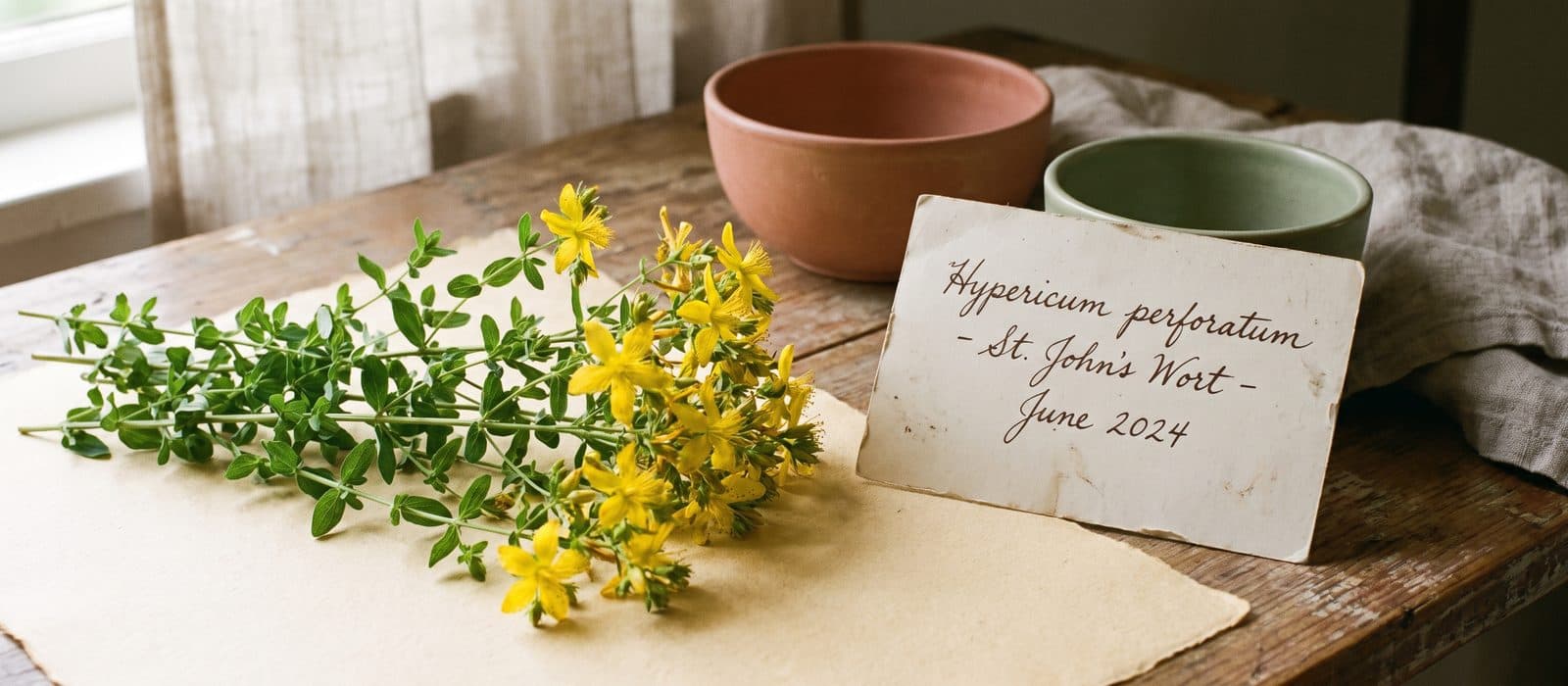
Homeopathic Hypericum is prepared from Hypericum perforatum, St John's wort, a perennial of meadows, hedgerows and roadsides across Europe and western Asia, now naturalised in North America and Australia. It grows to knee height and carries flat clusters of bright yellow, five-petalled flowers around midsummer. Its English name comes from flowering near St John's Day, 24 June. Hold a leaf up to the light and it looks pricked with tiny holes: these are translucent oil glands, and they give the plant its Latin name, perforatum. Rub a flower between the fingers and it stains them a deep red.
The homeopathic preparation uses the whole fresh plant in flower, steeped to make a mother tincture, which is then diluted and succussed to the potency on the label. Our guide to what is in a homeopathic remedy explains the process, and the potencies guide explains why, at the common potencies, no plant material is expected to remain and why science is sceptical as a result.
This is the one place on the page where the difference matters for safety. Herbal St John's wort, sold as capsules, tablets and teas for low mood, contains the plant in measurable amounts. It is known to interact with many prescription medicines, including some contraceptives, blood thinners, antidepressants and transplant drugs, and it can make the skin more sensitive to sunlight. Potentised Hypericum is a different product. Anyone taking prescription medicine who is unsure which kind they have, or who is considering a low-potency or tincture product, should ask a pharmacist.
What is the Hypericum picture?
The Hypericum picture is defined by the kind of pain more than by the person. Picture someone who has shut a car door on their fingertip. The finger is barely marked, but every few seconds a sharp, electric jolt shoots from the tip towards the hand, and the lightest brush of a sleeve sets it off again. They cradle the hand and cannot think about anything else. Or the child who has slid down the stairs onto their tailbone and now winces at every step, with pain that shoots down the back of the leg when they sit.
Classic texts describe the injured part as exquisitely sensitive and the pain as shooting, tearing or lancinating, travelling along the course of the nerve rather than staying in one sore spot. Boericke (1927) lists injuries to nerves, especially of fingers, toes and nails, crushed fingers, punctured wounds and the coccyx, and pain after a fall onto the spine. Nash (1898) and Clarke's Dictionary (1900–1902) paired it with puncture wounds in the same breath as Ledum.
The person's temperament is not the centre of this picture in the way it is for a remedy like Nux vomica or Pulsatilla. What homeopaths look for is the location (somewhere nerve-rich), the quality (shooting, electric, disproportionate) and the modalities.
What makes it better or worse?
The traditional modalities centre on touch, jarring and cold damp. Hypericum is worse from the slightest touch, from jarring and from cold, damp air, and better from keeping the injured part still.
| Modality | Worse | Better |
|---|---|---|
| Touch | The lightest touch on the injured part | Leaving it alone |
| Motion | Jarring, sudden movement, walking (tailbone) | Keeping still |
| Temperature and weather | Cold, damp and fog (Boericke) | No consistent keynote |
| Position | Sitting on the tailbone; pressure on the part | Bending the head backwards, for spinal pain (Boericke) |
| Rooms | A close, stuffy room | No consistent keynote |
Touch sensitivity is what most separates Hypericum from its injury neighbours; our guide to modalities, better and worse explains why a homeopath reads it before any remedy name.
What is Hypericum traditionally discussed for?
In homeopathic literature, Hypericum is traditionally discussed for injuries to nerve-rich parts with shooting, disproportionate pain. Each of these appears on one of our acute pages, where the Hypericum-like pattern sits beside its neighbours and the red flags come first.
Face, mouth and teeth
- Sharp jolts after a knock to the face: a black eye, a swollen nose after a fall and a swollen lip after an injury.
- A bitten tongue that fires with speech and temperature: a painful tongue bite.
- Electric dental pain: teeth sensitive to cold and a sudden toothache flare.
Spine and tailbone
- Shooting pain after landing on the coccyx: tailbone pain after a fall.
Fingers, toes and nails
- Nerve-line pain around the nail: a sore hangnail and an ingrown toenail.
- Sharp soreness after pinching friction: a painful friction blister.
Punctures, bites and stings
Overuse and pinch injuries
- Sharp, nerve-line pains rather than dull aching: soreness on the outside of the elbow and wrist pain from typing. Our guide to sprains, strains and overuse reads these cases side by side.
What is Hypericum not?
Hypericum is not "the nerve remedy", and it is not a substitute for wound care. The commonest misreading is to file any painful injury to a finger or toe under Hypericum. The tradition's picture is the shooting, electric, touch-intolerant pain of an injured nerve-rich part; a throbbing, bruised or merely sore injury belongs elsewhere. It is also not a reason to sit out a deep or dirty puncture wound, especially if tetanus vaccination is not up to date; an animal or human bite; a tick bite followed by a spreading or bull's-eye rash, fever or aches; numbness, tingling or weakness after an injury; loss of bladder or bowel control, or numbness in the saddle area, after a fall onto the back; a dental swelling with fever or spreading into the face; or vision changes after a black eye. Our guide to red flags first covers what to check before anything else.
Homeopaths separate Hypericum from its neighbours like this:
| Picture | Where it sits | Defining feature | Key modality |
|---|---|---|---|
| Hypericum | Nerve-rich injuries: fingertips, toes, tailbone, teeth | Shooting, electric pain out of proportion to the wound | Worse touch and jarring |
| Arnica montana | Bruising, shock, overexertion | Sore, bruised feeling; says they are fine | Worse touch; dreads being approached |
| Ledum | Punctures and bites | Puncture site cold, puffy, mottled | Better cold applications |
| Ruta graveolens | Tendons, bone surfaces, overuse | Deep, bruised aching; stiffness and weakness | Worse rest and cold damp |
| Calendula | Open, raw surface wounds | Torn or grazed skin; soreness at the wound | Worse damp, cloudy weather |
What potencies is Hypericum sold in?
Hypericum perforatum is sold most often as 30C pellets, the common shelf potency for single remedies, with 6C and 200C also widely available. Combined Hypericum and Calendula tinctures and creams for external use are also sold; those are low-dilution products and a different category. Potency describes the preparation process, not an amount of plant: 30C means thirty successive 1:100 dilutions with succussion between them. Our potencies guide explains the scale and what remains in the vial.
This page deliberately gives no frequency or instructions for taking Hypericum. That depends on a whole case, not a remedy name. Read the product label, and talk to a qualified practitioner about an individual situation.
What remedy lists don't tell you
Two things the first-aid kit lists leave out:
- The quality of the pain matters more than the injury. Two people can catch the same finger in the same drawer. One has a throbbing, bruised fingertip that aches when pressed; the other has electric jolts shooting up the hand at the lightest touch. The tradition puts them in different pictures, and asking "does it ache, or does it shoot?" is a question anyone can answer.
- The puncture question is Hypericum or Ledum, and temperature decides it. Classic texts pair the two for punctures and bites. The Ledum picture is a puncture that looks cold and mottled and feels better for cold; the Hypericum picture is one where pain shoots away from the wound. Our guide to stocking a home remedy kit explains why kits carry both, and why neither replaces cleaning the wound and checking tetanus status.
Where the Hypericum perforatum picture appears on this site
Acute pages that discuss this picture among their educational patterns, with the pattern name each page uses.
- What homeopathic remedy for a black eye after a bump?Hypericum-like nerve-rich crush pattern
- What homeopathic remedy for a painful friction blister?Hypericum-like nerve-rich soreness pattern
- What homeopathic remedy for a painful tongue bite?Hypericum-like nerve-zing tongue pattern
- What homeopathic remedy for a routine insect bite?Hypericum-like nerve-rich sting pattern
- What homeopathic remedy for a sore hangnail with redness?Hypericum-like nerve-line nail pain pattern
- What homeopathic remedy for a splinter or shallow puncture wound?Hypericum-like nerve-line pain pattern
- What homeopathic remedy for a sudden toothache flare?Hypericum-like nerve shooting dental pattern
- What homeopathic remedy for a swollen lip after an injury?Hypericum-like nerve-zing lip pattern
- What homeopathic remedy for a swollen nose after a fall?Hypericum-like nerve-edge pain pattern
- What homeopathic remedy for a tick bite with local redness?Hypericum-like nerve-line bite pattern
- What homeopathic remedy for an ingrown toenail?Hypericum-like nerve-line nail pain pattern
- What homeopathic remedy for soreness on the outside of the elbow?Hypericum-like nerve-line soreness pattern
- What homeopathic remedy for tailbone pain after a fall?Hypericum-like nerve-rich tailbone pain pattern
- What homeopathic remedy for teeth sensitive to cold?Hypericum-like shooting dental nerve pattern
- What homeopathic remedy for wrist pain from typing?Hypericum-like nerve-line soreness pattern
Not sure whether a picture fits?
A remedy profile describes a picture; it cannot tell you whether that picture matches what you are seeing. An acute consultation starts from the case itself: onset, sensations, what changes it, and the red flags.
Acute consultation · $45Frequently asked questions
- What is Hypericum?
- Hypericum perforatum is a homeopathic remedy prepared from St John's wort, a yellow-flowered meadow plant. In homeopathy it names a traditional picture: injuries to parts rich in nerves, such as fingertips, toes, nails, lips, tongue, teeth and the tailbone, with sharp, shooting pains that run along the nerve and feel out of proportion to the wound. It is a description homeopaths use to compare cases, not a finding that it works for any injury or condition.
- What is Hypericum used for in homeopathy?
- Homeopathic literature traditionally discusses Hypericum for crushed fingers and toes, punctures, splinters, bitten tongues and lips, tailbone falls and tooth pain, wherever sharp, electric pains shoot along nerve lines. The picture is defined by that shooting quality and the nerve-rich location, not by the name of an injury. Deep or dirty puncture wounds, numbness or weakness, and loss of bladder or bowel control after a fall need medical care first.
- What is Hypericum 30C used for?
- 30C is the common shelf potency of Hypericum, the one most single-remedy tubes and home kits carry. In the tradition the potency does not change the picture; Hypericum 30C is discussed for the same shooting, nerve-line injury pain as any other potency. What 30C means as a dilution is explained in our potencies guide.
- How is Hypericum perforatum taken?
- This page does not give instructions on how or how often to take any remedy, because that depends on a whole case rather than on a remedy name. The product label carries the manufacturer's directions, and a qualified practitioner can advise on an individual situation. A deep puncture, an animal bite or an injury with numbness or weakness belongs with a clinician first.
- Where can I buy Hypericum perforatum?
- Pharmacies, health-food shops and homeopathic manufacturers sell Hypericum perforatum as single-remedy pellets, most often in 30C, and it appears in many first-aid kits. This site also prepares custom single remedies to order: you name the remedy and potency, and the details are confirmed by email before anything is made. The order form does not give advice on which remedy to choose.
- What is Hypericum perforatum made from?
- Homeopathic Hypericum is prepared from the whole fresh flowering plant of St John's wort, Hypericum perforatum. The plant is steeped to make a mother tincture, which is then diluted and succussed step by step to the labelled potency. It is a different product from herbal St John's wort capsules and teas, which contain the plant in measurable amounts.
This guide is educational only and is not medical advice or a personalized remedy recommendation. Acute symptoms can become urgent; when in doubt, seek professional evaluation.