Remedy profile
Symphytum officinale in Homeopathy: Uses, Picture and Limits
What homeopathic Symphytum is made from, the bone-bruise and blow-to-the-eye picture homeopaths describe, what changes it, potencies sold, and its limits.
By Homeopathic BenefitsPublished 7 min read
Key takeaways
- Symphytum is the picture of pain in bone. Classic texts place it where an injury has reached the bone and the periosteum, the thin membrane that covers it, rather than the muscle or the skin.
- Its best-known keynote is the blow to the eyeball. Boericke (1927) and the older literature describe pain in the eye after a blow from a blunt object, such as a ball or a fist.
- The old name explains the reputation. Comfrey was called knitbone in English herbals long before homeopathy, and the homeopathic picture grew out of that folk use.
- The herb itself carries a warning. Comfrey taken by mouth can harm the liver; the potentised preparation is diluted far past the point where the plant is a concern.
- Bone and eye injuries are medical questions first. Deformity, inability to bear weight, a bent nose, any change in vision, or a blow to the head needs assessment before any remedy picture.
The short answer
Symphytum is a homeopathic remedy prepared from common comfrey, Symphytum officinale, a hairy-leaved plant of damp European ground that English herbalists called knitbone. In homeopathy it names a traditional picture rather than a treatment: pain that sits in bone and in the periosteum covering it, after a knock, a fall or a fracture that has already been set. Its other classic keynote is pain in the eyeball after a blow from a blunt object. It is a small remedy in the literature, with few mental or general symptoms, and it entered homeopathic use in the later nineteenth century mostly through clinical reports. It is not a way to manage a broken bone or an eye injury, both of which need medical care first.
| Latin name | Symphytum officinale |
|---|---|
| Abbreviation | Symph. |
| Common name | Comfrey, knitbone |
| Source | Fresh root of common comfrey, Symphytum officinale (Boraginaceae) (plant kingdom) |
| Commonly sold potencies | 6C, 30C, 200C |
| First proving | Introduced in the later nineteenth century largely from clinical reports rather than a full proving; recorded in Clarke's Dictionary (1900–1902) and Boericke (1927) |
What is Symphytum made from?
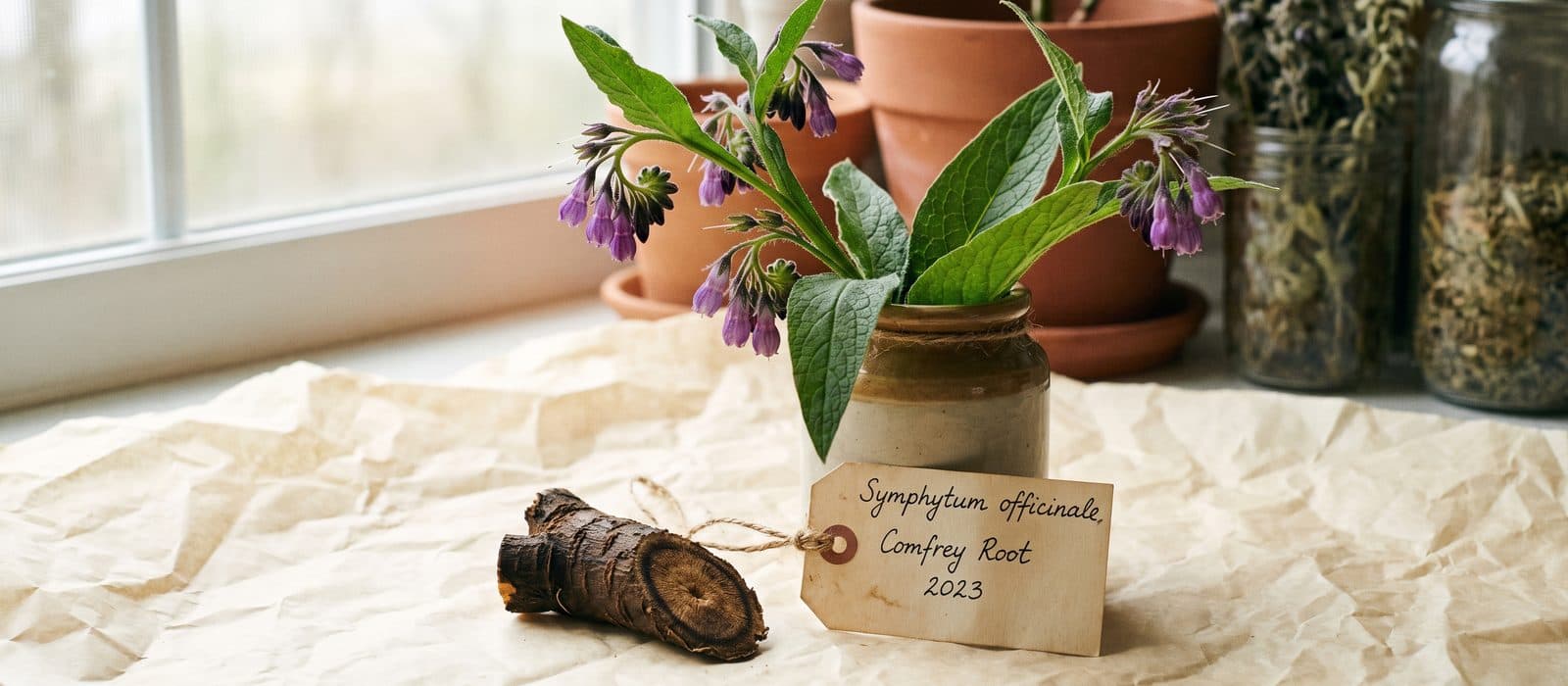
Homeopathic Symphytum is prepared from the fresh root of common comfrey, Symphytum officinale, a member of the borage family (Boraginaceae). It is a tall, bristly perennial of riverbanks, ditches and damp meadows across Europe, with broad rough leaves and drooping clusters of bell-shaped flowers in cream, mauve or purple. The root is thick, black outside and white and mucilaginous within. Its Latin name comes from the Greek for "to grow together", and its English names, knitbone and boneset, say the same thing: comfrey poultices were wrapped around broken limbs for centuries.
The plant deserves an honest note. Comfrey contains pyrrolizidine alkaloids, which can cause serious liver damage when the plant is taken by mouth. In 2001 the US Food and Drug Administration advised manufacturers to remove oral comfrey products from the market, and several other countries restrict them. Comfrey tea, tablets and home-made preparations from the root are not something to make or swallow at home. The homeopathic preparation starts from a mother tincture of the root and carries it through repeated dilution and succussion; at the common potencies the arithmetic says nothing of the root remains. Our potencies guide explains what that means, and why it is also the core of scientific scepticism about homeopathy. Herbal comfrey creams for the skin are a separate product with their own labelling.
What is the Symphytum picture?
The Symphytum picture is mostly local, and it is about where the pain lives. Imagine someone who caught a cricket ball on the shin a week ago. The bruise on the skin has faded, but pressing on the front of the bone still brings a sharp, pricking soreness, as if the bone itself were tender. Or someone whose nose met a door frame: the swelling has settled, yet the ache sits on the hard bridge of the nose, and every touch to the bone edges renews it. Classic texts describe exactly this pricking pain and soreness of the periosteum.
Boericke (1927) gathers the remedy under injuries to sinews, tendons and periosteum, and describes an irritable, painful bone at the site of an old fracture. The older literature extends that to fractures that were slow to knit, which is where the knitbone reputation and the homeopathic picture meet. Clarke's Dictionary (1900–1902) records the same territory and the clinical reports behind it.
The second keynote is the eye. Homeopathic writers repeatedly single out pain in the eyeball after a blow from a blunt object: a squash ball, an elbow, a fist. The surrounding black eye belongs to other pictures; Symphytum is described for the deeper ache in the globe and the bony rim of the socket.
There is little mental or emotional picture to speak of. Symphytum is one of the remedies homeopaths describe as acting on a tissue rather than on a whole temperament, which is why it so often appears beside broader pictures rather than in place of them.
What makes it better or worse?
The traditional modalities for Symphytum are sparse, and that is worth saying plainly. The literature records worse from touch and pressure on the injured bone, and little else of consistency.
| Modality | Worse | Better |
|---|---|---|
| Touch | Pressure on the bone edge or the injured spot | Leaving the part alone |
| Cause | Blows, falls, a fracture, a blunt blow to the eye | No consistent keynote |
| Tissue | Bone and periosteum rather than muscle | Not applicable |
| Motion | Movement that loads the injured bone | Rest |
| Temperature and time | No reliable keynote in the classic texts | No reliable keynote |
Where modalities are thin, homeopaths lean on location and cause instead. Our guide to modalities, better and worse explains how they are usually read.
What is Symphytum traditionally discussed for?
In homeopathic literature, Symphytum is traditionally discussed for injuries that reach bone. One of our acute pages carries the Symphytum-like pattern beside its neighbours, with the red flags first.
Face and nose
- The bone-bruise ache on the bridge of the nose after a knock: a swollen nose after a fall. That page sets out when a nose injury needs to be seen, including a bent nose, clear fluid from the nostrils or a head injury.
Nearby pages that discuss other pictures
- A black eye after a bump discusses the soft-tissue bruise; the classic texts add Symphytum only for the deeper ache in the eyeball itself.
- A bruised tailbone after a fall and shin splints from running describe aches near bone where homeopaths compare several pictures. Our guide to sprains, strains and overuse explains how the tissue involved changes the reading.
What is Symphytum not?
Symphytum is not "the broken bone remedy", and it is never a reason to delay an X-ray. A bone that looks deformed, a limb that cannot bear weight, numbness or coldness beyond an injury, or pain that is severe or worsening needs assessment, and a fracture is set and managed in conventional care. The tradition discusses Symphytum alongside that care, for the soreness of a bone already looked after, not instead of it. Nor is it an answer to an eye injury: any blow to the eye followed by blurred or double vision, flashes, floaters, a shadow across the vision, blood in the front of the eye or severe pain is an emergency. A blow to the head with drowsiness, vomiting or confusion is also a medical question first. Our guide to red flags first sets these out.
Homeopaths separate it from its neighbours like this:
| Picture | Where it sits | Defining feature | Key modality |
|---|---|---|---|
| Symphytum | Bone and periosteum; blow to the eyeball | Pricking soreness located in bone; old fracture site still tender | Worse touch and pressure on the bone |
| Arnica montana | Fresh bruising and shock | Bruised, sore all over; insists they are fine | Worse touch and jarring |
| Ruta graveolens | Tendons, bone surfaces, eye strain | Bruised, lame, stiff after overuse | Worse lying on the sore part, worse cold and damp |
| Calcarea phosphorica | Slow-growing or slow-knitting bones | Aching bones, weary, discontented; a constitutional picture | Worse cold and damp, changes of weather |
| Ledum | Black eyes and puncture wounds | Cold, mottled, puffy tissue that feels cold | Better cold applications |
The traditional distinction with Arnica is timing and depth. Arnica is the picture of the fresh, whole-body bruise; Symphytum belongs to the ache that has settled in the bone once the surface has calmed.
What potencies is Symphytum sold in?
Symphytum is sold most often as 30C and 6C pellets, with 200C available from specialist manufacturers. Potency describes the preparation process, not an amount of comfrey: 30C means thirty successive 1:100 dilutions with succussion between them. Our potencies guide explains the scale and what remains in the vial. Comfrey ointments and creams sold in the herbal aisle are not homeopathic potencies, even when they sit on the same shelf.
This page deliberately gives no frequency or instructions for taking Symphytum. That depends on a whole case, not a remedy name. Read the product label, and talk to a qualified practitioner about an individual situation.
What remedy lists don't tell you
Two things the "remedies for injuries" lists leave out:
- The question is which tissue hurts, not what happened. A fall can bruise skin, strain a muscle, wrench a tendon or knock a bone, all at once. Homeopaths try to locate where the pain now lives, and only the bone-and-periosteum part of that story belongs to Symphytum. Lists that file it under "fractures" skip the reasoning that made it distinctive.
- The folk name did a lot of the work. Much of what the literature says about Symphytum comes from clinical reports shaped by comfrey's centuries-old knitbone reputation, not from a large formal proving. That makes it a thinly documented remedy by homeopathic standards, and it is fair to read its keynotes as tradition rather than as anything tested.
Where the Symphytum officinale picture appears on this site
Acute pages that discuss this picture among their educational patterns, with the pattern name each page uses.
- What homeopathic remedy for a swollen nose after a fall?Symphytum-like bone-bruise pattern
Not sure whether a picture fits?
A remedy profile describes a picture; it cannot tell you whether that picture matches what you are seeing. An acute consultation starts from the case itself: onset, sensations, what changes it, and the red flags.
Acute consultation · $45Frequently asked questions
- What is Symphytum?
- Symphytum is a homeopathic remedy prepared from comfrey, Symphytum officinale, the plant known in English folk medicine as knitbone. In homeopathy it names a narrow traditional picture: pain that sits in bone and the membrane covering it, after a blow or a break, and pain in the eyeball after a blow from a blunt object. It is a description homeopaths use to compare cases, not a finding that it works for fractures or any other condition.
- What is Symphytum used for in homeopathy?
- Homeopathic literature traditionally discusses Symphytum for injuries that reach the bone: a knock to the shin or the bridge of the nose where the ache sits on the bone itself, a fracture that has already been set and is still sore, and a blow to the eyeball. The picture is defined by pain located in bone and periosteum, not by the word injury. A suspected break, a bent nose, any change in vision after a blow, or a head injury needs medical assessment first.
- What is Symphytum 30C used for?
- 30C is the common shelf potency of Symphytum, and 6C is also widely sold. In the tradition the potency does not change the picture; Symphytum 30C is discussed for the same bone-bruise and blow-to-the-eye state as any other potency. What 30C means as a dilution is explained in our potencies guide.
- How is Symphytum taken?
- This page does not give instructions on how or how often to take any remedy, because that depends on a whole case rather than on a remedy name. The product label carries the manufacturer's directions, and a qualified practitioner can advise on an individual situation. A possible broken bone or an eye injury belongs with a clinician first.
- Where can I buy Symphytum?
- Pharmacies, health-food shops and homeopathic manufacturers sell Symphytum as single-remedy pellets, most often in 30C or 6C, and it appears in some injury kits. This site also prepares custom single remedies to order: you name the remedy and potency, and the details are confirmed by email before anything is made. The order form does not give advice on which remedy to choose.
- What is Symphytum made from?
- Homeopathic Symphytum is prepared from the fresh root of common comfrey, Symphytum officinale, made into a mother tincture and then diluted and succussed step by step to the labelled potency. Raw comfrey contains pyrrolizidine alkaloids that can damage the liver, which is why comfrey tea and comfrey tablets taken by mouth are restricted or advised against in many countries. The potentised remedy is a different thing from the herb.
This guide is educational only and is not medical advice or a personalized remedy recommendation. Acute symptoms can become urgent; when in doubt, seek professional evaluation.