Remedy profile
Bellis perennis in Homeopathy: Uses, Picture and Limits
What homeopathic Bellis perennis is made from, the deep, sore, bruised-trunk picture homeopaths describe, what changes it, potencies sold, and its limits.
By Homeopathic BenefitsPublished 7 min read
Key takeaways
- Bellis perennis is the picture of the deep bruise. Classic texts describe soreness that sits deeper than the skin, in the trunk, breasts, abdomen and pelvis, after a blow or a fall.
- It is Arnica's quieter cousin. Both come from the daisy family; homeopaths reach for the Bellis picture when the injury is deeper and more localised than Arnica's bruised-all-over state.
- Overworked muscles belong to it too. Boericke (1927) calls it a great remedy for old labourers, especially gardeners, describing deep soreness and lameness after unaccustomed labour.
- It comes from the ordinary lawn daisy. The plant is not poisonous, and the potentised preparation is diluted far past the point where the plant remains.
- Deep bruising has real red flags. Abdominal pain after a blow, breathlessness after a chest injury, a breast lump, or bruises that appear without a cause are medical questions first.
The short answer
Bellis perennis is a homeopathic remedy prepared from the common daisy, the small white-and-yellow flower of lawns and meadows across Europe. In homeopathy it names a traditional picture rather than a treatment: deep, sore, bruised tissue, especially in the trunk, breasts, abdomen and pelvis, after a blow, a fall or heavy unaccustomed work. Classic materia medica describes lameness as if sprained, a sore, bruised feeling deep in the muscles, and a person worse from getting warm in bed and from cold drinks when overheated. It was brought into wider use by the English physician James Compton Burnett in the late nineteenth century. It is not a way to manage an injury to the chest or abdomen, and bruising with no clear cause always needs a doctor.
| Latin name | Bellis perennis |
|---|---|
| Abbreviation | Bell-p. |
| Common name | Common daisy, bruisewort |
| Source | Whole fresh flowering plant of the common daisy, Bellis perennis (Asteraceae) (plant kingdom) |
| Commonly sold potencies | 6C, 30C, 200C |
| First proving | Brought into wider use by James Compton Burnett in the late nineteenth century; recorded in Clarke's Dictionary (1900–1902) and Boericke (1927) |
What is Bellis perennis made from?
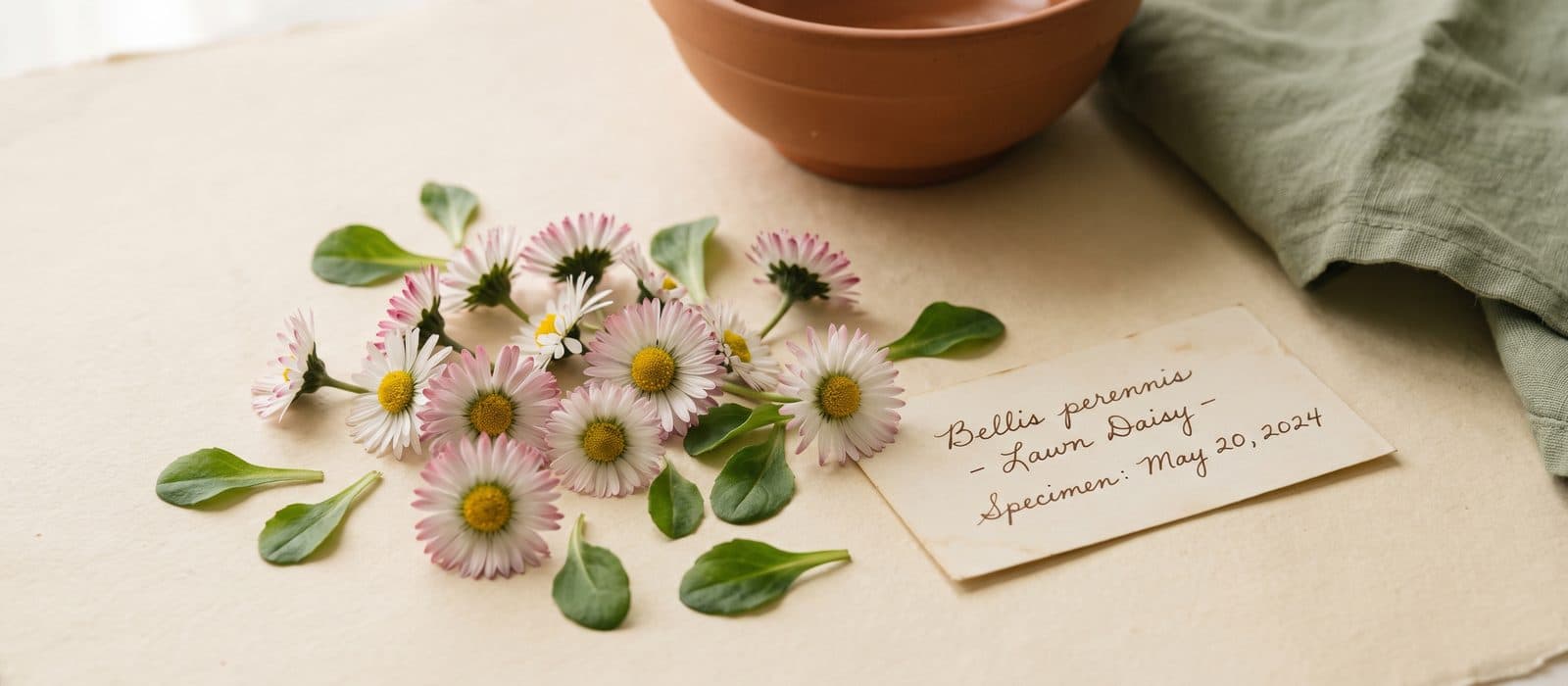
Homeopathic Bellis perennis is prepared from the whole fresh flowering plant of the common daisy, Bellis perennis, a member of the daisy family (Asteraceae). It is the low rosette of spoon-shaped leaves and white-rayed, yellow-centred flowers that turns up in almost every lawn in Europe, flowering from early spring to late autumn. Its Latin name means "pretty everlasting", for the way it flowers through most of the year; its old English name, bruisewort, records the folk use that came before homeopathy, when daisies were pressed onto bruises and sprains.
Bellis is one of the gentler sources in the materia medica. The daisy is not a poisonous plant, and there is none of the toxicity warning that sits on pages such as Arnica or Belladonna. The homeopathic preparation makes a mother tincture of the whole plant and then carries it through repeated dilution and succussion to the potency on the label. At the common potencies the arithmetic says nothing of the daisy remains. Our potencies guide explains what that means, and why it is also the heart of scientific scepticism about homeopathy.
Bellis and Arnica are botanical relatives, both in the daisy family, and the materia medica describes them as related bruise pictures that part company over depth and location.
What is the Bellis perennis picture?
The Bellis picture is soreness that goes deep. Picture someone who slipped on a wet step and landed hard on their side: the skin barely marked, but two days later the ribs and the muscles of the flank ache deeply and are sore to firm pressure. Or the person who spent a weekend digging a new vegetable bed after a winter at a desk. By Monday the large muscles of the back, buttocks and thighs feel bruised from the inside, and every stoop or lift reminds them.
Boericke (1927) describes Bellis as acting on the muscular fibres of the blood vessels, with muscular soreness, lameness as if sprained, and congestion and swelling after mechanical injury. He singles out injuries to the deeper tissues and the after-effects of surgery on the trunk, and he calls it a remedy for old labourers, especially gardeners, the people whose work pounds the same tissues day after day. Clarke's Dictionary (1900–1902) records Burnett's view of it as a remedy for blows and falls to the trunk.
The literature also records a curious companion: complaints that follow cold food or cold drinks taken while the body is hot, the gardener drinking iced water at the end of a hot afternoon. There is little emotional picture to speak of. Like Arnica, the person may want to keep going; unlike Arnica, there is no particular insistence that nothing is wrong. Bellis is described more by where it hurts than by who is hurting.
What makes it better or worse?
The traditional modalities centre on warmth and on motion. Bellis is worse from getting warm in bed and from hot baths, and better from continued gentle movement.
| Modality | Worse | Better |
|---|---|---|
| Temperature | Hot baths, becoming warm in bed; cold drinks or cold bathing when overheated | No consistent keynote |
| Touch | Firm pressure on the deep sore area | Leaving the area alone |
| Motion | Starting to move after rest | Continued gentle motion (Boericke) |
| Side | Left side (Boericke) | None listed |
| Weather | Cold wind; before storms | No consistent keynote |
The worse-from-warmth-of-bed modality is what most separates Bellis from Rhus toxicodendron, which likes heat; our guide to modalities, better and worse explains how homeopaths read them.
What is Bellis perennis traditionally discussed for?
In homeopathic literature, Bellis perennis is traditionally discussed for deep, sore bruising of the trunk and for overworked muscles. Each of these appears on one of our acute pages, where the Bellis-like pattern sits beside its neighbours and the red flags come first.
Deep bruising after a blow or fall
- Deep trunk, breast or pelvic bruising, discussed on a black eye after a bump, where the page compares the deep-tissue picture with the classic black-eye pictures.
Muscles after unaccustomed work
- The deep, sore-to-pressure ache in the bellies of heavily worked muscles: sore muscles after an unusual workout.
Nearby pages that discuss other pictures
- A bruised tailbone after a fall and back strain after lifting describe trunk injuries where homeopaths compare several pictures; our guide to sprains, strains and overuse explains how tissue and cause shape the reading.
What is Bellis perennis not?
Bellis perennis is not "Arnica for the breasts and belly", and it is never a reason to sit out an injury to the trunk. A blow to the abdomen followed by worsening pain, a swollen or rigid belly, faintness, vomiting or blood in the urine can mean an internal injury and needs urgent assessment. A chest injury with breathlessness or sharp pain on breathing needs to be seen. A lump in the breast needs checking by a doctor whether or not it followed a knock, and bruises that appear without a clear cause, or very easily, can be a sign of a blood or medication problem. Any blow to the abdomen in pregnancy is a reason to contact maternity care. Our guide to red flags first sets these out.
Homeopaths separate it from its neighbours like this:
| Picture | Where it sits | Defining feature | Key modality |
|---|---|---|---|
| Bellis perennis | Deep tissues of trunk, breast, pelvis; overworked muscle bellies | Deep, localised soreness; lame as if sprained | Worse warmth of bed and hot baths; better continued motion |
| Arnica montana | Fresh bruising and shock | Beaten all over; "I'm fine"; bed feels too hard | Worse touch and jarring |
| Hypericum | Nerve-rich areas: fingertips, spine, tailbone | Shooting, nerve-type pain along the injured area | Worse touch and jarring; worse cold and damp |
| Symphytum | Bone and periosteum; blow to the eyeball | Pricking soreness located in bone | Worse touch and pressure on the bone |
| Rhus toxicodendron | Joints and muscles after strain | Stiff on first moving, loosens with continued motion | Better continued motion and warmth |
The traditional distinction with Arnica is depth and spread: Arnica is the bruised-all-over person after a shaking accident, Bellis the deeper, more localised soreness in the trunk once the shock has passed.
What potencies is Bellis perennis sold in?
Bellis perennis is sold most often as 30C and 6C pellets, with 200C available from specialist manufacturers. Potency describes the preparation process, not an amount of daisy: 30C means thirty successive 1:100 dilutions with succussion between them. Our potencies guide explains the scale and what remains in the vial.
This page deliberately gives no frequency or instructions for taking Bellis perennis. That depends on a whole case, not a remedy name. Read the product label, and talk to a qualified practitioner about an individual situation.
What remedy lists don't tell you
Two things the "remedies for bruises" lists leave out:
- Bruise lists are really depth lists. Most lists put Arnica first and stop there. The classic authors sorted injuries by how deep they went and which tissue took the blow: skin and general soreness, deep soft tissue, nerve, tendon, bone. Bellis earns its place at the deep-soft-tissue step, which is why it keeps appearing in the same breath as Ruta and Symphytum.
- The gardener is the real archetype. Boericke's description of old labourers and gardeners is more useful than any list of injuries. It points to a body that has been worked hard in a repetitive way, then cooled down suddenly, and aches deeply as a result. Reading the picture as a kind of person and work, rather than a kind of bruise, is closer to how the tradition used it.
Where the Bellis perennis picture appears on this site
Acute pages that discuss this picture among their educational patterns, with the pattern name each page uses.
- What homeopathic remedy for a black eye after a bump?Bellis perennis-like deep tissue bruise pattern
- What homeopathic remedy for sore muscles after an unusual workout?Bellis perennis-like deep muscle-belly pattern
Not sure whether a picture fits?
A remedy profile describes a picture; it cannot tell you whether that picture matches what you are seeing. An acute consultation starts from the case itself: onset, sensations, what changes it, and the red flags.
Acute consultation · $45Frequently asked questions
- What is Bellis perennis?
- Bellis perennis is a homeopathic remedy prepared from the common lawn daisy, a close botanical relative of Arnica. In homeopathy it names a traditional picture of deep, sore bruising: injury to the trunk, breasts, abdomen or pelvis, and the deep muscle soreness of unaccustomed hard work. It is a description homeopaths use to compare cases, not a finding that it works for bruises or any other condition.
- What is Bellis perennis used for in homeopathy?
- Homeopathic literature traditionally discusses Bellis perennis for bruising that goes deeper than the skin: a blow to the chest, breast or abdomen, soreness in the trunk after a fall, and deep aching in heavily worked muscles after labour the body is not used to. The picture is defined by depth and soreness, not by the word bruise. A blow to the abdomen with worsening pain, a breast lump, or bruising with no clear cause needs medical assessment first.
- What is Bellis perennis 30C used for?
- 30C is the common shelf potency of Bellis perennis, with 6C also widely sold. In the tradition the potency does not change the picture; Bellis perennis 30C is discussed for the same deep, sore, bruised state as any other potency. What 30C means as a dilution is explained in our potencies guide.
- How is Bellis perennis taken?
- This page does not give instructions on how or how often to take any remedy, because that depends on a whole case rather than on a remedy name. The product label carries the manufacturer's directions, and a qualified practitioner can advise on an individual situation. A significant blow to the chest, abdomen or pelvis belongs with a clinician first.
- Where can I buy Bellis perennis?
- Pharmacies, health-food shops and homeopathic manufacturers sell Bellis perennis as single-remedy pellets, most often in 30C or 6C, and it appears in some injury and birth kits. This site also prepares custom single remedies to order: you name the remedy and potency, and the details are confirmed by email before anything is made. The order form does not give advice on which remedy to choose.
- What is Bellis perennis made from?
- Homeopathic Bellis perennis is prepared from the whole fresh flowering plant of the common daisy, made into a mother tincture and then diluted and succussed step by step to the labelled potency. The daisy is not a poisonous plant, but the potentised remedy is still a different thing from the herb, and at common potencies nothing of the plant remains.
This guide is educational only and is not medical advice or a personalized remedy recommendation. Acute symptoms can become urgent; when in doubt, seek professional evaluation.