Remedy profile
Cuprum metallicum in Homeopathy: Uses, Picture and Limits
What homeopathic Cuprum metallicum is made from, the violent cramping, spasmodic picture homeopaths describe, what changes it, potencies sold, and its limits.
By Homeopathic BenefitsPublished 7 min read
Key takeaways
- Cuprum metallicum is the picture of violent cramp. Homeopathic literature describes spasms that clench, knot and seize: calves drawn into hard lumps, toes pulled down, thumbs clenched into the palm.
- The spasm is the keynote, wherever it appears. Classic texts apply the same picture to limbs, the stomach and spasmodic coughs; what unites them is the sudden, gripping violence.
- It starts at the edges. Cramps that begin in the fingers and toes and spread inwards are the detail homeopaths remember.
- It is prepared from copper. Copper is a trace nutrient and its salts are poisonous in quantity; potentised preparations are diluted far past the point where any copper is expected to remain.
- Spasm has the clearest red flags. A seizure, a child turning blue while coughing, a swollen hot calf, or confusion after heat or altitude needs urgent medical care before any picture.
The short answer
Cuprum metallicum is a homeopathic remedy prepared from metallic copper, triturated with milk sugar and then diluted and succussed to the labelled potency. In homeopathy it names a traditional picture rather than a treatment: violent, gripping cramp and spasm that comes in bouts, starts in the fingers and toes, clenches the thumbs into the palms and knots the calves. Classic materia medica extends the same picture to spasmodic coughs and to the cramping exhaustion of heat and fluid loss. It was proved in Hahnemann's circle and is described at length by Boericke (1927) and Clarke's Dictionary (1900–1902). It is not a cramp remedy or a copper supplement, and nothing about the picture replaces medical care for spasms, seizures or heat illness.
| Latin name | Cuprum metallicum |
|---|---|
| Abbreviation | Cupr. |
| Common name | Metallic copper |
| Source | Metallic copper, finely divided, triturated with milk sugar and potentised (mineral kingdom) |
| Commonly sold potencies | 6C, 30C, 200C |
| First proving | Proved in Hahnemann's circle in the early nineteenth century; collected in Allen's Encyclopedia of Pure Materia Medica (1874–1879) |
What is Cuprum metallicum made from?
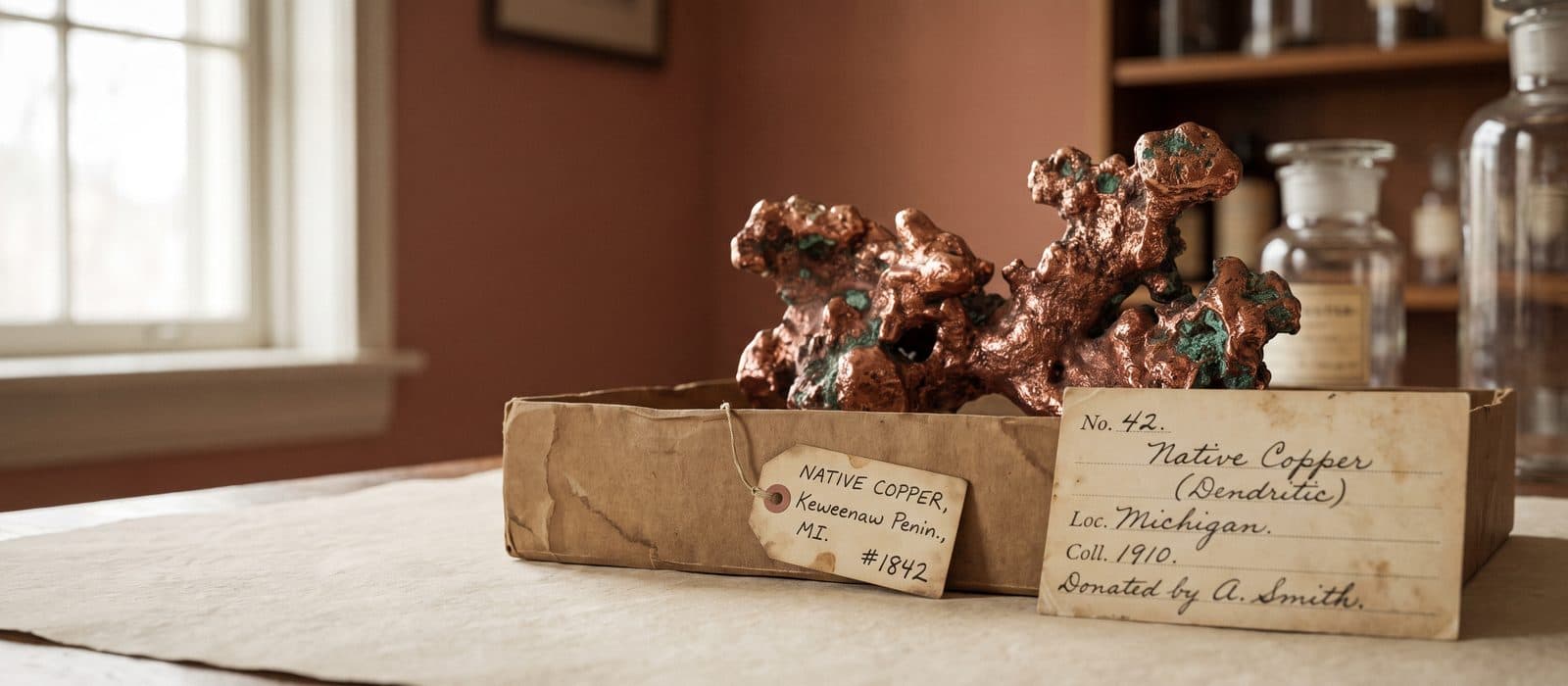
Cuprum metallicum is prepared from copper, the reddish metal of pipes and wiring; cuprum is simply the Latin for copper, from the Roman name for Cyprus, where the ancient world mined it. For the remedy, finely divided pure copper is ground with lactose for long periods, because a metal will not dissolve in the water and alcohol used for later steps. After the first few triturated potencies it is carried into liquid and diluted and succussed in the usual way. Our guide to what is in a homeopathic remedy explains the trituration stage.
The honest framing has two sides. Copper is an essential trace element: the body needs a small amount, which a normal diet supplies. But copper salts in quantity are poisonous, causing vomiting, cramping and, in severe cases, liver and kidney damage. That is the historical background to the remedy's cramping picture. Nothing on this page describes copper itself as something to swallow, and the remedy is not a copper supplement. At the common potencies the arithmetic says no atom of the metal is expected to remain; our potencies guide works through what that means and why it is also the reason mainstream science is sceptical. Our guide to reading Latin remedy names explains why metals appear on labels at all.
What is the Cuprum metallicum picture?
The Cuprum metallicum picture is the cramp that wakes someone at two in the morning with a yell. The calf has drawn up into a hard knot, the toes are pulled down and will not straighten, and the pain is so intense that the person can do nothing but wait for it to let go. Cuprum is the spasm at full strength, sudden, gripping and violent.
Boericke (1927) opens his entry with spasmodic affections, cramps and convulsions that begin in the fingers and toes, and with violent contractions and intermittent, painful spasms. The edges first, then inwards: the fingers curl, the thumbs clench into the palms, the cramp climbs from the feet into the calves. The face may go pale or bluish, and the spasm comes in bouts with intervals between them.
The same shape runs through the old descriptions of a spasmodic cough. Bouts come in fierce fits, the person goes breathless and dusky, and a sip of cold water is said to ease the spasm, an odd and memorable modality. Classic texts also link Cuprum to the cramping and collapse that follow heavy fluid loss: Hahnemann's 1831 writings on cholera named it, with Camphor and Veratrum album, for the cramping stage of that disease. Today that is a medical emergency, and the historical note is no more than the origin of the picture.
The mental side in Kent and Clarke is quieter than the body but distinctive: a tense, controlled, rather closed person, holding things in until they break out in a spasm of their own. Some modern homeopaths read Cuprum as the picture of rigid self-control, though that is interpretation built on the physical keynotes rather than something the classic provings state outright.
What makes it better or worse?
The traditional modalities centre on touch, exertion and cold drinks. Cuprum metallicum is worse from touch and exertion, and better from sips of cold water and from sweating.
| Modality | Worse | Better |
|---|---|---|
| Touch | Being touched during a spasm | No consistent keynote |
| Drink | No consistent keynote | Sips of cold water, especially in a coughing spasm |
| Exertion | Over-exertion, loss of sleep, heat with fluid loss | Rest once the spasm releases |
| Body state | Before a period; after vomiting | Sweating |
| Time | Night, especially in the small hours | No consistent keynote |
The cold-water detail is the one homeopaths single out, because most cramping pictures want warmth. Our guide to modalities, better and worse explains why a homeopath asks about these before anything else.
What is Cuprum metallicum traditionally discussed for?
In homeopathic literature, Cuprum metallicum is traditionally discussed for violent, spasmodic cramping. Each of these appears on one of our acute pages, where the Cuprum-like pattern sits beside its neighbours and the red flags come first.
Muscle cramp
- The violent calf or arch cramp that knots and seizes: a charley horse muscle cramp.
- Night-time cramping with spasmodic intensity: restless legs at night.
Heat, exertion and altitude
- Cramping and spasm after sweating hard in the heat: overheating after exertion. Confusion, a very high temperature or stopped sweating is heat stroke, an emergency.
- The cramping version of altitude stress: a mild altitude headache. A worsening headache, breathlessness at rest or unsteadiness at altitude means going down and getting help.
Our guide to sprains, strains and overuse covers the exertion side of these pages.
What is Cuprum metallicum not?
Cuprum metallicum is not "the cramp remedy", and the old texts' talk of convulsions is not a reason to think about remedies when someone has a seizure. The commonest misreading is to match the name to the word cramp. In the tradition, a cramp eased by a hot water bottle and firm pressure belongs to a different picture; Cuprum's is the violent, clenching spasm that starts in the extremities and wants cold sips rather than heat.
The red flags here are serious. A seizure, especially a first one, one lasting more than five minutes, or one in a child with a fever, needs emergency care. A child who goes blue, stops breathing or whoops while coughing needs a doctor urgently. A calf that is swollen, warm, red or painful to walk on can be a blood clot. Cramps with confusion, vomiting or no sweat after heat, and headache with breathlessness at altitude, are medical emergencies. Frequent cramps can come from medication or mineral imbalance and are worth a blood test.
Homeopaths separate Cuprum metallicum from its neighbours like this:
| Picture | Where it sits | Defining feature | Key modality |
|---|---|---|---|
| Cuprum metallicum | Violent cramp and spasm | Starts in fingers and toes; thumbs clenched; comes in bouts | Better cold sips; worse touch and exertion |
| Magnesia phosphorica | Cramp, colic, neuralgia | Shooting, spasmodic pain; fewer extremes | Better heat, firm pressure, bending double |
| Veratrum album | Collapse with fluid loss | Icy cold sweat on the forehead; profuse output | Worse exertion; better covering and lying down |
| Drosera | Spasmodic, tickling cough | Barking fits in quick succession, worse lying down | Worse after midnight; better sitting up |
What potencies is Cuprum metallicum sold in?
Cuprum metallicum is sold as single-remedy pellets, most often 30C, with 6C and 200C also available from homeopathic pharmacies. It is a less common kit remedy than Arnica or Nux vomica, so some shops order it in rather than keeping it on the shelf. Potency describes the preparation process, not an amount of copper: 30C means thirty successive 1:100 dilutions with succussion between them. Our potencies guide explains the scale and what remains in the vial.
This page deliberately gives no frequency or instructions for taking Cuprum metallicum. That depends on a whole case, not a remedy name. Read the product label, and talk to a qualified practitioner about an individual situation.
What remedy lists don't tell you
Two things the short lists leave out:
- Direction and temperature separate the cramp pictures. Several remedies are described for cramp. What the classic authors found characteristic in Cuprum was where it started, at the fingers and toes, how violent it was, and the odd relief from cold water. A cramp that starts in the calf and melts under a hot water bottle reads differently in the tradition, which is why our acute pages set Cuprum and Mag phos side by side rather than offering one "cramp remedy".
- The historical picture came from emergencies. Cuprum's reputation was built in an era when cholera, whooping cough and convulsive fevers were nursed at home because there was nothing else. Those are exactly the situations where modern care is decisive. The useful part of the old description for a reader today is the shape of an ordinary cramp, not the dramatic illnesses it was first written for; our guide to red flags first sets out where the line falls.
Where the Cuprum metallicum picture appears on this site
Acute pages that discuss this picture among their educational patterns, with the pattern name each page uses.
- What homeopathic remedy for a charley horse muscle cramp?Cuprum metallicum-like violent cramping pattern
- What homeopathic remedy for a mild altitude headache?Cuprum metallicum-like spasmodic cramping pattern
- What homeopathic remedy for overheating after exertion?Cuprum metallicum-like spasmodic cramping pattern
- What homeopathic remedy for restless legs at night?Cuprum metallicum-like violent cramping pattern
Not sure whether a picture fits?
A remedy profile describes a picture; it cannot tell you whether that picture matches what you are seeing. An acute consultation starts from the case itself: onset, sensations, what changes it, and the red flags.
Acute consultation · $45Frequently asked questions
- What is Cuprum metallicum?
- Cuprum metallicum is a homeopathic remedy prepared from metallic copper, ground with milk sugar and then diluted and succussed to the labelled potency. In homeopathy it names a traditional picture of violent cramp and spasm: cramps that begin in the fingers and toes, clenched thumbs, knotted calves and spasms that come in fierce bouts. It is a description homeopaths use to compare cases, not evidence that it works for cramps or any other condition.
- What is Cuprum metallicum used for in homeopathy?
- Homeopathic literature traditionally discusses Cuprum metallicum for intense, spasmodic states: violent calf and foot cramps, cramping after heat and exertion, and in the old texts spasmodic coughs and convulsive states. The violence and the spasm define the picture more than the location. A seizure, a child who turns blue while coughing, a swollen, hot calf, or confusion after heat need emergency or medical care first.
- What is Cuprum metallicum 30C used for?
- 30C is a common shelf potency of Cuprum metallicum in single-remedy ranges, though it is a less familiar kit remedy than Arnica or Nux vomica and some shops stock it only to order. In the tradition the potency does not change the picture; 30C is discussed for the same violent, spasmodic cramping picture as any other potency. Our potencies guide explains what 30C means as a dilution.
- How is Cuprum metallicum taken?
- This page does not give instructions on how or how often to take any remedy, because that depends on a whole case rather than on a remedy name. The product label carries the manufacturer's directions, and a qualified practitioner can advise on an individual situation. Convulsions, cramps with confusion after heat, or cramps that keep returning are medical questions first.
- Where can I buy Cuprum metallicum?
- Pharmacies, homeopathic manufacturers and some health-food shops sell Cuprum metallicum as single-remedy pellets, most often in 30C, though it is stocked less widely than the common kit remedies. This site also prepares custom single remedies to order: you name the remedy and potency, and the details are confirmed by email before anything is made. The order form does not give advice on which remedy to choose.
- What is Cuprum metallicum made from?
- Cuprum metallicum is made from metallic copper, finely divided and ground with milk sugar (trituration) through the first potency steps, then diluted and succussed to the labelled potency. Copper is an essential trace element in small amounts, but copper salts in quantity are poisonous. Potentised preparations are diluted far past the point where any copper is expected to remain, and the remedy is not a copper supplement.
This guide is educational only and is not medical advice or a personalized remedy recommendation. Acute symptoms can become urgent; when in doubt, seek professional evaluation.