Remedy profile
Veratrum album in Homeopathy: Uses, Picture and Limits
What homeopathic Veratrum album is made from, the cold, collapsing, profuse picture homeopaths describe, what changes it, the potencies sold, and its limits.
By Homeopathic BenefitsPublished 8 min read
Key takeaways
- Veratrum album is the picture of cold collapse. Classic texts describe profuse output, icy coldness, a blue-pale face and a cold sweat that stands on the forehead.
- Everything is profuse. Vomiting and diarrhoea together, copious sweat, great thirst for ice-cold water: the tradition reads the excess of output as the keynote.
- Cramps and weakness belong to it. Cramping in the belly and calves, and a faintness that comes on at the least movement.
- It comes from a seriously poisonous plant. White hellebore slows the heart and causes violent vomiting; potentised preparations are diluted far past the point where the root is a concern.
- This picture is a medical emergency first. Cold clammy skin, fainting, confusion or heavy fluid loss with little urine are signs of shock and dehydration that need urgent care.
The short answer
Veratrum album is a homeopathic remedy prepared from the root of white hellebore, a poisonous plant of European and Asian mountain meadows. In homeopathy it names a traditional picture rather than a treatment: a state of collapse with profuse vomiting and diarrhoea, icy coldness, a cold sweat on the forehead, cramps, and a weakness that makes the person faint at the least movement. Hahnemann proved it and included it in his Materia Medica Pura, after studying the white hellebore used as a violent purge by ancient physicians. It is not a remedy for gastroenteritis or food poisoning, and the state it describes is exactly the one where rehydration and emergency medical care come first.
| Latin name | Veratrum album |
|---|---|
| Abbreviation | Verat. |
| Common name | White hellebore |
| Source | Root of white hellebore, Veratrum album (Melanthiaceae) (plant kingdom) |
| Commonly sold potencies | 6C, 30C, 200C |
| First proving | Hahnemann, Materia Medica Pura (1811–1821); his 1812 Leipzig dissertation studied the hellebore of the ancients |
What is Veratrum album made from?
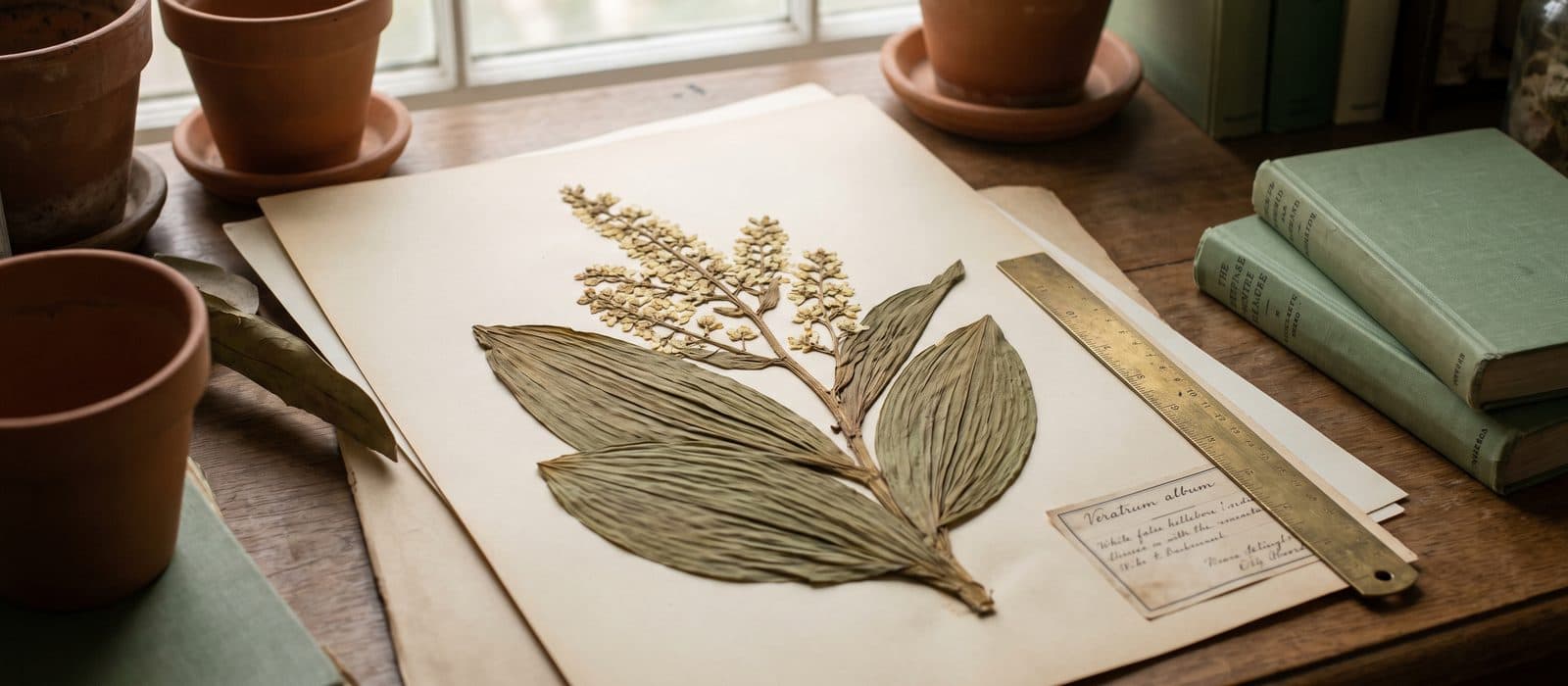
Homeopathic Veratrum album is prepared from the root and rhizome of Veratrum album, white hellebore, a tall perennial of damp alpine meadows and mountain pastures from Europe across to Siberia. It grows to more than a metre, with broad, pleated, strongly veined leaves and spikes of small greenish-white flowers. Despite the name it is not related to the Christmas rose and other Helleborus species; the common name comes from the ancient world, where "white hellebore" and "black hellebore" were two of the most famous drugs of Greek medicine.
The name on the label should be read plainly. Every part of the plant contains steroidal alkaloids that slow the heart, drop the blood pressure and cause violent vomiting, and poisoning can be fatal. Most poisonings in modern Europe happen by accident, when the leaves are mistaken for the yellow gentian, whose roots are used to make bitters and schnapps and which grows in the same pastures. The raw plant is never something to gather, brew or prepare at home.
The homeopathic preparation makes a tincture from the root and carries it through repeated dilution and succussion to the potency on the label. At the common potencies the arithmetic says no molecule of the original plant remains; our potencies guide sets out what that means, why it is also the reason mainstream science is sceptical, and why low potencies of toxic sources carry their own labelling. The guide to reading Latin remedy names explains why a poison appears on a remedy label at all.
The plant has a long history in Hahnemann's own work. His 1812 dissertation for the University of Leipzig was a study of helleborism, the ancient practice of purging patients with hellebore, and his proving of Veratrum album appears in the Materia Medica Pura. The poisoning picture and the homeopathic picture are close mirrors: vomiting, purging, coldness, sweat and collapse.
What is the Veratrum album picture?
The Veratrum album picture is a body emptying itself and growing cold. Vomiting and diarrhoea come together, violent and copious, and each bout leaves the person weaker. The face turns pale, bluish and drawn, the nose pinched, and a cold sweat stands on the forehead. The hands and feet are icy; the breath may feel cool. The person cannot stand or sit up without feeling they will faint. Boericke (1927) gives the essence in a phrase: a perfect picture of collapse, with extreme coldness, blueness and weakness.
Within that picture, classic texts single out three details. First, the thirst: great thirst for large quantities of ice-cold water, even though it may come straight back up, and a craving for sour, salty or juicy things. Second, the cramps: cramping in the belly before and during the stool, and cramps in the calves. Third, the sweat: cold, clammy and most marked on the forehead, especially with each effort or each stool.
Veratrum album also has a mental side that the classic authors described at length, quite separate from the digestive collapse. Kent's Lectures (1905) and Clarke's Dictionary (1900–1902) describe states of restless busyness, cutting and tearing things, loquacity and religious or haughty excitement. Those descriptions belong to a nineteenth-century literature on mental illness and are of historical interest only; anyone in that kind of state needs psychiatric care, not a remedy picture.
What makes it better or worse?
The traditional modalities centre on exertion, cold and fluid loss. Veratrum album is worse from the least movement, from drinking and from each evacuation, and better from warmth, covering and lying still.
| Modality | Worse | Better |
|---|---|---|
| Exertion | Rising, sitting up, exertion (faintness) | Lying down in the collapse; Boericke also lists walking about |
| Evacuation | During and after vomiting or stool | No consistent keynote |
| Temperature | Cold, wet weather; at night; being uncovered | Warmth, covering (Boericke) |
| Drinking | Drinking brings on vomiting | Craves ice-cold water regardless |
| Food | Fruit, cold food | Sour and salty things are craved |
The tension between craving ice-cold drinks and being better from warmth is one of the details homeopaths find characteristic; our guide to modalities, better and worse explains why such contradictions carry weight.
What is Veratrum album traditionally discussed for?
In homeopathic literature, Veratrum album is traditionally discussed for violent digestive upsets ending in cold collapse. Each of these appears on one of our acute pages, where the Veratrum-like pattern sits beside its neighbours and the red flags come first.
Digestion and fluid loss
- Profuse, draining diarrhoea with cold sweat and collapse-like weakness: sudden diarrhoea.
- Heavy fluid loss with cold sweat and near-faint weakness after a meal that seemed off: suspected food poisoning. Our guide to hangovers, rich food and bad food reads the digestive cases side by side.
On both pages the red flags come before any pattern, and with this picture more than most they are the point of the page.
What is Veratrum album not?
Veratrum album is not "the gastroenteritis remedy", and the reason matters more here than for almost any other remedy. The picture describes, in old language, a person going into shock from fluid loss: cold clammy skin, a pale or bluish face, a weak pulse, faintness on sitting up, and output faster than they can drink. In conventional terms that is severe dehydration, and it is a medical emergency. Very little or no urine for many hours, dizziness or fainting on standing, confusion, cold and mottled hands and feet, blood in the vomit or stool, or a baby, older person or pregnant woman who cannot keep fluids down all need urgent care. Oral rehydration solutions and, when needed, intravenous fluids are what restore a person in this state. Nineteenth-century homeopaths wrote about Veratrum album during the cholera epidemics; the honest reading of that history is that rehydration, not any remedy, is what changed survival from cholera. Our guide to red flags first sets out when to stop reading and seek care.
Homeopaths separate Veratrum album from its neighbours like this:
| Picture | Where it sits | Defining feature | Key modality |
|---|---|---|---|
| Veratrum album | Profuse output with cold collapse | Cold sweat on the forehead; thirst for ice-cold water; cramps | Worse least movement; better warmth and lying still |
| Arsenicum album | Anxious, weak, chilly digestive upsets | Restless fear and burning; small sips rather than large drinks | Worse after midnight; better warmth |
| Carbo vegetabilis | Sluggish collapse, much gas | Cold and faint but wants to be fanned; little output | Better fresh air and belching |
| Cuprum metallicum | Cramping states | Cramps dominate over output and coldness | Better a sip of cold water |
| Podophyllum | Gushing diarrhoea | Profuse, painless, gushing stools without the cold collapse | Worse early morning |
Veratrum album and Arsenicum album are often confused because both are cold, weak and digestive. The traditional distinction is in the thirst and the mind: Arsenicum sips warm drinks and is restless with fear; Veratrum gulps ice-cold water and lies prostrate with a cold sweat.
What potencies is Veratrum album sold in?
Veratrum album is sold most often as 30C pellets, with 6C and 200C also available from homeopathic pharmacies. Potency describes the preparation process, not an amount of root: 30C means thirty successive 1:100 dilutions with succussion between them. Our potencies guide explains the scale and what remains in the vial. Very low potencies of a toxic starting material are a separate category with their own labelling, and are not what this page describes.
This page deliberately gives no frequency or instructions for taking Veratrum album. That depends on a whole case, not a remedy name. Read the product label, and talk to a qualified practitioner about an individual situation.
What remedy lists don't tell you
Two things the "remedies for diarrhoea" lists leave out:
- The forehead sweat is the tell, and it is also the warning. Lists describe Veratrum as diarrhoea with vomiting, which describes most stomach bugs. What the classic authors found characteristic was the cold sweat on the forehead, the icy body and the faintness at the least movement. A homeopath who sees those signs today asks first whether this person is going into shock, and only then thinks about the picture.
- The mental chapters are history, not guidance. Older books devote pages to Veratrum's excited and religious mental states. They were written for asylum practice in another century. They are worth knowing as part of the remedy's literature, and worth recognising as describing states that need psychiatric care now.
Where the Veratrum album picture appears on this site
Acute pages that discuss this picture among their educational patterns, with the pattern name each page uses.
- What homeopathic remedy for sudden diarrhea?Veratrum album-like profuse, cold collapse pattern
- What homeopathic remedy for suspected food poisoning?Veratrum album-like cold collapse pattern
Not sure whether a picture fits?
A remedy profile describes a picture; it cannot tell you whether that picture matches what you are seeing. An acute consultation starts from the case itself: onset, sensations, what changes it, and the red flags.
Acute consultation · $45Frequently asked questions
- What is Veratrum album?
- Veratrum album is a homeopathic remedy prepared from the root of white hellebore, a poisonous mountain plant of Europe and northern Asia. In homeopathy it names a traditional picture of collapse: profuse vomiting and diarrhoea, icy coldness, a cold sweat on the forehead and near-fainting weakness. It is a description homeopaths use to compare cases, not evidence that it works for any condition.
- What is Veratrum album used for in homeopathy?
- Homeopathic literature traditionally discusses Veratrum album for violent digestive upsets with great fluid loss, coldness and collapse-like weakness, often with cramps and a thirst for ice-cold water. The picture is defined by the coldness, the cold sweat and the profuseness rather than by a diagnosis. Those same features, cold clammy skin, fainting and heavy fluid loss, are signs of shock and dehydration that need emergency medical care.
- What is Veratrum album 30C used for?
- 30C is the common shelf potency of Veratrum album, with 6C and 200C also sold. In the tradition the potency does not change the picture; Veratrum album 30C belongs to the same cold, collapsing, profuse description as any other potency. Our potencies guide explains what 30C means as a dilution.
- How is Veratrum album taken?
- This page does not give instructions on how or how often to take any remedy, because that depends on a whole case rather than on a remedy name. The product label carries the manufacturer's directions, and a qualified practitioner can advise on an individual situation. Profuse vomiting or diarrhoea with cold sweat, fainting or very little urine is an emergency, not a remedy decision.
- Where can I buy Veratrum album?
- Pharmacies, health-food shops and homeopathic manufacturers sell Veratrum album as single-remedy pellets, most often in 30C. This site also prepares custom single remedies to order: you name the remedy and potency, and the details are confirmed by email before anything is made. The order form does not give advice on which remedy to choose.
- What is Veratrum album made from?
- Homeopathic Veratrum album is prepared from the root of white hellebore, Veratrum album, made into a tincture and then diluted and succussed step by step to the labelled potency. The raw plant is highly poisonous: it slows the heart, drops the blood pressure and causes violent vomiting. It should never be gathered, brewed or prepared at home, and potentised preparations are diluted far past the point where the plant remains.
This guide is educational only and is not medical advice or a personalized remedy recommendation. Acute symptoms can become urgent; when in doubt, seek professional evaluation.