Remedy profile
Carbo vegetabilis in Homeopathy: Uses, Picture and Limits
What homeopathic Carbo vegetabilis is made from, the sluggish, bloated, air-hungry picture homeopaths describe, what changes it, potencies sold, and its limits.
By Homeopathic BenefitsPublished 7 min read
Key takeaways
- Carbo vegetabilis is the picture of stagnation. Digestion that has slowed to a crawl, gas that will not move, and a person who is cold, pale and sluggish.
- The gas sits high. Classic texts describe an upper abdomen so distended it presses against the chest, eased by belching and by loosening clothes.
- Air hunger is its keynote. The person wants the window open, the fan on, or someone fanning them, even while their hands and feet are cold.
- It is made from wood charcoal. Charcoal is not poisonous; the homeopathic remedy is a different product from the activated charcoal sold in pharmacies.
- Its red flags are serious ones. Chest pain put down to indigestion, breathlessness, blue lips, collapse, black or bloody stools, or bloating that persists for weeks needs medical care before any pattern discussion.
The short answer
Carbo vegetabilis is a homeopathic remedy prepared from wood charcoal, traditionally from birch or beech, ground with milk sugar and then diluted and succussed to the labelled potency. In homeopathy it names a traditional picture rather than a treatment: a sluggish, chilly, pale person with a bloated upper abdomen, heavy digestion and a strong craving for moving air. Classic materia medica describes gas that presses up against the chest, belching that brings the only relief, and a state of weakness and stagnation that older writers applied to digestion and to exhaustion alike. Hahnemann documented it in his Materia Medica Pura and expanded it in The Chronic Diseases. It is not a general wind or indigestion remedy, and nothing about the picture replaces medical care for chest symptoms or persistent bloating.
| Latin name | Carbo vegetabilis |
|---|---|
| Abbreviation | Carb-v. |
| Common name | Vegetable charcoal, wood charcoal |
| Source | Charcoal made from wood, traditionally birch or beech, triturated and potentised (mineral kingdom) |
| Commonly sold potencies | 6C, 30C, 200C |
| First proving | Hahnemann, Materia Medica Pura; expanded in The Chronic Diseases (1828–1830) |
What is Carbo vegetabilis made from?
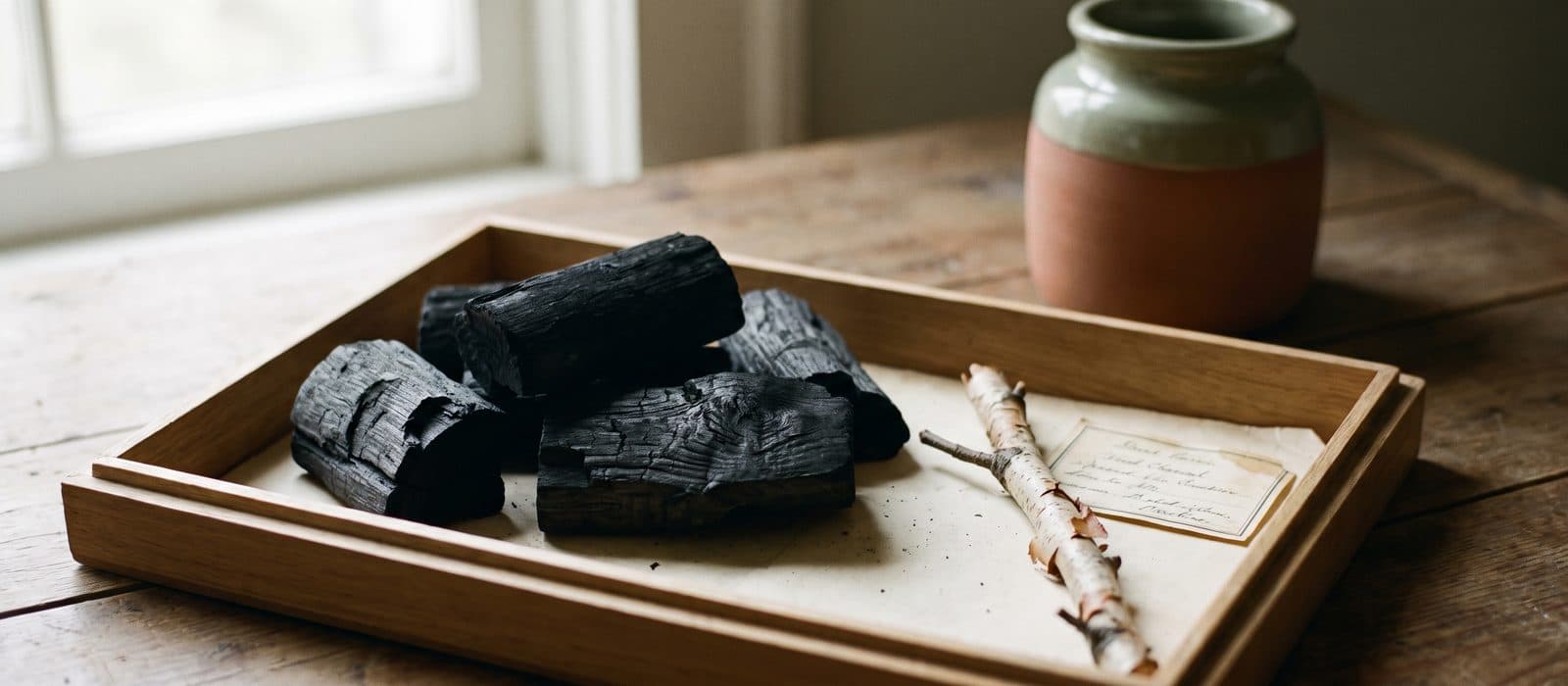
Homeopathic Carbo vegetabilis is prepared from vegetable charcoal: wood burned slowly with too little air to burn completely, leaving a black, porous, almost pure carbon. Hahnemann's instructions and the classic pharmacopoeias name birch or beech; Clarke's Dictionary (1900–1902) mentions poplar as well. The Latin name means simply "vegetable carbon", and it sits beside the animal charcoal Carbo animalis, a separate remedy in the materia medica. Our guide to reading Latin remedy names explains naming like this.
Charcoal does not dissolve in water or alcohol, so the first potency steps are made by trituration: grinding the powder with lactose for long periods until it can be carried into liquid and then diluted and succussed in the usual way. Hahnemann was particularly interested in this, since he held that grinding released properties in substances, like charcoal, that seemed inert in their crude form. At the common potencies the arithmetic says no particle of the charcoal remains; our potencies guide explains what that means and why it is also the reason mainstream science is sceptical.
Charcoal is not a poison, and this page does not need the warnings that go with Nux vomica or Arsenicum album. It does need one clarification. Activated charcoal, sold as a supplement and used in hospitals for some poisonings, is a different product: it is processed to be highly absorbent and is given in grams, not potentised. The two share a source and nothing else, and nothing on this page is about activated charcoal.
What is the Carbo vegetabilis picture?
The Carbo vegetabilis picture is the person after the big dinner who has gone from full to sluggish to faintly unwell. Imagine them slumped on the sofa with the waistband undone, the upper belly tight as a drum and pressing up so that breathing feels shallow. Every so often a belch comes up and they feel better for a moment. They are pale and a little clammy, their feet are cold, and yet they ask for the window open or sit right in front of the fan. Food, especially anything rich or fatty, has turned into a heavy weight and a lot of gas.
Classic texts make the slowness central. Boericke (1927) describes a state of lowered vitality and imperfect oxidation, digestion that is slow and putrid, and simple food that seems to disagree. Kent's Lectures (1905) give the vivid scene of a person who is cold to the touch, wants to be fanned and is relieved by belching. The old nickname "the corpse reviver" comes from nineteenth-century descriptions of collapse, which today are plainly medical emergencies, not home-remedy territory.
The temperament is dull and slow rather than dramatic. The person is indifferent, heavy-headed, low on energy, and sometimes says they have never been well since some earlier illness, a bout of food poisoning or a period of exhaustion. Clarke (1900–1902) connects the picture to that sense of a system that never fully recovered.
What makes it better or worse?
The traditional modalities centre on air, food and warmth. Carbo vegetabilis is worse from rich food, warm stuffy air and lying flat, and better from belching, cool moving air and being fanned.
| Modality | Worse | Better |
|---|---|---|
| Air | Warm, close, stuffy rooms | Fresh air, a fan, being fanned |
| Food | Fat, rich food, butter, wine, overeating | Belching, loosening clothes |
| Temperature | Evening chill, cold feet and hands (Boericke) | Cool air to the face despite feeling cold |
| Position | Lying flat | Sitting propped up |
| Time | Evening; after meals | No consistent keynote |
Our guide to modalities, better and worse explains why a homeopath reads these details before any remedy name, and why "bloating" alone says very little.
What is Carbo vegetabilis traditionally discussed for?
In homeopathic literature, Carbo vegetabilis is traditionally discussed for heavy, gassy, sluggish digestion. Each of these appears on one of our acute pages, where the Carbo veg-like pattern sits beside its neighbours and the red flags come first.
Bloating and trapped gas
- Upper-belly gas pressing against the chest, eased by belching and moving air: bloating after eating.
- The upper-distension picture with clothing loosened and a seat by the fan: gas pains with bloating.
After rich food
- Heaviness, belching and sluggish digestion more than sharp pain: nausea after rich food. Our guide to hangovers, rich food and bad food reads these cases side by side.
What is Carbo vegetabilis not?
Carbo vegetabilis is not "the wind remedy", and that is the misreading most lists encourage. Gas and bloating belong to several traditional pictures: the irritable, chilly person retching after excess, the one who is full after a few mouthfuls with gas in the lower belly, the one whose whole abdomen is drum-tight and gets no relief from belching. Carbo vegetabilis is the sluggish, cold, pale one with the gas high up, who belches gratefully and wants air. Without that, the name is only a well-known item in the kit.
The air hunger in the picture overlaps with something more serious, and this matters. Chest pain or pressure, breathlessness, pain spreading to the arm, jaw or back, sweating, blue or grey lips, or faintness in someone who says it is "just indigestion" needs emergency care. Vomiting blood, black or bloody stools, unexplained weight loss, difficulty swallowing, or bloating that persists most days for three weeks or more, particularly in women over fifty, belongs with a doctor. Our guide to red flags first covers these.
Homeopaths separate Carbo vegetabilis from its neighbours like this:
| Picture | Where it sits | Defining feature | Key modality |
|---|---|---|---|
| Carbo vegetabilis | Upper-abdominal gas, sluggish digestion | Cold, pale, slow; craves moving air | Better belching and being fanned; worse rich food |
| Lycopodium | Lower-abdominal gas and fullness | Full after a few mouthfuls; anticipatory insecurity | Worse 4–8 p.m.; better warm drinks |
| China officinalis | Whole abdomen distended | Weak after loss of fluids; belching brings no relief | Worse light touch; better firm pressure |
| Nux vomica | After excess, stimulants, overwork | Irritable, impatient, chilly; urging without result | Worse morning and cold; better warmth and a nap |
| Pulsatilla | Rich, fatty food | Mild, changeable, wants sympathy; thirstless | Better open air, worse warm stuffy rooms |
What potencies is Carbo vegetabilis sold in?
Carbo vegetabilis is sold most often as 30C pellets, the common shelf potency for single remedies, with 6C and 200C also widely available. Potency describes the preparation process, not an amount of charcoal: 30C means thirty successive 1:100 dilutions with succussion between them. Our potencies guide explains the scale and what remains in the vial.
This page deliberately gives no frequency or instructions for taking Carbo vegetabilis. That depends on a whole case, not a remedy name. Read the product label, and talk to a qualified practitioner about an individual situation.
What remedy lists don't tell you
Two things the "remedies for bloating" lists leave out:
- Where the gas sits is the first question. Lists file Carbo vegetabilis, Lycopodium and China under bloating and stop there. The classic authors separated them by location and by what belching does: high and relieved by belching in Carbo vegetabilis, low and rumbling in Lycopodium, everywhere and unrelieved in China. A hand on the belly and one question about belching tell you more than the word "bloated".
- The fan is the tell, and the fan is also the warning. The person who is cold but wants air blown on their face is the most memorable part of the picture. It is also the part that overlaps with genuine breathlessness, which is why the tradition's most famous Carbo vegetabilis scenes, the collapsed patient begging for air, are the ones a modern reader should read as a call for an ambulance. Our guide to the symptoms alongside the symptom explains how companions like this change the reading of a case.
Where the Carbo vegetabilis picture appears on this site
Acute pages that discuss this picture among their educational patterns, with the pattern name each page uses.
- What homeopathic remedy for bloating after eating?Carbo vegetabilis-like upper-gas pressure pattern
- What homeopathic remedy for gas pains with bloating?Carbo vegetabilis-like upper trapped-gas pattern
- What homeopathic remedy for nausea after rich food?Carbo veg-like bloating pattern
Not sure whether a picture fits?
A remedy profile describes a picture; it cannot tell you whether that picture matches what you are seeing. An acute consultation starts from the case itself: onset, sensations, what changes it, and the red flags.
Acute consultation · $45Frequently asked questions
- What is Carbo vegetabilis?
- Carbo vegetabilis is a homeopathic remedy prepared from wood charcoal, ground with milk sugar and then diluted and succussed. In homeopathy it names a traditional picture of sluggishness and stagnation: a bloated upper abdomen that presses up against the chest, relief from belching, a cold, pale, tired person who wants fresh air or to be fanned. It is a description homeopaths use to compare cases, not evidence that it works for any condition.
- What is Carbo vegetabilis used for in homeopathy?
- Homeopathic literature traditionally discusses Carbo vegetabilis for heavy, gassy digestion: bloating after eating, upper-belly gas that pushes against the chest, and nausea after rich food, with belching and moving air bringing the only ease. The picture is defined by the upper distension, the sluggishness and the hunger for air, not by the name of the complaint. Chest pain, breathlessness, black or bloody stools, or bloating that persists for weeks needs medical care first.
- What is Carbo vegetabilis 30C used for?
- 30C is the common shelf potency of Carbo vegetabilis, the one most single-remedy tubes and home kits carry. In the tradition the potency does not change the picture; Carbo vegetabilis 30C is discussed for the same sluggish, bloated, air-hungry state as any other potency. What 30C means as a dilution is explained in our potencies guide.
- How is Carbo vegetabilis taken?
- This page does not give instructions on how or how often to take any remedy, because that depends on a whole case rather than on a remedy name. The product label carries the manufacturer's directions, and a qualified practitioner can advise on an individual situation. Bloating that keeps coming back, or digestive symptoms with weight loss, belongs with a doctor first.
- Where can I buy Carbo vegetabilis?
- Pharmacies, health-food shops and homeopathic manufacturers sell Carbo vegetabilis as single-remedy pellets, most often in 30C, and it appears in many home kits. This site also prepares custom single remedies to order: you name the remedy and potency, and the details are confirmed by email before anything is made. The order form does not give advice on which remedy to choose.
- What is Carbo vegetabilis made from?
- Homeopathic Carbo vegetabilis is made from charcoal produced by burning wood, traditionally birch or beech, with little air. Because charcoal does not dissolve, it is ground for long periods with milk sugar through the first potency steps, then diluted and succussed to the labelled potency. It is not the same product as the activated charcoal sold as a conventional supplement or used in hospitals.
This guide is educational only and is not medical advice or a personalized remedy recommendation. Acute symptoms can become urgent; when in doubt, seek professional evaluation.