Remedy profile
Lycopodium clavatum in Homeopathy: Uses, Picture and Limits
What homeopathic Lycopodium is made from, the bloated, insecure, late-afternoon picture homeopaths describe, what changes it, potencies sold, and its limits.
By Homeopathic BenefitsPublished 7 min read
Key takeaways
- Lycopodium is the picture of fullness and insecurity. Homeopaths describe early fullness and gas below the navel alongside a person who doubts themselves before the event and copes once it starts.
- Its clock runs from about 4 to 8 p.m. Classic texts place the worst hours in the late afternoon and early evening, the time the belt gets loosened.
- Warm drinks and loose clothing belong to the picture. Cold food and anything tight around the waist are the classic aggravations.
- It comes from club moss spores, not a poison. The spores are nearly inert in their raw state; the tradition credits trituration with making them a remedy, and science is sceptical of that claim.
- Digestive red flags come first. Severe or persistent pain, blood, unexplained weight loss or a lasting change in bowel habit are medical questions before they are homeopathic ones.
The short answer
Lycopodium clavatum is a homeopathic remedy prepared from the spores of club moss, a creeping evergreen of northern heaths and woodland. In homeopathy it names a traditional picture rather than a treatment: a person who feels full after a few mouthfuls, whose gas and distension build through the afternoon, and who is anxious and doubtful before a performance but steadies once it begins. Classic materia medica gives it a marked worse time from about 4 to 8 p.m., a preference for warm drinks, and a tendency for symptoms to start on the right side. Hahnemann introduced it in The Chronic Diseases (1828–1830), and Kent's Lectures (1905) made it one of the best-known constitutional pictures. It is not a general bloating or confidence remedy, and nothing about the picture replaces medical care for severe or persistent symptoms.
| Latin name | Lycopodium clavatum |
|---|---|
| Abbreviation | Lyc. |
| Common name | Club moss, stag's-horn clubmoss, wolf's claw |
| Source | Spores of the club moss Lycopodium clavatum (Lycopodiaceae), triturated and potentised (plant kingdom) |
| Commonly sold potencies | 6C, 30C, 200C |
| First proving | Hahnemann, The Chronic Diseases (1828–1830) |
What is Lycopodium made from?
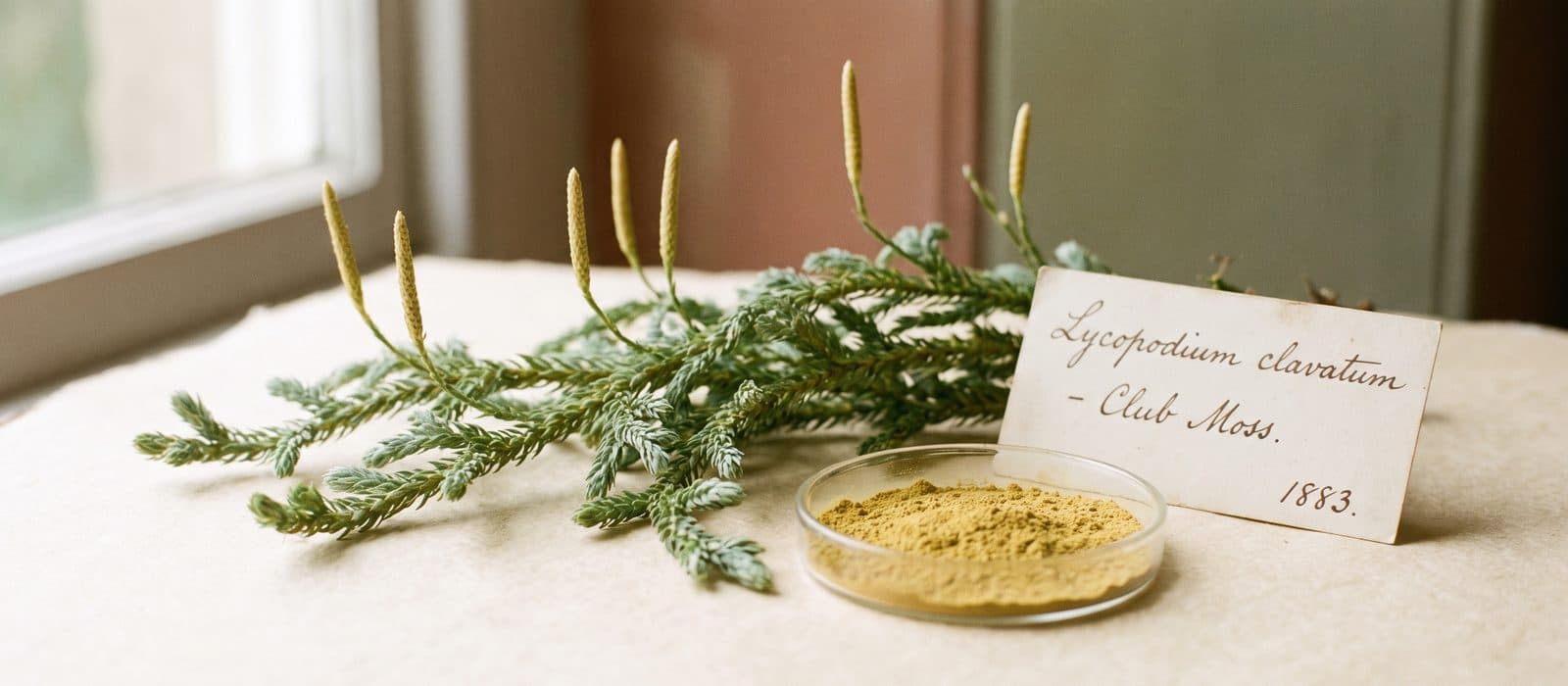
Homeopathic Lycopodium is prepared from the spores of Lycopodium clavatum, the stag's-horn clubmoss, a low creeping plant of moorland, heath and conifer forest across Europe, northern Asia and North America. It is not a true moss but an ancient vascular plant, a relative of the giant club mosses whose remains form much of the world's coal. In late summer it raises small upright cones that shed a fine, pale-yellow powder of spores.
That powder has an odd history. It repels water so well that a finger dusted with it comes out of a basin dry, and a cloud of it ignites in a bright flash, which is why it was used for early photographic flashes, stage effects and fireworks. Pharmacists once rolled pills in it to stop them sticking together.
Taken by mouth, the raw spores pass through largely unchanged. Hahnemann regarded Lycopodium as the clearest case for trituration: he argued that grinding the spores with milk sugar for long periods opened them up, and that the remedy only became active through that process. That is the tradition's claim, not a finding; our guide to what is in a homeopathic remedy explains the preparation, and the potencies guide explains why, at the common potencies, no spore material is expected to remain and why science is sceptical as a result.
What is the Lycopodium picture?
The Lycopodium picture is the capable person with a hollow feeling underneath. Picture someone due to give a presentation at four o'clock. They have prepared thoroughly and look composed, but all day they have dreaded being found out. Lunch was a few forkfuls before they felt full. By mid-afternoon their trousers are tight, the gas is rumbling low in the abdomen, and the mouth is dry. Then they stand up, start talking, and within a minute they are fine.
Classic texts describe this person as intelligent, conscientious and sensitive to how others see them, with confidence that is more performed than felt. Kent's Lectures (1905) sketched a version who is mild and deferential with superiors and short-tempered at home, a caricature worth reading as one shape among several rather than a judgement. Anticipation is the core of it: the fear comes before the event and fades once it is under way.
The body tells a parallel story. Boericke (1927) describes a person who is hungry yet filled by a few mouthfuls, with distension and rumbling gas mainly in the lower abdomen, worse after eating and worse from anything tight about the waist. Sweet things are wanted, warm drinks are preferred, and cold food sits badly. Complaints often begin on the right side or move from right to left. One old oddity is a foot that burns while the other stays cold.
What makes it better or worse?
The traditional modalities centre on the late afternoon, warmth and pressure. Lycopodium is worse from 4 to 8 p.m., from cold food and from tight clothing, and better from warm drinks, loosening the belt and moving about.
| Modality | Worse | Better |
|---|---|---|
| Time | About 4 to 8 p.m.; on waking, irritable | After midnight; once the evening has passed |
| Food and drink | Cold food and drinks; a few mouthfuls overfill; beans, cabbage, onions | Warm drinks and warm food |
| Clothing | Anything tight around the waist | Loosening the belt or waistband |
| Side | Right side, or moving from right to left | No consistent keynote |
| Temperature and motion | Warm, stuffy rooms; lying still | Cool open air for the head; gentle movement |
The clock is what most separates Lycopodium from its digestive neighbours; our guide to modalities, better and worse explains why timing is read before any remedy name.
What is Lycopodium traditionally discussed for?
In homeopathic literature, Lycopodium is traditionally discussed for fullness, gas and anticipatory insecurity, with the late afternoon as its marker. Each of these appears on one of our acute pages, where the Lycopodium-like pattern sits beside its neighbours and the red flags come first.
Digestion
- Early fullness and lower-abdominal distension: bloating after eating and gas pains with bloating.
- Evening bloating with incomplete relief: constipation after travel.
Anticipation and performance
- Doubt beforehand, steadiness once started: anticipatory anxiety and anxiety before an exam.
- The composed presenter with a dry voice: stage fright before speaking and dry mouth before a presentation.
Exertion, heat and circulation
- Weak, bloated and faint after effort: a mild altitude headache and overheating after exertion.
- The one-hot, one-cold foot: burning feet at the end of the day.
What is Lycopodium not?
Lycopodium is not "the bloating remedy", and it is not a confidence remedy for anyone who is nervous. The commonest misreading is to see gas and reach for the name. The tradition's picture is the combination of early fullness, lower-abdominal distension, the late-afternoon clock and the preference for warm drinks; bloating without that shape belongs elsewhere. Bloating that is persistent, new after the age of fifty, or comes with weight loss, blood, vomiting or a change in bowel habit is a medical question first. So is an altitude headache with confusion, unsteadiness or breathlessness at rest, which calls for descent and medical help, and any anxiety that arrives with chest pain or fainting.
Homeopaths separate Lycopodium from its neighbours like this:
| Picture | Where it sits | Defining feature | Key modality |
|---|---|---|---|
| Lycopodium | Lower-abdominal gas; anticipation | Full after a few mouthfuls; composed surface, insecure underneath | Worse 4 to 8 p.m.; better warm drinks |
| Carbo vegetabilis | Upper-abdominal gas | Sluggish, faint, wants air; belching gives relief | Better being fanned |
| Nux vomica | After excess and overwork | Irritable, chilly; urging without result | Worse morning; better a short nap |
| Argentum nitricum | Anticipation with a hurried edge | Rushed, impulsive; loud belching; craves sweets | Worse warmth; better cool air |
| Gelsemium | Anticipation that paralyses | Heavy, trembling, drowsy; wants to be left alone | Worse dwelling on the event |
What potencies is Lycopodium sold in?
Lycopodium clavatum is sold most often as 30C pellets, the common shelf potency for single remedies, with 6C and 200C also widely available. Potency describes the preparation process, not an amount of spore: 30C means thirty successive 1:100 dilutions with succussion between them. Our potencies guide explains the scale and what remains in the vial.
This page deliberately gives no frequency or instructions for taking Lycopodium. That depends on a whole case, not a remedy name. Read the product label, and talk to a qualified practitioner about an individual situation.
What remedy lists don't tell you
Two things the "remedies for bloating" lists leave out:
- The clock does more sorting than the gas. Two people can be equally bloated after lunch. The one whose distension peaks between four and eight, who wants a hot drink and opens the waistband, fits the Lycopodium picture; the one who feels best in the evening does not. Asking when it is worst is a question anyone can answer, and our guide to the symptoms alongside the symptom explains why it carries so much weight.
- Most of the literature describes it as a constitutional picture, not an acute one. Kent and his successors wrote about Lycopodium as a whole person over years, not a single afternoon's bloating. The acute pages use a thin slice of that description. Our guide to acute and chronic questions explains why a recurring pattern belongs with a practitioner who can take the full case.
Where the Lycopodium clavatum picture appears on this site
Acute pages that discuss this picture among their educational patterns, with the pattern name each page uses.
- What homeopathic remedy for a mild altitude headache?Lycopodium-like bloated weakness pattern
- What homeopathic remedy for anticipatory anxiety?Lycopodium-like confidence pattern
- What homeopathic remedy for anxiety before an exam?Lycopodium-like confidence-cover fear pattern
- What homeopathic remedy for bloating after eating?Lycopodium-like lower-abdomen fullness pattern
- What homeopathic remedy for burning feet at the end of the day?Lycopodium-like one-hot-one-cold foot pattern
- What homeopathic remedy for constipation after travel?Lycopodium-like bloating-before-bowel pattern
- What homeopathic remedy for dry mouth before a presentation?Lycopodium-like drying-voice performer pattern
- What homeopathic remedy for gas pains with bloating?Lycopodium-like lower gas-and-fullness pattern
- What homeopathic remedy for overheating after exertion?Lycopodium-like bloated weakness pattern
- What homeopathic remedy for stage fright before speaking?Lycopodium-like polished-surface fear pattern
Not sure whether a picture fits?
A remedy profile describes a picture; it cannot tell you whether that picture matches what you are seeing. An acute consultation starts from the case itself: onset, sensations, what changes it, and the red flags.
Acute consultation · $45Frequently asked questions
- What is Lycopodium?
- Lycopodium clavatum is a homeopathic remedy prepared from the spores of club moss, a low evergreen plant of northern heaths and forests. In homeopathy it names a traditional picture: digestive fullness and gas that build through the afternoon, a worse time from about 4 to 8 p.m., and a person whose outward composure covers a fear of failing. It is a description homeopaths use to compare cases, not a finding that it works for any condition.
- What is Lycopodium used for in homeopathy?
- Homeopathic literature traditionally discusses Lycopodium for bloating and lower-abdominal gas with early fullness, and for anticipatory nerves before an exam, a speech or a performance where confidence returns once the person has started. The picture is defined by that combination and its late-afternoon timing, not by the name of a complaint. Severe or persistent abdominal pain, blood in the stool or a lasting change in bowel habit needs medical care first.
- What is Lycopodium 30C used for?
- 30C is the common shelf potency of Lycopodium, the one most single-remedy tubes and home kits carry, though classical homeopaths often discuss it in higher potencies as a constitutional remedy. In the tradition the potency does not change the picture; Lycopodium 30C is discussed for the same bloated, anticipatory, worse-in-the-late-afternoon state as any other potency. What 30C means as a dilution is explained in our potencies guide.
- How is Lycopodium clavatum taken?
- This page does not give instructions on how or how often to take any remedy, because that depends on a whole case rather than on a remedy name. The product label carries the manufacturer's directions, and a qualified practitioner can advise on an individual situation. Ongoing digestive symptoms, or any that are severe, belong with a clinician first.
- Where can I buy Lycopodium clavatum?
- Pharmacies, health-food shops and homeopathic manufacturers sell Lycopodium clavatum as single-remedy pellets, most often in 30C, with 6C and 200C also common. This site also prepares custom single remedies to order: you name the remedy and potency, and the details are confirmed by email before anything is made. The order form does not give advice on which remedy to choose.
- What is Lycopodium clavatum made from?
- Homeopathic Lycopodium is made from the spores of club moss, Lycopodium clavatum, a fine pale-yellow powder shaken from the plant's upright cones. Because the spores are hard-coated and water-repellent, the first potency steps are made by grinding them with milk sugar (trituration) before dilution and succussion. The raw spore powder is not a classic poison, but it is not a food either, and it is not something to swallow.
This guide is educational only and is not medical advice or a personalized remedy recommendation. Acute symptoms can become urgent; when in doubt, seek professional evaluation.