Remedy profile
Argentum nitricum in Homeopathy: Uses, Picture and Limits
What homeopathic Argentum nitricum is made from, the hurried, anticipatory picture homeopaths describe, what changes it, potencies sold, and its limits.
By Homeopathic BenefitsPublished 7 min read
Key takeaways
- Argentum nitricum is the picture of hurried anticipation. A mind racing ahead to the event and to everything that could go wrong, with a body that cannot slow down.
- The gut joins in. Classic texts describe an urgent, loose, nervous gut before the engagement, with belching, bloating and a craving for sweets that disagree.
- It is warm-blooded. The person feels worse in warm, stuffy rooms and crowds and wants cool, fresh air.
- It comes from silver nitrate, a caustic salt. Raw silver nitrate burns and blackens skin; potentised preparations are diluted far past the point where it remains.
- Anxiety red flags come first. Chest pain, fainting, panic that keeps returning, anxiety that stops daily life, or thoughts of self-harm need professional help, not a remedy name.
The short answer
Argentum nitricum is a homeopathic remedy prepared from silver nitrate, a caustic silver salt long used in medicine to cauterise warts and, in the past, known as lunar caustic. In homeopathy it names a traditional picture rather than a treatment: hurried, impulsive, anticipatory anxiety, in which the person rehearses every way an exam, a flight or a speech could go wrong. Classic materia medica describes a warm-blooded person who walks fast, feels time drag, craves sweets, and has a nervous, urgent gut with belching and dizziness before the event. Boericke (1927) and Nash (1898) both give the anticipatory diarrhoea and the impulsive, hurried mind as central. It is not a general anxiety remedy, and anxiety that is persistent or severe belongs with a doctor or mental-health professional.
| Latin name | Argentum nitricum |
|---|---|
| Abbreviation | Arg-n. |
| Common name | Silver nitrate, lunar caustic |
| Source | Silver nitrate, a colourless crystalline salt of silver, potentised (mineral kingdom) |
| Commonly sold potencies | 6C, 30C, 200C |
| First proving | Proved in the nineteenth century and recorded in Allen's Encyclopedia (1874–1879); described in Hering's Guiding Symptoms, Nash (1898) and Boericke (1927) |
What is Argentum nitricum made from?
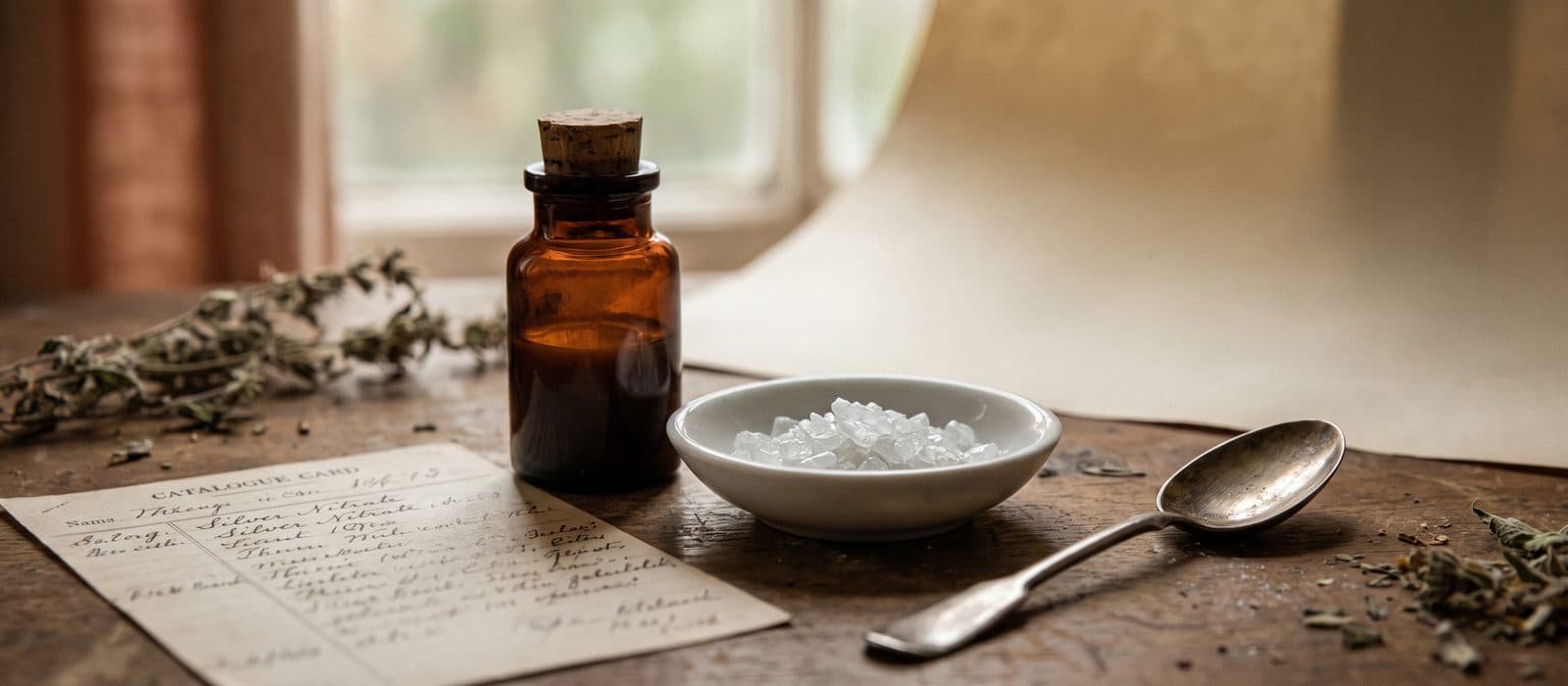
Homeopathic Argentum nitricum is prepared from silver nitrate, a colourless crystalline salt made by dissolving silver in nitric acid. Argentum is Latin for silver; nitricum names the nitrate. Alchemists linked silver with the moon, which is why the fused sticks of silver nitrate sold to apothecaries were called lunar caustic.
The old name is honest about what it does. Silver nitrate is caustic: it burns living tissue, and on skin it leaves stains that darken to black in light. For that reason it is still used in conventional medicine, in the form of silver nitrate sticks, to cauterise small wounds, warts and overgrown tissue, and it was once dropped into newborns' eyes to guard against infection. Swallowed, it is corrosive and poisonous, and long-term exposure to silver compounds can turn the skin a permanent blue-grey, a condition called argyria. It is never something to handle, swallow or prepare at home. Our guide to reading Latin remedy names explains why chemical names like this appear on labels.
The homeopathic preparation dissolves the salt and carries it through repeated dilution and succussion to the potency on the label. At the common potencies the arithmetic says no molecule of silver nitrate remains. Our potencies guide explains what that means, and why it is also the reason mainstream science is sceptical.
Argentum nitricum has a quieter sibling in Argentum metallicum, prepared from metallic silver, which the tradition describes very differently.
What is the Argentum nitricum picture?
The Argentum nitricum picture is the person who is already at the event before it has begun. Picture someone with a presentation on Thursday. By Monday they are running through it in their head, then running through every way it could go wrong: the slides fail, the mind goes blank, someone asks the question they cannot answer. They walk fast, talk fast, arrive early and then cannot sit in the waiting room. The mouth goes dry, they keep swallowing, the stomach churns and fills with wind, and there is an urgent trip to the toilet before they go in.
Classic texts describe this as hurried, impulsive and anticipatory. Boericke (1927) notes that time seems to pass slowly, that the person is always hurried, and that they are full of apprehension when ready to go to church or the opera, with diarrhoea coming on. Nash (1898) emphasised the impulsiveness: strange urges and fears, especially in high places, on bridges or in crowds, and the fear of being trapped or of fainting in an enclosed space. Dizziness and a sense of trembling run through the picture.
The body is warm and the cravings are specific. The person is uncomfortable in hot rooms and crowds, and wants cool, fresh air. Classic texts describe a strong craving for sweets and sugar, which then disagree, causing wind and loose stools, and loud, explosive belching that brings relief. The urgency of the gut mirrors the urgency of the mind.
What makes it better or worse?
The traditional modalities centre on warmth, anticipation and sweets. Argentum nitricum is worse from heat, crowds, sugar and waiting, and better from cool air and belching.
| Modality | Worse | Better |
|---|---|---|
| Temperature | Warm rooms, warm wraps, heat | Cool, fresh air; cold drinks |
| Emotion | Anticipation, waiting, an engagement ahead | Being busy and moving, once the event begins |
| Food | Sweets and sugar; cold food for some (Boericke) | Belching |
| Place | Crowds, heights, enclosed spaces | Open air, open spaces |
| Pressure | No consistent keynote | Pressure on the stomach or head |
Our guide to modalities, better and worse explains why a homeopath reads these before any remedy name.
What is Argentum nitricum traditionally discussed for?
In homeopathic literature, Argentum nitricum is traditionally discussed for anticipatory anxiety of a hurried, restless, digestive kind. Each of these appears on one of our acute pages, where the Argentum nitricum-like pattern sits beside its neighbours and the red flags come first.
Anticipation and nerves
- The hurried, what-if version of worry about something ahead: anticipatory anxiety.
- Restless, dizzy, gut-led nerves in the days before: anxiety before an exam.
Performance and speaking
- Days of catastrophe rehearsal before a talk: stage fright before speaking.
- The dry mouth and constant nervous swallowing in the countdown: dry mouth before a presentation.
What is Argentum nitricum not?
Argentum nitricum is not "the anxiety remedy" or "the exam remedy". The commonest misreading is to name it for anyone who is nervous before an event. The tradition describes a specific shape: hurried, impulsive, warm, sweet-craving and gut-driven, worse from waiting. A person who goes quiet, heavy and trembling before an exam belongs to a different picture. More importantly, anxiety itself is a health question. Chest pain, a racing or irregular heart, fainting or breathlessness should be checked by a doctor rather than assumed to be nerves. Panic attacks that keep coming, anxiety that stops someone working, studying or leaving the house, and any thoughts of self-harm need a doctor or mental-health professional. Our guide to red flags first sets out when to seek care.
Homeopaths separate it from its neighbours like this:
| Picture | Where it sits | Defining feature | Key modality |
|---|---|---|---|
| Argentum nitricum | Hurried anticipation | Impulsive, rushing, what-if; urgent gut; craves sweets | Worse warmth and waiting; better cool fresh air |
| Gelsemium | Paralysing anticipation | Dull, heavy, trembling, wants to be left alone; thirstless | Better after urinating; worse from bad news |
| Lycopodium | Anticipatory insecurity | Dreads the event, then performs well once started; bloating | Worse 4–8 p.m.; better warm drinks |
| Arsenicum album | Anxious, fastidious restlessness | Fear about health and safety; chilly and exhausted | Worse after midnight; better warmth |
Argentum nitricum and Gelsemium are the two classic anticipation pictures and are often confused. The traditional distinction is speed: Argentum nitricum hurries, talks and paces; Gelsemium slows, trembles and goes blank.
What potencies is Argentum nitricum sold in?
Argentum nitricum is sold most often as 30C pellets, the common shelf potency for single remedies, with 6C and 200C also widely available. Potency describes the preparation process, not an amount of silver salt: 30C means thirty successive 1:100 dilutions with succussion between them. Our potencies guide explains the scale and what remains in the vial, and why low potencies of toxic sources carry their own labelling.
This page deliberately gives no frequency or instructions for taking Argentum nitricum. That depends on a whole case, not a remedy name. Read the product label, and talk to a qualified practitioner about an individual situation.
What remedy lists don't tell you
Two things the "remedies for exam nerves" lists leave out:
- Speed is the tell, not fear. Every anticipatory picture is afraid of something. What the classic authors found characteristic of Argentum nitricum was the hurry: walking fast, talking fast, arriving early, feeling time drag, and a mind running ahead into scenarios. A homeopath asks how someone is nervous before asking what they are nervous about, and our guide to the symptoms alongside the symptom explains why.
- Temperature and cravings sort the anxious. Lists stop at the emotion. The tradition separates anxious people by whether they want a window open or a blanket, and whether they crave sweets or want nothing at all. Those small physical details, the ones that seem least connected to nerves, are what a homeopath taking a case writes down first, as our guide on how a homeopath takes a case describes. And because anxiety can be a long-running condition, our guide to homeopathy alongside conventional care covers where a doctor fits in.
Where the Argentum nitricum picture appears on this site
Acute pages that discuss this picture among their educational patterns, with the pattern name each page uses.
- What homeopathic remedy for anticipatory anxiety?Argentum nitricum-like hurried anticipation pattern
- What homeopathic remedy for anxiety before an exam?Argentum nitricum-like hurried diarrhea-fear pattern
- What homeopathic remedy for dry mouth before a presentation?Argentum nitricum-like nervous-swallow pattern
- What homeopathic remedy for stage fright before speaking?Argentum nitricum-like hurried anticipation pattern
Not sure whether a picture fits?
A remedy profile describes a picture; it cannot tell you whether that picture matches what you are seeing. An acute consultation starts from the case itself: onset, sensations, what changes it, and the red flags.
Acute consultation · $45Frequently asked questions
- What is Argentum nitricum?
- Argentum nitricum is a homeopathic remedy prepared from silver nitrate, the caustic silver salt once known as lunar caustic. In homeopathy it names a traditional picture: hurried, impulsive, anticipatory anxiety, with a mind that races ahead to everything that could go wrong, a nervous, urgent gut, a craving for sweets, and a person who is warm and wants cool, fresh air. It is a description homeopaths use to compare cases, not evidence that it works for anxiety or anything else.
- What is Argentum nitricum used for in homeopathy?
- Homeopathic literature traditionally discusses Argentum nitricum for anticipatory anxiety of a hurried, restless kind: the days before an exam, an interview, a flight or a speech, with what-if thinking, dizziness, a dry mouth and an urgent, loose gut. The picture is defined by the hurry and the anticipation, not by the word anxiety. Panic with chest pain or fainting, anxiety that stops daily life, or any thoughts of self-harm need professional help first.
- What is Argentum nitricum 30C used for?
- 30C is the common shelf potency of Argentum nitricum, the one most single-remedy tubes carry. In the tradition the potency does not change the picture: Argentum nitricum 30C belongs to the same hurried, anticipatory, warm-blooded description as any other potency. Our potencies guide explains what 30C means as a dilution.
- How is Argentum nitricum taken?
- This page does not give instructions on how or how often to take any remedy, because that depends on a whole case rather than on a remedy name. The product label carries the manufacturer's directions, and a qualified practitioner can advise on an individual situation. Anxiety that is persistent, severe or affecting daily life belongs with a doctor or mental-health professional.
- Where can I buy Argentum nitricum?
- Pharmacies, health-food shops and homeopathic manufacturers sell Argentum nitricum as single-remedy pellets, most often in 30C, sometimes labelled Arg nit. This site also prepares custom single remedies to order: you name the remedy and potency, and the details are confirmed by email before anything is made. The order form does not give advice on which remedy to choose.
- What is Argentum nitricum made from?
- Homeopathic Argentum nitricum is prepared from silver nitrate, a colourless crystalline salt made by dissolving silver in nitric acid. It is diluted and succussed step by step to the labelled potency. Raw silver nitrate is caustic and poisonous: it burns and blackens skin, and it is never something to handle, swallow or prepare at home. At the common potencies the arithmetic says no molecule of it remains.
This guide is educational only and is not medical advice or a personalized remedy recommendation. Acute symptoms can become urgent; when in doubt, seek professional evaluation.