Remedy profile
Sulphur in Homeopathy: Uses, Picture and Limits
What homeopathic Sulphur is made from, the hot, burning, itchy picture homeopaths describe, what changes it, the potencies sold, and its limits.
By Homeopathic BenefitsPublished 7 min read
Key takeaways
- Sulphur is the hot, burning, itching picture. Homeopaths describe red, burning, itchy skin in a person who runs warm and feels worse for every layer and blanket.
- Heat and water are its classic aggravations. The warmth of bed, a hot room and washing all make the itch worse; the feet go out from under the covers.
- The temperament carries as much weight as the skin. The old nickname "the ragged philosopher" describes a warm, untidy, opinionated thinker who forgets to eat until a sinking hunger at 11 a.m.
- It comes from purified yellow sulphur. The raw mineral is not a classic poison, and at the common potencies none of it is expected to remain.
- Skin red flags come first. Fever, spreading redness or warmth, red streaks, pus, blistering in the mouth or eyes, or swelling of the lips or throat are medical questions before they are homeopathic ones.
The short answer
Sulphur is a homeopathic remedy prepared from purified elemental sulphur, the yellow mineral known for centuries as brimstone. In homeopathy it names a traditional picture rather than a treatment: a hot-blooded person whose skin burns and itches, made worse by warmth, bed-heat and washing, who pushes their feet out from under the blankets at night. Classic materia medica pairs that body with a warm, untidy, theorising temperament and a sinking, empty feeling around 11 a.m. Hahnemann placed Sulphur at the centre of his theory of chronic disease in The Chronic Diseases (1828–1830), and Kent's Lectures (1905) gave it one of the longest entries in his book. It is not a general skin remedy, and nothing about the picture replaces medical care for a rash that is spreading, infected or comes with fever.
| Latin name | Sulphur |
|---|---|
| Abbreviation | Sulph. |
| Common name | Sulphur, flowers of sulphur, brimstone |
| Source | Sublimated elemental sulphur (flowers of sulphur), triturated and potentised (mineral kingdom) |
| Commonly sold potencies | 6C, 30C, 200C |
| First proving | Hahnemann; central to The Chronic Diseases (1828–1830) |
What is Sulphur made from?
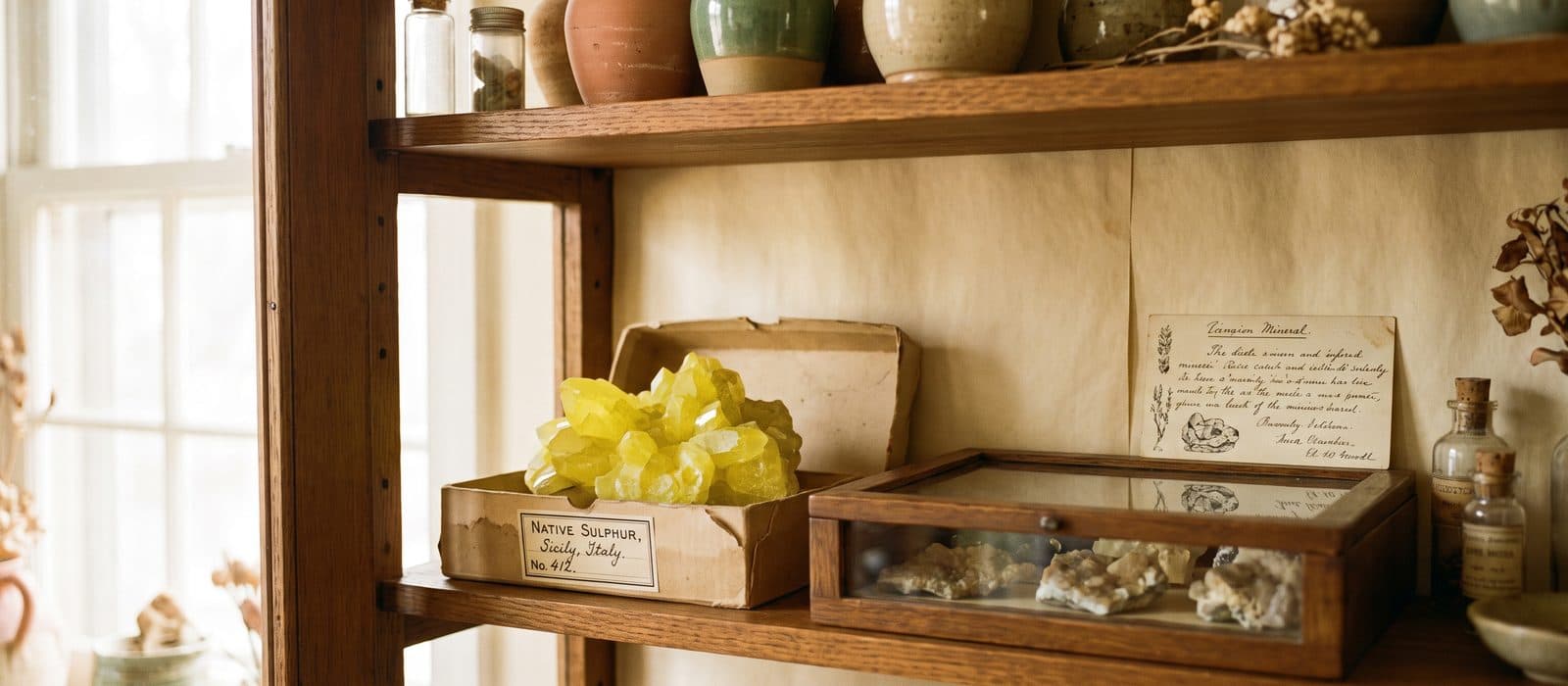
Homeopathic Sulphur is prepared from elemental sulphur, the bright yellow, brittle mineral found around volcanic vents and hot springs and recovered in large quantities from natural gas and oil refining. The form used in pharmacy is "flowers of sulphur": the fine powder that forms when sulphur is heated until it vaporises and then condensed on a cool surface. The old English word for it, brimstone, means burning stone, because it burns with a blue flame and a choking smell.
Sulphur has a long history in ordinary medicine and household use. Sulphur ointments were applied to the skin for centuries, and sulphur is still used in some conventional skin preparations today. It is not a classic poison like arsenic or strychnine, but sulphur dust and the fumes it gives off when burning irritate the eyes and lungs, and it is not something to swallow or prepare at home.
Because sulphur does not dissolve in water, the first potency steps are made by trituration: grinding the powder with milk sugar before it is carried into liquid and diluted and succussed in the usual way. Our guide to what is in a homeopathic remedy explains the process, and the potencies guide explains why, at the common potencies, no sulphur is expected to remain and why that is also the reason science is sceptical.
What is the Sulphur picture?
The Sulphur picture is a person who runs hot and lives in their head. Imagine someone in a warm flat on a winter evening, sleeves pushed up, surrounded by half-read books and a project spread across the table. Their shins itch. They scratch, and at first it feels wonderful; then the skin burns and they scratch again. In bed the itch gets worse as the covers warm up, and by midnight both feet are sticking out from under the duvet, looking for the cool air.
Classic texts sketch this person as an enthusiast and a theorist, full of ideas and opinions, more interested in the idea of a thing than in tidying up after it. The old nickname "the ragged philosopher" captures it: indifferent to appearances, happy in a mess, sure of their own conclusions. It can sound like a caricature, and homeopaths read it as one shape among several, but the warmth and the self-absorption are what separate the picture from a simple itchy rash.
The body follows the heat. Boericke (1927) describes burning everywhere: burning soles, burning skin, burning in the stomach, hot flushes rising to the head, and red lips, eyelids and other orifices. The itch is worse from warmth and from washing, and the person tends to avoid baths. Around 11 a.m. comes a sinking, empty feeling in the stomach that makes them hunt for food. Standing still is particularly disliked.
What makes it better or worse?
The traditional modalities centre on heat and water. Sulphur is worse from warmth, bed-heat, washing and standing, and better in cool open air and with the feet uncovered.
| Modality | Worse | Better |
|---|---|---|
| Temperature | Warmth of bed, warm rooms, heavy clothing | Cool open air; feet uncovered |
| Water | Washing and bathing, hot showers | Staying dry |
| Time | About 11 a.m. (sinking hunger); night in bed | No consistent keynote |
| Position | Standing still for long | Moving about; lying on the right side (Boericke) |
| Weather | Damp, changeable weather | Dry, warm weather (Boericke) |
Heat aggravation is what separates the Sulphur itch from several of its neighbours; our guide to modalities, better and worse explains why a homeopath reads it before any remedy name.
What is Sulphur traditionally discussed for?
In homeopathic literature, Sulphur is traditionally discussed for burning, itching, heat-aggravated states in a person who runs warm. Each of these appears on one of our acute pages, where the Sulphur-like pattern sits beside its neighbours and the red flags come first.
Skin
- Burning, itchy redness worse from heat and water: itchy dry skin in winter.
- The itch every layer aggravates: prickly heat rash.
- Hot, burning redness after shaving, worse in a warm shower: razor burn on the face.
- The hot, itchy reaction on newly inked skin: mild skin irritation after a tattoo.
Heat and flushing
- Hot soles pushed out of bed: burning feet at the end of the day.
- Heat surging with redness: a sudden hot flash. Our guide to seasonal acute patterns shows how heat and winter dryness change the picture.
What is Sulphur not?
Sulphur is not "the skin remedy", and that is the misreading most lists encourage. An itch or a rash can follow many traditional pictures: the puffy, stinging, better-from-cold one, the oozing, cracked one, the nettle-sting one. Sulphur is the hot, burning, worse-from-warmth-and-washing one in a person who runs warm. Without that, the name is just the most famous label in the list. It is also not a reason to sit out a rash with fever, spreading warmth or red streaks, pus or crusting on new tattoo or shaving skin, blistering in the mouth or eyes, or swelling of the lips or throat. Burning feet that persist, or come with numbness, are a reason to see a doctor about causes such as diabetes or vitamin deficiency. Hot flushes with chest pain, palpitations or fainting are a medical question first.
Homeopaths separate Sulphur from its neighbours like this:
| Picture | Where it sits | Defining feature | Key modality |
|---|---|---|---|
| Sulphur | Burning, itching, heat-aggravated skin | Hot-blooded, untidy, theorising; feet out of bed | Worse warmth and washing; better cool air |
| Apis mellifica | Puffy, rosy swelling | Stinging, waterlogged skin; thirstless | Better cold applications |
| Urtica urens | Nettle-like rash and heat bumps | Raised, stinging, itchy blotches | Worse touch and cool water |
| Graphites | Dry, cracked skin | Cracks that ooze a sticky, honey-like fluid; chilly | Worse cold; worse in bed at night |
| Lachesis | Hot flushes | Flushing with a sense of constriction; can't bear collars | Worse after sleep; worse heat |
What potencies is Sulphur sold in?
Sulphur is sold most often as 30C pellets, the common shelf potency for single remedies, with 6C and 200C also widely available. Potency describes the preparation process, not an amount of sulphur: 30C means thirty successive 1:100 dilutions with succussion between them. Our potencies guide explains the scale and what remains in the vial.
This page deliberately gives no frequency or instructions for taking Sulphur. That depends on a whole case, not a remedy name. Read the product label, and talk to a qualified practitioner about an individual situation.
What remedy lists don't tell you
Two things the "remedies for itchy skin" lists leave out:
- The bath question sorts more cases than the rash does. Ask whether a warm shower soothes the itch or sets it off. For the Sulphur picture, water and warmth both make it worse, and the person tends to put off washing. That single companion detail separates two rashes that look identical, which is why our guide to the symptoms alongside the symptom puts it near the top of the case.
- Sulphur's reputation is mostly constitutional. Hahnemann built his theory of chronic disease around it, and Kent wrote about it as a lifelong temperament rather than an afternoon's itch. The acute pages borrow only the burning and the heat. Our guide to acute and chronic questions explains why a skin problem that keeps returning belongs with a practitioner, and often with a dermatologist, rather than with a list.
Where the Sulphur picture appears on this site
Acute pages that discuss this picture among their educational patterns, with the pattern name each page uses.
- What homeopathic remedy for a sudden hot flash?Sulphur-like burning heat with redness pattern
- What homeopathic remedy for burning feet at the end of the day?Sulphur-like burning-soles pattern
- What homeopathic remedy for itchy dry skin in winter?Sulphur-like burning itchy redness pattern
- What homeopathic remedy for mild skin irritation after a tattoo?Sulphur-like burning itchy reaction pattern
- What homeopathic remedy for prickly heat rash?Sulphur-like heat-aggravated itch pattern
- What homeopathic remedy for razor burn on the face?Sulphur-like burning post-shave redness pattern
Not sure whether a picture fits?
A remedy profile describes a picture; it cannot tell you whether that picture matches what you are seeing. An acute consultation starts from the case itself: onset, sensations, what changes it, and the red flags.
Acute consultation · $45Frequently asked questions
- What is Sulphur?
- Sulphur is a homeopathic remedy prepared from purified elemental sulphur, the yellow mineral once called brimstone. In homeopathy it names a traditional picture: a hot-blooded person with burning, itching, reddened skin that is worse from warmth, bed-heat and washing, who pushes their feet out from under the covers at night. It is a description homeopaths use to compare cases, not a finding that it works for any skin or other condition.
- What is Sulphur used for in homeopathy?
- Homeopathic literature traditionally discusses Sulphur for burning, itching redness made worse by heat and water, such as winter itch, prickly heat or razor burn, and for burning soles and heat flushes. The picture is defined by the burning, the heat aggravation and the person's hot, untidy, theorising temperament, not by the name of a rash. A rash with fever, spreading redness, pus or blistering in the mouth needs medical care first.
- What is Sulphur 30C used for?
- 30C is the common shelf potency of Sulphur, the one most single-remedy tubes and home kits carry; classical homeopaths also discuss it widely in higher potencies. In the tradition the potency does not change the picture; Sulphur 30C is discussed for the same hot, burning, heat-aggravated state as any other potency. What 30C means as a dilution is explained in our potencies guide.
- How is Sulphur taken?
- This page does not give instructions on how or how often to take any remedy, because that depends on a whole case rather than on a remedy name. The product label carries the manufacturer's directions, and a qualified practitioner can advise on an individual situation. A rash that is spreading, infected or comes with fever belongs with a clinician first.
- Where can I buy Sulphur?
- Pharmacies, health-food shops and homeopathic manufacturers sell Sulphur as single-remedy pellets, most often in 30C, with 6C and 200C also common. This site also prepares custom single remedies to order: you name the remedy and potency, and the details are confirmed by email before anything is made. The order form does not give advice on which remedy to choose.
- What is Sulphur made from?
- Homeopathic Sulphur is made from flowers of sulphur, the fine yellow powder produced when sulphur is vaporised and condensed. Sulphur does not dissolve in water, so the first potency steps are made by grinding it with milk sugar (trituration) before dilution and succussion. At the common potencies no sulphur is expected to remain in the pellet.
This guide is educational only and is not medical advice or a personalized remedy recommendation. Acute symptoms can become urgent; when in doubt, seek professional evaluation.