Remedy profile
Graphites in Homeopathy: Uses, Picture and Limits
What homeopathic Graphites is made from, the thick, cracked, sticky-oozing skin picture homeopaths describe, what changes it, potencies sold, and its limits.
By Homeopathic BenefitsPublished 7 min read
Key takeaways
- Graphites is the picture of thick, cracked, sticky skin. Classic texts describe rough, hardened skin that splits and oozes a sticky, honey-like fluid which dries into crusts.
- The cracks gather in particular places. Mouth corners, fingertips, behind the ears, between the fingers and in skin folds and creases.
- Oozing, not dry, is the distinction. Many cracked-skin pictures stay dry and bleed; the Graphites picture weeps and glues.
- It is made from plain graphite. The "black lead" of pencils, which is carbon and contains no lead.
- Skin has red flags first. Spreading honey-coloured crusts, increasing redness, heat or swelling, fever, red streaks, or painful punched-out blisters on eczema need medical care before any pattern discussion.
The short answer
Graphites is a homeopathic remedy prepared from graphite, the soft, grey-black form of carbon used in pencil leads, ground with milk sugar and then diluted and succussed to the labelled potency. In homeopathy it names a traditional picture rather than a treatment: skin that is thick, rough and dry yet cracks and oozes a sticky, honey-like fluid that crusts over, especially at the corners of the mouth, on the fingertips, behind the ears and in skin folds. Hahnemann introduced it in The Chronic Diseases, and the classic authors added a constitutional picture of a chilly, cautious, easily saddened person. It is not an eczema remedy, and sticky, crusting skin can be an infection that needs a doctor or pharmacist.
| Latin name | Graphites |
|---|---|
| Abbreviation | Graph. |
| Common name | Black lead, plumbago (graphite) |
| Source | Natural graphite, a crystalline form of carbon, triturated and potentised (mineral kingdom) |
| Commonly sold potencies | 6C, 30C, 200C |
| First proving | Hahnemann, The Chronic Diseases (1828–1830) |
What is Graphites made from?
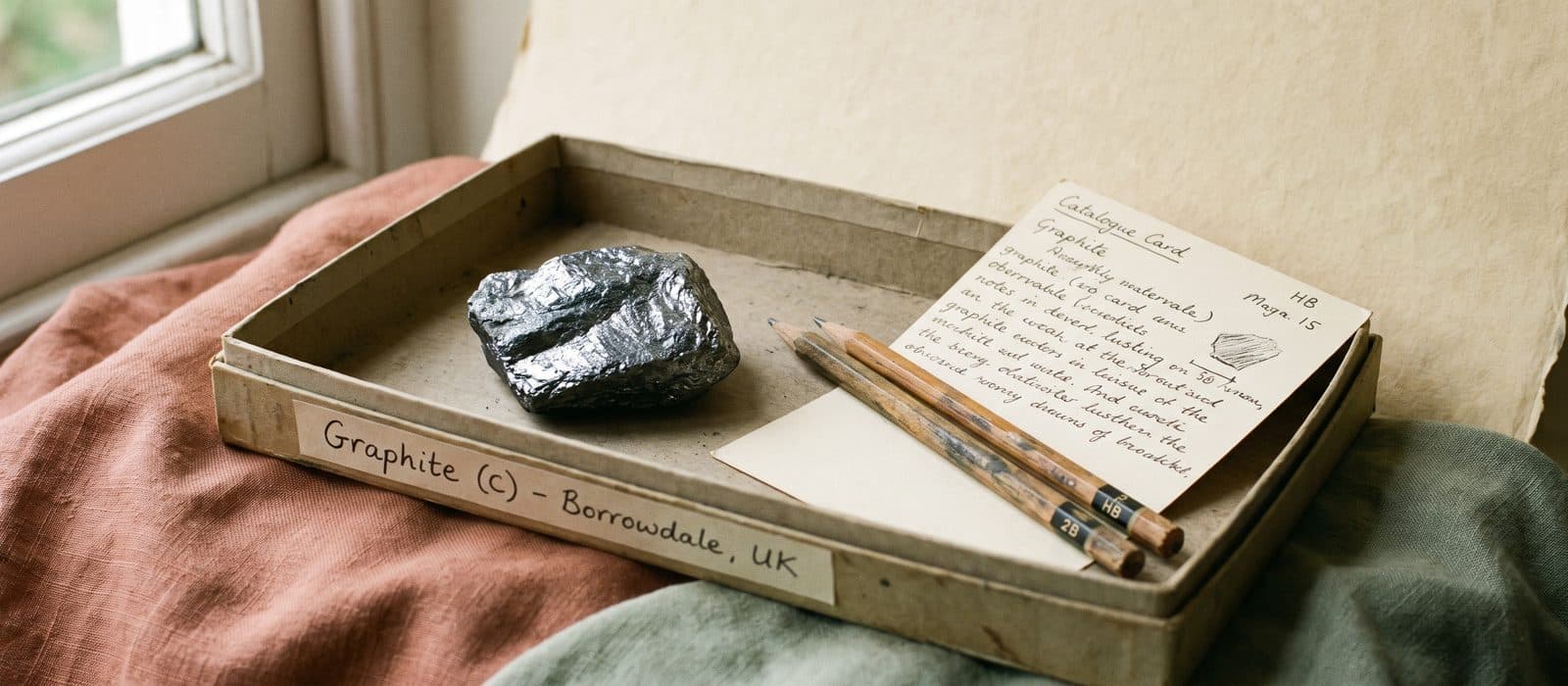
Homeopathic Graphites is prepared from natural graphite, a soft, greasy, grey-black crystalline form of carbon. It is the same mineral that makes the mark in a pencil, lubricates locks and lines foundry moulds. Its old English names, black lead and plumbago, come from a long-standing confusion with lead ore; graphite contains no lead at all, and neither do pencils.
Graphite does not dissolve in water or alcohol, so the first potency steps are made by trituration: grinding the powder with lactose for long periods until it can be carried into liquid, after which it is diluted and succussed to the potency on the label in the usual way. Our guide to what is in a homeopathic remedy explains how this works for insoluble starting materials. At the common potencies the arithmetic says no particle of the original graphite remains; our potencies guide explains that honestly, including why it is also the reason mainstream science is sceptical.
Graphite itself is not a poison in the way some remedy sources are. Industrial graphite dust is an occupational lung hazard for people who mine or mill it, which is a reason not to grind it at home, but the mineral in a pencil is harmless to handle.
Hahnemann introduced Graphites in The Chronic Diseases (1828–1830), as one of the remedies he described for long-standing tendencies rather than short illnesses. That origin shows in the picture: the skin symptoms come with a constitution attached.
What is the Graphites picture?
The Graphites picture is skin that cannot decide whether it is dry or wet. Imagine someone's hands in midwinter: the skin of the fingertips has thickened and hardened, and along the edge of a nail a crack has opened. It weeps a little clear, sticky fluid that dries into a yellowish crust, glues the crack shut, and then tears again every time the finger bends. The corners of the mouth do the same, splitting when the person yawns or bites into an apple, then crusting over.
Boericke (1927) describes unhealthy skin that is rough, hard and persistently dry, with eruptions that ooze a sticky, honey-like exudation, and cracks in the nipples, mouth corners, between the toes and behind the ears. Classic texts add thick, crumbling or deformed nails, and old scars that harden. The itching is worse from warmth, particularly the warmth of bed at night.
The constitutional picture fills out the rest. Kent's Lectures (1905) describe a person who is chilly, inclined to put on weight, sluggish in digestion and often constipated, cautious, hesitant and slow to decide, and easily moved to sadness, the classic detail being someone who weeps at music. The old texts read the skin and the person together; in an acute skin flare, homeopaths still look at the skin first, and only then ask whether the rest of the picture fits.
What makes it better or worse?
The traditional modalities are mixed in an instructive way. Graphites is a chilly picture, yet the skin itches more from warmth; it is worse at night and from the warmth of bed, and better from being wrapped up, in the dark and after eating.
| Modality | Worse | Better |
|---|---|---|
| Temperature | Warmth of bed for the itch; cold for the person | Wrapping up, being covered |
| Time | At night | No consistent keynote |
| Motion | Stretching or opening cracked skin: wide mouth, bending fingers | Keeping the part still |
| Season | Cold, dry winter weather for the cracks | No consistent keynote |
| Other | Light (Boericke); during and after a period | Dark; eating, for the stomach symptoms |
A chilly person whose skin itches from warmth is the kind of contradiction homeopaths read closely; our guide to modalities, better and worse explains why.
What is Graphites traditionally discussed for?
In homeopathic literature, Graphites is traditionally discussed for skin that thickens, cracks, oozes and crusts. Each of these appears on one of our acute pages, where the Graphites-like pattern sits beside its neighbours and the red flags come first.
Cracks and splits
- Thickened, crack-prone fingertips that ooze and crust at the splits: split fingertips in dry weather.
- Cracks settling into the mouth corners with sticky crusting: painfully chapped lips.
- Sticky, oozing, cracked irritation in dry, cold weather: itchy dry skin in winter. Our guide to seasonal acute patterns covers the winter skin pictures together.
Irritated skin that weeps and crusts
- Thick, oozy skin cracking with sticky discharge after a plant rash: a poison ivy rash.
- Crusting irritation settling into chin creases and beard folds: razor burn on the face.
- Tattooed skin turning sticky and crusting beyond the expected thin scab: mild skin irritation after a tattoo.
What is Graphites not?
Graphites is not "the eczema remedy" or a remedy for cracked skin in general. The commonest misreading is to match the dryness: cracked, therefore Graphites. The tradition's picture is the thickening, the sticky, honey-like ooze and the crusting in particular places; cracks that stay dry and bleed belong to other pictures. More importantly, the details that define the picture overlap with infection. Honey-coloured crusts, especially around the nose and mouth or spreading quickly, are the classic sign of impetigo, a contagious bacterial skin infection that needs a pharmacist or doctor. Increasing redness, warmth, swelling or pain, red streaks spreading from a crack or a tattoo, pus, or a fever suggest infection. In someone with eczema, clusters of painful, punched-out blisters or sores that suddenly appear and spread can be eczema herpeticum, which needs same-day medical care. A plant rash on the face, eyes or genitals, or one that covers a large area, belongs with a clinician, and any swelling of the face or difficulty breathing is an emergency. Our guide to red flags first sets these out.
Homeopaths separate Graphites from its neighbours like this:
| Picture | Where it sits | Defining feature | Key modality |
|---|---|---|---|
| Graphites | Thick, cracked, weeping skin | Sticky, honey-like ooze that crusts; cracks in folds, mouth corners, fingertips | Itch worse warmth of bed; better wrapped up |
| Petroleum | Deep winter cracks | Dry, rough, deep fissures that bleed rather than ooze | Worse winter; better warm, dry weather |
| Antimonium crudum | Thick, horny skin | Callused, cracked mouth corners; thickly white-coated tongue; cross and sulky | Worse heat of the sun and cold bathing |
| Sulphur | Itching, burning skin | Dry, red, burning itch that is scratched until it burns | Worse warmth of bed and washing |
| Hepar sulphuris | Skin that tends to fester | Exquisitely sensitive, splinter-like pain; prone to pus | Worse cold and touch; better warm applications |
Graphites and Petroleum are the two classic winter-crack pictures. The traditional distinction is wet against dry: Graphites oozes a sticky fluid and crusts; Petroleum stays dry and bleeds.
What potencies is Graphites sold in?
Graphites is sold most often as 30C pellets, the common shelf potency for single remedies, with 6C and 200C also widely available. Potency describes the preparation process, not an amount of graphite: 30C means thirty successive 1:100 dilutions with succussion between them. Our potencies guide explains the scale and what remains in the vial.
This page deliberately gives no frequency or instructions for taking Graphites. That depends on a whole case, not a remedy name. Read the product label, and talk to a qualified practitioner about an individual situation.
What remedy lists don't tell you
Two things the "remedies for cracked skin" lists leave out:
- The ooze is the clue and also the warning. Lists describe Graphites as cracked, dry skin, which fits half of winter. What the classic authors found characteristic was the sticky, honey-like fluid that glues the crack and crusts. That same honey-coloured crust is also what a pharmacist looks for when checking for impetigo, so a homeopath who sees it asks the infection questions first.
- Location is part of the picture. Mouth corners, fingertips, behind the ears and the creases of folds come up again and again in the old descriptions. Our guide to the symptoms alongside the symptom explains why a homeopath notes exactly where a crack sits, not just that it is there.
Where the Graphites picture appears on this site
Acute pages that discuss this picture among their educational patterns, with the pattern name each page uses.
- What homeopathic remedy for a poison ivy rash?Graphites-like oozing, thick skin cracking pattern
- What homeopathic remedy for itchy dry skin in winter?Graphites-like oozing eczema pattern
- What homeopathic remedy for mild skin irritation after a tattoo?Graphites-like sticky crusting pattern
- What homeopathic remedy for painfully chapped lips?Graphites-like corner-crack crusting pattern
- What homeopathic remedy for razor burn on the face?Graphites-like fold-crusting irritation pattern
- What homeopathic remedy for split fingertips in dry weather?Graphites-like thick-skin oozing crack pattern
Not sure whether a picture fits?
A remedy profile describes a picture; it cannot tell you whether that picture matches what you are seeing. An acute consultation starts from the case itself: onset, sensations, what changes it, and the red flags.
Acute consultation · $45Frequently asked questions
- What is Graphites?
- Graphites is a homeopathic remedy prepared from graphite, the soft, grey-black form of carbon used in pencil 'leads'. In homeopathy it names a traditional picture centred on the skin: thick, rough, cracked skin that oozes a sticky, honey-like fluid and crusts, especially in folds, at the corners of the mouth and on the fingertips. It is a description homeopaths use to compare cases, not evidence that it works for eczema or any other condition.
- What is Graphites used for in homeopathy?
- Homeopathic literature traditionally discusses Graphites for skin that thickens, cracks and oozes a sticky fluid that dries into crusts: split fingertips, cracked mouth corners, crusting in skin folds and irritated skin that weeps rather than staying dry. The picture is defined by the stickiness, the cracks and the thickening rather than by a diagnosis. Honey-coloured crusts that spread, increasing redness, warmth or swelling, fever, or painful blisters on eczema need medical care first.
- What is Graphites 30C used for?
- 30C is the common shelf potency of Graphites, with 6C and 200C also widely sold. In the tradition the potency does not change the picture; Graphites 30C belongs to the same thick, cracked, sticky-oozing description as any other potency. Our potencies guide explains what 30C means as a dilution.
- How is Graphites taken?
- This page does not give instructions on how or how often to take any remedy, because that depends on a whole case rather than on a remedy name. The product label carries the manufacturer's directions, and a qualified practitioner can advise on an individual situation. Skin that is spreading, weeping heavily, crusting yellow or showing signs of infection belongs with a clinician first.
- Where can I buy Graphites?
- Pharmacies, health-food shops and homeopathic manufacturers sell Graphites as single-remedy pellets, most often in 30C. This site also prepares custom single remedies to order: you name the remedy and potency, and the details are confirmed by email before anything is made. The order form does not give advice on which remedy to choose.
- What is Graphites made from?
- Homeopathic Graphites is made from natural graphite, a crystalline form of carbon. Because graphite does not dissolve, it is first ground for long periods with milk sugar (trituration) and then diluted and succussed step by step to the labelled potency. Despite the old name 'black lead', graphite contains no lead.
This guide is educational only and is not medical advice or a personalized remedy recommendation. Acute symptoms can become urgent; when in doubt, seek professional evaluation.