Remedy profile
Calcarea carbonica in Homeopathy: Uses, Picture and Limits
What homeopathic Calcarea carbonica is made from, the chilly, sweaty, steady picture homeopaths describe, what changes it, potencies sold, and its limits.
By Homeopathic BenefitsPublished 7 min read
Key takeaways
- Calcarea carbonica is a constitutional picture first. Classic texts describe a whole person, chilly, sweaty, steady and easily tired, more than a single complaint.
- The sweaty head and the cold, damp feet are the physical keynotes. The sweat soaks the pillow at night; the feet feel as if in damp stockings.
- Overwhelm is the emotional keynote. Homeopaths describe a reliable, cautious person who copes until there is too much, then becomes anxious and fears losing control.
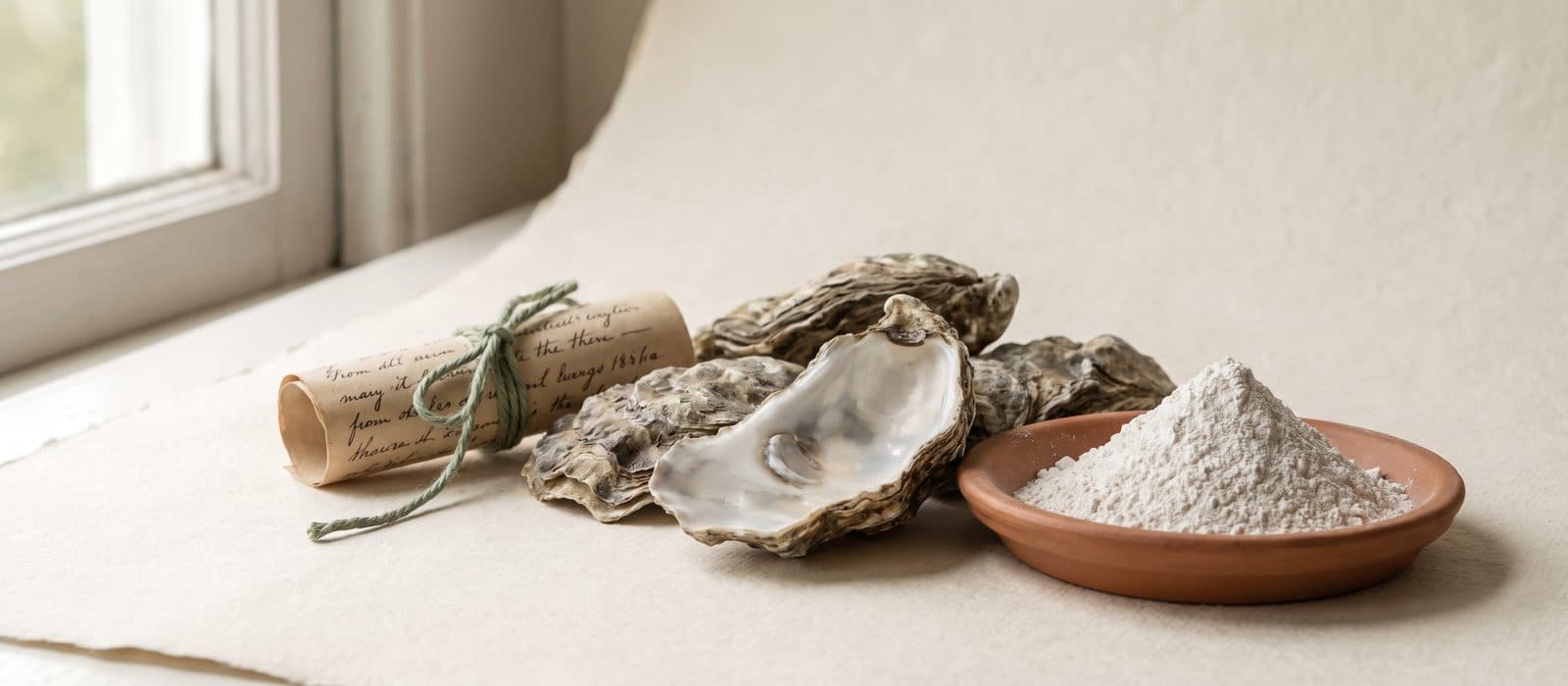
- It comes from oyster shell. Calcium carbonate is an everyday compound; the remedy is prepared from the shell's inner chalky layer.
- Growth, feeding and persistent fatigue are medical questions first. A child who is slow to walk, talk or gain weight, or an adult who is always exhausted, needs a doctor before any pattern discussion.
The short answer
Calcarea carbonica is a homeopathic remedy prepared from calcium carbonate taken from the middle layer of the oyster shell, ground with milk sugar and then diluted and succussed to the labelled potency. In homeopathy it names one of the broad constitutional pictures: a chilly, solid, easily tired person who sweats on the head, craves eggs and sweets, and becomes anxious when life piles up. Hahnemann published it in The Chronic Diseases (1828–1830), and Kent's Lectures (1905) give it one of their longest chapters. On this site it appears in acute pages mainly around teething children. It is not a calcium supplement or a "bone remedy", and nothing in the picture replaces a medical look at a child who is not growing or a tiredness that will not lift.
| Latin name | Calcarea carbonica |
|---|---|
| Abbreviation | Calc. |
| Common name | Calcium carbonate from oyster shell (Calcarea ostrearum) |
| Source | The middle, chalky layer of the oyster shell (Ostrea edulis), triturated and potentised (mineral kingdom) |
| Commonly sold potencies | 6C, 30C, 200C |
| First proving | Hahnemann, The Chronic Diseases (1828–1830) |
What is Calcarea carbonica made from?
Homeopathic Calcarea carbonica is prepared from calcium carbonate, but not from just any chalk. Hahnemann specified the middle, snow-white layer of the oyster shell, between the rough outer crust and the pearly lining, which is why the remedy is sometimes labelled Calcarea ostrearum, "lime of oysters". The common edible oyster, Ostrea edulis, is the traditional source. Our guide to reading Latin remedy names explains how Calcarea came to mean calcium compounds on a label.
Calcium carbonate does not dissolve in water, so the first potency steps are made by trituration: the shell layer is ground with lactose for long periods, then carried into liquid and diluted and succussed in the usual way. There is nothing poisonous about the starting material; it is the same compound as chalk, limestone and the antacid tablets sold in any pharmacy.
That last point is a source of confusion. A homeopathic potency of Calcarea carbonica contains no meaningful calcium. At 12C the dilution passes the Avogadro limit, and the arithmetic says no molecule of the original shell is expected to remain. It is not a way of taking calcium, and nothing on this page should be read as a comment on calcium supplements. Our potencies guide explains the scale, and why the same arithmetic is the reason mainstream science is sceptical.
What is the Calcarea carbonica picture?
The Calcarea carbonica picture is a steady person who is easily worn out. Classic texts describe someone solid and reliable, slow to start and slow to stop, who does the work methodically and keeps going until the load is simply too great. Then the picture tips into anxiety: fear that something bad will happen, fear of illness, fear of going out of their mind, and a sense that others can see they are not coping. Kent (1905) dwells on this overwhelm, and on the obstinacy that comes with it when the person is pushed.
Physically the picture is chilly and damp. The person feels the cold, yet sweats easily, above all on the head and the back of the neck, so that the pillow is wet in the morning. The hands are clammy, and the feet feel cold and damp, as if in wet stockings. Exertion tires quickly, climbing stairs leaves them breathless, and they are worse in cold, wet weather. Sweat, vomit and stools have a sour smell in the old descriptions. They often crave eggs, sweets and sometimes odd things such as chalk or earth, and milk may disagree.
The children's version is the one most homeopaths meet first. Boericke (1927) and Clarke (1900–1902) describe a large-headed, fair, plump baby, slow to teethe, slow to walk, sweating on the head in sleep, with a sour smell and a placid but stubborn temperament. That description is historical and observational. A child who is late with milestones needs a paediatric assessment, not a constitutional label.
What makes it better or worse?
The traditional modalities centre on cold, damp and exertion. Calcarea carbonica is worse from cold in all its forms, from wet weather and from effort, and better in dry weather.
| Modality | Worse | Better |
|---|---|---|
| Temperature | Cold air, cold water, washing | Warmth (though the head sweats easily) |
| Weather | Cold, damp, changing weather | Dry weather and dry climates |
| Exertion | Physical or mental effort, climbing stairs or hills | Rest |
| Position | Standing | Lying on the painful side |
| Time | Evening anxiety; night sweats on the head | Morning, after a rest |
These modalities are general, not tied to one complaint, which is typical of a constitutional picture. Our guide to modalities, better and worse explains why homeopaths give them so much weight.
What is Calcarea carbonica traditionally discussed for?
In homeopathic literature, Calcarea carbonica is traditionally discussed far more as a constitutional picture than as an acute one. Only one of our acute pages names it, and the rest of this section comes from the classic materia medica rather than from acute pages.
Children and teething
- The sweaty-headed, slow-teething, easily tired toddler: a fussy teething day. Our teething page covers the closely related Calcarea phosphorica picture, and our guide to observing a sick child covers what to watch for.
The constitutional picture (classic texts)
- Kent (1905) and Clarke (1900–1902) discuss it for people who are chronically chilly and easily fatigued, with head sweats and a tendency to sour digestion. This is long-term case work, the territory of our guide to acute and chronic questions.
- Older texts discuss it for slow bone and teeth development in children and for joint complaints worse in damp weather. These are descriptions from the nineteenth-century literature, and each of them is a medical question first.
Mood and overwhelm (classic texts)
- The cautious, overworked person who becomes anxious and fearful when the load gets too heavy. Ongoing anxiety belongs with a doctor or therapist, and a homeopath would take a full case rather than match a name to a mood. Our guide to how a homeopath takes a case explains that process.
What is Calcarea carbonica not?
Calcarea carbonica is not a calcium supplement, and it is not "the remedy for slow children" or "the remedy for weight gain". The commonest misreading takes one feature, the plump baby or the oyster shell, and mistakes it for the whole picture. The tradition's Calcarea carbonica is the combination of chilliness with head sweats, quick fatigue from effort, sour smells, the craving for eggs, and anxiety when overwhelmed; a person with one of these and none of the others belongs elsewhere.
It is also not a substitute for a medical look. Slow growth, late walking or talking, poor feeding, unexplained weight change, persistent exhaustion, breathlessness on stairs, and night sweats in an adult all have medical causes that need checking, among them thyroid, anaemia and heart and lung problems. Those come first.
Homeopaths separate Calcarea carbonica from its neighbours like this:
| Picture | Where it sits | Defining feature | Key modality |
|---|---|---|---|
| Calcarea carbonica | Chilly, steady, easily tired | Sweaty head, cold damp feet, anxiety when overwhelmed | Worse cold, damp and exertion; better dry weather |
| Calcarea phosphorica | Thin, growing, restless children | Discontented, wants to go somewhere; slow, difficult teething | Worse cold, damp and change of weather |
| Silicea | Chilly, fine-boned, low stamina | Yielding but stubborn; sweaty feet more than head | Worse cold and draughts; better wrapping the head |
| Baryta carbonica | Shy, slow, easily embarrassed | Timidity and immaturity rather than overwork | Worse cold; worse thinking of symptoms |
| Sulphur | Warm, untidy, philosophical | Hot, especially the feet at night; dislikes washing | Worse heat and standing; better open air |
What potencies is Calcarea carbonica sold in?
Calcarea carbonica is sold most often as 30C pellets, with 6C and 200C also widely available; 12C and higher potencies are made to order by specialist pharmacies. Potency describes the preparation process, not an amount of calcium: 30C means thirty successive 1:100 dilutions with succussion between them. Our potencies guide explains the scale and what remains in the vial.
This page deliberately gives no frequency or instructions for taking Calcarea carbonica. That depends on a whole case, not a remedy name, and constitutional remedies in particular are traditionally prescribed by a practitioner after a long consultation. Read the product label, and talk to a qualified practitioner about an individual situation.
What remedy lists don't tell you
Two things the short lists leave out:
- The sweat is the clue, not the build. Remedy lists often reduce Calcarea carbonica to "plump, fair and slow", which is a description of a body type, not a state. What the classic texts lean on is the combination of chilliness with sweat on the head, sour smells and quick fatigue from effort. Plenty of plump people show none of that, and plenty of thin ones do.
- Overwhelm is not laziness. The old descriptions of a slow, heavy person can read as a judgement. Kent's Calcarea is someone who has worked steadily for years and has reached the end of what they can carry; the fear is of breaking down, not a lack of effort. That distinction matters to how a homeopath takes the case, and to how anyone at home talks to the person. Our guide to the symptoms alongside the symptom explains why the general state outweighs the complaint.
Where the Calcarea carbonica picture appears on this site
Acute pages that discuss this picture among their educational patterns, with the pattern name each page uses.
- What homeopathic remedy for a fussy teething day in a toddler?Calcarea carbonica-like sweaty head pattern
Not sure whether a picture fits?
A remedy profile describes a picture; it cannot tell you whether that picture matches what you are seeing. An acute consultation starts from the case itself: onset, sensations, what changes it, and the red flags.
Acute consultation · $45Frequently asked questions
- What is Calcarea carbonica?
- Calcarea carbonica is a homeopathic remedy prepared from calcium carbonate taken from the inner layer of the oyster shell, ground with milk sugar and then diluted and succussed. In homeopathy it names one of the large constitutional pictures: a chilly, easily tired, sweaty, steady person who becomes anxious when overwhelmed. It is a description homeopaths use to compare cases, not evidence that it works for any condition.
- What is Calcarea carbonica used for in homeopathy?
- Homeopathic literature discusses Calcarea carbonica mainly as a constitutional picture rather than an acute one: slow, solid, chilly people who sweat easily on the head, tire with exertion and worry when overloaded. In acute pages it appears most often around children, for example a teething toddler with a sweaty head. A child who is not feeding, drinking or growing as expected is a medical question first.
- What is Calcarea carbonica 30C used for?
- 30C is a common shelf potency of Calcarea carbonica, alongside 6C and 200C. In the tradition the potency does not change the picture; 30C is discussed for the same chilly, sweaty, slow-and-steady picture as any other potency, and constitutional prescribing is usually left to a practitioner who has taken the whole case. Our potencies guide explains what 30C means as a dilution.
- How is Calcarea carbonica taken?
- This page does not give instructions on how or how often to take any remedy, because that depends on a whole case rather than on a remedy name. The product label carries the manufacturer's directions, and a qualified practitioner can advise on an individual situation. Delayed growth, poor feeding, or tiredness that does not lift are questions for a doctor first.
- Where can I buy Calcarea carbonica?
- Pharmacies, health-food shops and homeopathic manufacturers sell Calcarea carbonica as single-remedy pellets, most often in 30C, and sometimes under the older name Calcarea ostrearum. This site also prepares custom single remedies to order: you name the remedy and potency, and the details are confirmed by email before anything is made. The order form does not give advice on which remedy to choose.
- What is Calcarea carbonica made from?
- Calcarea carbonica is made from calcium carbonate taken from the middle, chalky layer of the oyster shell, as Hahnemann specified, rather than from laboratory chalk. The shell layer is triturated with milk sugar through the first potency steps and then diluted and succussed to the labelled potency. Calcium carbonate itself is an everyday substance, the same compound as chalk and limestone.
This guide is educational only and is not medical advice or a personalized remedy recommendation. Acute symptoms can become urgent; when in doubt, seek professional evaluation.