Remedy profile
Silicea in Homeopathy: Uses, Picture and Limits
What homeopathic Silicea is made from, the chilly, slow-to-mend, low-stamina picture homeopaths describe, what changes it, potencies sold, and its limits.
By Homeopathic BenefitsPublished 8 min read
Key takeaways
- Silicea is the picture of slowness and low reserves. Classic texts describe a chilly, fine-boned person who tires easily, in whom colds linger and small wounds are slow to close.
- Splinters and nail folds are its best-known territory. Homeopaths describe the sensation of something stuck in the skin, and low-grade festering that never quite comes to a head or settles.
- The temperament is yielding on the surface and stubborn underneath. The old texts pair timidity and anticipatory nerves with a quiet obstinacy, and a lack of stamina with conscientiousness.
- It is made from silica, and is also a Schüssler tissue salt. Silica is the mineral of quartz and flint; Silicea 6X tablets belong to the nineteenth-century tissue-salt tradition.
- Lingering is not the same as harmless. Spreading redness, red streaks, fever, swelling around the eye, a severe headache, or any foot wound in someone with diabetes is a medical question first.
The short answer
Silicea is a homeopathic remedy prepared from silica, silicon dioxide, the mineral that makes up quartz, flint and most sand. In homeopathy it names a traditional picture rather than a treatment: a chilly, delicate person with little stamina, in whom things are slow, so that colds leave a sinus congestion that never clears, small cuts and splits take weeks to close, and a splinter or nail fold festers at a low grade. Classic materia medica pairs that with a temperament that is timid and yielding yet obstinate, and with sweaty, cold hands and feet. Hahnemann published it in The Chronic Diseases (1828–1830), and Wilhelm Schüssler later made it one of his twelve tissue salts. It is not a remedy for splinters or sinusitis as such, and nothing about the picture replaces medical care for an infection that is spreading.
| Latin name | Silicea |
|---|---|
| Abbreviation | Sil. |
| Common name | Silica, pure flint (silicon dioxide) |
| Source | Silicon dioxide (silica), traditionally from rock crystal or flint, triturated and potentised (mineral kingdom) |
| Commonly sold potencies | 6X, 6C, 30C, 200C |
| First proving | Hahnemann, The Chronic Diseases (1828–1830) |
What is Silicea made from?
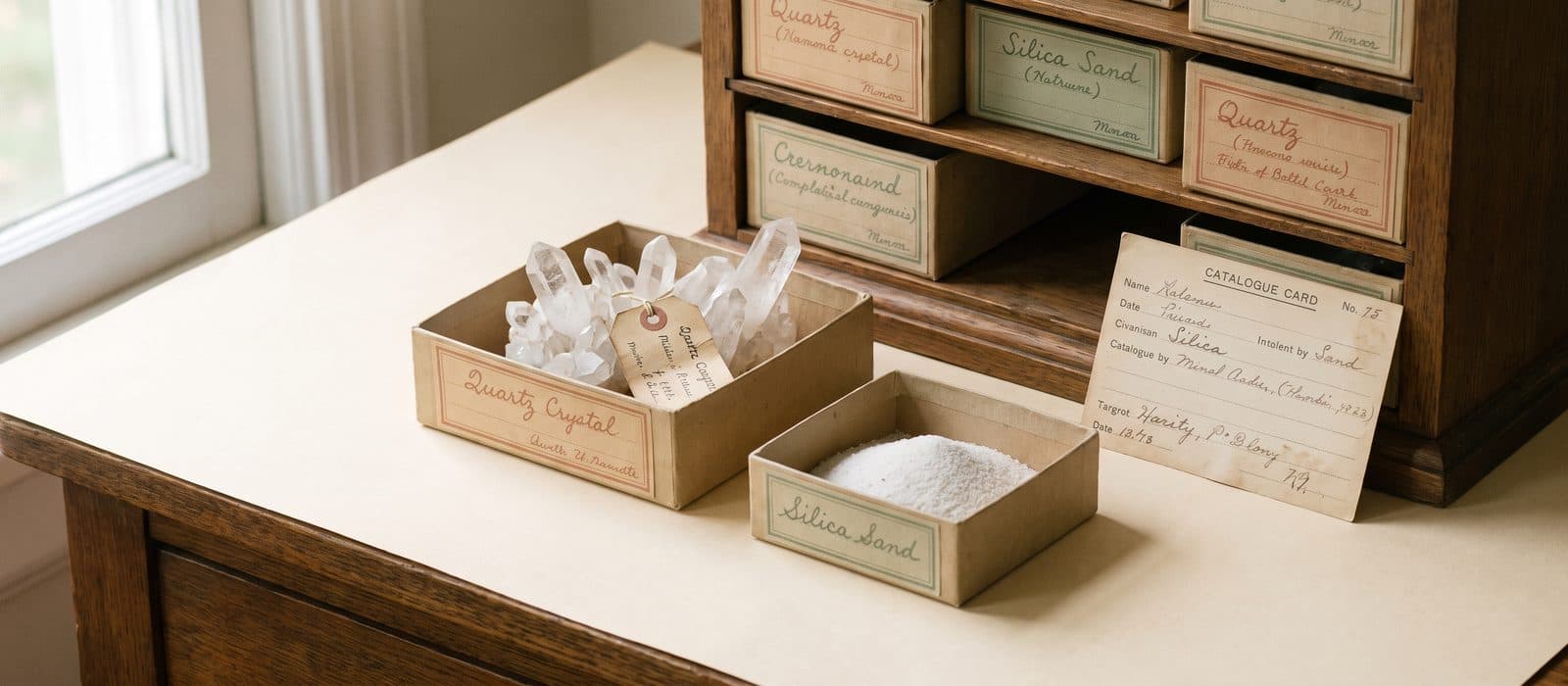
Silicea is prepared from silicon dioxide (SiO₂), silica. It is one of the commonest substances on Earth: quartz is crystalline silica, flint and chert are compact forms of it, and most sand is made of its grains. The classic preparation used pure rock crystal or flint; manufacturers now often start from purified, precipitated silica. The Latin name simply means flint.
Silica does not dissolve in water or alcohol, so the first potency steps are made by trituration: grinding the powder with lactose for long periods, then carrying it into liquid for the usual dilution and succussion. Our guide to what is in a homeopathic remedy explains the process, and our potencies guide explains what remains at each step.
Silica is not a poison in the way arsenic or nux vomica seeds are. There is one honest caveat: breathing fine crystalline silica dust over years, in quarrying, stonemasonry or sandblasting, causes the lung disease silicosis. That is an occupational hazard of dust, not a property of a lactose tablet, and it has nothing to do with the potentised remedy.
Silicea also has a second life outside classical homeopathy. In the 1870s the German physician Wilhelm Heinrich Schüssler proposed that illness reflected a shortage of twelve mineral salts in the body's cells, and sold those salts in low 6X potencies as "tissue salts" or "cell salts". Silicea is one of the twelve. The deficiency theory has no support in modern physiology, and a 6X tablet supplies far less silica than ordinary food does, but the tissue-salt tradition is still why Silicea 6X sits on so many pharmacy shelves.
What is the Silicea picture?
The Silicea picture is a person whose reserves run low. Picture someone fine-boned and pale, who is always the coldest in the room, who wraps a scarf round their head on a mild day and whose hands and feet are cold and damp. Every winter cold leaves something behind: a blocked nose that is worse at night, a dull pressure over the sinuses that lasts for weeks. A splinter that anyone else would forget becomes a sore, puffy spot that neither settles nor comes to a head. The skin of the fingertips splits in dry weather and the splits take an age to close. Nails are brittle or ridged.
Boericke (1927) frames the remedy around imperfect assimilation and a want of grit, physical and moral, and that phrase sums up the temperament classic texts describe. The Silicea person is conscientious, careful and anxious before an exam or a performance, gives way readily to others in small things, yet digs in quietly on matters that count. Kent's Lectures (1905) describe a person who lacks the stamina to carry an undertaking through, and who dreads failure, yet does the work well once started.
Physically, the old texts emphasise chilliness above everything, sweat on the head and feet, and a tendency for small infections to linger and suppurate slowly. The headache classically starts at the back of the neck and spreads over the head to settle above one eye, and is better from wrapping the head up warmly. Homeopaths read all of this as one quality: a system that reacts slowly and without much vigour.
What makes it better or worse?
The traditional modalities centre on cold and covering. Silicea is worse from cold, draughts and uncovering, especially the head, and better from warmth and from wrapping up.
| Modality | Worse | Better |
|---|---|---|
| Temperature | Cold air, draughts, uncovering the head or feet | Warmth, wrapping the head up warmly |
| Weather | Damp and cold; changes of weather | Warm, humid summer weather (Boericke) |
| Time | Night; morning; around the new moon (classic texts) | No consistent keynote |
| Exertion | Mental effort; anticipation of an ordeal | Rest |
| Position | Lying on the left side (Boericke) | None listed |
Our guide to modalities, better and worse explains why a homeopath gives these details as much weight as the complaint itself.
What is Silicea traditionally discussed for?
In homeopathic literature, Silicea is traditionally discussed for slow, lingering, low-grade states in chilly people. Each of these appears on one of our acute pages, where the Silicea-like pattern sits beside its neighbours and the red flags come first.
Splinters and nail folds
- The sense that something is still stuck in the skin: a splinter or shallow puncture wound.
- A splinter-like soreness along the nail fold with low-grade swelling: a sore hangnail with redness and an ingrown toenail.
Skin that mends slowly
- Small splits that close remarkably slowly in a cold, dry winter: split fingertips in dry weather.
Sinuses and lingering colds
- The congestion that never quite finishes after each cold: sinus pressure during a cold and a sinus pressure headache.
- Stuffiness that lingers for weeks, worst at night: nighttime nasal congestion. Our guide to acute versus chronic explains why a pattern that keeps returning is a question for a full consultation rather than a single acute page.
What is Silicea not?
Silicea is not "the splinter remedy", and it is not a way to draw anything out of the body. The commonest misreading is to match the name to the object: a splinter, therefore Silicea. The tradition's picture is the chilly, low-stamina person in whom a small irritation lingers; a fresh splinter in a robust, warm-blooded person is simply a splinter, and the right tool is a clean pair of tweezers. The second misreading is that lingering means mild. A nail fold that is getting redder and hotter, red streaks spreading from a wound, a fever, a deep puncture through a shoe, glass or metal in a wound, or any foot wound in someone with diabetes or poor circulation needs medical care. Sinus symptoms lasting more than ten days, severe facial pain, swelling or redness around the eye, changes in vision, a severe headache or a stiff neck do too. Our guide to red flags first sets these out.
Homeopaths separate Silicea from its neighbours like this:
| Picture | Where it sits | Defining feature | Key modality |
|---|---|---|---|
| Silicea | Slow, low-grade, lingering states | Chilly, low stamina; splinter sensation; slow to mend | Worse cold and uncovering; better wrapping the head |
| Hepar sulphuris | Festering nail folds and splinters | Exquisitely sensitive to touch and cold; quicker, angrier inflammation | Worse the least draught; better warm wraps |
| Pulsatilla | Lingering catarrh after a cold | Mild, weepy, thirstless; bland yellow-green discharge | Better cool open air; worse warm rooms |
| Kali bichromicum | Sinus pressure | Thick, stringy discharge; pain at small, pinpoint spots | Worse cold, morning; better warmth and pressure |
| Graphites | Cracked skin | Deep cracks that ooze a sticky, honey-like fluid | Worse cold and at night |
Silicea and Hepar sulphuris are the two chilly pictures most often confused around splinters and nail folds. The traditional distinction is intensity: Hepar is acutely sensitive, irritable and quick to inflame; Silicea is slow, low-grade and lacking in reaction.
What potencies is Silicea sold in?
Silicea is sold in two traditions. As a Schüssler tissue salt it comes as 6X tablets, meaning six successive 1:10 dilutions. As a classical homeopathic remedy it is sold as 6C and 30C pellets, with 200C available from specialist manufacturers. Potency describes the preparation process, not an amount of silica: 30C means thirty successive 1:100 dilutions with succussion between them. Our potencies guide explains both scales and what remains in the vial.
This page deliberately gives no frequency or instructions for taking Silicea in any form. That depends on a whole case, not a remedy name. Read the product label, and talk to a qualified practitioner about an individual situation.
What remedy lists don't tell you
Two things the short lists leave out:
- The person matters more than the splinter. The classic descriptions are of a constitution: chilly, delicate, conscientious, with damp hands and feet and colds that linger. That is why the Silicea picture turns up on pages as different as split fingertips and night-time congestion. A list that says "Silicea: splinters" keeps the object and loses the person, and the person is what the classic authors were describing.
- The "pushes things out" story is lore, not evidence. A popular claim online is that Silicea expels splinters, and a companion warning is that it might disturb implants or stitches. Neither has evidence behind it, and both overstate what a dilution past the point of any remaining silica could do. A retained foreign body, a deep puncture or an infected nail fold is a job for a clinician, and our guide to seasonal acute patterns covers what each season tends to bring, and when the calendar misleads.
Where the Silicea picture appears on this site
Acute pages that discuss this picture among their educational patterns, with the pattern name each page uses.
- What homeopathic remedy for a sinus pressure headache?Silicea-like lingering pressure pattern
- What homeopathic remedy for a sore hangnail with redness?Silicea-like splinter-like nail margin pattern
- What homeopathic remedy for a splinter or shallow puncture wound?Silicea-like slow foreign-body irritation pattern
- What homeopathic remedy for an ingrown toenail?Silicea-like splinter-like nail margin pattern
- What homeopathic remedy for nighttime nasal congestion?Silicea-like never-quite-clear pattern
- What homeopathic remedy for sinus pressure during a cold?Silicea-like slow-to-clear, low-resistance pattern
- What homeopathic remedy for split fingertips in dry weather?Silicea-like slow-mending fingertip pattern
Not sure whether a picture fits?
A remedy profile describes a picture; it cannot tell you whether that picture matches what you are seeing. An acute consultation starts from the case itself: onset, sensations, what changes it, and the red flags.
Acute consultation · $45Frequently asked questions
- What is Silicea?
- Silicea is a homeopathic remedy prepared from silica, silicon dioxide, the mineral of quartz, flint and sand. It is also one of the twelve Schüssler tissue salts. In homeopathy it names a traditional picture: a chilly, fine-boned, easily tired person in whom small things mend slowly, colds linger, little wounds fester, and splinters seem to stay in. It is a description homeopaths use to compare cases, not a finding that it works for any condition.
- What is Silicea used for in homeopathy?
- Homeopathic literature traditionally discusses Silicea for slow, lingering, low-grade states: sinus congestion that never quite clears after a cold, a nail fold or fingertip that feels as if a splinter were in it, and small cracks and wounds that are slow to close in a chilly person. The picture is defined by the slowness, the chilliness and the lack of stamina, not by the complaint. Spreading redness, red streaks, fever, swelling around the eye, or a foot wound in someone with diabetes needs medical care first.
- What is Silicea 30C used for?
- 30C is a common shelf potency of Silicea, sold alongside the 6X tissue-salt tablets and 6C. In the tradition the potency does not change the picture; Silicea 30C is discussed for the same chilly, slow-to-mend state as any other potency. What 30C and 6X mean as dilutions is explained in our potencies guide.
- How is Silicea taken?
- This page does not give instructions on how or how often to take any remedy or tissue salt, because that depends on a whole case rather than on a remedy name. The product label carries the manufacturer's directions, and a qualified practitioner can advise on an individual situation. Any wound or nail fold that is getting redder, hotter or more painful belongs with a clinician first.
- Where can I buy Silicea?
- Pharmacies, health-food shops and homeopathic manufacturers sell Silicea as 6X tissue-salt tablets and as single-remedy pellets, most often in 6C or 30C. This site also prepares custom single remedies to order: you name the remedy and potency, and the details are confirmed by email before anything is made. The order form does not give advice on which remedy to choose.
- What is Silicea made from?
- Silicea is made from silicon dioxide, the substance of quartz and flint, traditionally prepared from pure rock crystal or flint and now often from purified precipitated silica. Because silica does not dissolve in water, it is ground with milk sugar (trituration) through the first potency steps, then diluted and succussed to the labelled potency. Silica in a tablet is harmless; breathing fine crystalline silica dust at work is a recognised lung hazard, which is a separate matter.
This guide is educational only and is not medical advice or a personalized remedy recommendation. Acute symptoms can become urgent; when in doubt, seek professional evaluation.