Remedy profile
Kali bichromicum in Homeopathy: Uses, Picture and Limits
What homeopathic Kali bichromicum is made from, the thick, stringy, pinpoint-pressure picture homeopaths describe, what changes it, potencies sold, and limits.
By Homeopathic BenefitsPublished 7 min read
Key takeaways
- Kali bichromicum is the picture of thick, stringy mucus. Tough, sticky, yellow-green discharge that can be drawn out in strings is its best-known keynote.
- Its pains sit in small spots. Classic texts describe pressure at the root of the nose, or a pain elsewhere, that could be covered with the tip of a finger.
- It belongs to the later, thickened stage. The picture is the cold that has settled and turned sticky, not the watery first day.
- It comes from a toxic industrial chromium salt. Raw potassium dichromate is corrosive and carcinogenic; potentised preparations are diluted far past the point where it remains.
- Sinus red flags come first. Swelling or redness around the eye, double or blurred vision, a severe headache, a stiff neck, confusion or a high fever needs urgent medical care.
The short answer
Kali bichromicum is a homeopathic remedy prepared from potassium dichromate, an orange-red chromium salt once used widely in dyeing, tanning, photography and chrome plating. In homeopathy it names a traditional picture rather than a treatment: thick, tough, ropy mucus that can be pulled out in strings, with pressure or pain fixed in small, precise spots, classically at the root of the nose. Classic materia medica describes it for the settled, thickened stage of colds, sinus congestion and postnasal drip, and for pains that appear and disappear suddenly or wander from place to place. It was proved in Britain in the mid-nineteenth century, and Boericke (1927) gives the stringy discharge as its leading feature. It is not a general sinus remedy, and sinus symptoms with warning signs, or that drag on, need a clinician.
| Latin name | Kali bichromicum |
|---|---|
| Abbreviation | Kali-bi. |
| Common name | Potassium dichromate, bichromate of potash |
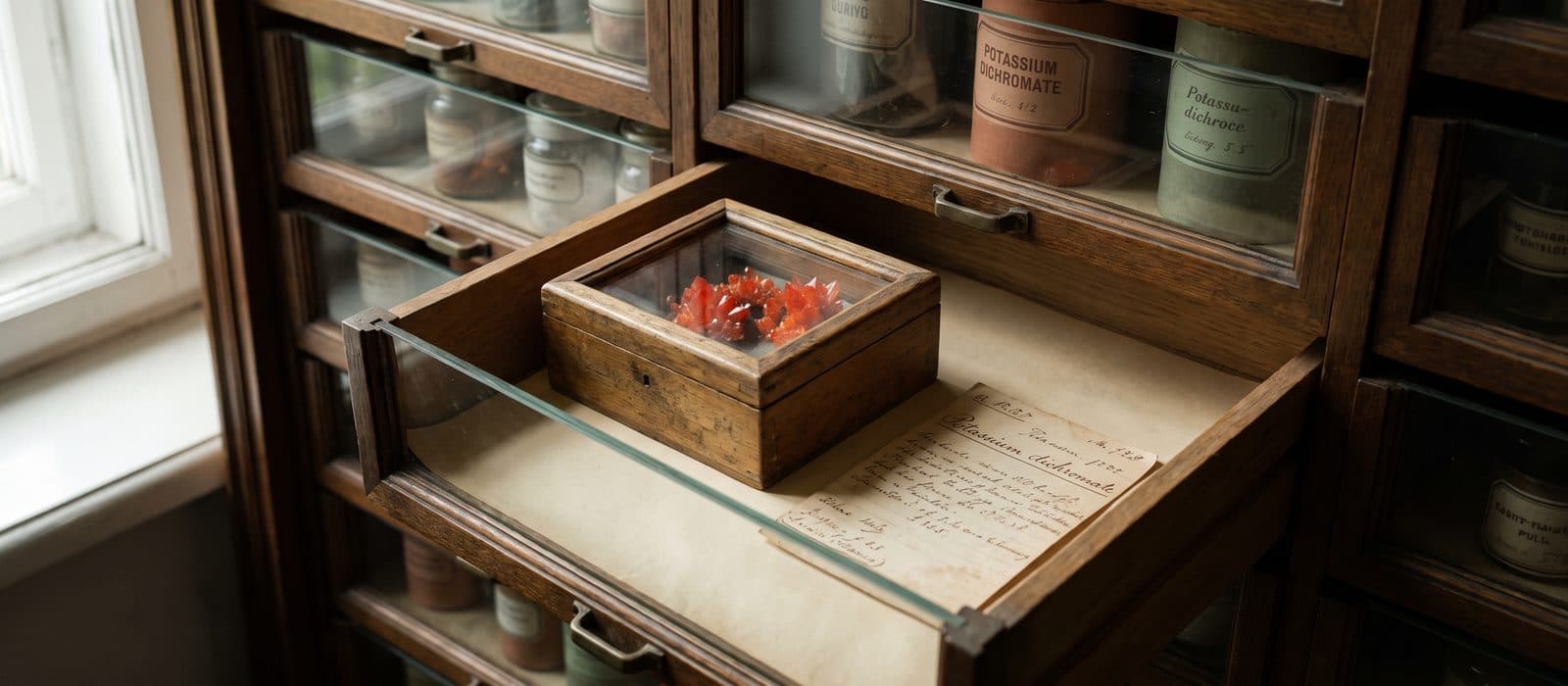
| Source | Potassium dichromate, an orange-red crystalline salt of chromium, triturated and potentised (mineral kingdom) |
| Commonly sold potencies | 6C, 30C, 200C |
| First proving | Proved in Britain in the 1840s and recorded in Allen's Encyclopedia (1874–1879); described in Hering's Guiding Symptoms and Boericke (1927) |
What is Kali bichromicum made from?
Homeopathic Kali bichromicum is prepared from potassium dichromate, the old "bichromate of potash", a bright orange-red crystalline salt. Kali is the old pharmaceutical name for potassium, and bichromicum refers to the dichromate, the form of chromium the salt carries. Our guide to reading Latin remedy names explains how these chemical names work on a label.
The salt was an industrial workhorse in the nineteenth and twentieth centuries, used for dyeing and tanning, in early photography and in chrome plating. It is also seriously toxic. Potassium dichromate contains hexavalent chromium, which is corrosive to skin and mucous membranes and a known human carcinogen. Workers in chromate factories developed deep, punched-out "chrome ulcers" on the skin and, strikingly, ulceration and perforation of the nasal septum. It is never something to handle, taste or prepare at home.
The homeopathic preparation grinds the salt with milk sugar (trituration) through the first potency steps, then dilutes and succusses it to the labelled potency. At the common potencies the arithmetic says no trace of the original salt remains. Our potencies guide explains what that means and why it is also the reason mainstream science is sceptical.
The occupational poisoning and the homeopathic picture overlap at the nose: thick, sticky secretions, crusts and deep, punched-out sores in the industrial record, thick stringy mucus and pinpoint pressure in the materia medica.
What is the Kali bichromicum picture?
The Kali bichromicum picture is the cold that has turned to glue. Picture someone a week into a cold. The streaming has stopped; now the nose is blocked with something thick, yellow-green and elastic that will not blow clear, and what does come away comes in long, sticky strings. Mucus drips down the back of the throat and has to be hawked up in the morning. There is a dull, fixed pressure at the root of the nose, between the eyes, as if a peg were pushed into the bridge, and they can put a fingertip exactly on the worst point.
That precision is the second keynote. Boericke (1927) describes pains in small spots that can be covered with the point of a finger, pains that shift rapidly from one place to another, and pains that appear and disappear suddenly. Classic texts describe the same in the head, where a sinus headache may begin with blurred vision that clears as the pain sets in, and in joints, where the tradition notes that rheumatic pains and catarrh can alternate.
The mental picture is thin in the older literature. Some later teachers describe a conventional, rule-following, rather narrow-minded temperament, but the tradition reads Kali bichromicum chiefly from the discharge and the pain. The person is usually chilly, worse in the morning on waking, and stuffier in cold, damp weather.
What makes it better or worse?
The traditional modalities centre on the morning, cold and the discharge itself. Kali bichromicum is worse in the morning and from cold, damp air, and better from warmth and once the mucus comes away.
| Modality | Worse | Better |
|---|---|---|
| Time | Morning on waking; around 2–3 a.m. for a cough | As the day goes on |
| Temperature | Cold, damp air; undressing | Warmth, heat (Boericke) |
| Weather | Hot weather for some complaints (Boericke); cold damp for catarrh | No consistent keynote |
| Discharge | When the mucus is stuck and blocking | After clearing the stringy mucus |
| Food and drink | Beer (Boericke) | No consistent keynote |
Our guide to modalities, better and worse explains why a homeopath asks about these before anything else.
What is Kali bichromicum traditionally discussed for?
In homeopathic literature, Kali bichromicum is traditionally discussed for the thick, sticky stage of catarrh and the pinpoint sinus pressure that goes with it. Each of these appears on one of our acute pages, where the Kali bichromicum-like pattern sits beside its neighbours and the red flags come first.
Sinus pressure
- Pressure at the root of the nose with thick, stringy discharge during a cold: sinus pressure during a cold.
- A headache centred at the bridge of the nose with a mapped point of maximum pressure: a sinus pressure headache. A severe or sudden headache is a different question; that page sets out the red flags.
Nose and throat
- Thick, sticky blockage at night with stringy discharge in the morning: nighttime nasal congestion.
- Ropy mucus dripping down the back of the throat: a cough from postnasal drip.
What is Kali bichromicum not?
Kali bichromicum is not "the sinus remedy", and it is not a reason to keep waiting on a sinus infection that is not settling. The picture is specific: tough, stringy, sticky mucus and pain fixed in a small spot. Thick yellow or green mucus on its own is common in ordinary colds and describes many pictures. The warning signs are what matter. Swelling, redness or pain around an eye, double or reduced vision, a severe headache, a stiff neck, confusion, a high fever, or a face that is swollen on one side needs urgent care. Symptoms that last more than about ten days, or improve and then get worse again, are worth a clinician's look, and young children and people with weakened immunity warrant a lower threshold. Our guide to red flags first sets these out.
Homeopaths separate it from its neighbours like this:
| Picture | Where it sits | Defining feature | Key modality |
|---|---|---|---|
| Kali bichromicum | Thick, settled catarrh | Tough, stringy mucus; pain in a fingertip-sized spot | Worse morning and cold damp; better warmth |
| Pulsatilla | Thick, bland catarrh | Yellow-green but soft and easy, not stringy; mild, weepy, thirstless | Better open air; worse warm stuffy rooms |
| Hydrastis | Thick postnasal discharge | Yellow mucus dripping down the throat; raw, sore passages | Worse inhaling cold air |
| Kali muriaticum | Middle stage of catarrh | Thick white or grey mucus; white-coated tongue | Worse rich food; worse cold air |
| Mercurius | Raw, burning catarrh | Greenish, offensive discharge; sweaty, salivating, sensitive to heat and cold | Worse at night and in a warm bed |
Kali bichromicum and Pulsatilla share yellow-green mucus and are often confused. The traditional distinction is texture and temperament: Kali bichromicum's mucus is tough and stringy and the pain is pinpoint, while Pulsatilla's is soft and easy and the person is mild and wants company.
What potencies is Kali bichromicum sold in?
Kali bichromicum is sold most often as 30C pellets, the common shelf potency for single remedies, with 6C and 200C also widely available. Potency describes the preparation process, not an amount of salt: 30C means thirty successive 1:100 dilutions with succussion between them. Our potencies guide explains the scale and what remains in the vial, and why low potencies of toxic sources carry their own labelling.
This page deliberately gives no frequency or instructions for taking Kali bichromicum. That depends on a whole case, not a remedy name. Read the product label, and talk to a qualified practitioner about an individual situation.
What remedy lists don't tell you
Two things the "remedies for sinus congestion" lists leave out:
- Texture matters more than colour. Lists sort mucus by colour, yellow, green or white. What the classic authors found characteristic of Kali bichromicum was how it behaves: tough, elastic, drawn out in strings, sticking to the back of the throat. A homeopath reading a catarrhal case asks what the discharge does as well as what colour it is, because the colour alone points at half the kit.
- Stage matters as much as symptom. The tradition places Kali bichromicum late, after the watery first days of a cold, when the discharge has thickened and the pressure has settled into a spot. The same nose on day one belongs to a different picture. That sequence is part of why our guide to first colds of the school year follows a cold through its stages rather than naming anything at the start.
Where the Kali bichromicum picture appears on this site
Acute pages that discuss this picture among their educational patterns, with the pattern name each page uses.
- What homeopathic remedy for a cough from postnasal drip?Kali bichromicum-like thick postnasal pattern
- What homeopathic remedy for a sinus pressure headache?Kali bichromicum-like nose-root pressure pattern
- What homeopathic remedy for nighttime nasal congestion?Kali bichromicum-like sticky night congestion pattern
- What homeopathic remedy for sinus pressure during a cold?Kali bichromicum-like sticky, stringy discharge pattern
Not sure whether a picture fits?
A remedy profile describes a picture; it cannot tell you whether that picture matches what you are seeing. An acute consultation starts from the case itself: onset, sensations, what changes it, and the red flags.
Acute consultation · $45Frequently asked questions
- What is Kali bichromicum?
- Kali bichromicum is a homeopathic remedy prepared from potassium dichromate, an orange-red chromium salt used in industry and known to be toxic. In homeopathy it names a traditional picture: thick, tough, stringy mucus that can be drawn out in strings, and pain or pressure fixed in small spots, especially at the root of the nose. It is a description homeopaths use to compare cases, not evidence that it works for sinus problems or anything else.
- What is Kali bichromicum used for in homeopathy?
- Homeopathic literature traditionally discusses Kali bichromicum for the later, thickened stage of colds and sinus congestion: sticky, ropy yellow-green discharge, postnasal drip, and pressure at the root of the nose that can be covered with a fingertip. The picture is defined by the stringiness and the pinpoint pain, not by the name of the complaint. Swelling around the eye, changes in vision, a severe headache, a stiff neck, confusion or high fever needs urgent medical care.
- What is Kali bichromicum 30C used for?
- 30C is the common shelf potency of Kali bichromicum, the one most single-remedy tubes carry, and it appears in many cold and sinus kits. In the tradition the potency does not change the picture: Kali bichromicum 30C belongs to the same thick, stringy, pinpoint-pressure description as any other potency. Our potencies guide explains what 30C means as a dilution.
- How is Kali bichromicum taken?
- This page does not give instructions on how or how often to take any remedy, because that depends on a whole case rather than on a remedy name. The product label carries the manufacturer's directions, and a qualified practitioner can advise on an individual situation. Sinus symptoms that last beyond about ten days, or get worse after starting to improve, belong with a clinician.
- Where can I buy Kali bichromicum?
- Pharmacies, health-food shops and homeopathic manufacturers sell Kali bichromicum as single-remedy pellets, most often in 30C, sometimes labelled Kali bich. This site also prepares custom single remedies to order: you name the remedy and potency, and the details are confirmed by email before anything is made. The order form does not give advice on which remedy to choose.
- What is Kali bichromicum made from?
- Homeopathic Kali bichromicum is prepared from potassium dichromate, an orange-red crystalline salt of hexavalent chromium. It is ground with milk sugar through the first potency steps, then diluted and succussed to the labelled potency. The raw salt is corrosive, toxic and a known carcinogen, and is never something to handle or prepare at home; at the common potencies the arithmetic says none of it remains.
This guide is educational only and is not medical advice or a personalized remedy recommendation. Acute symptoms can become urgent; when in doubt, seek professional evaluation.