Remedy profile
Kali muriaticum in Homeopathy: Uses, Picture and Limits
What homeopathic Kali muriaticum is made from, the thick-white-catarrh tissue-salt picture homeopaths describe, what changes it, potencies sold, and its limits.
By Homeopathic BenefitsPublished 7 min read
Key takeaways
- Kali muriaticum is the "second stage" of a cold in the tissue-salt tradition. Schüssler's scheme places it after the first, feverish stage, once catarrh has thickened and turned white.
- White is the keynote. Thick white or greyish mucus, a white or grey coating on the tongue, and white-coated sore throats run through the classic descriptions.
- The ears are its signature territory. Old texts describe blocked, stuffy, crackling ears after a cold, worse swallowing or blowing the nose.
- It is potassium chloride, an everyday salt. It is sold most often as a 6X tissue salt, labelled Kali mur or tissue salt no. 4.
- Ear and chest red flags come first. Ear pain with fever, discharge from the ear, hearing that does not return, or difficulty breathing are medical questions before any pattern discussion.
The short answer
Kali muriaticum is a homeopathic remedy and Schüssler tissue salt prepared from potassium chloride, ground with milk sugar and potentised, most often to 6X. In the tissue-salt tradition it names the middle stage of a cold or catarrh, when discharges have become thick and white, the tongue is coated white or grey, and the ears feel blocked and crackle on swallowing. Wilhelm Schüssler introduced it as one of his twelve tissue salts in 1873, and Boericke (1927) carries it into the homeopathic materia medica. It is not an ear-infection remedy or a decongestant, and a painful ear with fever, or any discharge from the ear, needs a clinician first.
| Latin name | Kali muriaticum |
|---|---|
| Abbreviation | Kali-m. |
| Common name | Potassium chloride; tissue salt no. 4 (Kali mur) |
| Source | Potassium chloride, a white mineral salt, triturated with milk sugar and potentised (mineral kingdom) |
| Commonly sold potencies | 6X, 6C, 30C |
| First proving | Introduced by Wilhelm Schüssler as one of his twelve tissue salts (1873); described in Boericke (1927) |
What is Kali muriaticum made from?
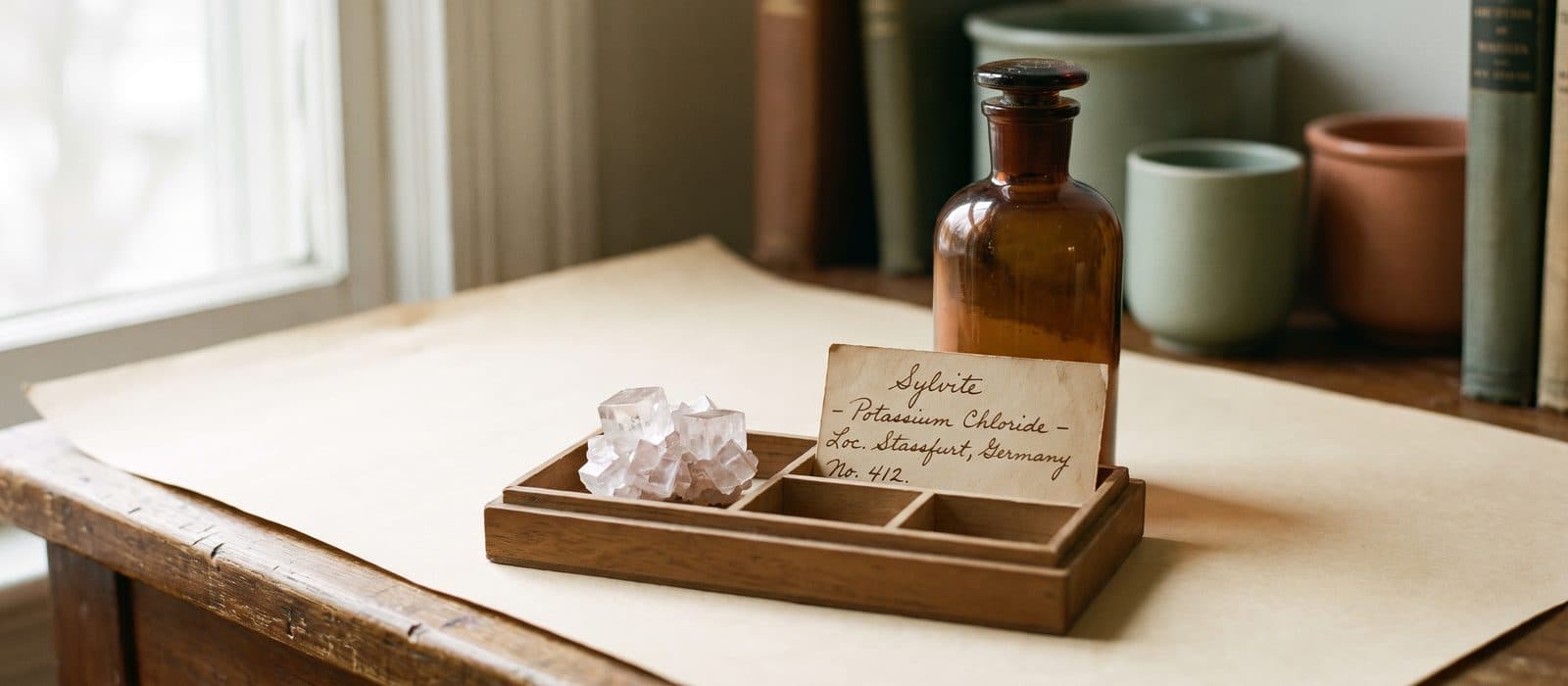
Kali muriaticum is prepared from potassium chloride (KCl), a white crystalline salt. It is mined as the mineral sylvite, used in fertilisers, and sold in shops as a low-sodium table-salt substitute. The name is old chemistry: kali is potassium, from the same Arabic root as "alkali", and muriaticum means chloride, from muriatic acid, the old name for hydrochloric acid. Our guide to reading Latin remedy names explains why Kali mur and Kali-m. are the same vial.
The tissue-salt form is triturated: the salt is ground with lactose and pressed into small tablets at 6X, a 1:10 dilution repeated six times, so one part in a million. Homeopathic pharmacies also prepare it on the centesimal scale. Potassium chloride is an everyday substance, and the amount in a 6X tablet is minute. Our potencies guide explains the X and C scales, and why the dilution itself is the reason mainstream science is sceptical.
What is the Kali muriaticum picture?
Kali muriaticum describes a cold that has settled in. The first, hot and flushed stage, which Schüssler assigned to Ferrum phosphoricum, has passed, and what is left is thick, white, sticky catarrh. The nose is blocked with white or greyish mucus, the sinuses feel full, and the person clears their throat of white phlegm. The tongue is coated white or greyish-white at the back. Glands in the neck may be swollen and firm.
The ears are where homeopaths most often meet this picture. Boericke (1927) describes catarrh of the middle ear, with stuffiness, snapping and crackling noises on swallowing or blowing the nose, and a dull sense of deafness after a cold. Children with this picture may say their ears feel "full" or "popping". The old texts also describe white-coated sore throats and small white ulcers in the mouth.
The timeline matters as much as the symptoms. The Kali muriaticum picture is a cold several days old, past its fever, that has thickened rather than cleared. In children that "full" ear after a cold is very common and usually settles as the cold resolves, but fluid that lingers behind the eardrum can dull hearing for weeks. A child who seems not to hear, turns the television up, or whose speech or attention changes after repeated colds needs a hearing check, whatever picture the catarrh fits. Clarke (1900–1902) and Boericke both describe the same picture in the chest, with a loose cough and thick white phlegm that is hard to bring up.
Unlike the constitutional pictures, Kali muriaticum has little mental-emotional colour in the classic texts. It is described by its discharges, its stage and its tissues rather than by a temperament, which reflects its origin in Schüssler's physiological scheme rather than in Hahnemann's provings.
What makes it better or worse?
The traditional modalities are few and centre on rich food and movement. Kali muriaticum is described as worse from fatty food and from motion, and better from cold drinks and gentle rubbing.
| Modality | Worse | Better |
|---|---|---|
| Food | Rich, fatty food and pastry | Plain food |
| Movement | Motion | Rest |
| Temperature | Cold, damp weather | Cold drinks |
| Ears | Swallowing, blowing the nose | No consistent keynote |
| Touch | No consistent keynote | Rubbing |
Because the picture is thin on modalities, the colour and stage of the discharge carry more weight than usual. Our guide to modalities, better and worse explains how homeopaths weigh them.
What is Kali muriaticum traditionally discussed for?
Kali muriaticum is not named as a pattern on our acute pages. The complaints the tissue-salt and homeopathic literature traditionally discuss it for do have acute pages, where other pictures are compared and the red flags come first.
Ears
- Blocked, stuffy, crackling ears after a cold: our page on an earache during a mild illness covers the red flags for ear pain and the pictures homeopaths compare.
Nose and sinuses
- Thick white catarrh with blocked sinuses: sinus pressure during a cold, where Kali bichromicum's stringier, yellower picture sits.
- Blocked nose at night with white mucus: nighttime nasal congestion.
Throat and chest
- White phlegm running down the back of the throat: a cough from postnasal drip.
- A loose cough with thick white phlegm: a wet, productive cough.
Mouth
- Small white mouth ulcers with a white-coated tongue: a painful canker sore.
Our guides to the first colds of the school year and seasonal acute patterns read these cold stages side by side.
What is Kali muriaticum not?
Kali muriaticum is not an ear-infection remedy, and it is not a potassium supplement. The commonest misreading is to match "blocked ears" to "Kali mur" and stop there. The tradition's picture is a stage: thick white discharge, a white-coated tongue and a settled, non-feverish cold. A hot, painful, throbbing ear with fever belongs to a different stage and, first, to a clinician. Severe ear pain, fever, discharge or blood from the ear, swelling behind the ear, hearing loss that lasts more than a few weeks, a stiff neck, or difficulty breathing are reasons for medical care.
Homeopaths separate Kali muriaticum from its neighbours like this:
| Picture | Where it sits | Defining feature | Key modality |
|---|---|---|---|
| Kali muriaticum | Settled middle stage of a cold | Thick white catarrh, white-coated tongue, crackling ears | Worse rich food and motion |
| Ferrum phosphoricum | First, feverish stage | Flushed, mild fever, few distinct symptoms | Worse motion; better cold applications |
| Kali bichromicum | Sticky sinus catarrh | Stringy, yellow-green mucus; pain at a small spot | Worse cold and morning |
| Pulsatilla | Ripe, bland catarrh | Thick yellow-green, non-irritating discharge; weepy and clingy | Worse warm rooms; better open air |
What potencies is Kali muriaticum sold in?
Kali muriaticum is sold most often as 6X tissue-salt tablets, labelled Kali mur or tissue salt no. 4, and also as 6C and 30C pellets from homeopathic manufacturers. 6X means six successive 1:10 dilutions, one part in a million; 30C means thirty successive 1:100 dilutions with succussion between them. Our potencies guide explains both scales and what remains in the vial.
This page deliberately gives no frequency or instructions for taking Kali muriaticum. That depends on a whole case, not a remedy name. Read the product label, and talk to a qualified practitioner about an individual situation.
What remedy lists don't tell you
Two things the short lists leave out:
- It comes from a different tradition. Wilhelm Schüssler, a German physician, proposed in 1873 that illness reflected a shortage of one of twelve mineral salts in the tissues, and that low potencies of those salts could restore the balance. His theory of cell chemistry has not held up, but his twelve salts became a parallel tradition sold alongside homeopathic remedies. Kali muriaticum's picture comes largely from his scheme and from clinical reports, not from a Hahnemann-style proving, which is why it reads as a stage of a cold rather than a person.
- The stage idea is the useful part. Schüssler's sequence, Ferrum phosphoricum for the first feverish stage, Kali muriaticum for the thickened second stage, and Kali sulphuricum for the yellow, ripening third, is a simple way to describe where a cold has got to. Observing the colour and consistency of a discharge over a few days is something anyone can do, and it is the kind of detail a homeopath asks about. Our guide to red flags first covers what to check before any of that.
Not sure whether a picture fits?
A remedy profile describes a picture; it cannot tell you whether that picture matches what you are seeing. An acute consultation starts from the case itself: onset, sensations, what changes it, and the red flags.
Acute consultation · $45Frequently asked questions
- What is Kali muriaticum?
- Kali muriaticum is a homeopathic remedy and Schüssler tissue salt prepared from potassium chloride, ground with milk sugar and then potentised. In homeopathy and the tissue-salt tradition it names a picture of the settled, middle stage of a cold or catarrh: thick white or greyish mucus, a white-coated tongue, and blocked, crackling ears. It is a description used to compare cases, not evidence that it works for any condition.
- What is Kali muriaticum used for in homeopathy?
- Homeopathic and tissue-salt literature traditionally discusses Kali muriaticum for catarrh that has thickened and turned white: blocked noses and sinuses, a stuffy feeling in the ears, a cough with white phlegm, and swollen glands. Ear pain with fever, discharge from the ear, hearing loss that does not clear, or breathing difficulty are medical questions first.
- What is Kali muriaticum 30C used for?
- Kali muriaticum is most often sold as a 6X tissue salt rather than in 30C, though some homeopathic manufacturers do sell 30C. In the tradition the potency does not change the picture; 30C is discussed for the same thick-white-catarrh picture as the tissue-salt form. Our potencies guide explains what the X and C scales mean.
- How is Kali muriaticum taken?
- This page does not give instructions on how or how often to take any remedy or tissue salt, because that depends on a whole case rather than on a remedy name. The product label carries the manufacturer's directions, and a qualified practitioner can advise on an individual situation. A painful ear with fever, or any discharge from the ear, needs a clinician first.
- Where can I buy Kali muriaticum?
- Pharmacies, health-food shops and homeopathic manufacturers sell Kali muriaticum, most often as 6X tissue-salt tablets labelled Kali mur or tissue salt no. 4, and less often as 30C pellets. This site also prepares custom single remedies to order: you name the remedy and potency, and the details are confirmed by email before anything is made. The order form does not give advice on which remedy to choose.
- What is Kali muriaticum made from?
- Kali muriaticum is made from potassium chloride, the white salt also sold as a table-salt substitute. In the old chemical naming, kali means potassium and muriaticum means chloride, from muriatic acid. It is ground with milk sugar and then potentised; the 6X tissue salt is a one-in-a-million dilution.
This guide is educational only and is not medical advice or a personalized remedy recommendation. Acute symptoms can become urgent; when in doubt, seek professional evaluation.