Remedy profile
Hydrastis canadensis in Homeopathy: Uses, Picture and Limits
What homeopathic Hydrastis is made from, the thick, yellow, ropy mucus picture homeopaths describe, what changes it, potencies sold, and its limits.
By Homeopathic BenefitsPublished 7 min read
Key takeaways
- Hydrastis is the picture of thick, yellow, ropy catarrh. Classic texts describe tenacious mucus that strings and drops down the back of the throat, with raw, smarting membranes.
- Exhaustion runs underneath it. The traditional Hydrastis person is worn down, often after a long illness, with a weak, sinking feeling in the stomach that eating does not settle.
- It comes from goldenseal. The bright-yellow root is also a herbal supplement with known medicine interactions; the homeopathic potency is a separate preparation.
- Catarrh and cough have red flags. Breathlessness, chest pain, blood in the mucus, a fever that returns after improving, or a cough lasting more than three weeks needs a clinician first.
The short answer
Hydrastis canadensis is a homeopathic remedy prepared from the root of goldenseal, a low woodland plant of eastern North America with a vivid yellow root. In homeopathy it names a traditional picture rather than a treatment: catarrh of the mucous membranes with thick, yellow, tenacious, ropy mucus, typically running down the back of the nose into the throat and leaving it raw. Classic materia medica pairs that discharge with a tired, run-down person, a weak and sinking stomach, and slow recovery after a long cold. It entered homeopathy through nineteenth-century American practice and is thinly documented compared with the major remedies. It is not a general "catarrh remedy", and a cough or discharge that lingers, or comes with breathlessness or blood, belongs with a clinician first.
| Latin name | Hydrastis canadensis |
|---|---|
| Abbreviation | Hydr. |
| Common name | Goldenseal, yellow root, orange root |
| Source | Fresh root and rhizome of goldenseal, Hydrastis canadensis (Ranunculaceae) (plant kingdom) |
| Commonly sold potencies | 6C, 30C |
| First proving | Introduced through American practice in the mid-nineteenth century; provings collected in Hale's New Remedies and Allen's Encyclopedia (1874–1879) |
What is Hydrastis made from?
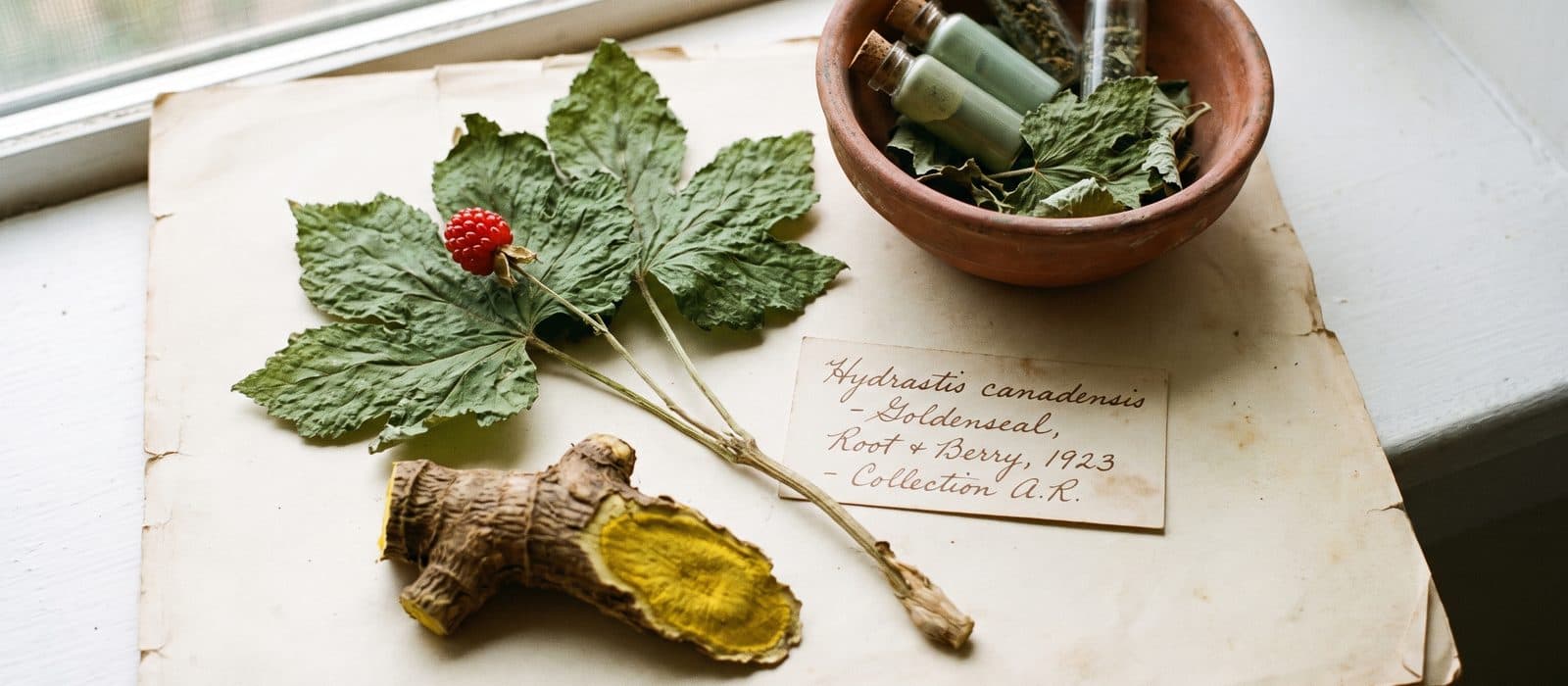
Homeopathic Hydrastis is prepared from the fresh root and rhizome of goldenseal, Hydrastis canadensis, a small perennial of the buttercup family (Ranunculaceae) that grows in rich, shaded hardwood forest across eastern North America. Each plant has one or two deeply lobed leaves, a single small greenish-white flower without petals, and later a raspberry-like red fruit. The knotted rhizome is a startling bright yellow inside, which gave it the names yellow root and orange root and made it a dye as well as a medicine for Indigenous peoples of the region.
The colour comes from alkaloids, chiefly berberine and hydrastine. That matters for the herbal product. Herbal goldenseal, sold as capsules, teas and tinctures, contains measurable amounts of these alkaloids, and the US National Center for Complementary and Integrative Health notes that it can interfere with the way the body processes many prescription medicines and is not considered safe in pregnancy, while breastfeeding or for infants. Demand for the herbal root also led to heavy wild harvesting, and goldenseal is now listed under CITES, the international convention on trade in endangered species.
The homeopathic preparation is a different thing. The fresh root is steeped in alcohol to make a mother tincture, then diluted and succussed step by step to the potency on the label; at 30C the arithmetic says no molecule of the root remains. Our potencies guide explains what that means and why it is also the reason science is sceptical. Because both products sit on shelves under the same name, it is worth reading the label to see which one is in your hand.
What is the Hydrastis picture?
The Hydrastis picture is the cold that has gone on too long. Imagine someone three weeks after a heavy cold: the fever has long gone, but the back of the nose still produces thick, yellowish mucus that strings down into the throat, so they hawk and clear and swallow all day. The throat feels raw and smarting from the constant drip. They are pale, tired and a little thin, and they describe an empty, sinking feeling at the pit of the stomach that a meal does not fill.
Classic texts build the remedy around the mucous membranes. Boericke (1927) describes it as acting on mucous membranes everywhere, with secretions that are thick, yellow and ropy, and he gives particular attention to the back of the nose, where mucus drops into the throat. Hale, the nineteenth-century American who did most to bring the remedy into homeopathy, placed the same weight on the discharge. The quality is the point: not watery, not bland and creamy, but thick, tough and stringy.
The second half of the picture is constitutional weakness. The materia medica describes debility, loss of appetite, weak digestion with that sinking emptiness, and a tendency to constipation, in a person who looks and feels run down. Boericke notes a tongue that is large and flabby and shows the imprint of the teeth. The impression the old authors give is of a body that has lost tone, with the mucous membranes producing more than they should.
What makes it better or worse?
Hydrastis is one of the remedies described more by its discharges than by its modalities; the classic texts give comparatively few clear "better" and "worse" features. What they record centres on the drip, the air and the stomach.
| Modality | Worse | Better |
|---|---|---|
| Time | Morning, clearing mucus that has gathered overnight | No consistent keynote |
| Air | Cold, raw air on the inflamed membranes | Mild, warm air |
| Position | Lying down, as mucus drops into the throat | Upright |
| Stomach | An empty, sinking feeling that eating does not settle | No clear keynote |
Because the modalities are thin, homeopaths reading a Hydrastis-like case lean on the character of the mucus and the exhaustion, and compare it closely with neighbours that have stronger modalities. Our guide to modalities, better and worse explains why those features normally come first.
What is Hydrastis traditionally discussed for?
In homeopathic literature, Hydrastis is traditionally discussed for thick, yellow, stringy catarrh in a worn-down person. On this site it appears on one acute page, where the Hydrastis-like pattern sits beside its neighbours and the red flags come first.
Postnasal drip and cough
- Thick, ropy mucus with raw throat sensations: a cough from postnasal drip. That page sets the Hydrastis-like pattern beside the sticky, stringy Kali bichromicum-like picture and the bland, changeable Pulsatilla-like one.
Lingering catarrh after a cold
- The classic texts describe the same discharge in the nose and sinuses. Our page on sinus pressure with a cold covers other pictures and the red flags for sinus pain, and our guide to a child's first colds covers what to watch in the early days.
Weak digestion in a run-down person
- The sinking, empty stomach and poor appetite of the picture appear in the old texts rather than on an acute page here; persistent loss of appetite or weight is a reason to see a doctor.
What is Hydrastis not?
Hydrastis is not "the remedy for catarrh" or for sinus trouble in general. Thick mucus turns up in many traditional pictures, and homeopaths separate them by texture, colour, what changes it and the state of the person. Hydrastis is the thick, yellow, ropy discharge in someone exhausted and slow to recover. Without the run-down, sinking quality, the stringy mucus alone points as readily to its neighbours.
Nor is it a reason to wait out symptoms that need assessment. A cough lasting more than three weeks, breathlessness, chest pain, coughing up blood, a fever that returns after the person seemed to improve, facial swelling or severe one-sided facial pain, or unexplained weight loss all need a clinician. Our guide to red flags first sets out the principle. Herbal goldenseal, separately, should not be started alongside prescription medicines without asking a pharmacist.
Homeopaths separate it from its neighbours like this:
| Picture | Where it sits | Defining feature | Key modality |
|---|---|---|---|
| Hydrastis | Lingering catarrh in a run-down person | Thick, yellow, ropy mucus dropping into the throat; sinking stomach | Worse raw air; few strong modalities |
| Kali bichromicum | Sinus and postnasal catarrh | Very sticky, stringy, greenish-yellow mucus; pain in small spots | Worse cold and morning; better warmth |
| Pulsatilla | Ripe, later-stage cold | Bland, creamy, yellow-green discharge; mild, weepy, thirstless | Better open air; worse warm rooms |
| Kali muriaticum | Second-stage catarrh | Thick, white, milky mucus; white-coated tongue | Worse rich, fatty food |
What potencies is Hydrastis sold in?
Homeopathic Hydrastis is sold most often as 6C and 30C pellets; it is a less common shelf remedy than the major polychrests, so it is more often found through homeopathic manufacturers than in a general pharmacy. Potency describes the preparation process, not an amount of root: 30C means thirty successive 1:100 dilutions with succussion between them. Our potencies guide explains the scale and what remains in the vial. Herbal goldenseal products are not potencies and are not covered here.
This page deliberately gives no frequency or instructions for taking Hydrastis. That depends on a whole case, not a remedy name. Read the product label, and talk to a qualified practitioner about an individual situation.
What remedy lists don't tell you
Two things the "remedies for postnasal drip" lists leave out:
- The texture of the mucus is the whole first question. Lists group Hydrastis, Kali bichromicum and Pulsatilla together as "catarrh remedies", but the tradition separates them almost entirely by what the discharge is like: ropy and tough, sticky enough to draw into strings, or bland and creamy. Noticing that, and the colour, and when it is worst, is more useful than knowing any remedy name, and it is exactly what a clinician will ask about too.
- A thinly documented remedy deserves modest claims. Hydrastis has a clear discharge picture and a fuzzy everything-else. The classic authors recorded less about its modalities and mental state than for the major remedies, and some later texts add claims the early provings do not support. An honest reading keeps to the mucus and the debility and holds the rest loosely, which is also the spirit of our guide to reading Latin remedy names.
Where the Hydrastis canadensis picture appears on this site
Acute pages that discuss this picture among their educational patterns, with the pattern name each page uses.
- What homeopathic remedy for a cough from postnasal drip?Hydrastis-like thick ropy mucus pattern
Not sure whether a picture fits?
A remedy profile describes a picture; it cannot tell you whether that picture matches what you are seeing. An acute consultation starts from the case itself: onset, sensations, what changes it, and the red flags.
Acute consultation · $45Frequently asked questions
- What is Hydrastis?
- Hydrastis is a homeopathic remedy prepared from the root of goldenseal, Hydrastis canadensis, a woodland plant of eastern North America. In homeopathy it names a traditional picture centred on the mucous membranes: thick, yellow, ropy mucus that drops down the back of the throat, a raw, sore feeling, and a tired, run-down person with a weak, sinking stomach. It is a description homeopaths use to compare cases, not a finding that it works for any condition.
- What is Hydrastis used for in homeopathy?
- Homeopathic literature traditionally discusses Hydrastis for catarrh with thick, yellowish, stringy mucus, especially mucus that runs down from the back of the nose and leaves the throat raw, often in someone worn down by a long cold. The picture is defined by the quality of the discharge and the exhaustion, not by the name of a complaint. Breathlessness, a high or returning fever, blood in the mucus, or a cough lasting more than three weeks needs a clinician first.
- What is Hydrastis 30C used for?
- 30C is a common shelf potency of Hydrastis, sold alongside 6C. In the tradition the potency does not change the picture; Hydrastis 30C is discussed for the same thick, ropy, catarrhal state as any other potency. What 30C means as a dilution is explained in our potencies guide.
- How is Hydrastis taken?
- This page does not give instructions on how or how often to take any remedy, because that depends on a whole case rather than on a remedy name. The product label carries the manufacturer's directions, and a qualified practitioner can advise on an individual situation. A cough or catarrh that is not improving after three weeks belongs with a clinician.
- Where can I buy Hydrastis?
- Homeopathic manufacturers and some pharmacies and health-food shops sell Hydrastis as single-remedy pellets, most often in 6C or 30C. Herbal goldenseal capsules and tinctures are a different product, so check that the label describes a homeopathic potency. This site also prepares custom single remedies to order: you name the remedy and potency, and the details are confirmed by email before anything is made. The order form does not give advice on which remedy to choose.
- What is Hydrastis made from?
- Homeopathic Hydrastis is prepared from the fresh root and rhizome of goldenseal, made into a mother tincture and then diluted and succussed step by step to the labelled potency. The root is bright yellow because it contains berberine and hydrastine. Herbal goldenseal, which contains measurable amounts of these alkaloids, can interact with many prescription medicines; a homeopathic potency is a separate preparation.
This guide is educational only and is not medical advice or a personalized remedy recommendation. Acute symptoms can become urgent; when in doubt, seek professional evaluation.