Remedy profile
Baryta carbonica in Homeopathy: Uses, Picture and Limits
What homeopathic Baryta carbonica is made from, the shy, slow-to-mature, glandular picture homeopaths describe, what changes it, potencies sold, and its limits.
By Homeopathic BenefitsPublished 7 min read
Key takeaways
- Baryta carbonica is a picture of immaturity and timidity. Classic texts describe a shy person who hides from strangers, doubts themselves, and seems younger than their age.
- It has two classic ages. The old texts describe both the slow-to-develop child and the older person whose memory and confidence are fading.
- Swollen glands and tonsils are the physical keynote. Boericke (1927) and Clarke (1900–1902) describe tonsils that enlarge and inflame with every cold.
- It comes from barium carbonate, a real poison. Raw barium carbonate has been sold as rat poison; potentised preparations are diluted far past the point where any is expected to remain.
- Development, memory and the throat have red flags first. Missed milestones, memory loss, and a throat that makes swallowing or breathing hard are medical questions before any pattern discussion.
The short answer
Baryta carbonica is a homeopathic remedy prepared from barium carbonate, a heavy white mineral salt, triturated with milk sugar and then diluted and succussed to the labelled potency. In homeopathy it names a traditional constitutional picture rather than an acute one: a shy, timid, self-doubting person who seems younger than their years, prone to swollen glands and tonsils that flare with every cold. Hahnemann published it in The Chronic Diseases (1828–1830), and the classic texts describe it both in slow-to-mature children and in older people losing confidence and memory. It is not a remedy for learning difficulties or dementia, and those, like recurrent tonsillitis, need a medical assessment first.
| Latin name | Baryta carbonica |
|---|---|
| Abbreviation | Bar-c. |
| Common name | Barium carbonate |
| Source | Barium carbonate, a heavy white mineral salt (the mineral witherite), triturated and potentised (mineral kingdom) |
| Commonly sold potencies | 6C, 30C, 200C |
| First proving | Hahnemann, The Chronic Diseases (1828–1830) |
What is Baryta carbonica made from?
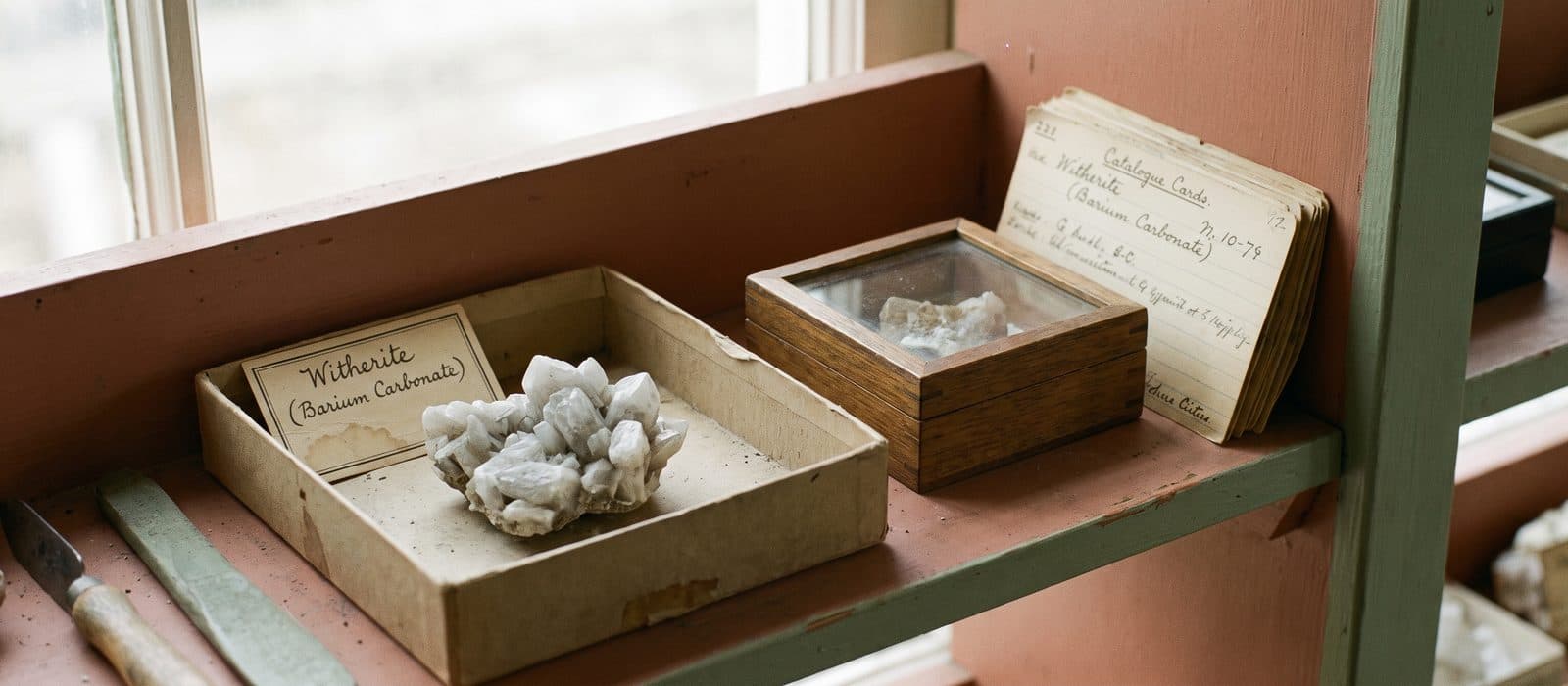
Homeopathic Baryta carbonica is prepared from barium carbonate (BaCO₃), a dense white powder. It occurs naturally as the mineral witherite, named after the eighteenth-century English physician William Withering, and is produced industrially for glass, ceramics and brick-making. Baryta comes from the Greek for heavy, after the weight of barium minerals. Our guide to reading Latin remedy names explains how the older chemical names ended up on labels.
Barium carbonate is poisonous. It dissolves in stomach acid, releasing barium that disturbs potassium balance in the body and can cause severe muscle weakness and heart rhythm problems; it has long been sold as rat poison. It is never something to prepare or use at home. It is also not the same thing as the barium sulphate given for X-ray imaging, which is insoluble and passes through the body unchanged.
Because barium carbonate is insoluble in water, the first potency steps are made by trituration with lactose before the material is carried into liquid and then diluted and succussed in the usual way. At 12C the arithmetic says no molecule of the original salt is expected to remain, which is why properly prepared high potencies are not a poisoning concern and also why mainstream science is sceptical of the method. Our potencies guide works through both sides.
What is the Baryta carbonica picture?
The Baryta carbonica picture is a person who feels small in the world. Classic texts describe a child who hides behind a parent or the furniture when visitors arrive, peeps out between their fingers, and will not speak to strangers; who is slow to learn, unsure of themselves, and easily laughed at. Kent (1905) describes the same timidity in adults: a lack of confidence, difficulty making decisions, and a feeling that other people are watching and judging.
The other classic age is old age. Boericke (1927) describes older people who become forgetful, childish in their behaviour, and anxious about small things, with a sense that the mind is slowing. The old texts are direct about this in a way that can read unkindly now; they were describing what they saw in an era with no understanding of dementia or developmental conditions.
Physically, the keynote is glandular. The tonsils and the glands of the neck swell readily, and every cold settles in the throat; the old descriptions speak of tonsils that enlarge and suppurate with each chill. The person is chilly and sensitive to cold, especially cold feet, and catches cold easily. Clarke (1900–1902) also describes slow physical development in children, with a small stature and delayed walking and talking.
What makes it better or worse?
The traditional modalities centre on cold and on attention. Baryta carbonica is worse from cold and damp and, unusually, from thinking about its own symptoms, and better from warmth and walking in the open air.
| Modality | Worse | Better |
|---|---|---|
| Temperature | Cold, cold damp air, getting the feet cold | Warm wrapping |
| Attention | Thinking about the symptoms; being watched | Being left unobserved |
| Company | Strangers | Familiar people |
| Position | Lying on the painful side | No consistent keynote |
| Activity | Washing | Walking in the open air |
The "worse thinking about it" modality is one the old texts share with only a handful of remedies. Our guide to modalities, better and worse explains how homeopaths read details like this.
What is Baryta carbonica traditionally discussed for?
Baryta carbonica is not named on any of our acute pages; it is a constitutional picture, and most of what follows comes from the classic materia medica. Where the complaint has an acute page, that page sets out the red flags first.
Throat and glands
- The old texts traditionally discuss Baryta carbonica for a tendency to enlarged tonsils and neck glands that flare with every cold. The acute side of a sore throat, and its red flags, are on our page about the first day of a sore throat. A throat that stops a person swallowing saliva, a muffled voice, or difficulty breathing needs urgent care.
Childhood development (classic texts)
- Boericke and Clarke describe shy, slow-to-mature children with delayed milestones. Delayed walking, talking or learning needs a paediatric assessment, and our guide to observing a sick child covers how to note what you see. This is long-term case work, the territory of our guide to acute and chronic questions.
Older age (classic texts)
- Kent and Boericke discuss it for older people losing memory and confidence. New forgetfulness, confusion or personality change in an older adult always needs a doctor first; some causes are reversible and time matters.
What is Baryta carbonica not?
Baryta carbonica is not "the remedy for slow children" and it is not a dementia remedy. The commonest misreading takes the historical description of a backward child or a childish old person and turns it into a label, which is both inaccurate and unkind. The tradition's picture is a combination: shyness and self-doubt out of proportion, a sense of being watched, chilliness, and swollen glands with every cold. A shy child with none of the rest is just a shy child.
It is also not a substitute for assessment. Missed developmental milestones, a child who has lost skills, memory loss or confusion in an adult, a neck lump that persists, and repeated severe tonsillitis all have medical causes that need checking. Our guide to red flags first explains the principle.
Homeopaths separate Baryta carbonica from its neighbours like this:
| Picture | Where it sits | Defining feature | Key modality |
|---|---|---|---|
| Baryta carbonica | Shy, slow to mature, glandular | Timidity, self-doubt, hides from strangers | Worse cold; worse thinking of symptoms |
| Calcarea carbonica | Chilly, steady, easily tired | Sweaty head, overwhelm rather than timidity | Worse cold, damp and exertion |
| Silicea | Chilly, fine-boned, low stamina | Lacks confidence but is capable and stubborn | Worse cold and draughts |
| Pulsatilla | Gentle, clingy, changeable | Seeks company and consolation rather than hiding | Worse warm rooms; better open air |
| Hepar sulphuris | Sore throats with sharp pain | Splinter-like pain, irritable, oversensitive | Worse cold air and touch |
What potencies is Baryta carbonica sold in?
Baryta carbonica is sold most often as 30C pellets, with 6C and 200C available from homeopathic manufacturers and specialist pharmacies. Potency describes the preparation process, not an amount of barium: 30C means thirty successive 1:100 dilutions with succussion between them. Our potencies guide explains the scale and what remains in the vial. Very low potencies of a toxic starting material are a separate category with their own labelling, and are not what this page describes.
This page deliberately gives no frequency or instructions for taking Baryta carbonica. That depends on a whole case, not a remedy name, and constitutional remedies are traditionally prescribed after a long consultation. Read the product label, and talk to a qualified practitioner about an individual situation.
What remedy lists don't tell you
Two things the short lists leave out:
- The keynote is self-consciousness, not slowness. Lists often reduce Baryta carbonica to "slow" or "backward", words that describe a judgement rather than a state. What the classic texts actually lean on is the feeling of being watched and found wanting, and the retreat that follows: hiding, not answering, deferring to others. That is observable, and it is the detail that separates the picture from its neighbours.
- The old descriptions need reading in their century. Nineteenth-century physicians had no concept of autism, learning disability or dementia as we now understand them, and described what they saw in blunt language. A modern homeopath reads those pages as historical observations of behaviour, not as diagnoses, and works alongside the paediatrician, the school or the memory clinic rather than instead of them.
Not sure whether a picture fits?
A remedy profile describes a picture; it cannot tell you whether that picture matches what you are seeing. An acute consultation starts from the case itself: onset, sensations, what changes it, and the red flags.
Acute consultation · $45Frequently asked questions
- What is Baryta carbonica?
- Baryta carbonica is a homeopathic remedy prepared from barium carbonate, a heavy white mineral salt, ground with milk sugar and then diluted and succussed. In homeopathy it names a traditional constitutional picture: a shy, timid person who seems younger than their years, with a tendency to swollen glands and tonsils. It is a description homeopaths use to compare cases, not evidence that it works for any condition.
- What is Baryta carbonica used for in homeopathy?
- Homeopathic literature discusses Baryta carbonica mainly as a constitutional picture: shy, slow-to-mature children, older people whose confidence and memory are fading, and a tendency to enlarged tonsils and glands with every cold. Each of those is a medical question first: developmental delay, memory change and recurrent tonsillitis all need a doctor's assessment.
- What is Baryta carbonica 30C used for?
- 30C is a common shelf potency of Baryta carbonica, alongside 6C and 200C. In the tradition the potency does not change the picture, and Baryta is a constitutional remedy that homeopaths usually leave to a practitioner who has taken a full case. Our potencies guide explains what 30C means as a dilution.
- How is Baryta carbonica taken?
- This page does not give instructions on how or how often to take any remedy, because that depends on a whole case rather than on a remedy name. The product label carries the manufacturer's directions, and a qualified practitioner can advise on an individual situation. Delayed development, memory loss, or a throat that makes swallowing or breathing hard need medical care first.
- Where can I buy Baryta carbonica?
- Homeopathic manufacturers and specialist pharmacies sell Baryta carbonica as single-remedy pellets, most often in 30C; it is less often on general shop shelves than the acute remedies. This site also prepares custom single remedies to order: you name the remedy and potency, and the details are confirmed by email before anything is made. The order form does not give advice on which remedy to choose.
- What is Baryta carbonica made from?
- Baryta carbonica is made from barium carbonate, which occurs naturally as the mineral witherite and is also made industrially. It is ground with milk sugar through the first potency steps, then diluted and succussed to the labelled potency. Raw barium carbonate is poisonous and has been sold as rat poison; it is never something to prepare or use at home, and properly potentised preparations are diluted past the point where any is expected to remain.
This guide is educational only and is not medical advice or a personalized remedy recommendation. Acute symptoms can become urgent; when in doubt, seek professional evaluation.