Remedy profile
Antimonium crudum in Homeopathy: Uses, Picture and Limits
What homeopathic Antimonium crudum is made from, the overfull, white-tongued picture homeopaths describe, what changes it, potencies sold, and its limits.
By Homeopathic BenefitsPublished 7 min read
Key takeaways
- Antimonium crudum is the picture of the overloaded stomach. Classic texts describe the person who has eaten too much, especially rich, sour or cured food, and now feels full, nauseous and belching.
- The tongue is its signature. Homeopathic literature describes a thick, milky-white coating, as if the tongue had been whitewashed.
- The mood is sulky and touch-averse. Older texts describe children, especially, who cannot bear to be touched or even looked at.
- It is prepared from stibnite, an antimony ore. Antimony compounds are poisonous; potentised preparations are diluted far past the point where any is expected to remain.
- Digestive red flags come first. Vomiting blood or dark, coffee-ground material, severe abdominal pain, chest pain, or signs of dehydration, especially in a child, are medical questions before homeopathic ones.
The short answer
Antimonium crudum is a homeopathic remedy prepared from black antimony sulphide, the grey metallic mineral stibnite, ground with lactose and then diluted and succussed to the labelled potency. In homeopathy it names a traditional picture rather than a treatment: the overloaded stomach after too much food, especially rich, sour or cured food, with nausea, belching that tastes of what was eaten, and a tongue coated thick and milky white. The mood is sulky and irritable, and classic texts describe children who cannot bear to be touched or looked at. Hahnemann included it in The Chronic Diseases, and Boericke (1927) placed the white tongue among its strongest keynotes. It is not a general indigestion remedy, and nothing about the picture replaces medical care for persistent or severe vomiting.
| Latin name | Antimonium crudum |
|---|---|
| Abbreviation | Ant-c. |
| Common name | Black sulphide of antimony, stibnite |
| Source | Antimony trisulphide (the mineral stibnite), triturated and potentised (mineral kingdom) |
| Commonly sold potencies | 6C, 30C |
| First proving | Hahnemann, The Chronic Diseases (1828–1830; expanded in the 2nd edition, 1835–1839) |
What is Antimonium crudum made from?
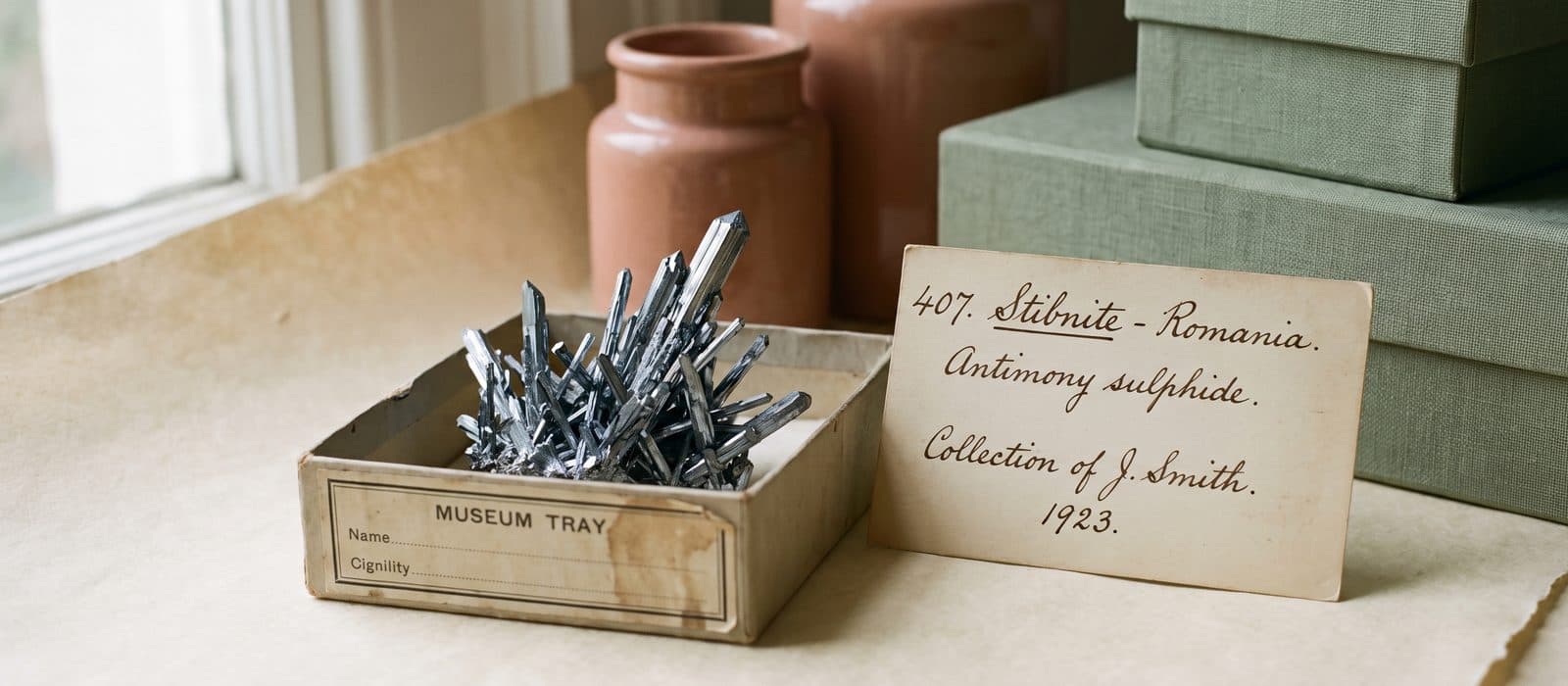
Antimonium crudum is prepared from antimony trisulphide (Sb₂S₃), which occurs naturally as the mineral stibnite: long, brittle, lead-grey crystals with a bright metallic lustre. Crudum means raw or crude, and the name distinguishes the native sulphide from the many refined antimony compounds of old pharmacy. Ground stibnite was used as the eye cosmetic kohl in the ancient world, and antimony compounds were widely used as emetics for centuries.
That last history is the reason for honest framing. Antimony and its compounds are poisonous; the old emetics caused violent vomiting, and poisoning damages the heart, liver and gut. The raw mineral is never something to prepare or use at home. Because stibnite does not dissolve in water, the first potency steps are made by trituration, grinding the mineral with lactose for long periods before the preparation is carried into liquid and diluted and succussed. At the common potencies the arithmetic says no molecule of the original substance is expected to remain. Our potencies guide works through what that means and why it is also the reason science is sceptical.
Antimonium crudum has a well-known sibling, Antimonium tartaricum, tartar emetic, which is a different antimony compound with a chest picture rather than a stomach one. Our guide to reading Latin remedy names explains why the second word on a label matters as much as the first.
What is the Antimonium crudum picture?
The Antimonium crudum picture is the person who ate too much and is now paying for it in a heavy, sullen way. Picture the evening after a holiday feast: too much rich meat, pickles, sour wine and pastry, and now a stomach that feels loaded, nausea that will not quite resolve, and belching that brings back the taste of dinner. Look at the tongue and it is coated thick and white, like milk or whitewash, from tip to root. Vomiting, if it comes, brings no lasting relief.
Classic texts are as interested in the mood as the stomach. Boericke (1927) describes a child who is fretful and peevish, who cannot bear to be touched or looked at, and who is cross whatever is offered. Adults are sulky, do not want to talk, and are easily put out. Older texts also record a sentimental streak, an odd, wistful mood in moonlight, which is one of those details the tradition kept because it was so unexpected.
The picture extends to the skin in a consistent way. Classic materia medica describes thick, horny skin: hard calluses on the soles, corns, warts with a horny surface, cracked corners of the mouth and split, slow-growing nails. Homeopaths read the white tongue and the thickened skin as the same tendency showing in two places.
What makes it better or worse?
The traditional modalities centre on food, heat and cold water. Antimonium crudum is worse from overeating, acids and the heat of the sun or a fire, and better from rest and in the open air.
| Modality | Worse | Better |
|---|---|---|
| Food | Overeating; sour food, vinegar, sour wine; rich and cured food | Eating little; fasting from the offending food |
| Heat | Heat of the sun; radiated heat from a fire | Moderate, moist warmth |
| Water | Cold bathing, cold washing | Rest |
| Contact | Being touched or looked at | Being left alone |
| Air | Close rooms | Open air (Boericke) |
The modalities are what separate one overfull stomach from another; our guide to modalities, better and worse explains why a homeopath reads them before any remedy name.
What is Antimonium crudum traditionally discussed for?
In homeopathic literature, Antimonium crudum is traditionally discussed for the consequences of overeating and for thickened, horny skin. On this site it appears on one acute page, where the pattern sits beside its neighbours and the red flags come first.
Digestion after excess
- Nausea after rich food: the overfull pattern, after too much rich, acidic or cured food, with belching, nausea and a coated tongue. Our guide to hangovers, rich food and bad food explains how homeopaths separate overeating from food that was off.
Skin and nails (classic texts)
- Older materia medica describes calluses, corns, horny warts, cracked corners of the mouth and split nails. There is no acute page for these here; a growth that changes, bleeds or spreads is a medical question first.
What is Antimonium crudum not?
Antimonium crudum is not "the indigestion remedy", and a white tongue alone does not make the picture. Overeating can follow several traditional pictures: the irritable, chilly person retching without result, the mild, weepy one who wants air and is not thirsty, the one whose nausea is constant while the tongue stays clean. Antimonium crudum is the overfull, sulky, touch-averse one with the thick white tongue. Without that combination the name is just another label.
It is also not a reason to wait out vomiting that will not settle. Vomiting blood or dark coffee-ground material, severe or worsening abdominal pain, a rigid or swollen abdomen, chest pain, signs of dehydration such as little or no urine, or a child who cannot keep fluids down all need medical care first. So does "indigestion" in someone with heart risk factors.
Homeopaths separate it from its neighbours like this:
| Picture | Where it sits | Defining feature | Key modality |
|---|---|---|---|
| Antimonium crudum | Overeating, sour and rich food | Thick milky-white tongue; belching tasting of food; sulky, will not be touched or looked at | Worse heat of sun and cold bathing; better open air and rest |
| Nux vomica | Excess, stimulants, overwork | Irritable, impatient, chilly; retching without result | Worse morning and cold; better warmth and a nap |
| Pulsatilla | Rich, fatty food | Mild, changeable, wants company; thirstless | Better open air; worse warm stuffy rooms |
| Ipecacuanha | Constant nausea | Persistent nausea not eased by vomiting; tongue clean | Worse from motion and stooping |
What potencies is Antimonium crudum sold in?
Antimonium crudum is sold most often as 6C and 30C pellets, usually through homeopathic pharmacies. Potency describes the preparation process, not an amount of mineral: 30C means thirty successive 1:100 dilutions with succussion between them, after the initial trituration. Our potencies guide explains the scale and what remains in the vial.
This page deliberately gives no frequency or instructions for taking Antimonium crudum. That depends on a whole case, not a remedy name. Read the product label, and talk to a qualified practitioner about an individual situation.
What remedy lists don't tell you
Two things the "remedies for overeating" lists leave out:
- Look at the tongue. Classic texts built whole distinctions on it: thick and white in one picture, clean despite constant nausea in another. It takes two seconds and a mirror, and most people describing an upset stomach never mention it. Parents of a sick child can note it too, as our guide to observing a sick child explains.
- The mood after the meal matters as much as the meal. Two children who ate too much at the same party can react in opposite ways: one clingy and wanting to be held, the other turning away and crying if anyone so much as looks at them. The tradition places them in different pictures, and a list sorted by "overeating" cannot tell them apart.
Where the Antimonium crudum picture appears on this site
Acute pages that discuss this picture among their educational patterns, with the pattern name each page uses.
- What homeopathic remedy for nausea after rich food?Antimonium crudum-like overfull pattern
Not sure whether a picture fits?
A remedy profile describes a picture; it cannot tell you whether that picture matches what you are seeing. An acute consultation starts from the case itself: onset, sensations, what changes it, and the red flags.
Acute consultation · $45Frequently asked questions
- What is Antimonium crudum?
- Antimonium crudum is a homeopathic remedy prepared from black antimony sulphide, the grey metallic mineral stibnite, ground with milk sugar and then diluted and succussed to the labelled potency. In homeopathy it names a traditional picture: the overfull stomach after too much food, with a thick, milky-white coated tongue, belching that tastes of the meal, and a sulky mood that does not want to be touched or looked at. It is a description homeopaths use to compare cases, not a finding that it works for any condition.
- What is Antimonium crudum used for in homeopathy?
- Homeopathic literature traditionally discusses Antimonium crudum for digestive upset after overeating, especially rich, sour or cured food, with nausea, belching and a thickly white-coated tongue. Classic texts also describe thick, horny skin, cracked corners of the mouth and split nails. Vomiting blood or coffee-ground material, severe abdominal pain, chest pain or signs of dehydration need medical care first.
- What is Antimonium crudum 30C used for?
- 30C is a commonly sold potency of Antimonium crudum, along with 6C, mostly through homeopathic pharmacies. In the tradition the potency does not change the picture; 30C is discussed for the same overfull, white-tongued state as any other potency. Our potencies guide explains what 30C means as a dilution.
- How is Antimonium crudum taken?
- This page does not give instructions on how or how often to take any remedy, because that depends on a whole case rather than on a remedy name. The product label carries the manufacturer's directions, and a qualified practitioner can advise on an individual situation. Vomiting that will not settle, especially in a child, belongs with a clinician first.
- Where can I buy Antimonium crudum?
- Homeopathic pharmacies and manufacturers sell Antimonium crudum as single-remedy pellets, most often in 6C and 30C. This site also prepares custom single remedies to order: you name the remedy and potency, and the details are confirmed by email before anything is made. The order form does not give advice on which remedy to choose.
- What is Antimonium crudum made from?
- Antimonium crudum is made from antimony trisulphide, the mineral stibnite, a brittle, lead-grey ore with a metallic shine. It is ground with lactose (trituration) through the first potency steps, then diluted and succussed to the labelled potency. Antimony compounds are poisonous, and the raw mineral is never something to use at home; potentised preparations are diluted far past the point where any is expected to remain.
This guide is educational only and is not medical advice or a personalized remedy recommendation. Acute symptoms can become urgent; when in doubt, seek professional evaluation.