Remedy profile
Antimonium tartaricum in Homeopathy: Uses, Picture and Limits
What homeopathic Antimonium tartaricum is made from, the drowsy, rattling chest picture homeopaths describe, what changes it, potencies sold, and its limits.
By Homeopathic BenefitsPublished 7 min read
Key takeaways
- The picture is rattle without result. Homeopathic literature describes a chest that sounds full of loose mucus, yet the person is too weak to bring much of it up.
- Drowsiness and weakness come with it. Classic texts pair the rattling with sleepiness, a pale or dusky face, cold sweat and a thickly white-coated tongue.
- The old texts place it at the two ends of life. Infants and elderly people are where Boericke (1927) and Nash (1898) describe it most, and they are also the people in whom a rattling chest is most likely to be serious.
- It comes from tartar emetic, a real poison. Antimony potassium tartrate was a powerful emetic and a notorious poison; potentised preparations are diluted far past the point where any is expected to remain.
- Breathing difficulty is an emergency first. Fast or laboured breathing, ribs pulling in, blue or grey lips, a baby too breathless to feed, or a person who is hard to rouse needs emergency care before any pattern discussion.
The short answer
Antimonium tartaricum is a homeopathic remedy prepared from tartar emetic, antimony potassium tartrate, triturated with milk sugar and then diluted and succussed to the labelled potency. In homeopathy it names a traditional picture rather than a treatment: a chest that rattles loudly with mucus the person cannot clear, in someone who is weak, drowsy and pale, often a small child or an elderly person. Classic materia medica adds a white-coated tongue, nausea, sweat and a wish to sit propped upright. Boericke (1927) opens his entry with the great rattling of mucus and very little expectoration. It is not a cough remedy, and nothing about the picture replaces urgent medical care when breathing is laboured or the person is hard to wake.
| Latin name | Antimonium tartaricum |
|---|---|
| Abbreviation | Ant-t. |
| Common name | Tartar emetic (antimony potassium tartrate) |
| Source | Antimony potassium tartrate, a crystalline salt of antimony, triturated and potentised (mineral kingdom) |
| Commonly sold potencies | 6C, 30C, 200C |
| First proving | Nineteenth-century provings and poisoning records, collected in Allen's Encyclopedia of Pure Materia Medica (1874–1879) |
What is Antimonium tartaricum made from?
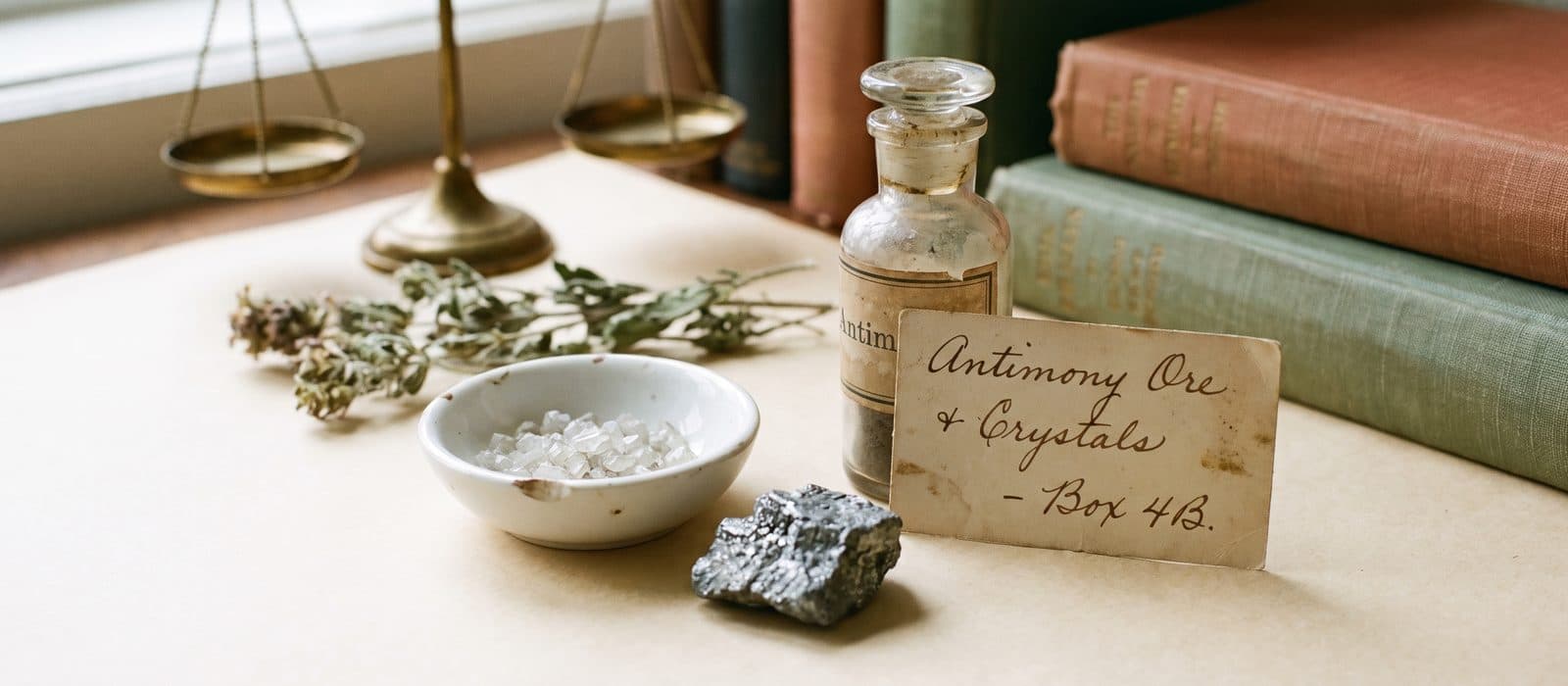
Antimonium tartaricum is prepared from antimony potassium tartrate, a colourless or white crystalline salt made by combining antimony oxide with cream of tartar. Its old name, tartar emetic, describes its use: for centuries physicians gave it to provoke vomiting and sweating, and it sat in every apothecary's cabinet beside ipecacuanha. Antimony itself is a brittle, silvery metalloid; the homeopathic label shortens the salt's name to its antimony and its tartrate.
The honest framing matters here. Tartar emetic is poisonous. In material amounts it causes violent vomiting, collapse, a weak irregular heart and, in large enough amounts, death; it was used as a poison in several notorious nineteenth-century murder cases, and its medical use faded as safer options arrived. It is never something to prepare, buy in raw form or swallow at home.
The homeopathic preparation grinds the salt with lactose (trituration) through the first steps, then carries it through repeated dilution and succussion. At 12C and beyond, the arithmetic says no molecule of the original substance is expected to remain; our potencies guide sets out what that means, and why it is also the reason mainstream science is sceptical. The guide to reading Latin remedy names explains why a classic poison appears on a remedy label at all. Its chemical cousin, Antimonium crudum, is the black sulphide of antimony and belongs to an entirely different picture.
What is the Antimonium tartaricum picture?
The Antimonium tartaricum picture is the person whose chest sounds worse than they can do anything about. Picture a toddler at the end of a heavy cold, or an elderly parent after days in bed: every breath carries a coarse, bubbling rattle you can hear from the doorway, and each cough loosens something without bringing it up. The effort of coughing is too much. They doze between bouts, wake to cough, and sink back.
Classic texts make the drowsiness and the weakness as important as the chest. Nash (1898) and Boericke (1927) describe sleepiness, a pale or bluish tinge around the face, cold sweat and great prostration. The tongue is coated thick and white, sometimes with red edges, and there is often nausea, the kind that comes in waves with the cough and eases briefly after vomiting or bringing up a little phlegm. Thirst is usually low.
The mood is that of someone too worn out to be bothered. The old texts describe a child who whines when touched or looked at and wants to be carried and propped up rather than laid flat. Adults in the picture are described the same way: irritable at being disturbed, and wanting only to sit upright and be left to breathe. The whole state is heavy, slow and sinking rather than restless or feverishly bright.
What makes it better or worse?
The traditional modalities centre on position and on getting the mucus out. Antimonium tartaricum is worse lying down and in a warm, close room, and better sitting up and after bringing up phlegm.
| Modality | Worse | Better |
|---|---|---|
| Position | Lying down, especially flat | Sitting upright, propped on pillows |
| Discharge | Mucus that will not come up | Coughing up phlegm, belching, vomiting |
| Temperature | Warm, stuffy rooms; damp cold weather | Cool, open air |
| Time | Evening and night | No consistent keynote |
| Contact | Being touched or looked at (in children) | Being carried upright |
Several of these modalities overlap with what any doctor or nurse would also notice about a struggling chest, which is part of why our guide to modalities, better and worse reads them as observations first and pattern language second.
What is Antimonium tartaricum traditionally discussed for?
In homeopathic literature, Antimonium tartaricum is traditionally discussed for loose, rattling chest states with drowsiness and weakness. It appears on one of our acute pages, where the Antimonium tartaricum-like pattern sits beside its neighbours and the red flags come first.
Chest and cough
- The loud, loose, rattling cough that is hard to clear, with fatigue or drowsiness: a wet, productive cough.
Where the old texts take it further
- Classic materia medica also describes the picture in infants with rattling breathing and in elderly people with a weak, mucus-filled chest. On this site those situations sit firmly in the "seek care" category: our guides to red flags first and observing a sick child explain what to check, and when not to wait.
What is Antimonium tartaricum not?
Antimonium tartaricum is not "the remedy for a chesty cough", and its reputation in older books for the very young and the very old is the part most likely to be misread. A rattling chest in a baby can be bronchiolitis; in an elderly or bed-bound person it can be pneumonia, heart failure or aspiration. Those are medical emergencies or near-emergencies, and the drowsiness the old texts describe is, in modern terms, a warning sign rather than a keynote to match. Fast breathing, ribs or the skin at the base of the throat pulling in with each breath, grunting, blue or grey lips, a baby who cannot feed, high fever, confusion, or a person who is hard to wake all mean emergency care first.
Homeopaths separate Antimonium tartaricum from its neighbours like this:
| Picture | Where it sits | Defining feature | Key modality |
|---|---|---|---|
| Antimonium tartaricum | Loose, rattling chest with weakness | Rattle without result; drowsy, pale, white tongue | Worse lying down; better sitting up and expectorating |
| Ipecacuanha | Rattling cough with nausea | Constant nausea, clean tongue; gagging cough | Worse warm, damp air; nausea not eased by vomiting |
| Pulsatilla | Loose cough late in a cold | Bland, changeable discharge; mild, wants company | Better open air, worse warm stuffy rooms |
| Carbo vegetabilis | Collapse states with air hunger | Cold, sluggish, wants to be fanned | Better moving air and belching |
What potencies is Antimonium tartaricum sold in?
Antimonium tartaricum is sold as 6C and 30C pellets by most homeopathic manufacturers, with 200C available from specialist pharmacies. It is less often on general pharmacy shelves than Arnica or Nux vomica. Potency describes the preparation process, not an amount of antimony: 30C means thirty successive 1:100 dilutions with succussion between them. Our potencies guide explains the scale and what remains in the vial. Very low potencies of a toxic starting material are a separate category with their own labelling, and are not what this page describes.
This page deliberately gives no frequency or instructions for taking Antimonium tartaricum. That depends on a whole case, not a remedy name. Read the product label, and talk to a qualified practitioner about an individual situation.
What remedy lists don't tell you
Two things the short lists leave out:
- The keynote and the warning sign are the same observation. Nineteenth-century writers recorded rattling breath, drowsiness and a dusky face as a picture to match. A modern reader has to see the same three features as signs that the lungs may not be moving enough air. That is why this page puts the emergency signs before the picture, and why our wet, productive cough page puts them before its patterns too.
- "Hard to clear" is the useful detail, not "wet". Many loose coughs bring phlegm up easily and leave the person feeling better each time. The tradition's picture is the cough that loosens nothing, in a person too tired to try. Lists that say "wet cough" lose the distinction; our guide to the symptoms alongside the symptom explains why the companions (drowsiness, nausea, the coated tongue) matter more than the label on the cough.
Where the Antimonium tartaricum picture appears on this site
Acute pages that discuss this picture among their educational patterns, with the pattern name each page uses.
- What homeopathic remedy for a wet, productive cough?Antimonium tartaricum-like loose, rattling pattern
Not sure whether a picture fits?
A remedy profile describes a picture; it cannot tell you whether that picture matches what you are seeing. An acute consultation starts from the case itself: onset, sensations, what changes it, and the red flags.
Acute consultation · $45Frequently asked questions
- What is Antimonium tartaricum?
- Antimonium tartaricum is a homeopathic remedy prepared from tartar emetic, antimony potassium tartrate, ground with milk sugar and then diluted and succussed to the labelled potency. In homeopathy it names a traditional picture: a chest full of rattling mucus that the person is too weak and drowsy to cough up, with a pale or dusky face and a white-coated tongue. It is a description homeopaths use to compare cases, not evidence that it works for any condition.
- What is Antimonium tartaricum used for in homeopathy?
- Homeopathic literature traditionally discusses Antimonium tartaricum for loud, rattling, loose coughs where little comes up, in a person who is drowsy, weak and wants to sit propped up. Classic texts describe it most often in the very young and the very old. Rattling breathing in those two groups is exactly where breathing difficulty must be ruled out first: fast or laboured breathing, blue or grey lips, or a person who is hard to wake needs emergency care.
- What is Antimonium tartaricum 30C used for?
- 30C is a common shelf potency of Antimonium tartaricum, though it is stocked less widely than the household names and often has to be ordered from a homeopathic pharmacy. In the tradition, the potency does not change the picture; 30C is discussed for the same drowsy, rattling, weak state as any other potency. What 30C means as a dilution is explained in our potencies guide.
- How is Antimonium tartaricum taken?
- This page does not give instructions on how or how often to take any remedy, because that depends on a whole case rather than on a remedy name. The product label carries the manufacturer's directions, and a qualified practitioner can advise on an individual situation. A rattling chest with any difficulty breathing is a medical question first, and in a baby or an elderly person it is an urgent one.
- Where can I buy Antimonium tartaricum?
- Homeopathic pharmacies and manufacturers sell Antimonium tartaricum as single-remedy pellets, most often in 6C or 30C; general pharmacies carry it less often than the best-known remedies. This site also prepares custom single remedies to order: you name the remedy and potency, and the details are confirmed by email before anything is made. The order form does not give advice on which remedy to choose.
- What is Antimonium tartaricum made from?
- Antimonium tartaricum is made from antimony potassium tartrate, the white crystalline salt long known as tartar emetic. It is ground with milk sugar (trituration) through the first potency steps, then diluted and succussed to the labelled potency. Tartar emetic itself is poisonous and is never something to prepare or swallow at home; at 12C and beyond the arithmetic says no molecule of it is expected to remain.
This guide is educational only and is not medical advice or a personalized remedy recommendation. Acute symptoms can become urgent; when in doubt, seek professional evaluation.