Remedy profile
Lachesis muta in Homeopathy: Uses, Picture and Limits
What homeopathic Lachesis is made from, the intense, flushed, can't-bear-a-collar picture homeopaths describe, what changes it, potencies sold, and its limits.
By Homeopathic BenefitsPublished 7 min read
Key takeaways
- Lachesis is the picture of intensity under pressure. Homeopaths describe a person who is flushed, talkative and wound up, with a feeling that everything is pent up and needs release.
- Constriction is the keynote. Collars, scarves, tight waistbands and even a light touch on the throat are intolerable.
- It is worse after sleep and better once something flows. Classic texts describe waking into the symptoms, and relief when menstrual flow or another discharge begins. The left side is favoured.
- It comes from bushmaster venom. The raw venom is seriously poisonous; potentised preparations are diluted far past the point where it remains.
- Hormonal and bleeding red flags come first. Very heavy bleeding, bleeding after the menopause, flushes with chest pain or palpitations, and low moods with thoughts of self-harm are medical questions before they are homeopathic ones.
The short answer
Lachesis muta is a homeopathic remedy prepared from the venom of the bushmaster, the largest pit viper of the Americas. In homeopathy it names a traditional picture rather than a treatment: an intense, flushed, talkative person who cannot bear anything tight around the neck or waist, feels worst on waking, and improves once a discharge such as menstrual flow begins. Classic materia medica favours the left side and describes a purplish, congested colour and a heat that is worse in warm weather. Constantine Hering introduced it from venom he obtained in Surinam in 1828, and Boericke (1927) singled it out for the menopausal years. It is not a menopause or premenstrual remedy in general, and nothing about the picture replaces medical care for heavy bleeding or symptoms that are severe or new.
| Latin name | Lachesis muta |
|---|---|
| Abbreviation | Lach. |
| Common name | Bushmaster (snake venom) |
| Source | Venom of the bushmaster, Lachesis muta (Viperidae), triturated and potentised (animal kingdom) |
| Commonly sold potencies | 6C, 30C, 200C |
| First proving | Constantine Hering, from venom obtained in Surinam in 1828; published in the 1830s and collected in Hering's Guiding Symptoms |
What is Lachesis made from?
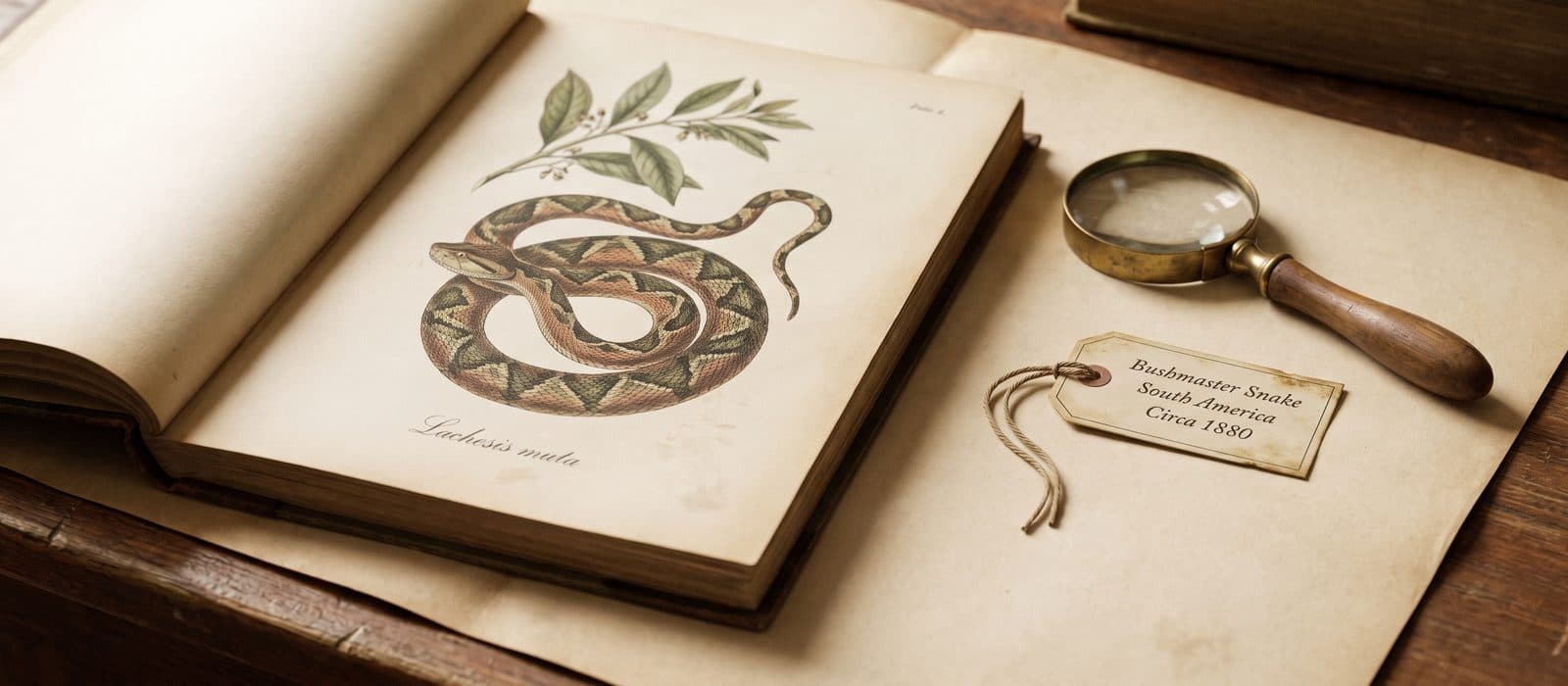
Homeopathic Lachesis is prepared from the venom of Lachesis muta, the bushmaster, a long, heavy-bodied pit viper of the Amazon basin and the forests of northern South America. It can grow to well over two metres, hunts at night, and is rarely seen. Its scientific name borrows from Greek myth: Lachesis was the Fate who measured out the length of each life's thread.
The remedy's history is tied to one man. Constantine Hering, a German physician who later helped found homeopathy in the United States, was working in Surinam when he obtained bushmaster venom in 1828 and triturated it with milk sugar. Homeopathic histories tell that he was affected by the work of preparing it, and that he and his colleagues went on to record the symptoms of the potentised venom. Hering published the results in the 1830s, and the material was later gathered in his Guiding Symptoms.
The source deserves plain words. Bushmaster venom is seriously poisonous, and a bite is a medical emergency that needs antivenom; the raw venom is never something to handle, prepare or use outside a laboratory. Homeopathic Lachesis is triturated and then diluted and succussed far past the point where any venom is expected to remain. Our potencies guide sets out what that means and why it is also the reason science is sceptical, and our guide to reading Latin remedy names explains why poisonous sources appear on labels at all.
What is the Lachesis picture?
The Lachesis picture is a person who feels everything at full pressure. Imagine a woman in her early fifties who wakes at dawn already flushed, the heat climbing up her neck into her face. She has pulled her scarf off before she is properly awake and cannot bear the duvet near her throat. By mid-morning she has talked through three subjects at speed, jumping from one to the next, and has noticed, sharply, that a colleague seemed to be whispering about her. The day before her period used to be the worst of the month; once the flow started, she felt like herself again.
Classic texts describe this person as intense, quick, perceptive and expressive, with a mind that runs ahead and a tongue that keeps up. Kent's Lectures (1905) and Clarke's Dictionary (1900–1902) describe loquacity, jealousy and suspicion as part of the picture, alongside a feeling of being pent up and needing an outlet. Homeopaths read these as features of a state, not a judgement of character.
The body mirrors the pressure. Boericke (1927) describes hot flushes, congestion of the head, palpitations, and a purplish or bluish tinge to swollen or inflamed parts. Symptoms favour the left side or travel from left to right. Sleep makes things worse: the person sleeps into their symptoms and wakes with them at their peak. Anything that constricts the throat, chest or waist is intolerable, and even a light touch there can feel too much, while firm pressure is better tolerated.
What makes it better or worse?
The traditional modalities centre on constriction, sleep and release. Lachesis is worse after sleep, from heat and from anything tight, and better when a discharge begins and in cool open air.
| Modality | Worse | Better |
|---|---|---|
| Time | On waking; after sleep, even a nap | As the day goes on |
| Clothing and touch | Collars, scarves, tight waistbands; light touch on the throat | Loose clothing; firm rather than light pressure |
| Discharge | Before menstrual flow; suppressed discharges | Once the flow or another discharge begins |
| Temperature | Heat, sun, warm rooms, warm drinks (for the throat) | Cool open air |
| Side and season | Left side, or left to right; spring | No consistent keynote |
The worse-after-sleep keynote is unusual enough that homeopaths read its presence as a strong pointer; our guide to modalities, better and worse explains why timing is read before any remedy name.
What is Lachesis traditionally discussed for?
In homeopathic literature, Lachesis is traditionally discussed for flushed, congested, constricted states that ease when something is released. It appears on two of our acute pages, where the Lachesis-like pattern sits beside its neighbours and the red flags come first.
Flushing and the menopause
- Heat surging with a sense of tightness and intolerance of collars: a sudden hot flash.
The menstrual cycle
- Intense flushing, pressure and irritability before the flow, with relief once it starts: premenstrual irritability.
Beyond these pages, classic texts discuss Lachesis for left-sided sore throats worse from warm drinks and empty swallowing, and for complaints in which a purplish colour and a fear of constriction recur. Those are described here as literature, not as acute guidance; a sore throat with difficulty swallowing saliva, drooling or a muffled voice is an emergency.
What is Lachesis not?
Lachesis is not "the menopause remedy", and it is not a premenstrual remedy for anyone who is irritable before a period. The commonest misreading is to match the name to the life stage. The tradition's picture is the combination of constriction, worse-after-sleep timing, left-sidedness, intensity and relief from flow; a hot flush without that shape belongs elsewhere. It is also not a reason to sit out very heavy bleeding, bleeding between periods or after the menopause, flushes with chest pain, palpitations or fainting, a sudden severe headache, or low moods before a period that bring thoughts of self-harm. Those are reasons to see a doctor, and our guide to homeopathy alongside conventional care explains how the two fit together.
Homeopaths separate Lachesis from its neighbours like this:
| Picture | Where it sits | Defining feature | Key modality |
|---|---|---|---|
| Lachesis | Flushes; premenstrual pressure | Intense, talkative; can't bear anything tight; left-sided | Worse after sleep; better once flow begins |
| Sepia | Flushes; premenstrual irritability | Worn out, indifferent, wants to be alone; dragging-down sensation | Better vigorous exercise |
| Sulphur | Heat surging with redness | Hot-blooded; burning soles out of bed | Worse warmth of bed and washing |
| Belladonna | Sudden heat and throbbing | Bright red, hot, dry; right-sided | Worse jarring, light and noise |
| Pulsatilla | Changeable cycles and moods | Mild, weepy, wants company and comfort | Better open air; worse warm stuffy rooms |
What potencies is Lachesis sold in?
Lachesis muta is sold most often as 30C and 200C pellets, with 6C also available. Potency describes the preparation process, not an amount of venom: 30C means thirty successive 1:100 dilutions with succussion between them. Our potencies guide explains the scale and what remains in the vial. Very low potencies of a venom are a separate category with their own labelling, and are not what this page describes.
This page deliberately gives no frequency or instructions for taking Lachesis. That depends on a whole case, not a remedy name. Read the product label, and talk to a qualified practitioner about an individual situation.
What remedy lists don't tell you
Two things the "remedies for hot flushes" lists leave out:
- The neck is the quickest question. Ask whether a polo neck, a necklace or the duvet near the throat has become unbearable. In the Lachesis picture the answer is an emphatic yes, and it often comes before the person mentions the flush at all. Lists sorted by symptom never ask, and the answer separates Lachesis from several pictures that flush just as hard.
- Most of what is written about Lachesis is constitutional. Hering, Kent and Clarke described it as a whole person over years, and the acute pages use only a thin slice of that: the flush and the premenstrual pressure. Our guide to acute and chronic questions explains why a pattern that returns every month or every night belongs with a practitioner who can take the full case.
Where the Lachesis muta picture appears on this site
Acute pages that discuss this picture among their educational patterns, with the pattern name each page uses.
- What homeopathic remedy for a sudden hot flash?Lachesis-like flushing with constriction pattern
- What homeopathic remedy for premenstrual irritability?Lachesis-like intense congestive pattern
Not sure whether a picture fits?
A remedy profile describes a picture; it cannot tell you whether that picture matches what you are seeing. An acute consultation starts from the case itself: onset, sensations, what changes it, and the red flags.
Acute consultation · $45Frequently asked questions
- What is Lachesis?
- Lachesis muta is a homeopathic remedy prepared from the venom of the bushmaster, a large pit viper of the South American rainforest. In homeopathy it names a traditional picture: an intense, talkative person with flushing and congestion who cannot bear anything tight around the neck or waist, feels worse after sleep and better once a discharge such as menstrual flow begins. It is a description homeopaths use to compare cases, not a finding that it works for any condition.
- What is Lachesis used for in homeopathy?
- Homeopathic literature traditionally discusses Lachesis for flushing with a sense of constriction, as in some menopausal hot flushes, and for the intense, pressured, irritable days before a period that ease once the flow starts. The picture is defined by the constriction, the left-sidedness and the worse-after-sleep timing, not by the name of a complaint. Very heavy bleeding, bleeding after the menopause, or flushes with chest pain or palpitations need medical care first.
- What is Lachesis 30C used for?
- 30C is a common shelf potency of Lachesis and the one most single-remedy tubes carry, though classical homeopaths often discuss it in higher potencies. In the tradition the potency does not change the picture; Lachesis 30C is discussed for the same flushed, constricted, worse-after-sleep state as any other potency. What 30C means as a dilution is explained in our potencies guide.
- How is Lachesis muta taken?
- This page does not give instructions on how or how often to take any remedy, because that depends on a whole case rather than on a remedy name. The product label carries the manufacturer's directions, and a qualified practitioner can advise on an individual situation. Heavy or unexpected bleeding, and mood changes that feel unmanageable, belong with a clinician first.
- Where can I buy Lachesis muta?
- Pharmacies, health-food shops and homeopathic manufacturers sell Lachesis muta as single-remedy pellets, most often in 30C and 200C. It is less often found in basic home kits than remedies such as Arnica. This site also prepares custom single remedies to order: you name the remedy and potency, and the details are confirmed by email before anything is made. The order form does not give advice on which remedy to choose.
- What is Lachesis muta made from?
- Homeopathic Lachesis is prepared from the venom of the bushmaster snake, Lachesis muta. The venom is ground with milk sugar (trituration) through the first potency steps, then diluted and succussed to the labelled potency. Raw snake venom is seriously poisonous and never something to handle, which is why it appears on labels only in potentised form.
This guide is educational only and is not medical advice or a personalized remedy recommendation. Acute symptoms can become urgent; when in doubt, seek professional evaluation.