Remedy profile
Sepia officinalis in Homeopathy: Uses, Picture and Limits
What homeopathic Sepia is made from, the worn-out, dragged-down, wants-to-be-alone picture homeopaths describe, what changes it, potencies sold, and its limits.
By Homeopathic BenefitsPublished 7 min read
Key takeaways
- Sepia is the picture of someone worn down and pulling away. Exhausted, flat, irritable with those closest, and wanting to be left alone rather than comforted.
- A dragged-down feeling runs through the body. Classic texts describe a bearing-down sensation in the pelvis, sagging energy and nausea at the smell or thought of food.
- Vigorous movement is the surprising exception. The traditional Sepia person feels better after a brisk walk, a run or a dance, when rest does nothing.
- It is made from cuttlefish ink. The source is not a poison; it is the ink that gave artists the colour sepia.
- Pregnancy and mood red flags come first. Vomiting that stops fluids staying down, bleeding in pregnancy, or low mood with thoughts of self-harm needs medical care, whatever the picture.
The short answer
Sepia is a homeopathic remedy prepared from the ink of the common cuttlefish, Sepia officinalis, a marine mollusc of European coastal waters. In homeopathy it names a traditional picture rather than a treatment: a person who is worn out and dragged down, indifferent or irritable towards the people they love, sensitive to smells, chilly, and wanting to be left alone. Classic materia medica describes a bearing-down sensation, nausea at the sight or smell of food, and the striking keynote that vigorous exercise lifts the whole state. Hahnemann introduced it in The Chronic Diseases, and Kent's Lectures (1905) gave it one of their longest portraits. It is not a hormone remedy or a "women's remedy", and nothing in the picture replaces care in pregnancy or for depression.
| Latin name | Sepia officinalis |
|---|---|
| Abbreviation | Sep. |
| Common name | Cuttlefish ink |
| Source | Ink from the ink sac of the common cuttlefish, Sepia officinalis (Sepiidae) (animal kingdom) |
| Commonly sold potencies | 6C, 30C, 200C |
| First proving | Hahnemann, The Chronic Diseases (1828–1839) |
What is Sepia made from?
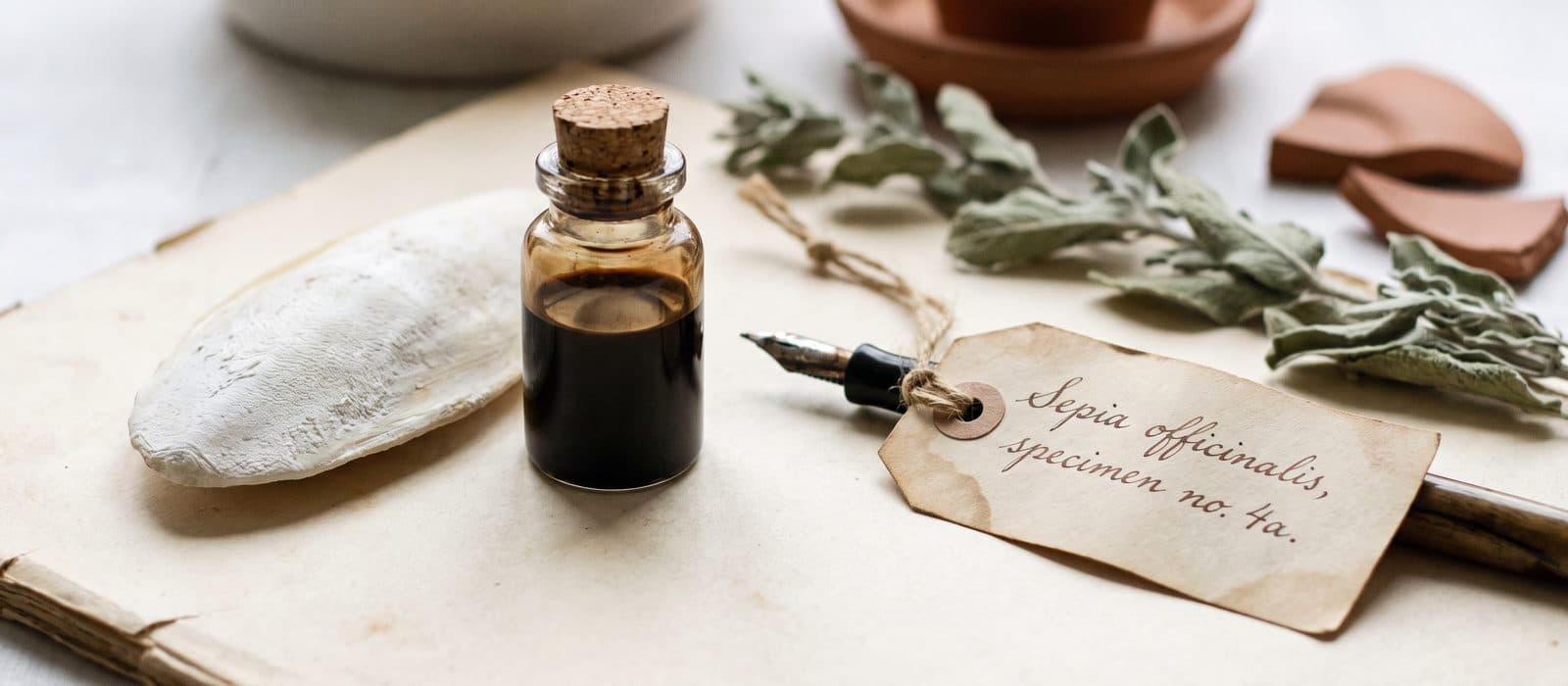
Homeopathic Sepia is prepared from the ink of Sepia officinalis, the common cuttlefish, a ten-armed relative of the squid and octopus living in the shallow coastal waters of the eastern Atlantic and the Mediterranean. When threatened, the cuttlefish releases a cloud of dark brown-black ink from a sac near its gut and slips away behind it. The ink is rich in melanin, the same family of pigment that colours skin and hair.
Unlike many remedy sources, the raw material is not a poison. Cuttlefish ink is still sold as a food colouring for black risotto and pasta, and for centuries the dried ink was the brown artists' and writers' pigment that gave the colour sepia its name. A story often repeated in homeopathic histories says Hahnemann noticed an artist friend who habitually wetted his brush with sepia in his mouth, and who was unwell in ways that led Hahnemann to test the ink. The anecdote is traditional rather than documented, and is best read as part of the remedy's folklore.
The homeopathic preparation grinds the dried ink with milk sugar and carries it through repeated dilution and succussion to the potency on the label. At the common potencies the arithmetic says no ink remains. Our potencies guide explains what that means and why it is also the reason mainstream science is sceptical, and what is in a homeopathic remedy covers the pellet and its carrier.
What is the Sepia picture?
The Sepia picture is a person who has given and given and now has nothing left. Imagine a parent at the end of a long stretch of broken nights, a demanding job and everyone needing something: they love their family, but right now they want them all to go away. Affection feels like another demand. They snap at their partner, then feel nothing much about it, and would rather sit alone than be asked what is wrong. Kent's Lectures (1905) describe this indifference to loved ones and to the things that used to matter, and both Kent and Boericke (1927) note the weepiness that can come when the person is asked about their symptoms.
The body is dragged down too. Classic texts describe a bearing-down sensation in the pelvis, as if everything would fall out, so that the person sits with legs crossed; a sagging, empty feeling in the stomach not relieved by eating; and nausea at the smell or even the thought of food, worse in the morning. They are chilly, sensitive to cold and to smells, and often have a sallow complexion; the older texts mention a yellowish "saddle" across the nose and cheeks.
The keynote that surprises people is what helps. Rest and sympathy do little, but brisk, vigorous movement, a fast walk, a run, dancing, lifts the whole state for a while. The classic authors regard that contrast, exhausted yet better for exertion, as more characteristic than any single physical symptom.
What makes it better or worse?
The traditional modalities centre on exertion, time of day and the hormonal cycle. Sepia is worse in the morning and evening and before menses, and better from vigorous exercise and warmth.
| Modality | Worse | Better |
|---|---|---|
| Activity | Sitting still, standing, kneeling | Vigorous exercise, brisk walking, dancing |
| Time | Morning and evening; before menses; in pregnancy | Afternoon, after exertion |
| Temperature | Cold air, before a thunderstorm | Warmth, a warm bed, hot applications |
| Senses and company | Smell of food, consolation, being fussed over | Being left alone; occupation |
| Position | Standing; the dragging sensation on the feet | Crossing the legs; drawing the limbs up (Boericke) |
Our guide to modalities, better and worse explains why a homeopath reads these before any remedy name.
What is Sepia traditionally discussed for?
In homeopathic literature, Sepia is traditionally discussed for depleted, dragged-down states, especially around the menstrual cycle and pregnancy. Each of these appears on one of our acute pages, where the Sepia-like pattern sits beside its neighbours and the red flags come first.
Pregnancy
- Nausea with a worn-out, dragged-down feeling and strong aversions to smells and food: nausea in early pregnancy. That page sets out when vomiting in pregnancy needs a midwife or doctor.
The menstrual cycle and mood
- Dragging fatigue, irritability and a wish to push loved ones away before a period: premenstrual irritability.
In the wider tradition, Sepia is one of the major constitutional pictures, discussed by Kent and Clarke (Dictionary, 1900–1902) for long-standing states rather than acute episodes. That kind of discussion belongs to a practitioner taking a whole case over time; our guide to acute versus chronic explains why this site keeps to acute questions.
What is Sepia not?
Sepia is not "the women's remedy", "the hormone remedy" or "the menopause remedy", although many lists describe it that way. The picture is a particular temperament and a particular kind of exhaustion: indifference to loved ones, aversion to sympathy, relief from vigorous exercise. Without those, a premenstrual or pregnant state reads as something else. The tradition also describes the picture in men.
It is also not a substitute for medical care in the situations where Sepia-like states are most often discussed. Vomiting in pregnancy that stops you keeping fluids down, weight loss, bleeding or pain in pregnancy, very heavy or irregular bleeding, a dragging pelvic sensation that could be a prolapse, and low mood that does not lift, especially after childbirth or with any thought of self-harm, all need a doctor or midwife. Postnatal depression is common and responds to proper care. Our guide to homeopathy alongside conventional care sets out how the two fit.
Homeopaths separate it from its neighbours like this:
| Picture | Where it sits | Defining feature | Key modality |
|---|---|---|---|
| Sepia | Depletion, dragging down | Indifferent or irritable to loved ones; wants to be alone; chilly | Better vigorous exercise; worse consolation |
| Pulsatilla | Changeable, cyclical states | Mild, weepy, wants company and comfort; thirstless | Better open air and consolation; worse warm rooms |
| Natrum muriaticum | Held-in grief | Reserved, private, dwells on hurts; avoids consolation | Worse sun and heat; better alone |
| Nux vomica | Overwork and excess | Driven, impatient, irritable with everyone; chilly | Worse morning and stimulants; better a nap |
| Lachesis | Pressure and congestion | Talkative, intense, jealous; cannot bear anything tight | Worse after sleep; better once a discharge starts |
What potencies is Sepia sold in?
Sepia is sold most often as 30C pellets, the common shelf potency for single remedies, with 6C and 200C also widely available. Potency describes the preparation process, not an amount of ink: 30C means thirty successive 1:100 dilutions with succussion between them. Our potencies guide explains the scale and what remains in the vial.
This page deliberately gives no frequency or instructions for taking Sepia. That depends on a whole case, not a remedy name. Read the product label, and talk to a qualified practitioner about an individual situation; in pregnancy, also talk to your midwife or doctor.
What remedy lists don't tell you
Two things the "remedies for PMS" and "remedies for morning sickness" lists leave out:
- The relationship to other people is the keynote. Lists sort Sepia under a complaint, but the classic authors found the person's stance towards those closest to them more characteristic than any physical symptom. Two people with identical nausea in pregnancy can sit on opposite sides of it: one wants company and cries for comfort, the other wants everyone out of the room. Only the second reads as Sepia. Our guide to the symptoms alongside the symptom explains why.
- "Exhausted but better for exercise" is a real distinction, and an easy one to miss. Most tired people feel worse for exertion. The traditional Sepia picture is the person who drags themselves out for a fast walk and comes back more themselves. It is the kind of detail nobody volunteers unless asked, which is why case-taking asks "what changes it?" rather than "what is it?".
Where the Sepia officinalis picture appears on this site
Acute pages that discuss this picture among their educational patterns, with the pattern name each page uses.
- What homeopathic remedy for nausea in early pregnancy?Sepia-like dragging, aversion pattern
- What homeopathic remedy for premenstrual irritability?Sepia-like dragged, averse pattern
Not sure whether a picture fits?
A remedy profile describes a picture; it cannot tell you whether that picture matches what you are seeing. An acute consultation starts from the case itself: onset, sensations, what changes it, and the red flags.
Acute consultation · $45Frequently asked questions
- What is Sepia?
- Sepia is a homeopathic remedy prepared from the ink of the common cuttlefish, Sepia officinalis. In homeopathy it names a traditional picture: a person worn out and dragged down, irritable with the people closest to them, wanting to be left alone, and oddly better for vigorous exercise. It is a description homeopaths use to compare cases, not a finding that it works for hormonal problems or any other condition.
- What is Sepia used for in homeopathy?
- Homeopathic literature traditionally discusses Sepia for a dragged-down, depleted state with a bearing-down sensation, nausea at the smell or thought of food, and irritability or indifference towards loved ones, often around the menstrual cycle or pregnancy. The picture is defined by the exhaustion, the aversions and the relief from exercise, not by the name of a complaint. Vomiting that stops you keeping fluids down, low mood that does not lift, or thoughts of harming yourself need medical care first.
- What is Sepia 30C used for?
- 30C is the common shelf potency of Sepia, the one most single-remedy tubes carry. In the tradition the potency does not change the picture; Sepia 30C is discussed for the same worn-out, averse, dragged-down state as any other potency. What 30C means as a dilution is explained in our potencies guide.
- How is Sepia taken?
- This page does not give instructions on how or how often to take any remedy, because that depends on a whole case rather than on a remedy name. The product label carries the manufacturer's directions, and a qualified practitioner can advise on an individual situation. In pregnancy, check anything you are considering with your midwife or doctor.
- Where can I buy Sepia?
- Pharmacies, health-food shops and homeopathic manufacturers sell Sepia as single-remedy pellets, most often in 30C. This site also prepares custom single remedies to order: you name the remedy and potency, and the details are confirmed by email before anything is made. The order form does not give advice on which remedy to choose.
- What is Sepia made from?
- Homeopathic Sepia is prepared from the ink of the common cuttlefish, Sepia officinalis, the dark brown-black fluid the animal releases to escape predators. The dried ink is ground with milk sugar and then diluted and succussed step by step to the labelled potency. The ink is the same substance once used to make the artists' pigment called sepia.
This guide is educational only and is not medical advice or a personalized remedy recommendation. Acute symptoms can become urgent; when in doubt, seek professional evaluation.