Remedy profile
Natrum muriaticum in Homeopathy: Uses, Picture and Limits
What homeopathic Natrum muriaticum is made from, the reserved, salt-loving picture homeopaths describe, what changes it, potencies sold, and its limits.
By Homeopathic BenefitsPublished 7 min read
Key takeaways
- Natrum muriaticum is the picture of grief kept inside. Homeopaths describe a reserved, dignified person who dwells on old hurts, cries alone and dislikes being consoled.
- The body keynotes are sun, salt and dryness. Classic texts describe hammering headaches with the sun or after close work, a craving for salt, thirst, and dry lips with a crack in the middle of the lower lip.
- It is made from ordinary salt. That is the tradition's most striking claim and also the easiest place to see why science is sceptical.
- It is one of the twelve tissue salts. Besides the C potencies, it is sold as 6X in the Schüssler tissue-salt tradition.
- Headache and swelling red flags come first. A sudden or severe headache, a mouth ulcer lasting over three weeks, or swelling in one leg with pain or redness are medical questions before they are homeopathic ones.
The short answer
Natrum muriaticum is a homeopathic remedy prepared from sodium chloride, ordinary common salt, triturated with milk sugar and then diluted and succussed to the labelled potency. In homeopathy it names a traditional picture rather than a treatment: a reserved person who holds grief and disappointment inside, dislikes sympathy and cries alone, with hammering headaches after sun or close work, dry, cracked lips and a strong taste for salt. Hahnemann described it in The Chronic Diseases, and Wilhelm Schüssler later made it one of his twelve tissue salts. Kent's Lectures (1905) gave it one of his most memorable portraits. It is not a headache or grief remedy in general, and nothing about the picture replaces medical care for symptoms that are severe, new or not settling.
| Latin name | Natrum muriaticum |
|---|---|
| Abbreviation | Nat-m. |
| Common name | Common salt (sodium chloride) |
| Source | Sodium chloride, purified common salt, triturated and potentised (mineral kingdom) |
| Commonly sold potencies | 6X, 6C, 30C, 200C |
| First proving | Hahnemann, The Chronic Diseases; later one of Schüssler's twelve tissue salts (1873) |
What is Natrum muriaticum made from?
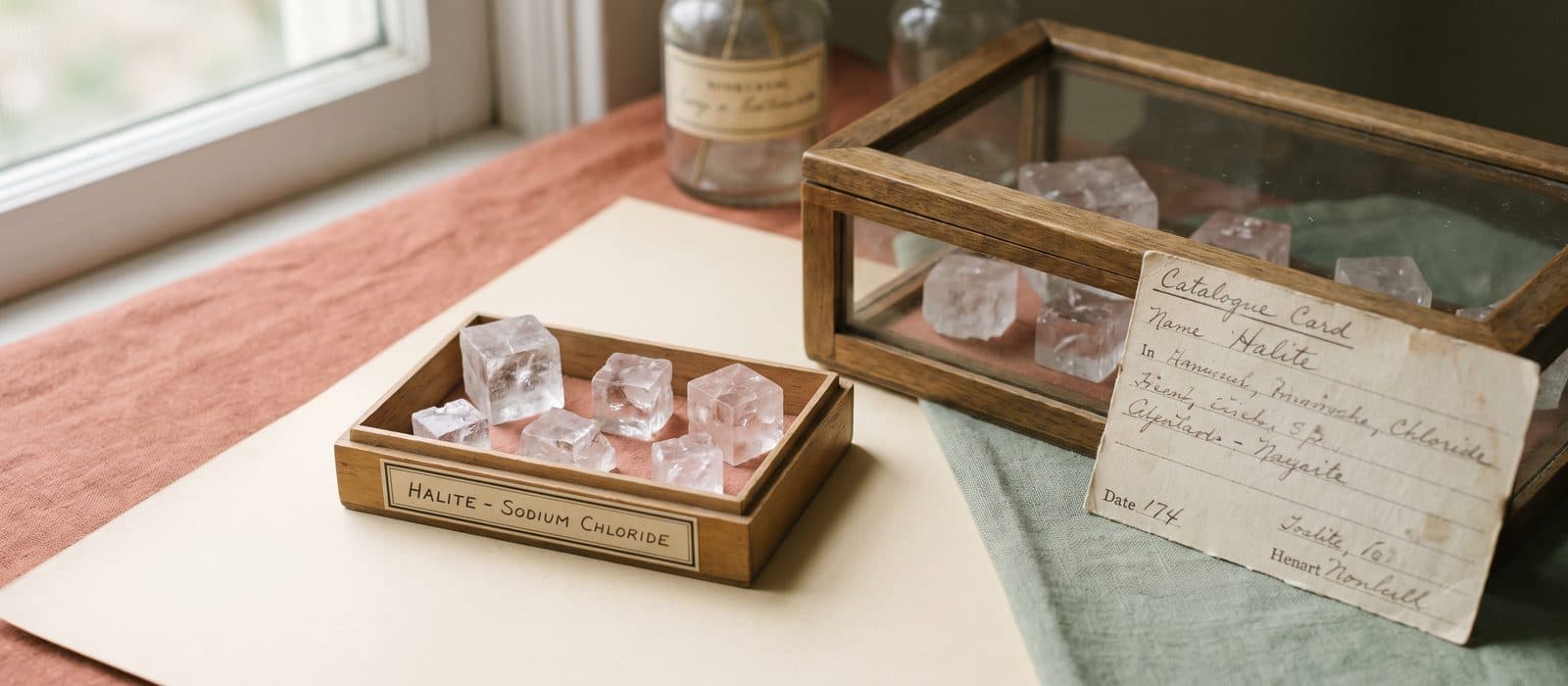
Natrum muriaticum is prepared from sodium chloride (NaCl), the compound that makes up table salt, rock salt and most of the salt in seawater. The name is old pharmacy Latin: natrum for sodium (hence the chemical symbol Na) and muriaticum from muria, brine, for the chloride. Homeopathic pharmacies use purified salt rather than kitchen salt, because table salt often contains anti-caking agents and added iodine.
Salt dissolves readily in water, but the tradition still begins with trituration: grinding the salt with milk sugar through the first potency steps before it is carried into liquid and diluted and succussed. Our guide to what is in a homeopathic remedy explains the process.
This remedy puts the tradition's central claim in its plainest form. Everyone eats a few grams of salt a day, far more than any pellet could ever contain, so homeopaths argue that the effect they describe depends on the preparation process, not the substance. Science finds that implausible, and our guide to homeopathy and the evidence sets out why. What this page can say honestly is that the remedy is not a source of salt, and that a craving for salt is not a reason to eat more of it; anyone with high blood pressure or kidney disease should follow their doctor's advice on salt.
Natrum muriaticum is also one of the twelve tissue salts of Wilhelm Schüssler, a German physician who in 1873 proposed a simplified system of mineral salts in low decimal potencies. Most tissue-salt tablets are sold as 6X, and the potencies guide explains what that scale means.
What is the Natrum muriaticum picture?
The Natrum muriaticum picture is the person who carries an old hurt with dignity and does not want to talk about it. Imagine a student in exam season: polite, self-contained, a little formal. A break-up months ago still sits under everything, but she has told no one, and when a friend puts an arm around her she stiffens and changes the subject. She cries in the bathroom with the tap running. After a day of revision at the desk, a hammering headache arrives, as if small hammers were beating inside her head. By evening it has eased, and her lower lip, dry all term, has split again in the middle.
Classic texts describe this person as sensitive, conscientious and easily hurt, but inclined to close up rather than show it. Kent's Lectures (1905) made the dislike of consolation the famous keynote: sympathy makes things worse, not better. The picture dwells on past grief, remembers slights, and prefers to be alone to cry. Homeopaths read this as a state that can follow grief or disappointment, not as a personality type.
The physical picture is just as distinctive. Boericke (1927) describes headaches that come with the sun and ease when it sets, or after eyestrain, a craving for salt, great thirst, cold sores around the mouth, a mapped tongue, and dry, cracked lips with a split in the middle of the lower lip. Fluid seems to collect where it should not: puffy eyelids, swollen ankles.
What makes it better or worse?
The traditional modalities centre on sun, heat and sympathy. Natrum muriaticum is worse from the sun, around 10 a.m. and from consolation, and better in cool open air and when left alone.
| Modality | Worse | Better |
|---|---|---|
| Sun and heat | Sun exposure, heat, warm rooms | Cool open air, a cool wash |
| Time | About 10 a.m.; headaches from sunrise to sunset | Evening, once the sun has gone |
| Emotion | Consolation, sympathy, being fussed over | Being left alone |
| Exertion | Reading, close work, mental effort | Rest in a quiet room |
| Place | The seaside, for many (some are better there) | No consistent keynote |
The response to sympathy is what separates this picture from several of its neighbours; our guide to modalities, better and worse explains why a homeopath reads it before any remedy name.
What is Natrum muriaticum traditionally discussed for?
In homeopathic literature, Natrum muriaticum is traditionally discussed for dry, sun-sensitive, inward states in a reserved person. Each of these appears on one of our acute pages, where the Natrum-muriaticum-like pattern sits beside its neighbours and the red flags come first.
Mouth and lips
- Crops of ulcers that return in stressful seasons: a painful canker sore.
- The classic split in the middle of the lower lip: painfully chapped lips.
Headache
- The hammering headache that follows sustained close work: a headache from eye strain.
- The headache brought on by sun and heat: a dehydration headache.
Fluid and puffiness
- Puffiness with thirst and emotional reserve after heat or exertion: mild leg swelling.
What is Natrum muriaticum not?
Natrum muriaticum is not "the grief remedy", and it is not a headache remedy for anyone with a headache. The commonest misreading is to hear "grief" and reach for the name. The tradition's picture is the combination of held-in emotion, the dislike of consolation, the sun or eyestrain headache, salt craving and dryness; grief without that shape belongs elsewhere, and grief that becomes depression belongs with a doctor or counsellor. It is also not a reason to sit out a sudden, severe or "worst ever" headache, a headache with a stiff neck, fever, confusion or changed vision, a mouth ulcer that lasts more than three weeks, swelling in one leg with pain, warmth or redness, or swelling in both legs with breathlessness. Those are medical questions first.
Homeopaths separate Natrum muriaticum from its neighbours like this:
| Picture | Where it sits | Defining feature | Key modality |
|---|---|---|---|
| Natrum muriaticum | Old grief; sun and eyestrain headaches | Reserved, cries alone; salt craving; cracked lower lip | Worse sun and consolation |
| Ignatia amara | Fresh grief and shock | Sighing, lump in the throat, contradictory moods | Worse consolation; changeable |
| Pulsatilla | Weepy, changeable states | Cries openly and wants comfort; thirstless | Better consolation and open air |
| Glonoin | Sun and heat headaches | Surging, bursting, throbbing head | Worse heat and the sun; worse jarring |
| Apis mellifica | Puffy swelling | Rosy, stinging, waterlogged; thirstless | Better cold; worse heat |
What potencies is Natrum muriaticum sold in?
Natrum muriaticum is sold most often as 30C pellets and as 6X tissue-salt tablets, with 6C and 200C also widely available. Potency describes the preparation process, not an amount of salt: 6X means six successive 1:10 dilutions, and 30C means thirty successive 1:100 dilutions with succussion between them. Our potencies guide explains both scales and what remains in the vial.
This page deliberately gives no frequency or instructions for taking Natrum muriaticum. That depends on a whole case, not a remedy name. Read the product label, and talk to a qualified practitioner about an individual situation.
What remedy lists don't tell you
Two things the short lists leave out:
- What happens when you comfort the person is the deciding question. Two people can be equally sad after a loss. One wants to be held and feels better for it; the other goes rigid and leaves the room. The tradition puts them in different pictures, and our guide to how a homeopath takes a case shows how questions like this are asked without prying.
- The lip crack and the headache are usually one story. Homeopaths connect the dry, split lower lip, the cold sores, the salt craving and the sun headache as parts of a single picture, often in the same person year after year. A list that files them under four different complaints misses the pattern, and a pattern that keeps returning is a question for a practitioner, which our guide to acute and chronic questions explains.
Where the Natrum muriaticum picture appears on this site
Acute pages that discuss this picture among their educational patterns, with the pattern name each page uses.
- What homeopathic remedy for a dehydration headache?Natrum muriaticum-like sun headache pattern
- What homeopathic remedy for a headache from eye strain?Natrum muriaticum-like post-focus hammering pattern
- What homeopathic remedy for a painful canker sore?Natrum muriaticum-like recurrent ulcer pattern
- What homeopathic remedy for mild leg swelling?Natrum muriaticum-like fluid retention pattern
- What homeopathic remedy for painfully chapped lips?Natrum muriaticum-like center-crack pattern
Not sure whether a picture fits?
A remedy profile describes a picture; it cannot tell you whether that picture matches what you are seeing. An acute consultation starts from the case itself: onset, sensations, what changes it, and the red flags.
Acute consultation · $45Frequently asked questions
- What is Natrum muriaticum?
- Natrum muriaticum is a homeopathic remedy prepared from sodium chloride, ordinary salt, ground with milk sugar and then diluted and succussed. In homeopathy it names a traditional picture: a reserved person who keeps grief and hurt inside and dislikes being consoled, with hammering headaches that follow the sun or close work, dry, cracked lips, and a craving for salt. It is a description homeopaths use to compare cases, not a finding that it works for any condition.
- What is Natrum muriaticum used for in homeopathy?
- Homeopathic literature traditionally discusses Natrum muriaticum for hammering headaches after sun or eyestrain, recurrent mouth ulcers and cold sores, dry lips with a crack in the middle of the lower lip, and puffiness in a reserved, thirsty person. The picture is defined by that combination and the emotional reserve, not by the name of a complaint. A sudden, severe headache, a mouth ulcer that lasts more than three weeks, or swelling in one leg needs medical care first.
- What is Natrum muriaticum 30C used for?
- 30C is a common shelf potency of Natrum muriaticum, alongside 6X in the tissue-salt tradition and 6C and 200C. In the tradition the potency does not change the picture; Natrum muriaticum 30C is discussed for the same reserved, sun-sensitive, dry-lipped state as any other potency. What 30C and 6X mean as dilutions is explained in our potencies guide.
- How is Natrum muriaticum taken?
- This page does not give instructions on how or how often to take any remedy, because that depends on a whole case rather than on a remedy name. The product label carries the manufacturer's directions, and a qualified practitioner can advise on an individual situation. A severe or unusual headache, or a mouth ulcer that does not clear, belongs with a clinician first.
- Where can I buy Natrum muriaticum?
- Pharmacies, health-food shops and homeopathic manufacturers sell Natrum muriaticum as single-remedy pellets, most often in 30C, and as a 6X tissue-salt tablet. This site also prepares custom single remedies to order: you name the remedy and potency, and the details are confirmed by email before anything is made. The order form does not give advice on which remedy to choose.
- What is Natrum muriaticum made from?
- Natrum muriaticum is made from sodium chloride, the same compound as table salt, purified and then ground with milk sugar (trituration) before dilution and succussion to the labelled potency. The name is old pharmacy Latin: natrum for sodium and muriaticum for the chloride. Salt itself is a normal part of the diet, and the remedy is not a source of it.
This guide is educational only and is not medical advice or a personalized remedy recommendation. Acute symptoms can become urgent; when in doubt, seek professional evaluation.