Remedy profile
China officinalis in Homeopathy: Uses, Picture and Limits
What homeopathic China officinalis is made from, the drained, bloated, touchy picture homeopaths describe, what changes it, potencies sold, and its limits.
By Homeopathic BenefitsPublished 8 min read
Key takeaways
- China officinalis is the picture of depletion. Classic texts describe weakness, faintness and oversensitivity after losing fluids: diarrhoea, sweating, bleeding or a long draining illness.
- Its bloating is whole-belly and stubborn. The abdomen is distended all over, and belching or passing wind gives little or no relief.
- Light touch is worse, hard pressure is better. The person flinches at a brush of the skin or a draught, yet presses firmly on the painful part.
- It is the bark that started homeopathy. Hahnemann's 1790 experiment with cinchona bark is the founding story of the method; the bark is also the source of quinine.
- Depletion has red flags first. Signs of dehydration, blood loss, fainting, a fever after travel to a malaria area, or a sudden change in hearing need medical care before any pattern discussion.
The short answer
China officinalis is a homeopathic remedy prepared from the dried bark of the cinchona tree, the "Peruvian bark" of South America and the natural source of quinine. In homeopathy it names a traditional picture rather than a treatment: a person drained by the loss of body fluids, weak and faint, with a belly bloated all over that passing wind does little to relieve, and nerves so raw that a light touch or a draught is unbearable. It holds a special place in the tradition because Samuel Hahnemann's experiment with cinchona bark in 1790 is the origin of homeopathy itself. It is not a remedy for malaria, dehydration or blood loss, and nothing about the picture replaces medical care for any of them.
| Latin name | China officinalis |
|---|---|
| Abbreviation | Chin. |
| Common name | Peruvian bark, Jesuits' bark, cinchona |
| Source | Dried bark of the cinchona tree, Cinchona officinalis (Rubiaceae) (plant kingdom) |
| Commonly sold potencies | 6C, 30C, 200C |
| First proving | Hahnemann's self-experiment with cinchona bark (1790); proving published in Materia Medica Pura (1811–1821) |
What is China officinalis made from?
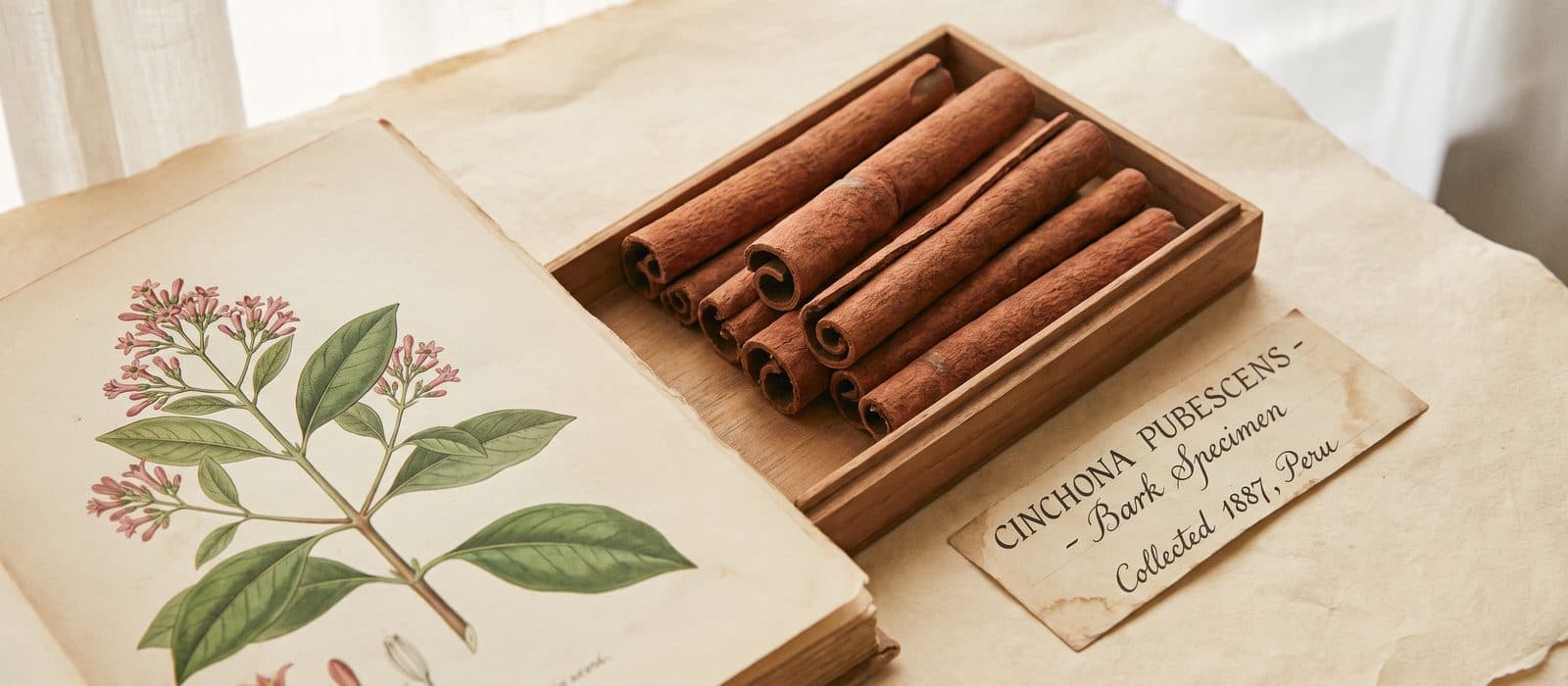
Homeopathic China officinalis is prepared from the dried bark of Cinchona officinalis, an evergreen tree of the coffee family (Rubiaceae) native to the cloud forests of the Andes in Peru, Ecuador and Bolivia. Several cinchona species have been used for the bark; the homeopathic labels name officinalis, "of the apothecary", and most simply abbreviate it to China, from quina, a native name for the bark. Its older English names, Peruvian bark and Jesuits' bark, record how it reached Europe in the seventeenth century through Jesuit missionaries, where it became the first effective medicine for the intermittent fevers we now call malaria.
The bark's active alkaloids, quinine above all, were isolated in 1820, and quinine is still a conventional medicine. That is why the raw bark is not something to brew at home: quinine at medicinal strength causes a well-described set of side effects called cinchonism, including ringing in the ears, headache, nausea and blurred vision, and it can be seriously harmful in excess. The homeopathic preparation steeps the bark into a tincture and then dilutes and succusses it to the potency on the label. At the common potencies the arithmetic says no molecule of the bark remains; our potencies guide explains what that means and why it is also the reason science is sceptical.
The bark matters to homeopathy for another reason. In 1790, while translating William Cullen's Treatise of the Materia Medica, Hahnemann disagreed with Cullen's explanation of why the bark worked on fevers and tried the bark on himself to find out. He reported developing symptoms resembling the intermittent fever the bark was used for. That observation became the principle of similars, the idea on which every later proving rests. Our short history of homeopathy tells the story in more detail.
What is the China officinalis picture?
The China officinalis picture is the person who has lost too much and has nothing left. Imagine someone on the third day after a stomach bug: the diarrhoea has stopped, but they are grey, shaky and sweating at the least effort, their ears are ringing, their head throbs when they stand up, and the belly is blown up like a drum. A door closing or a hand brushing their arm makes them start. Boericke (1927) puts the cause at the head of his entry: debility from exhausting discharges and the loss of vital fluids.
The digestive side is the most recognisable part. The whole abdomen is distended, not just the upper or the lower part, and the classic texts stress that belching or passing wind brings little or no relief. Fruit, milk and tea are described as disagreeing; food lies heavily; there may be loose, painless stools with much wind, followed by more weakness. The bloating and the exhaustion feed each other.
Sensitivity runs through the whole picture. The skin is so touchy that the lightest contact, a draught on the neck or the brush of a sheet, is felt as an aggravation, yet hard, firm pressure on a painful part is a relief. The head throbs with the pulse and is sensitive to the touch of a comb. The ears ring or roar. In the mind, Kent and others describe a person who is apathetic and low by day but whose head fills with plans and schemes at night, so that sleep will not come. Classic texts also give China a marked periodicity: complaints that return at the same hour, or every other day, a detail that echoes the intermittent fevers of its history.
What makes it better or worse?
The traditional modalities centre on depletion, touch and draughts. China officinalis is worse from loss of fluids, light touch and cold air, and better from hard pressure, warmth and loosening tight clothing.
| Modality | Worse | Better |
|---|---|---|
| Cause | Loss of fluids: diarrhoea, sweating, bleeding | Rest and recovering strength |
| Touch | The lightest touch, brushing the skin | Hard, firm pressure on the painful part |
| Air | Draughts, cold air, the open air | Warmth |
| Food | Fruit, milk, tea, eating late | No consistent keynote |
| Time | At night; complaints returning at the same hour or every other day | No consistent keynote |
| Abdomen | Tight clothing, a full meal | Loosening clothing, bending double |
The pairing of "worse light touch, better hard pressure" is one of the modalities homeopaths treasure because so few pictures have it; our guide to modalities, better and worse explains why details like this outweigh the name of a complaint.
What is China officinalis traditionally discussed for?
In homeopathic literature, China officinalis is traditionally discussed for states of depletion and the bloated, oversensitive weakness that follows them. Each of these appears on one of our acute pages, where the China-like pattern sits beside its neighbours and the red flags come first.
Digestion and bloating
- Whole-belly fermentative bloating that passing wind barely touches: bloating after eating and gas pains with bloating.
After fluid loss
- The drained, gassy weakness that can follow a bad gut upset: suspected food poisoning.
- A headache with weakness and dizziness after losing fluids: a dehydration headache. Rehydration and the red flags on that page come before any pattern.
Ears
- Ringing that surfaces during exhaustion and depletion, after illness or a draining stretch: ringing in the ears after stress.
What is China officinalis not?
China officinalis is not "the dehydration remedy", and it is not a homeopathic form of quinine. The commonest misreading is to read the history as a promise: because cinchona bark gave the world quinine, a homeopathic China must do something for fevers. It does not follow, and homeopathic China is not a substitute for antimalarial medicine. Any fever after travel to a malaria area is a medical emergency, even weeks after returning. The picture is also no reason to sit out the states it describes. Weakness after heavy fluid loss can mean dehydration that needs fluids and a clinician: very little urine, dizziness on standing, confusion, or a baby or older person who is drowsy or not drinking all need prompt care. Blood in vomit or stool, fainting, black stools, or bloating with weight loss or persistent change in bowel habit belong with a doctor. Sudden hearing loss or ringing in one ear only needs urgent assessment. Our guide to red flags first sets these out.
Homeopaths separate China officinalis from its neighbours like this:
| Picture | Where it sits | Defining feature | Key modality |
|---|---|---|---|
| China officinalis | Depletion after fluid loss | Whole-belly bloating not relieved by wind; oversensitive to light touch | Worse light touch and draughts; better hard pressure |
| Carbo vegetabilis | Upper-abdominal gas, faintness | Sluggish, cold, wants air; belching gives relief | Better being fanned and belching |
| Lycopodium | Lower-abdominal bloating | Full after a few mouthfuls; anticipatory insecurity | Worse 4–8 p.m.; better warm drinks |
| Phosphoricum acidum | Exhaustion after loss | The mind goes flat first; apathy before physical weakness | Worse exertion and being talked to; better a short sleep |
| Veratrum album | Acute, profuse fluid loss | Collapse with icy cold sweat on the forehead | Worse exertion; better warmth and lying down |
China and Phosphoricum acidum are both "after loss" pictures. The traditional distinction is the order of events: in China the body is drained first and the nerves follow; in Phosphoricum acidum the mind goes flat and indifferent before the body gives way.
What potencies is China officinalis sold in?
China officinalis is sold most often as 30C pellets, the common shelf potency for single remedies, with 6C also widely available and 200C from specialist pharmacies. Labels may read China, China officinalis or Cinchona officinalis; they describe the same remedy. Potency describes the preparation process, not an amount of bark: 30C means thirty successive 1:100 dilutions with succussion between them. Our potencies guide explains the scale and what remains in the vial.
This page deliberately gives no frequency or instructions for taking China officinalis. That depends on a whole case, not a remedy name. Read the product label, and talk to a qualified practitioner about an individual situation.
What remedy lists don't tell you
Two things the "remedies for bloating" lists leave out:
- The cause is part of the picture. Classic texts did not describe China as bloating on its own; they described bloating and oversensitivity in someone who has been drained. A bloated, comfortable, well-rested person after a heavy meal sits closer to other pictures. Asking "what has this person lost recently?" is the question that separates China from its neighbours.
- Where the gas sits, and whether wind helps, matters. Homeopaths separate the digestive pictures by geography and relief: upper belly eased by belching, lower belly with late-afternoon fullness, or the whole belly with no relief from either. A list that says "gas and bloating" puts all three under one heading and loses the distinction the tradition relies on.
Where the China officinalis picture appears on this site
Acute pages that discuss this picture among their educational patterns, with the pattern name each page uses.
- What homeopathic remedy for a dehydration headache?China officinalis-like drained headache pattern
- What homeopathic remedy for bloating after eating?China officinalis-like fermentative gas pattern
- What homeopathic remedy for gas pains with bloating?China officinalis-like unrelieved fermentation pattern
- What homeopathic remedy for ringing in the ears after stress?China-like depletion ringing pattern
- What homeopathic remedy for suspected food poisoning?China officinalis-like drained, gassy weakness pattern
Not sure whether a picture fits?
A remedy profile describes a picture; it cannot tell you whether that picture matches what you are seeing. An acute consultation starts from the case itself: onset, sensations, what changes it, and the red flags.
Acute consultation · $45Frequently asked questions
- What is China officinalis?
- China officinalis is a homeopathic remedy prepared from the bark of the cinchona tree, the South American 'Peruvian bark' that is also the natural source of quinine. In homeopathy it names a traditional picture: the person left weak, bloated and oversensitive after losing fluids, through diarrhoea, sweating or bleeding. It is a description homeopaths use to compare cases, not evidence that it works for any condition.
- What is China officinalis used for in homeopathy?
- Homeopathic literature traditionally discusses China officinalis for states of depletion: weakness after fluid loss, a whole-belly bloating that passing wind does little to ease, a headache or ringing in the ears in a drained person, and oversensitivity to the lightest touch. The picture is defined by the exhaustion and its cause rather than by the name of a complaint. Signs of dehydration, blood loss, or a fever after travel to a malaria area need medical care first.
- What is China officinalis 30C used for?
- 30C is the common shelf potency of China officinalis, the one most single-remedy tubes carry, with 6C also widely sold. In the tradition the potency does not change the picture; China 30C is discussed for the same drained, bloated, oversensitive state as any other potency. Our potencies guide explains what 30C means as a dilution.
- How is China officinalis taken?
- This page does not give instructions on how or how often to take any remedy, because that depends on a whole case rather than on a remedy name. The product label carries the manufacturer's directions, and a qualified practitioner can advise on an individual situation. Weakness after heavy fluid or blood loss is a medical question before it is a homeopathic one.
- Where can I buy China officinalis?
- Pharmacies, health-food shops and homeopathic manufacturers sell China officinalis as single-remedy pellets, most often in 30C, sometimes labelled simply 'China' or 'Cinchona officinalis'. This site also prepares custom single remedies to order: you name the remedy and potency, and the details are confirmed by email before anything is made. The order form does not give advice on which remedy to choose.
- What is China officinalis made from?
- Homeopathic China officinalis is prepared from the dried bark of the cinchona tree, steeped into a tincture and then diluted and succussed step by step to the labelled potency. The raw bark contains quinine and related alkaloids, which are real medicines with real side effects; it is not something to brew or take at home, and homeopathic China is not a substitute for antimalarial medicine.
This guide is educational only and is not medical advice or a personalized remedy recommendation. Acute symptoms can become urgent; when in doubt, seek professional evaluation.