Remedy profile
Chininum sulphuricum in Homeopathy: Uses, Picture and Limits
What homeopathic Chininum sulphuricum is made from, the ringing, roaring, periodic picture homeopaths describe, what changes it, potencies sold, and its limits.
By Homeopathic BenefitsPublished 7 min read
Key takeaways
- Chininum sulphuricum is the older literature's tinnitus picture. Homeopathic texts describe loud ringing, buzzing and roaring in the ears as the main complaint, sometimes with dulled hearing and dizziness.
- It mirrors what quinine does. Quinine in large amounts causes ringing ears, deafness, headache and dizziness, a poisoning pattern doctors call cinchonism; the homeopathic picture follows it closely.
- Periodicity is its second keynote. Classic texts describe complaints that return at the same hour, and a spine tender to the lightest touch.
- It is not China. China officinalis is the whole cinchona bark and has its own, broader picture of depletion; Chininum sulphuricum is one purified salt of it.
- Ear red flags come first. Sudden hearing loss, ringing in one ear only, ringing that pulses with the heartbeat, or ear noise with vertigo plus weakness, numbness, slurred speech or severe headache is a medical question before any pattern discussion, and sudden hearing loss is urgent.
The short answer
Chininum sulphuricum is a homeopathic remedy prepared from quinine sulphate, the salt of the main alkaloid in cinchona bark, triturated with milk sugar and then diluted and succussed to the labelled potency. In homeopathy it names a traditional picture rather than a treatment: violent ringing, buzzing and roaring in the ears, often with dulled hearing and dizziness, in a person whose complaints come back at regular intervals and whose spine is sore to touch. The picture closely mirrors the effects of quinine in large amounts, recorded in nineteenth-century provings and poisoning cases collected in Allen's Encyclopedia. Boericke (1927) leads his ear section with the ringing and roaring. It is not a tinnitus remedy, and nothing about the picture replaces medical assessment of new ear noise or a change in hearing.
| Latin name | Chininum sulphuricum |
|---|---|
| Abbreviation | Chin-s. |
| Common name | Quinine sulphate |
| Source | Quinine sulphate, the sulphate salt of the main alkaloid of cinchona bark, triturated and potentised (mineral kingdom) |
| Commonly sold potencies | 6C, 30C |
| First proving | Provings and quinine poisoning records of the nineteenth century, collected in Allen's Encyclopedia of Pure Materia Medica (1874–1879) |
What is Chininum sulphuricum made from?
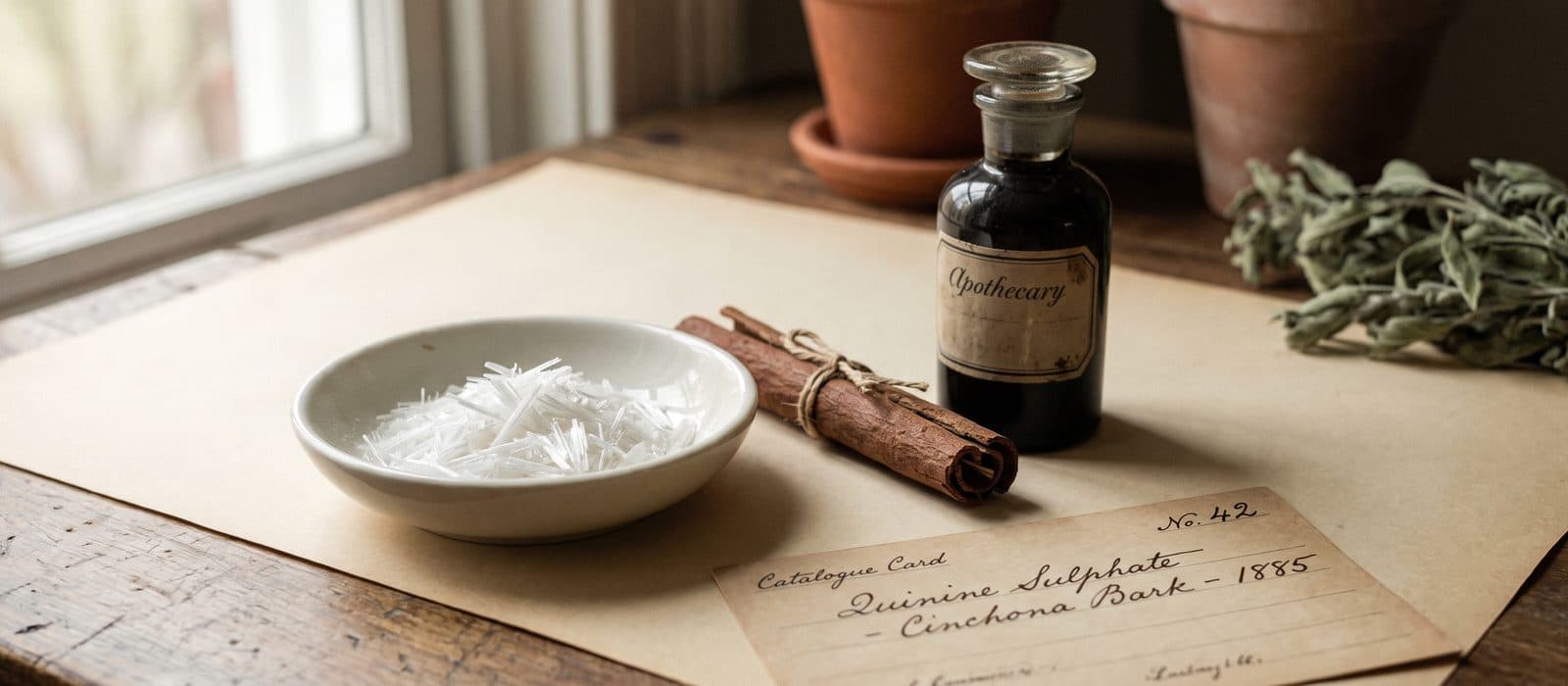
Chininum sulphuricum is prepared from quinine sulphate, a white, bitter, crystalline salt. Quinine is the main alkaloid in the bark of the cinchona trees of the Andes, the "Peruvian bark" that Europeans learned of in the seventeenth century as a medicine for intermittent fevers. French chemists Pelletier and Caventou isolated quinine from the bark in 1820, and the sulphate salt quickly became one of the most widely used medicines of the century, above all for malaria.
The relationship with China officinalis matters here. Homeopathy's founding story is Hahnemann's 1790 experiment with cinchona bark, recorded under the name China; China officinalis is that whole-bark remedy and has its own profile. Chininum sulphuricum is a single purified salt from the bark, proved and recorded separately, and its picture is narrower. Labels and acute pages that say "China" mean the bark, not this salt. Our guide to a short history of homeopathy tells the cinchona story.
Quinine is a real medicine with real hazards. In medicinal amounts it causes cinchonism: ringing ears, hearing loss, headache, nausea, blurred vision and dizziness. It can also cause dangerous drops in blood platelets and other serious reactions, which is why the US FDA has warned against using quinine for night-time leg cramps. It is never something to self-prescribe, and the small amount in tonic water is a separate matter. The homeopathic preparation triturates and dilutes the salt far past the point where any is expected to remain; our potencies guide explains that honestly, including why it is also the reason mainstream science is sceptical.
What is the Chininum sulphuricum picture?
The Chininum sulphuricum picture is the person for whom the noise in the ears is the illness. Imagine someone at the end of a hard week who lies down and finds that the faint hum they usually ignore has become a roar: ringing, buzzing, the rush of a waterfall or a kettle, loud enough to drown conversation and keep them awake. Voices sound muffled or far away; standing up quickly brings a swaying dizziness. They are exhausted, oversensitive and irritable, and the noise is worst when the room goes quiet.
Classic texts, gathered by Allen and condensed by Boericke (1927), draw the picture closely from quinine poisoning: violent ringing and roaring with deafness, vertigo with the noise, headache, and a weak, chilly, washed-out state. Boericke also places it among remedies discussed for Ménière's-type attacks of vertigo with ear noise, a historical use that today belongs firmly with an ear specialist.
The second strand is periodicity. Because quinine was the fever-bark medicine, the old writers recorded complaints that returned with clockwork regularity, chills, neuralgia or headache arriving at the same hour each day. They also describe the spine, especially the upper back, as so sensitive that light touch along the vertebrae is painful. These details rarely appear in modern summaries, but they are what the older texts used to tell the remedy from its neighbours.
What makes it better or worse?
The traditional modalities centre on touch, quiet and time. Chininum sulphuricum is worse from touch and at regular recurring hours, and the ear noise is worse in quiet surroundings.
| Modality | Worse | Better |
|---|---|---|
| Time | The same hour each day; periodic return | Between attacks |
| Touch | Light touch, especially along the spine | Firm pressure (in some older texts) |
| Surroundings | Quiet rooms, lying down at night, for the ear noise | Background sound |
| Position | Rising quickly, for the dizziness | Keeping still |
| State | Exhaustion, loss of fluids | Rest |
The modalities here are thinner and less consistent across the old texts than for the major remedies; our guide to modalities, better and worse explains how homeopaths read them.
What is Chininum sulphuricum traditionally discussed for?
In homeopathic literature, Chininum sulphuricum is traditionally discussed for prominent ear noise as the complaint itself. It appears on one of our acute pages, where the Chininum sulphuricum-like pattern sits beside its neighbours and the red flags come first.
Ears and hearing
- Prominent ringing and roaring with shifts in hearing sensitivity, after a stressful stretch: ringing in the ears after stress. On that page the China-like depletion pattern sits alongside it, which is the clearest place to see the two pictures side by side.
Where the old texts take it further
- Classic materia medica also describes vertigo with ear noise and periodic complaints. Our acute pages do not discuss Chininum sulphuricum for those; a spinning vertigo episode has its own neighbours and its own red flags.
What is Chininum sulphuricum not?
Chininum sulphuricum is not a tinnitus remedy, and it is not China. The commonest misreading is to count any ringing in the ears as a match; the tradition's picture is loud, roaring noise as the main complaint, with dulled hearing, dizziness, exhaustion and the periodic, touch-sensitive features. Most tinnitus is better served by a hearing assessment than by a remedy name. Sudden loss of hearing in one or both ears is an emergency because treatment within days matters. Ringing in one ear only, ringing that pulses in time with the heartbeat, ear noise after a head injury, or vertigo with weakness, numbness, double vision, slurred speech or a severe headache also need prompt medical care. Anyone on prescribed quinine or other medicines who develops ringing ears should tell their prescriber.
Homeopaths separate Chininum sulphuricum from its neighbours like this:
| Picture | Where it sits | Defining feature | Key modality |
|---|---|---|---|
| Chininum sulphuricum | Loud ear noise as the complaint | Violent ringing and roaring; dulled hearing; tender spine | Worse touch and at a recurring hour |
| China officinalis | Depletion after loss of fluids | Ringing with weakness, bloating, oversensitivity | Worse light touch; better firm pressure |
| Coffea cruda | Overstimulation, wired states | Every sense heightened; racing mind; sleepless | Worse noise and excitement; better warmth |
| Cocculus | Vertigo with exhaustion | Hollow, dizzy, nauseated after lost sleep or travel | Worse motion and sleep loss |
What potencies is Chininum sulphuricum sold in?
Chininum sulphuricum is sold as 6C and 30C pellets by homeopathic manufacturers, with other potencies made to order. It is a specialist remedy: general pharmacies rarely stock it and it is not part of standard home kits. Potency describes the preparation process, not an amount of quinine: 30C means thirty successive 1:100 dilutions with succussion between them. Our potencies guide explains the scale and what remains in the vial.
This page deliberately gives no frequency or instructions for taking Chininum sulphuricum. That depends on a whole case, not a remedy name. Read the product label, and talk to a qualified practitioner about an individual situation.
What remedy lists don't tell you
Two things the short lists leave out:
- The picture is a poisoning record, and the poisoning still happens. Much of what the old texts say about Chininum sulphuricum comes from people who took large amounts of quinine for malaria and lost their hearing to it. That is the logic of a proving, but it is also a reminder that tinnitus can be caused by medicines, including quinine and some antibiotics, diuretics and large amounts of aspirin. A medication review belongs at the start of any tinnitus conversation; our guide to homeopathy alongside conventional care explains how the two fit together.
- The bark and the salt are easily muddled. "China", "Cinchona", "Chininum" and "quinine" all appear in older books, sometimes interchangeably. Homeopaths keep them separate because the whole bark and the purified salt were proved separately and produced different pictures. Our guide to reading Latin remedy names explains how to tell which one a label means.
Where the Chininum sulphuricum picture appears on this site
Acute pages that discuss this picture among their educational patterns, with the pattern name each page uses.
- What homeopathic remedy for ringing in the ears after stress?Chininum sulphuricum-like ringing-roaring pattern
Not sure whether a picture fits?
A remedy profile describes a picture; it cannot tell you whether that picture matches what you are seeing. An acute consultation starts from the case itself: onset, sensations, what changes it, and the red flags.
Acute consultation · $45Frequently asked questions
- What is Chininum sulphuricum?
- Chininum sulphuricum is a homeopathic remedy prepared from quinine sulphate, the salt of the alkaloid extracted from cinchona bark. In homeopathy it names a traditional picture centred on the ears: loud ringing, buzzing and roaring, sometimes with dulled hearing and dizziness, along with complaints that return at regular intervals and a spine that is tender to touch. It is a description homeopaths use to compare cases, not evidence that it works for any condition.
- What is Chininum sulphuricum used for in homeopathy?
- Homeopathic literature traditionally discusses Chininum sulphuricum for prominent ringing and roaring in the ears as the main complaint, for dizziness with ear noises, and for complaints that come back at the same hour. The picture mirrors what large amounts of quinine do to hearing. Sudden hearing loss, ringing in one ear only, ringing that pulses with the heartbeat, or ear noise with weakness, facial drooping or severe headache needs medical care first.
- What is Chininum sulphuricum 30C used for?
- 30C is one of the potencies Chininum sulphuricum is sold in, alongside 6C, though it is a specialist remedy that is usually ordered from a homeopathic pharmacy rather than bought off the shelf. In the tradition, the potency does not change the picture; 30C is discussed for the same ringing, roaring, periodic picture as any other potency. What 30C means as a dilution is explained in our potencies guide.
- How is Chininum sulphuricum taken?
- This page does not give instructions on how or how often to take any remedy, because that depends on a whole case rather than on a remedy name. The product label carries the manufacturer's directions, and a qualified practitioner can advise on an individual situation. New tinnitus, and especially any sudden change in hearing, belongs with a clinician first.
- Where can I buy Chininum sulphuricum?
- Homeopathic pharmacies and manufacturers sell Chininum sulphuricum as single-remedy pellets, usually in 6C or 30C; it is rarely found on general shelves or in home kits. This site also prepares custom single remedies to order: you name the remedy and potency, and the details are confirmed by email before anything is made. The order form does not give advice on which remedy to choose.
- What is Chininum sulphuricum made from?
- Chininum sulphuricum is made from quinine sulphate, a white crystalline salt of quinine, the alkaloid extracted from the bark of South American cinchona trees. It is ground with milk sugar (trituration) through the first potency steps, then diluted and succussed to the labelled potency. Quinine in medicinal amounts can cause ringing ears, deafness and serious blood reactions, so it is never something to self-prescribe; potentised preparations are diluted far past the point where any remains.
This guide is educational only and is not medical advice or a personalized remedy recommendation. Acute symptoms can become urgent; when in doubt, seek professional evaluation.