Remedy profile
Podophyllum peltatum in Homeopathy: Uses, Picture and Limits
What homeopathic Podophyllum is made from, the gushing, early-morning, exhausting picture homeopaths describe, what changes it, potencies sold, and its limits.
By Homeopathic BenefitsPublished 8 min read
Key takeaways
- Podophyllum is the picture of gushing, early-morning diarrhoea. Classic texts describe profuse, watery, offensive stools that come out with force, often driving the person out of bed around dawn.
- Gurgling before, emptiness after. Loud rumbling and cramping precede the stool; a weak, sinking, empty feeling in the abdomen follows it.
- It comes from the May apple. The root and its resin are seriously poisonous and violently purgative; potentised preparations are diluted far past the point where the root is a concern.
- The old texts tie it to heat and teething. Hot weather and teething children appear repeatedly in the classic descriptions.
- Diarrhoea is a fluids question first. Blood or black stool, signs of dehydration, a high fever, severe abdominal pain, or diarrhoea in a baby or frail older person needs medical care before anything else.
The short answer
Podophyllum peltatum is a homeopathic remedy prepared from the root of the May apple, a woodland plant of eastern North America whose root and resin are a powerful, poisonous purgative. In homeopathy it names a traditional picture rather than a treatment: sudden, profuse, gushing, offensive diarrhoea, worst in the early morning, preceded by gurgling and cramping and followed by a weak, empty, exhausted feeling. Classic materia medica describes the same picture in hot weather and in teething children, and adds a tendency for diarrhoea to alternate with constipation or with headache. It was proved in nineteenth-century American homeopathy and is recorded in Hering and Allen. It is not a general diarrhoea remedy, and the first priorities with diarrhoea are fluids and the red flags.
| Latin name | Podophyllum peltatum |
|---|---|
| Abbreviation | Podo. |
| Common name | May apple, American mandrake |
| Source | Fresh root and rhizome of the May apple, Podophyllum peltatum (Berberidaceae) (plant kingdom) |
| Commonly sold potencies | 6C, 30C, 200C |
| First proving | Proved in nineteenth-century American homeopathy; recorded in Hering's Guiding Symptoms and Allen's Encyclopedia (1874–1879) |
What is Podophyllum made from?
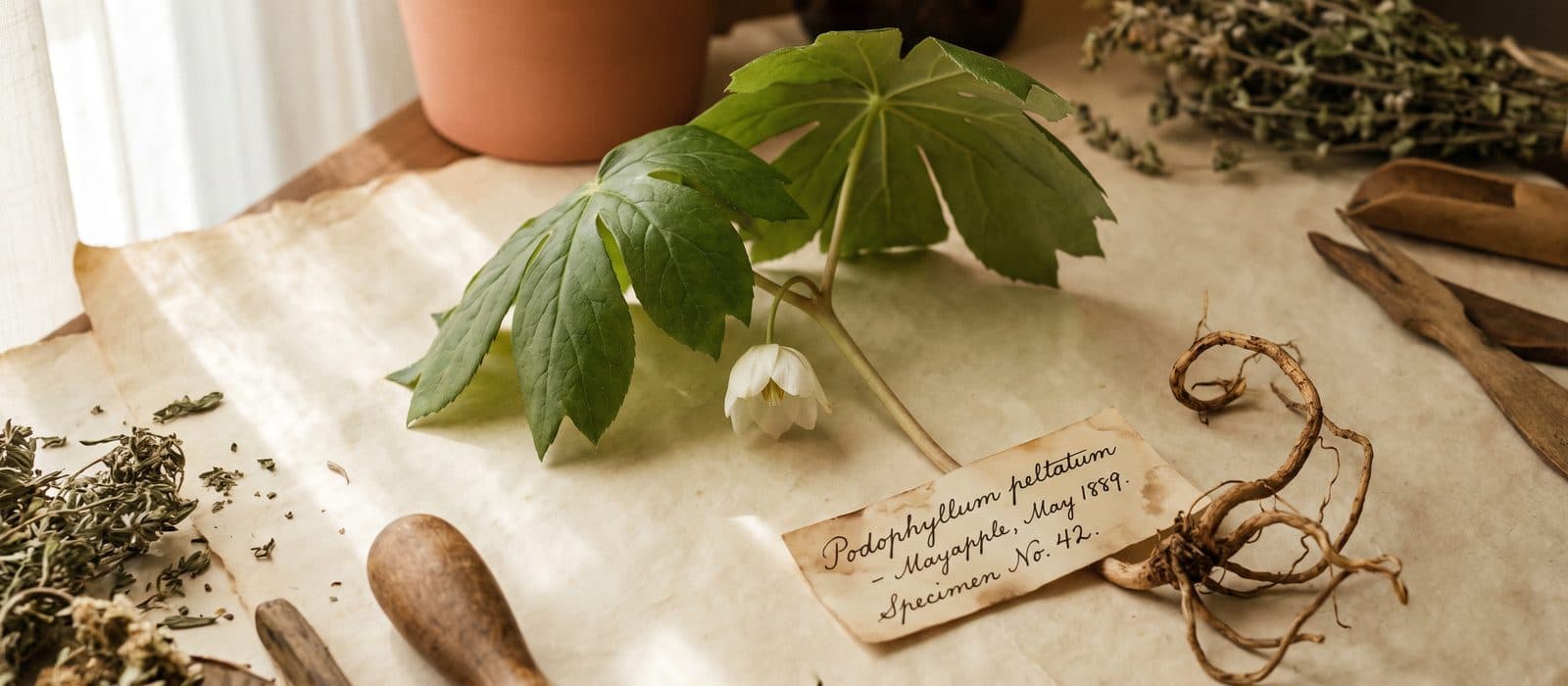
Homeopathic Podophyllum is prepared from the fresh root and rhizome of the May apple, Podophyllum peltatum, a perennial of the barberry family (Berberidaceae) that carpets the floor of moist deciduous woodland in eastern North America. Each plant raises one or two large, deeply lobed, umbrella-like leaves on a single stalk, which is what peltatum, "shield-shaped", refers to. A single waxy white flower hangs beneath the leaves in spring, followed by a yellowish fruit in late summer. The name American mandrake is a borrowing; it is unrelated to the European mandrake.
The source needs to be stated plainly. The rhizome, leaves and unripe fruit are poisonous. The root yields a resin called podophyllin, which Indigenous peoples and later American physicians used as a drastic purgative and which causes violent diarrhoea, vomiting and, in poisoning, nerve damage, collapse and death. Purified podophyllotoxin from the resin is used today in conventional prescription products applied to the skin, and semi-synthetic derivatives are used in chemotherapy, which shows how potent the plant is. The raw root, the resin and the plant are never something to eat, brew or prepare at home.
The homeopathic preparation steeps the fresh root in alcohol to make a mother tincture, then dilutes and succusses it step by step to the potency on the label. At the common potencies the arithmetic says no molecule of the root remains. Our potencies guide explains that honestly, including why it is also the reason mainstream science is sceptical. As with other poisonous sources, the overlap between what the raw plant does and the homeopathic picture is the idea behind a proving: the purgative root is traditionally discussed for gushing diarrhoea. Our guide to reading Latin remedy names explains why names like this appear on labels.
What is the Podophyllum picture?
The Podophyllum picture is the bowel that empties like a tap. Imagine someone woken just before dawn by loud gurgling and rumbling in the belly, cramping that sends them hurrying to the bathroom, and a sudden, gushing, watery stool that pours out with force and smells bad. They go back to bed and it happens again an hour later, and again after breakfast. By mid-morning they feel completely drained, with an empty, sinking, weak feeling in the abdomen, as if everything had been washed out of them. By the afternoon and evening it may have quietened, only to begin again the next morning.
Classic texts make the force and the timing the keynotes. Boericke (1927) describes profuse, painless or gurgling, watery, offensive stools that gush out, worse in the early morning, in hot weather and during teething, and followed by great weakness and a sinking sensation in the abdomen. Hering's Guiding Symptoms records the same picture in children: the hot, teething infant with frequent green, watery, gushing stools. The literature also notes rectal prolapse with the stool, which in a child is a reason to see a doctor.
There are other strands. The old authors describe alternation: diarrhoea alternating with constipation, or with headache, so that one eases as the other arrives. They also describe a liver strand, with fullness and soreness under the right ribs, which reflects the nineteenth-century use of podophyllin as a "liver" purgative. The mental side is thin; the materia medica records low spirits and a person who is talkative or moaning in sleep, but the picture is read mainly through the bowel and the exhaustion.
What makes it better or worse?
The traditional modalities centre on time of day, heat and teething. Podophyllum is worse in the early morning and in hot weather, and the old texts record relief from lying on the abdomen.
| Modality | Worse | Better |
|---|---|---|
| Time | Early morning, from before dawn into the forenoon | Afternoon and evening |
| Weather | Hot weather, summer | Cooler weather |
| Life stage | Teething, in the classic descriptions of children | No consistent keynote |
| Eating and drinking | Eating or drinking, which can set off the next gush | No consistent keynote |
| Position | Moving about | Lying on the abdomen (Boericke) |
The morning timing is the modality most often used to separate Podophyllum from its neighbours. Our guide to modalities, better and worse explains why timing like this is read before any remedy name.
What is Podophyllum traditionally discussed for?
In homeopathic literature, Podophyllum is traditionally discussed for gushing, early-morning diarrhoea with exhaustion. On this site it appears on one acute page, where the Podophyllum-like pattern sits beside its neighbours and the red flags come first.
Sudden diarrhoea
- Gushing, offensive diarrhoea with cramping and weakness: sudden diarrhoea. That page sets the Podophyllum-like pattern beside the anxious, burning Arsenicum album-like and the cold, collapsed Veratrum album-like pictures.
Diarrhoea on the move and in the heat
- The classic texts link the picture to hot weather and changes of routine. Our pages on suspected food poisoning and stomach flu cramps cover neighbouring pictures, and our guide to travel and acute patterns covers diarrhoea away from home.
Teething children
- The old texts' teething diarrhoea. Our page on teething covers other pictures; diarrhoea in a baby is a dehydration risk, and our guide to observing a sick child sets out what to watch.
What is Podophyllum not?
Podophyllum is not "the diarrhoea remedy". Diarrhoea fits many traditional pictures, separated by timing, by what the person is like and by what follows: the anxious, chilly, restless person with burning; the cold, sweating, collapsed one; the drained, bloated one after fluid loss. Podophyllum's description is the forceful gush, the early-morning timing, the gurgling and the empty exhaustion afterwards. Without those features the name is just a label.
It is also not a reason to wait. Diarrhoea becomes dangerous through fluid loss, and replacing fluids comes first. Blood or black, tarry stool, signs of dehydration (very little or dark urine, dizziness on standing, a dry mouth, sunken eyes, or in a baby a dry nappy, no tears or a sunken soft spot), a high fever, severe or constant abdominal pain, diarrhoea lasting more than a couple of days in an adult, or any diarrhoea in a baby, a frail older person or someone with a serious illness needs a clinician. Our guide to red flags first sets out the principle.
Homeopaths separate it from its neighbours like this:
| Picture | Where it sits | Defining feature | Key modality |
|---|---|---|---|
| Podophyllum | Gushing, morning diarrhoea | Profuse, forceful, offensive; gurgling before, empty weakness after | Worse early morning and hot weather |
| Arsenicum album | Food poisoning, anxious exhaustion | Small, burning stools; anxious, restless, chilly; sips of water | Worse after midnight; better warmth |
| Veratrum album | Profuse loss with collapse | Watery, copious stools with cold sweat on the forehead and great weakness | Worse from drinking; wants cold drinks |
| China officinalis | Drained after fluid loss | Painless, exhausting diarrhoea; bloated, gassy, sensitive | Worse after eating fruit and at night |
| Sulphur | Early-morning urgency | Driven out of bed by urgency; hot, itchy, untidy | Worse early morning and from warmth |
Podophyllum and Sulphur share the early-morning timing and are often confused; the traditional distinction is the sheer volume and force of the Podophyllum stool and the emptiness that follows.
What potencies is Podophyllum sold in?
Homeopathic Podophyllum is sold most often as 30C pellets, with 6C and 200C also available. Potency describes the preparation process, not an amount of root: 30C means thirty successive 1:100 dilutions with succussion between them. Our potencies guide explains the scale and what remains in the vial, and why low-potency products of poisonous sources carry their own labelling.
This page deliberately gives no frequency or instructions for taking Podophyllum. That depends on a whole case, not a remedy name. Read the product label, and talk to a qualified practitioner about an individual situation.
What remedy lists don't tell you
Two things the "remedies for diarrhoea" lists leave out:
- The clock is part of the description. Lists sort diarrhoea remedies by cause, food poisoning or travel or a stomach bug, but the classic authors cared far more about when it happened and what it was like. A gush that drives someone out of bed at five in the morning and fades by evening reads very differently from small, burning stools after midnight, even when the cause is the same.
- The red flags matter more with diarrhoea than with most acute complaints. It is the one common acute problem that can turn dangerous within hours in a baby or an older person, simply through fluid loss. A homeopath reading a diarrhoea case starts with fluids, urine output and the warning signs, and only then asks about gurgling or timing; our guide to observing a sick child covers what that looks like in practice.
Where the Podophyllum peltatum picture appears on this site
Acute pages that discuss this picture among their educational patterns, with the pattern name each page uses.
- What homeopathic remedy for sudden diarrhea?Podophyllum-like gushing, cramping pattern
Not sure whether a picture fits?
A remedy profile describes a picture; it cannot tell you whether that picture matches what you are seeing. An acute consultation starts from the case itself: onset, sensations, what changes it, and the red flags.
Acute consultation · $45Frequently asked questions
- What is Podophyllum?
- Podophyllum is a homeopathic remedy prepared from the root of the May apple, Podophyllum peltatum, a woodland plant of eastern North America whose root is a powerful and poisonous purgative. In homeopathy it names a traditional picture: profuse, gushing, offensive diarrhoea, worst in the early morning, with gurgling and cramping beforehand and a weak, empty, exhausted feeling afterwards. It is a description homeopaths use to compare cases, not a finding that it works for diarrhoea or any other condition.
- What is Podophyllum used for in homeopathy?
- Homeopathic literature traditionally discusses Podophyllum for sudden, gushing, watery diarrhoea that drives the person out of bed in the early morning, with rumbling beforehand and great weakness afterwards; the old texts also describe it in children during teething and in hot weather. The picture is defined by the gush, the timing and the exhaustion, not by the name of a complaint. Blood in the stool, signs of dehydration, high fever or severe pain needs medical care first.
- What is Podophyllum 30C used for?
- 30C is a common shelf potency of Podophyllum, alongside 6C and 200C. In the tradition the potency does not change the picture; Podophyllum 30C is discussed for the same gushing, early-morning, exhausting state as any other potency. What 30C means as a dilution is explained in our potencies guide.
- How is Podophyllum taken?
- This page does not give instructions on how or how often to take any remedy, because that depends on a whole case rather than on a remedy name. The product label carries the manufacturer's directions, and a qualified practitioner can advise on an individual situation. With diarrhoea, replacing fluids comes first, and a baby, an older person or anyone showing signs of dehydration needs a clinician.
- Where can I buy Podophyllum?
- Pharmacies, health-food shops and homeopathic manufacturers sell Podophyllum as single-remedy pellets, most often in 30C, and it appears in some home kits. This site also prepares custom single remedies to order: you name the remedy and potency, and the details are confirmed by email before anything is made. The order form does not give advice on which remedy to choose.
- What is Podophyllum made from?
- Homeopathic Podophyllum is prepared from the fresh root and rhizome of the May apple, made into a mother tincture and then diluted and succussed step by step to the labelled potency. The raw root and its resin, podophyllin, are seriously poisonous and strongly purgative, and the plant should never be eaten, brewed or prepared at home. A purified compound from the resin, podophyllotoxin, is used in conventional prescription products applied to the skin.
This guide is educational only and is not medical advice or a personalized remedy recommendation. Acute symptoms can become urgent; when in doubt, seek professional evaluation.