Remedy profile
Spongia tosta in Homeopathy: Uses, Picture and Limits
What homeopathic Spongia tosta is made from, the dry, sawing, croupy cough picture homeopaths describe, what changes it, the potencies sold, and its limits.
By Homeopathic BenefitsPublished 7 min read
Key takeaways
- Spongia is the picture of a dry, sawing cough. Classic texts compare the sound to a saw driven through a pine board: hard, rasping, barking and dry, with very little loosening.
- Dryness runs through it. The larynx, throat and chest feel dry and tight, as if breathing through a sponge, and the person may wake with a sense of suffocation.
- Warm drinks ease it; cold air and talking aggravate it. The cough is traditionally worse before midnight and better from eating or drinking something warm.
- It is made from roasted sea sponge. Sponge is an animal; the old pre-homeopathic use of burnt sponge for goitre came from its iodine.
- Croup has red flags. Noisy breathing at rest, drooling, blue or grey lips, a child who is drowsy or struggling to breathe, or any breathing difficulty in a baby is an emergency.
The short answer
Spongia tosta is a homeopathic remedy prepared from roasted sea sponge. In homeopathy it names a traditional picture rather than a treatment: a dry, hard, barking cough that sounds like a saw going through wood, with dryness and tightness in the larynx and chest, worse before midnight, from cold air and from talking, and eased a little by warm drinks. Classic materia medica places it in the nineteenth-century discussion of croup, between the sudden onset described for Aconite and the loose, rattling stage described for Hepar sulphuris. Hahnemann recorded it in Materia Medica Pura, and Boericke (1927) gave the sawing cough its famous comparison. It is not a substitute for urgent care, and a child struggling to breathe needs emergency help first.
| Latin name | Spongia tosta |
|---|---|
| Abbreviation | Spong. |
| Common name | Roasted sea sponge |
| Source | Roasted sea sponge, Spongia officinalis (Spongiidae) (animal kingdom) |
| Commonly sold potencies | 6C, 30C |
| First proving | Hahnemann, Materia Medica Pura (1811–1821) |
What is Spongia tosta made from?
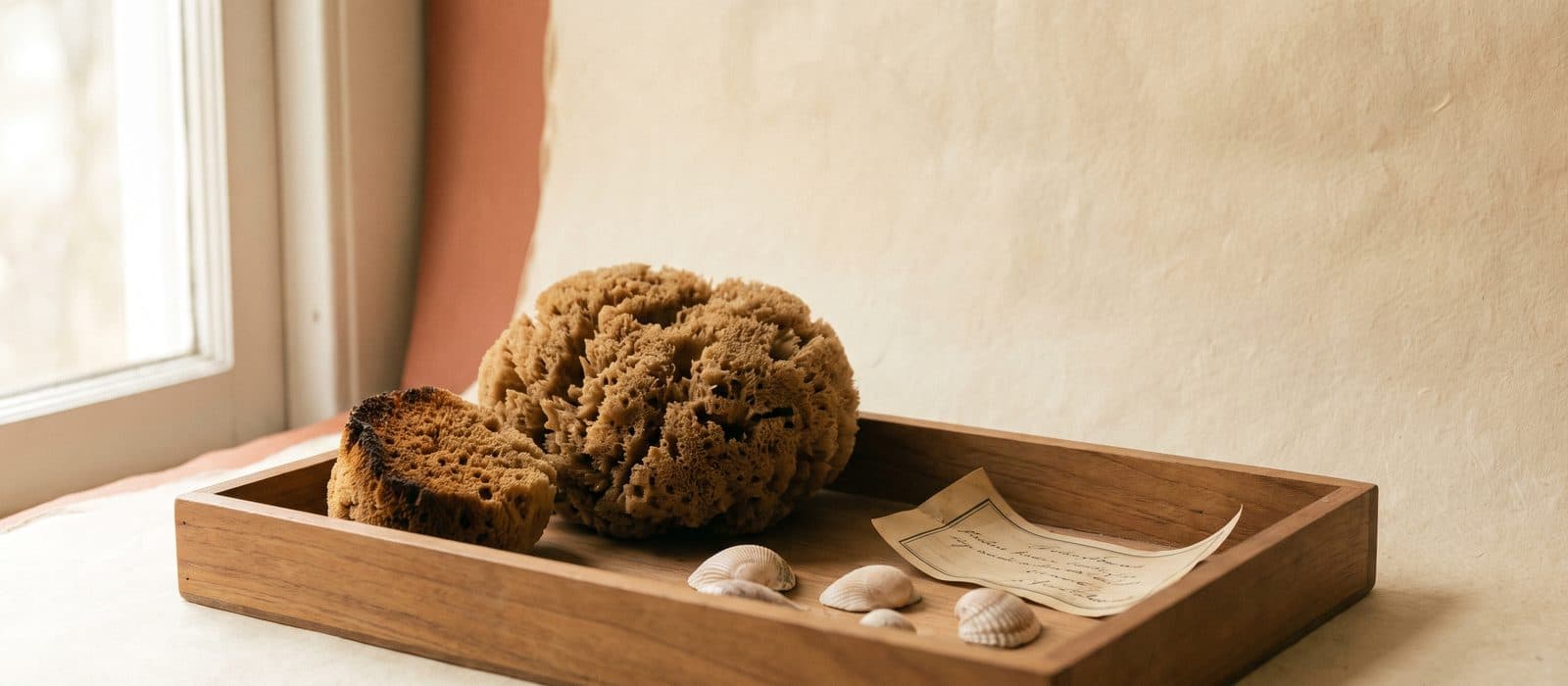
Homeopathic Spongia tosta is prepared from sea sponge, traditionally the bath sponge Spongia officinalis of the Mediterranean. A sponge is an animal: the soft, springy object sold for washing is the skeleton of a simple marine creature that lives fixed to the sea floor and filters seawater for food. Tosta means roasted. The sponge is roasted until it turns brown and brittle, then ground, and the potencies are built from that powder by trituration and then by repeated dilution and succussion. Our guide to reading Latin remedy names explains why labels keep these descriptive Latin names.
Burnt sponge has an older medical history than homeopathy. For centuries it was given for goitre, the swelling of the thyroid gland in the neck, and in the early nineteenth century chemists traced its effect to iodine, which sponges concentrate from seawater. That history is why the classic homeopathic texts also mention the thyroid and the glands of the neck under Spongia.
Roasted sponge is not poisonous in the way nightshade or arsenic is, but it is not a home preparation, and nothing on this page describes making or swallowing it. At the common potencies the arithmetic says no molecule of the sponge remains; our potencies guide explains what that means and why it is also the reason mainstream science is sceptical.
What is the Spongia picture?
The Spongia picture is the child who wakes at eleven at night with a cough like a seal barking. The sound is hard and dry, rasping in and out like a saw, and there is almost nothing to bring up. They sit up, frightened, holding the throat; they say it feels as if they are breathing through a sponge, or as if there is a plug in the larynx. A warm drink settles things for a while. Cold air from an open window, talking, or lying with the head low sets it off again.
Classic texts describe dryness of all the air passages as the heart of the picture. Boericke (1927) gives the comparison that every later book repeats: a cough like a saw driven through a pine board, with the larynx dry, burning and constricted. The cough is worse before midnight and better from eating or drinking, especially warm things. Hoarseness and a sore, dry larynx belong with it, as does a tickle that keeps the dry cough going.
The materia medica pairs the cough with fear. The person wakes with a sense of suffocation and anxiety, sometimes with palpitation, and the older literature notes that waking after midnight with a feeling of being smothered is characteristic. That fear is understandable: a tight, dry, barking cough in the night is frightening for the person and for whoever is listening. It is also exactly the moment to check the breathing before thinking about any remedy picture.
Nineteenth-century homeopaths often described croup as a sequence of three pictures: the sudden, fearful onset after cold dry wind, the dry sawing middle stage, and the loose, rattling, chilly later stage. Spongia was the name given to that middle stage.
What makes it better or worse?
The traditional modalities centre on dryness and warmth. Spongia is worse before midnight, from cold dry air and from talking, and better from warm food and drink.
| Modality | Worse | Better |
|---|---|---|
| Time | Before midnight; on waking from sleep | No consistent keynote |
| Air | Cold, dry wind; dry, dusty air | Warm, moist air |
| Eating and drinking | Cold drinks, sweets (Boericke) | Warm drinks and warm food |
| Voice | Talking, singing, swallowing | Resting the voice |
| Position | Lying with the head low | Sitting up, bending forward |
Warm drinks easing a dry cough is the modality homeopaths look for first here; our guide to modalities, better and worse explains why a small detail like that can carry more weight than the name of the cough.
What is Spongia traditionally discussed for?
In homeopathic literature, Spongia is traditionally discussed for dry, sawing, croupy coughs with a sense of dryness and tightness. Each of these appears on one of our acute pages, where the Spongia-like pattern sits beside its neighbours and the red flags come first.
Dry coughs
- A dry, tickling cough, where the cough is hard, dry and sawing rather than merely ticklish.
- A cough after dust exposure, where dry air and dust leave the larynx feeling rasped and tight.
The classic croup discussion appears in the older texts rather than on our acute pages, because a croupy cough in a young child is a question for a clinician first. Our guides to observing a sick child and the first colds of the school year cover what to watch for.
What is Spongia not?
Spongia is not "the croup remedy", and croup is not a home-remedy situation to wait out. Croup can tighten the airway quickly. Call emergency services for noisy, high-pitched breathing (stridor) when the child is calm and at rest, drooling or difficulty swallowing, blue or grey lips, a child who is pulling in at the ribs or the base of the neck, or a child who is unusually drowsy or floppy. Any breathing difficulty in a baby, a sudden cough after a possible choking episode, or a high fever with a very sore throat belongs with a clinician first. In adults, a dry cough that lasts more than three weeks, coughing blood, or breathlessness also needs medical assessment. Our guide to red flags first sets out why.
Homeopaths separate it from its neighbours like this:
| Picture | Where it sits | Defining feature | Key modality |
|---|---|---|---|
| Spongia tosta | Dry, croupy cough | Hard, sawing, barking; dry, tight larynx | Better warm drinks; worse before midnight |
| Aconite | Sudden onset after cold wind | Abrupt, fearful, restless; hoarse dry cough | Worse at night; after cold dry wind |
| Hepar sulphuris | Later, looser croup | Rattling, loose cough; very chilly and touchy | Worse cold air and uncovering; better warmth |
| Drosera | Spasmodic coughing fits | Fits in rapid succession, tickle in the larynx | Worse after midnight and lying down |
| Phosphorus | Hoarse, tickly cough | Hoarse, raw larynx; thirsty for cold drinks | Worse talking and cold air |
What potencies is Spongia tosta sold in?
Spongia tosta is sold most often as 6C or 30C pellets, usually from homeopathic pharmacies and manufacturers rather than general shops. Potency describes the preparation process, not an amount of sponge: 30C means thirty successive 1:100 dilutions with succussion between them. Our potencies guide explains the scale and what remains in the vial.
This page deliberately gives no frequency or instructions for taking Spongia. That depends on a whole case, not a remedy name. Read the product label, and talk to a qualified practitioner about an individual situation.
What remedy lists don't tell you
Two things the "remedies for a dry cough" lists leave out:
- The sound of the cough is the case. A dry cough can be tickly, hacking, spasmodic, barking or sawing, and homeopaths read those as different descriptions. Spongia belongs to the sawing, rasping one with almost no mucus. A recording on a phone, made at the worst moment, often says more than any written note, and our guide to the symptoms alongside the symptom explains how to describe what you hear.
- The time on the clock separates neighbours. A dry cough that is worst before midnight and one that is worst after midnight sit in different pictures in the classic texts. It is a small detail that complaint-sorted lists never mention, and it is one of the first things a homeopath asks.
Where the Spongia tosta picture appears on this site
Acute pages that discuss this picture among their educational patterns, with the pattern name each page uses.
- What homeopathic remedy for a cough after dust exposure?Spongia-like dry, croupy dryness pattern
- What homeopathic remedy for a dry, tickling cough?Spongia-like dry, croupy dryness pattern
Not sure whether a picture fits?
A remedy profile describes a picture; it cannot tell you whether that picture matches what you are seeing. An acute consultation starts from the case itself: onset, sensations, what changes it, and the red flags.
Acute consultation · $45Frequently asked questions
- What is Spongia tosta?
- Spongia tosta is a homeopathic remedy prepared from roasted sea sponge. In homeopathy it names a traditional picture of dryness in the airways: a dry, hard, barking or sawing cough that sounds like a saw going through wood, with a sense of tightness and dryness in the throat and chest, often worse before midnight. It is a description homeopaths use to compare cases, not a finding that it works for croup or any other condition.
- What is Spongia used for in homeopathy?
- Homeopathic literature traditionally discusses Spongia for dry, croupy, sawing coughs and for tickly, dry coughs that come with a feeling of dryness or constriction in the larynx. The picture is defined by the dry, rasping sound and the ease from warm drinks, not by the name of the complaint. A child with noisy breathing at rest, drooling, blue lips, or difficulty breathing needs emergency care first.
- What is Spongia 30C used for?
- 30C is one of the potencies Spongia is most often sold in, alongside 6C, usually from homeopathic pharmacies rather than general shops. In the tradition the potency does not change the picture; Spongia 30C is discussed for the same dry, sawing, croupy cough as any other potency. What 30C means as a dilution is explained in our potencies guide.
- How is Spongia tosta taken?
- This page does not give instructions on how or how often to take any remedy, because that depends on a whole case rather than on a remedy name. The product label carries the manufacturer's directions, and a qualified practitioner can advise on an individual situation. A croupy cough in a young child, especially with any difficulty breathing, belongs with a clinician first.
- Where can I buy Spongia tosta?
- Homeopathic pharmacies and manufacturers sell Spongia tosta as single-remedy pellets, usually in 6C or 30C, and it appears in some cough-focused home kits. This site also prepares custom single remedies to order: you name the remedy and potency, and the details are confirmed by email before anything is made. The order form does not give advice on which remedy to choose.
- What is Spongia tosta made from?
- Homeopathic Spongia tosta is prepared from sea sponge, the skeleton of a marine animal, that has been roasted until brown and brittle and then ground. The roasted sponge is made into a tincture or trituration and diluted and succussed step by step to the labelled potency. Roasted sponge was an old remedy for goitre long before homeopathy, because sponge is naturally rich in iodine.
This guide is educational only and is not medical advice or a personalized remedy recommendation. Acute symptoms can become urgent; when in doubt, seek professional evaluation.