Remedy profile
Aesculus hippocastanum in Homeopathy: Uses, Picture and Limits
What homeopathic Aesculus is made from, the aching, congested pile-and-low-back picture homeopaths describe, what changes it, potencies sold, and its limits.
By Homeopathic BenefitsPublished 7 min read
Key takeaways
- Aesculus is the picture of venous fullness. Classic texts describe a sense of congestion in the rectum, the low back and the veins, as though everything were too full.
- The rectum feels full of sticks. Homeopathic literature describes dry, aching haemorrhoids that bleed little, with a sensation of splinters or small sticks pricking inside.
- The low back aches with it. A dull, lame ache across the sacrum and hips, worse walking and stooping, is part of the same picture.
- It is made from conkers. Raw horse chestnut seeds are poisonous if eaten; the homeopathic preparation is diluted far past the point where the seed remains.
- Bowel red flags come first. Rectal bleeding not yet checked by a clinician, black or tarry stools, a change in bowel habit, weight loss or severe pain with a hard lump are medical questions before homeopathic ones.
The short answer
Aesculus hippocastanum is a homeopathic remedy prepared from the seeds of the horse chestnut tree, the conkers children collect in autumn. In homeopathy it names a traditional picture rather than a treatment: aching, purplish haemorrhoids that bleed little, a dry rectum that feels full of small sticks, and a dull, lame ache across the low back and hips that walking and stooping make worse. Classic materia medica describes the whole state as venous congestion, a sense of fullness in the portal and pelvic veins. It was proved by American homeopaths in the nineteenth century and is recorded in Hale's New Remedies and Allen's Encyclopedia; Boericke (1927) gave it a long entry. It is not a general haemorrhoid remedy, and nothing about the picture replaces a medical look at rectal bleeding.
| Latin name | Aesculus hippocastanum |
|---|---|
| Abbreviation | Aesc. |
| Common name | Horse chestnut, conker tree |
| Source | Ripe seeds (conkers) of the horse chestnut tree, Aesculus hippocastanum (Sapindaceae) (plant kingdom) |
| Commonly sold potencies | 6C, 30C |
| First proving | Proved by American homeopaths in the mid-nineteenth century; recorded in Hale's New Remedies and Allen's Encyclopedia (1874–1879) |
What is Aesculus hippocastanum made from?
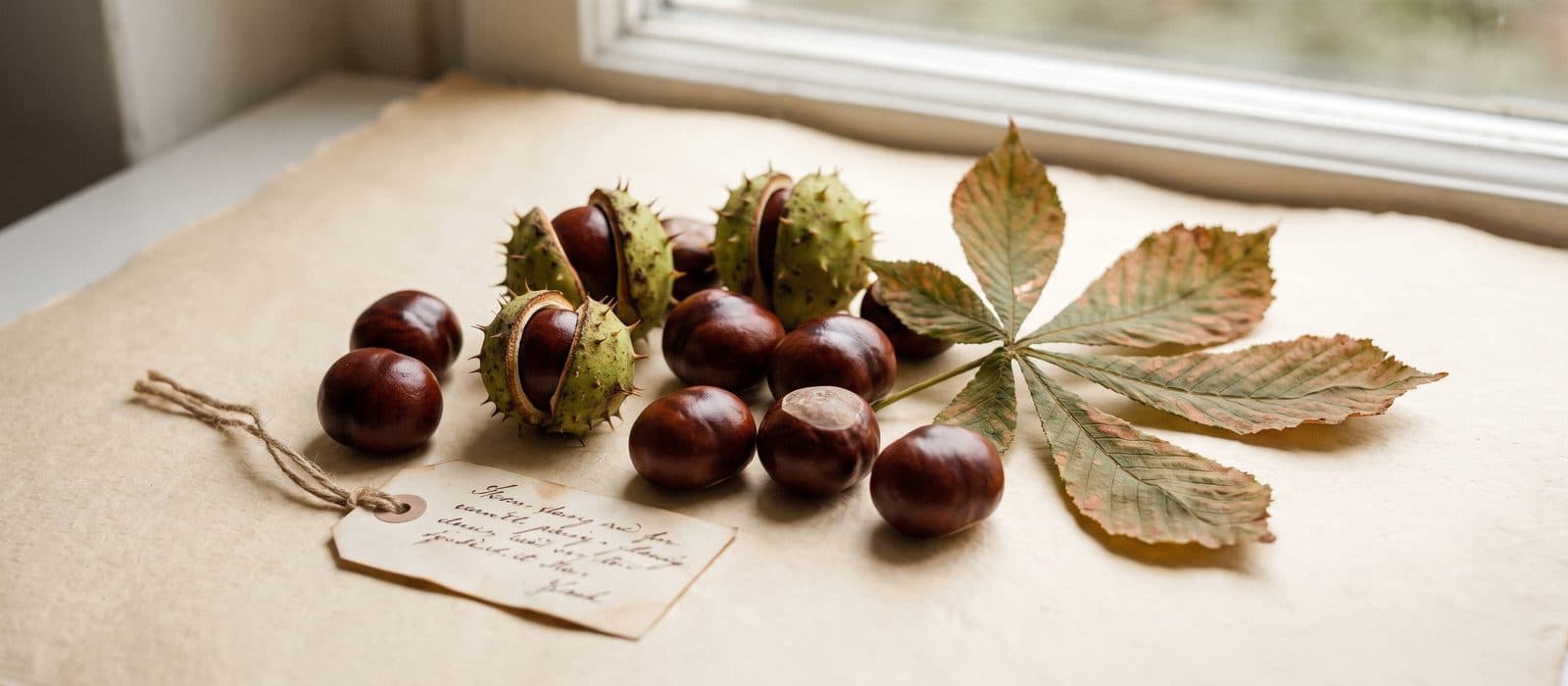
Homeopathic Aesculus is prepared from the ripe seeds of Aesculus hippocastanum, the horse chestnut, a large tree native to the mountains of the Balkans and planted in parks and avenues across Europe and North America. In spring it carries upright candles of white flowers; in autumn the spiny green husks split to release glossy brown seeds, the conkers. The seeds are made into a tincture and then diluted and succussed step by step to the labelled potency.
Conkers look edible and are not. They contain aescin and other saponins, and eating them causes vomiting, diarrhoea and abdominal pain, with more serious effects reported in children and animals. They are a different tree and a different nut from the sweet chestnut, Castanea sativa, sold for roasting, and the two are easy to confuse. Raw horse chestnut is never something to prepare or eat at home. At the common homeopathic potencies the arithmetic says no molecule of the seed remains; our potencies guide sets out what that means and why it is also the reason science is sceptical.
There is a second, separate product to keep apart. Standardised horse chestnut seed extract, a herbal medicine sold in measurable milligram amounts of aescin, has been studied in clinical trials for chronic venous insufficiency. That research is about a herbal extract, not about the homeopathic remedy, and it says nothing about potentised Aesculus. Our guide to reading Latin remedy names explains why the same Latin name can sit on very different products.
What is the Aesculus hippocastanum picture?
The Aesculus picture is the person who feels congested, heavy and full in the lower half of the body. Imagine someone who has been sitting at a desk for weeks, a little constipated, whose haemorrhoids have flared: they ache more than they bleed, they look purplish, and the rectum feels dry and hot, as though it were full of small sticks or splinters. Passing a stool is followed by a long aching that lingers for hours. Alongside it there is a dull, lame ache across the low back and the sacro-iliac joints that makes walking and bending forward an effort, and getting up from a chair a small project.
Boericke (1927) describes the remedy's action on the lower bowel and the portal circulation, with venous congestion, fullness in various parts, and a back that "gives out" on walking or stooping. Older texts also record a dry, raw, hot throat with swollen veins at the back of it, and a mood of irritability and low spirits, the gloom of someone uncomfortable in their own body.
The common thread is fullness without much discharge. That is the part homeopaths found most characteristic, and it is what separates this picture from haemorrhoids that bleed freely.
What makes it better or worse?
The traditional modalities centre on movement, posture and time of day. Aesculus is worse from walking, stooping and standing and in the morning, and better in cool open air.
| Modality | Worse | Better |
|---|---|---|
| Motion | Walking, stooping, rising from sitting | Rest |
| Position | Standing | Lying still |
| Bowel | After a stool; aching lasts for hours | Between stools |
| Time | Morning, on waking | Later in the day |
| Air | Warm, close rooms | Cool open air (Boericke) |
Those modalities are what separate one pile picture from another; our guide to modalities, better and worse explains why a homeopath reads them before any remedy name.
What is Aesculus hippocastanum traditionally discussed for?
In homeopathic literature, Aesculus is traditionally discussed for venous congestion in the lower body, chiefly haemorrhoids with low back aching. On this site it appears on one acute page, where the pattern sits beside its neighbours and the red flags come first.
Lower bowel and rectum
- A painful haemorrhoid flare: the aching, back-related pile pattern, with dryness, a sense of sticks in the rectum, and fullness more than bleeding.
Back and veins (classic texts)
- Older materia medica describes a lame, aching low back and sacro-iliac region, worse walking and stooping, and a general sense of fullness in the veins, including a dry throat with visible veins. Back pain with numbness, weakness in the legs or changes in bladder or bowel control is an emergency, not a pattern question.
What is Aesculus hippocastanum not?
Aesculus is not "the haemorrhoid remedy", and it is not a substitute for finding out why there is blood. Rectal bleeding has many causes, and most are minor, but some are not. Bleeding that has never been checked, dark red or black stools, a change in bowel habit lasting more than a few weeks, unexplained weight loss, pain with a hard, very tender lump, or bleeding in anyone over fifty all need medical assessment first. Our red flags first guide explains why those questions come before any pattern.
It is also not horse chestnut seed extract, and the herbal research does not transfer to the homeopathic remedy in either direction.
Homeopaths separate it from its neighbours like this:
| Picture | Where it sits | Defining feature | Key modality |
|---|---|---|---|
| Aesculus hippocastanum | Aching, congested piles with back pain | Dry rectum, as if full of sticks; bleeds little; lame low back | Worse walking and stooping; better cool air |
| Hamamelis | Bleeding, bruised veins | Piles that bleed freely with a sore, bruised feeling | Worse from pressure and warm, moist air |
| Nux vomica | Piles with constipation and excess | Ineffectual urging; irritable, chilly, sedentary | Worse morning and from rich food; better warmth |
| Sulphur | Itching, burning piles | Burning and itching around the anus; hot, uncovers | Worse from heat and bathing |
What potencies is Aesculus hippocastanum sold in?
Aesculus is sold most often as 6C and 30C pellets, usually through homeopathic pharmacies, and the name also appears on some combination products and topical creams. Potency describes the preparation process, not an amount of seed: 30C means thirty successive 1:100 dilutions with succussion between them. Our potencies guide explains the scale and what remains in the vial.
This page deliberately gives no frequency or instructions for taking Aesculus. That depends on a whole case, not a remedy name. Read the product label, and talk to a qualified practitioner about an individual situation.
What remedy lists don't tell you
Two things the "remedies for piles" lists leave out:
- The back is part of the case. Many people with a haemorrhoid flare would never think to mention a dull ache across the low back and hips. In the Aesculus picture that ache is one of the defining features, and our guide to the symptoms alongside the symptom explains why the "unrelated" complaint is often the one that sorts the case.
- Whether it bleeds matters more than how much it hurts. Classic texts divide pile pictures sharply into those that ache and hardly bleed and those that bleed freely. Lists that sort by "haemorrhoids" lose that division, and it is also the question a clinician will ask first, for different reasons.
Where the Aesculus hippocastanum picture appears on this site
Acute pages that discuss this picture among their educational patterns, with the pattern name each page uses.
- What homeopathic remedy for a painful hemorrhoid flare?Aesculus-like aching, back-related pile pattern
Not sure whether a picture fits?
A remedy profile describes a picture; it cannot tell you whether that picture matches what you are seeing. An acute consultation starts from the case itself: onset, sensations, what changes it, and the red flags.
Acute consultation · $45Frequently asked questions
- What is Aesculus hippocastanum?
- Aesculus hippocastanum is a homeopathic remedy prepared from the seeds of the horse chestnut tree, the shiny brown conkers of autumn. In homeopathy it names a traditional picture: aching, congested haemorrhoids with a feeling of sticks or splinters in the rectum, paired with a dull ache across the low back and hips. It is a description homeopaths use to compare cases, not a finding that it works for any condition.
- What is Aesculus used for in homeopathy?
- Homeopathic literature traditionally discusses Aesculus for venous fullness, chiefly painful, aching haemorrhoids that bleed little, with dryness in the rectum and a sense of sticks pricking it, and a low-back ache made worse by walking and stooping. The picture is defined by that fullness and aching rather than by a diagnosis. Rectal bleeding, black stools, a change in bowel habit or weight loss need medical care first.
- What is Aesculus 30C used for?
- 30C is a commonly sold potency of Aesculus, along with 6C, mostly through homeopathic pharmacies. In the tradition the potency does not change the picture; 30C is discussed for the same aching, congested pattern as any other potency. Our potencies guide explains what 30C means as a dilution.
- How is Aesculus taken?
- This page does not give instructions on how or how often to take any remedy, because that depends on a whole case rather than on a remedy name. The product label carries the manufacturer's directions, and a qualified practitioner can advise on an individual situation. Any rectal bleeding that has not been looked at by a clinician belongs with one first.
- Where can I buy Aesculus?
- Homeopathic pharmacies and manufacturers sell Aesculus hippocastanum as single-remedy pellets, most often in 6C and 30C, and it also appears in some combination products and topical creams. This site also prepares custom single remedies to order: you name the remedy and potency, and the details are confirmed by email before anything is made. The order form does not give advice on which remedy to choose.
- What is Aesculus made from?
- Homeopathic Aesculus is prepared from the ripe seeds of the horse chestnut tree, native to the Balkans and planted across Europe and North America. The seeds are made into a tincture, then diluted and succussed to the labelled potency. Raw conkers contain aescin and other saponins and are poisonous if eaten; they are not the sweet chestnuts sold for roasting.
This guide is educational only and is not medical advice or a personalized remedy recommendation. Acute symptoms can become urgent; when in doubt, seek professional evaluation.