Remedy profile
Hamamelis virginiana in Homeopathy: Uses, Picture and Limits
What homeopathic Hamamelis virginiana is made from, the passive, bruised, venous picture homeopaths describe, what changes it, potencies sold, and its limits.
By Homeopathic BenefitsPublished 7 min read
Key takeaways
- Hamamelis is the picture of passive, venous congestion. Dark blood that oozes rather than spurts, veins that feel full and sore, and a bruised ache along their length are its classic keynotes.
- The soreness follows the veins. Classic texts describe tenderness tracing along a vein rather than sitting at one point.
- It comes from witch hazel. The same North American shrub gives the familiar skin toner, but the homeopathic remedy is a potentised preparation, not the distilled water.
- It is a small, specific picture. The materia medica gives Hamamelis a narrow range: veins, passive bleeding and bruised soreness.
- Bleeding red flags come first. A nosebleed lasting over 20 minutes, any new or heavy rectal bleeding, black stools, or a hot, swollen limb needs medical care.
The short answer
Hamamelis virginiana is a homeopathic remedy prepared from witch hazel, a shrub of the eastern woodlands of North America. In homeopathy it names a traditional picture rather than a treatment: passive, venous congestion. Classic materia medica describes dark blood that oozes slowly rather than spurting, veins that feel full, sore and bruised along their length, and a weary, heavy aching in the affected part. American homeopaths brought it into practice in the mid-nineteenth century, and its proving records are gathered in Hering's Guiding Symptoms and Allen's Encyclopedia. It is not a general bleeding or haemorrhoid remedy, and nothing about the picture replaces medical care for bleeding that is heavy, persistent or unexplained.
| Latin name | Hamamelis virginiana |
|---|---|
| Abbreviation | Ham. |
| Common name | Witch hazel |
| Source | Fresh bark of the twigs and root of Hamamelis virginiana (Hamamelidaceae) (plant kingdom) |
| Commonly sold potencies | 6C, 30C |
| First proving | Introduced by American homeopaths in the mid-nineteenth century; provings recorded in Hering's Guiding Symptoms and Allen's Encyclopedia |
What is Hamamelis made from?
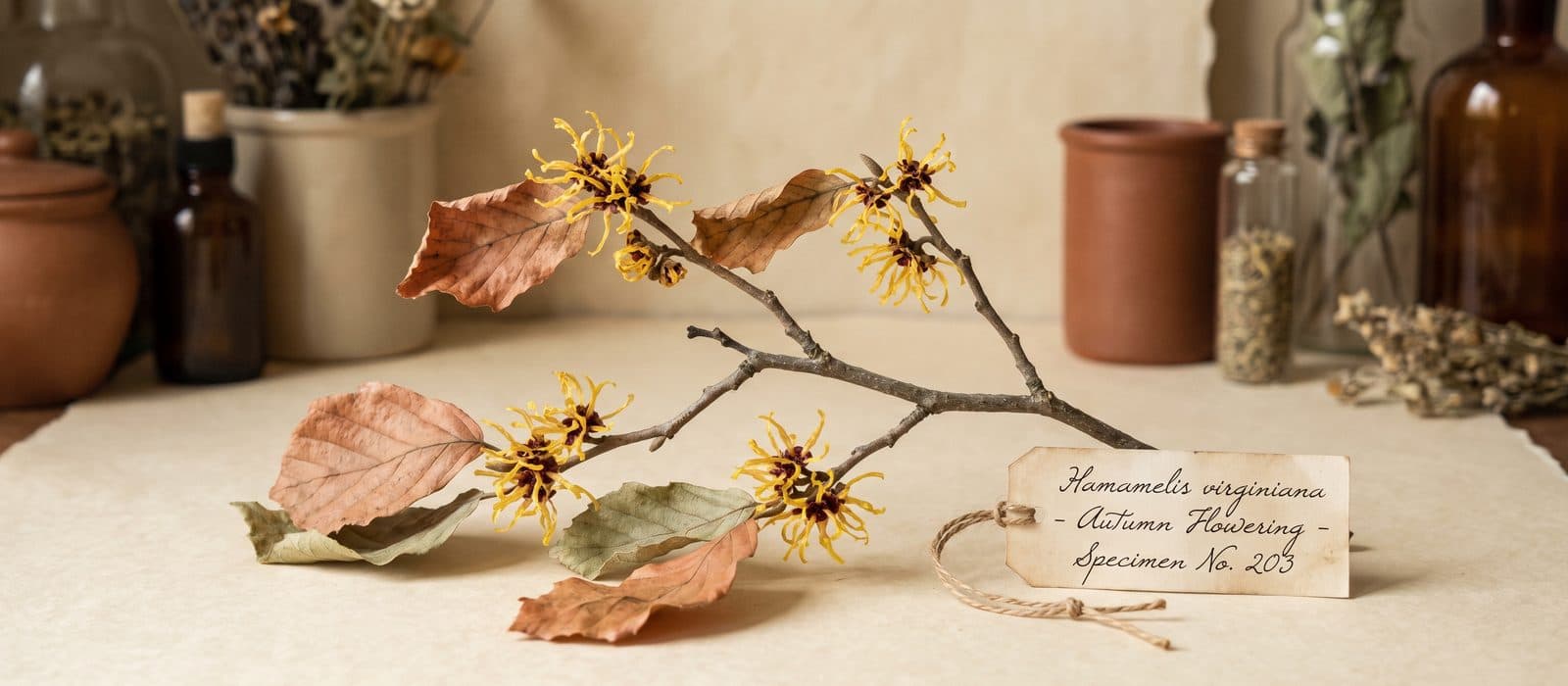
Homeopathic Hamamelis is prepared from the fresh bark of the twigs and root of Hamamelis virginiana, witch hazel. It is a large shrub or small tree of the forests of eastern North America, from Nova Scotia down to Georgia, and it has a strange calendar: its spidery yellow flowers open in October and November, after the leaves have fallen, and the seed capsules of the previous year split at the same time and can throw their black seeds several metres. Settlers used the forked branches as divining rods. The "witch" in the name is usually traced to an Old English word meaning pliant, not to witchcraft.
Indigenous peoples of the region used witch hazel bark and leaves long before European settlement, and its distilled extract became one of the best-known household products in nineteenth-century America. The familiar witch hazel water sold today for the skin is a distillate of the twigs, and creams and ointments carrying the name are topical cosmetic or pharmacy products. The homeopathic remedy is something else again: a mother tincture of the fresh bark, then diluted and succussed step by step to the labelled potency. Our guide to what is in a homeopathic remedy explains the difference between these kinds of product.
Unlike many remedies, Hamamelis does not come from a poisonous source. At the common potencies the arithmetic says no molecule of the bark remains in any case; our potencies guide explains what that means and why it is also the reason science is sceptical.
What is the Hamamelis picture?
The Hamamelis picture is a part of the body where blood has pooled and moves sluggishly. Imagine the person whose nose begins to ooze dark blood without any force behind it, the flow slow and steady, the face full and heavy. Or someone a day after a blood test, the puncture itself barely marked, but the vein above it aching and tender as it runs up the arm, as if it had been bruised along its whole length.
Classic texts build the picture from these features. Boericke (1927) describes Hamamelis as a venous remedy, with passive bleeding of dark blood, congestion and a bruised soreness of the affected parts. The bleeding is described as passive and venous rather than bright and arterial: it seeps rather than spurts, the blood is dark, and it tends to come from places where veins are full, such as the nose, the rectum and varicose veins. Veins feel sore, full and as if they would burst; the soreness is bruised and tender to touch.
There is often weariness to go with it. The limbs feel tired and heavy, and the person may feel weak after bleeding out of proportion to the amount lost. Boericke records a curious mental note from the provings, a wish for the respect that is due to one, though the remedy's reputation rests on the physical picture far more than the mental one. Haemorrhoids in this picture are bleeding and sore, with a bruised, raw feeling more than the sharp, back-aching fullness of other pictures.
What makes it better or worse?
The traditional modalities centre on warmth, damp and pressure on the congested part. Hamamelis is worse from warm, moist air, touch and jarring, and better from rest and keeping still.
| Modality | Worse | Better |
|---|---|---|
| Air and weather | Warm, moist air (Boericke) | Cool, fresh air |
| Touch | Touch, pressure on the sore veins | Being left undisturbed |
| Motion | Jarring, exertion, standing for long | Rest and keeping still |
| Position | Hanging the limb down | Raising the affected part |
| Time | Daytime, with exertion | No consistent keynote |
Our guide to modalities, better and worse explains why a homeopath asks about these before any remedy name.
What is Hamamelis traditionally discussed for?
In homeopathic literature, Hamamelis is traditionally discussed for passive venous oozing and bruised, sore veins. Each of these appears on one of our acute pages, where the Hamamelis-like pattern sits beside its neighbours and the red flags come first.
Nose
- Bleeding that feels passive and venous, with congestion and fullness: a sudden nosebleed. A nosebleed that does not stop after 20 minutes of firm pressure, follows a head injury, or happens in someone on blood thinners needs medical care.
Veins and bruising
- The bruised, sore-vein aching that traces up a drawn vein rather than sitting at the puncture alone: bruising after a blood draw. An arm that becomes hot, red and swollen, numb or tingling, or a hard, painful vein, should be checked by a clinician.
Haemorrhoids
- Passive venous oozing with bruised soreness: a painful haemorrhoid flare. Rectal bleeding should never simply be assumed to be piles; new bleeding, black or tarry stools, or a change in bowel habit needs medical assessment.
What is Hamamelis not?
Hamamelis is not "the bleeding remedy", and that is the misreading most lists encourage. The picture is the passive, dark, venous quality and the bruised soreness of full veins. Bright-red, gushing bleeding reads differently in the tradition, and bleeding of any kind is first a question of how much, from where and why.
That question belongs with a clinician more often than not. A nosebleed lasting over 20 minutes despite pressure, frequent nosebleeds, bleeding after a head injury, rectal bleeding that is new, heavy or dark, black stools, unexplained bruising, or bleeding in someone on anticoagulants needs medical assessment. A leg or arm that becomes swollen, hot and painful may be a clot rather than a bruise. Our guide to red flags first sets these out.
Homeopaths separate Hamamelis from its neighbours like this:
| Picture | Where it sits | Defining feature | Key modality |
|---|---|---|---|
| Hamamelis | Passive venous congestion | Dark, oozing blood; sore, full veins; bruised along their length | Worse warm, moist air and touch; better rest |
| Arnica montana | Bruising from injury | Sore, bruised, "I'm fine", does not want to be touched | Worse touch and jarring |
| Aesculus | Haemorrhoids with back ache | Fullness and sharp sticks in the rectum, aching low back; often little bleeding | Worse standing and walking |
| Phosphorus | Bright, free bleeding | Bright-red blood that flows easily; open, sympathetic, thirsty for cold drinks | Better company and cold drinks |
| Bellis perennis | Deep bruising | Bruising of deeper tissues after injury or surgery | Worse cold drinks when hot; better motion |
Arnica and Hamamelis are the two classic "bruised" pictures and are often confused. The traditional distinction is the cause and the tissue: Arnica follows an injury and the bruising sits where the blow landed; Hamamelis is about veins that are already full and sore, with dark blood seeping from them.
What potencies is Hamamelis sold in?
Homeopathic Hamamelis is sold as single-remedy pellets, usually in 6C and 30C. Potency describes the preparation process, not an amount of bark: 30C means thirty successive 1:100 dilutions with succussion between them. Our potencies guide explains the scale and what remains in the vial. Witch hazel creams, ointments and distilled waters are separate products with their own labelling, and this page does not describe them.
This page deliberately gives no frequency or instructions for taking Hamamelis. That depends on a whole case, not a remedy name. Read the product label, and talk to a qualified practitioner about an individual situation.
What remedy lists don't tell you
Two things the "remedies for bleeding and bruising" lists leave out:
- The colour and force of the blood are the tell. Lists put Hamamelis beside any bleeding, which makes it a word rather than a picture. What the classic authors found characteristic was dark blood that oozes passively from full veins, with the bruised soreness of the vessel itself. Without that quality, the tradition reads the case as something else.
- The name on the skin-care shelf is not the remedy. Witch hazel is so familiar as a toner and an ointment that readers assume the homeopathic remedy is the same thing in a different bottle. It is not. Distilled witch hazel and topical creams are concentrated plant products used on the skin; homeopathic Hamamelis is a potentised preparation, and the two should not be confused when reading a label.
Where the Hamamelis virginiana picture appears on this site
Acute pages that discuss this picture among their educational patterns, with the pattern name each page uses.
- What homeopathic remedy for a painful hemorrhoid flare?Hamamelis-like passive venous oozing pattern
- What homeopathic remedy for a sudden nosebleed?Hamamelis-like passive venous oozing pattern
- What homeopathic remedy for bruising after a blood draw?Hamamelis-like sore vein-line pattern
Not sure whether a picture fits?
A remedy profile describes a picture; it cannot tell you whether that picture matches what you are seeing. An acute consultation starts from the case itself: onset, sensations, what changes it, and the red flags.
Acute consultation · $45Frequently asked questions
- What is Hamamelis virginiana?
- Hamamelis virginiana is a homeopathic remedy prepared from witch hazel, a small North American shrub that flowers in late autumn. In homeopathy it names a traditional picture: passive, dark, venous oozing and a bruised soreness that seems to follow the veins, with a sense of fullness and congestion. It is a description homeopaths use to compare cases, not evidence that it works for any condition.
- What is Hamamelis used for in homeopathy?
- Homeopathic literature traditionally discusses Hamamelis for passive, dark, slow bleeding and sore, congested veins: a nosebleed that oozes rather than spurts, a haemorrhoid flare with bruised soreness, or the aching that traces up a vein after a blood draw. The picture is defined by that passive, venous, bruised quality, not by the name of a complaint. A nosebleed lasting over 20 minutes, any rectal bleeding that is new or heavy, or a hot, swollen arm needs medical care first.
- What is Hamamelis 30C used for?
- 30C is one of the potencies Hamamelis is commonly sold in, alongside 6C. In the tradition the potency does not change the picture: Hamamelis 30C belongs to the same passive, venous, bruised description as any other potency. Witch hazel also appears in many topical creams and distilled waters, which are a different kind of product from a potentised remedy. Our potencies guide explains what 30C means as a dilution.
- How is Hamamelis taken?
- This page does not give instructions on how or how often to take any remedy, because that depends on a whole case rather than on a remedy name. The product label carries the manufacturer's directions, and a qualified practitioner can advise on an individual situation. Bleeding that is heavy, persistent or unexplained belongs with a clinician first.
- Where can I buy Hamamelis?
- Pharmacies, health-food shops and homeopathic manufacturers sell homeopathic Hamamelis as single-remedy pellets, usually in 6C or 30C. This site also prepares custom single remedies to order: you name the remedy and potency, and the details are confirmed by email before anything is made. The order form does not give advice on which remedy to choose.
- What is Hamamelis made from?
- Homeopathic Hamamelis is prepared from the fresh bark of the twigs and root of Hamamelis virginiana, witch hazel, steeped into a mother tincture and then diluted and succussed step by step to the labelled potency. Witch hazel is not a poisonous plant, but the potentised remedy is a different product from the distilled witch hazel water sold for the skin.
This guide is educational only and is not medical advice or a personalized remedy recommendation. Acute symptoms can become urgent; when in doubt, seek professional evaluation.