Remedy profile
Anacardium orientale in Homeopathy: Uses, Picture and Limits
What homeopathic Anacardium is made from, the burning, raw-skin and divided-mind picture homeopaths describe, what changes it, potencies sold, and its limits.
By Homeopathic BenefitsPublished 7 min read
Key takeaways
- Anacardium's skin picture is burning, blistering rawness. Classic texts describe intensely itching vesicles, raw cracked edges and a burning that hot water aggravates.
- Its source blisters skin on contact. The marking nut belongs to the same plant family as poison ivy and the cashew, and its juice is a powerful skin irritant.
- The mind is the part homeopaths remember. Older texts describe failing memory, low self-confidence and a feeling of being pulled between two opposing wills.
- Eating eases it. An empty, gnawing stomach that feels better while eating is one of the classic physical keynotes.
- Plant-rash red flags come first. A rash on the face, eyes or genitals, widespread blistering, facial swelling, trouble breathing, or signs of infection are medical questions before homeopathic ones.
The short answer
Anacardium orientale is a homeopathic remedy prepared from the marking nut of Semecarpus anacardium, an Indian tree whose nut contains a black, acrid juice that blisters skin. In homeopathy it names a traditional picture rather than a treatment: burning, intensely itching, blistering skin with raw, cracked edges, together with a mind that feels divided, forgetful and lacking in confidence, and an empty stomach that is better for eating. Hahnemann included it in The Chronic Diseases, and Kent's Lectures (1905) gave its mental picture a long chapter. It is not a poison ivy remedy, and nothing about the picture replaces medical care for a severe or spreading plant rash.
| Latin name | Anacardium orientale |
|---|---|
| Abbreviation | Anac. |
| Common name | Marking nut, Malacca bean |
| Source | The black, acrid juice of the marking nut, Semecarpus anacardium (Anacardiaceae) (plant kingdom) |
| Commonly sold potencies | 6C, 30C, 200C |
| First proving | Hahnemann, The Chronic Diseases (2nd edition, 1835–1839) |
What is Anacardium orientale made from?
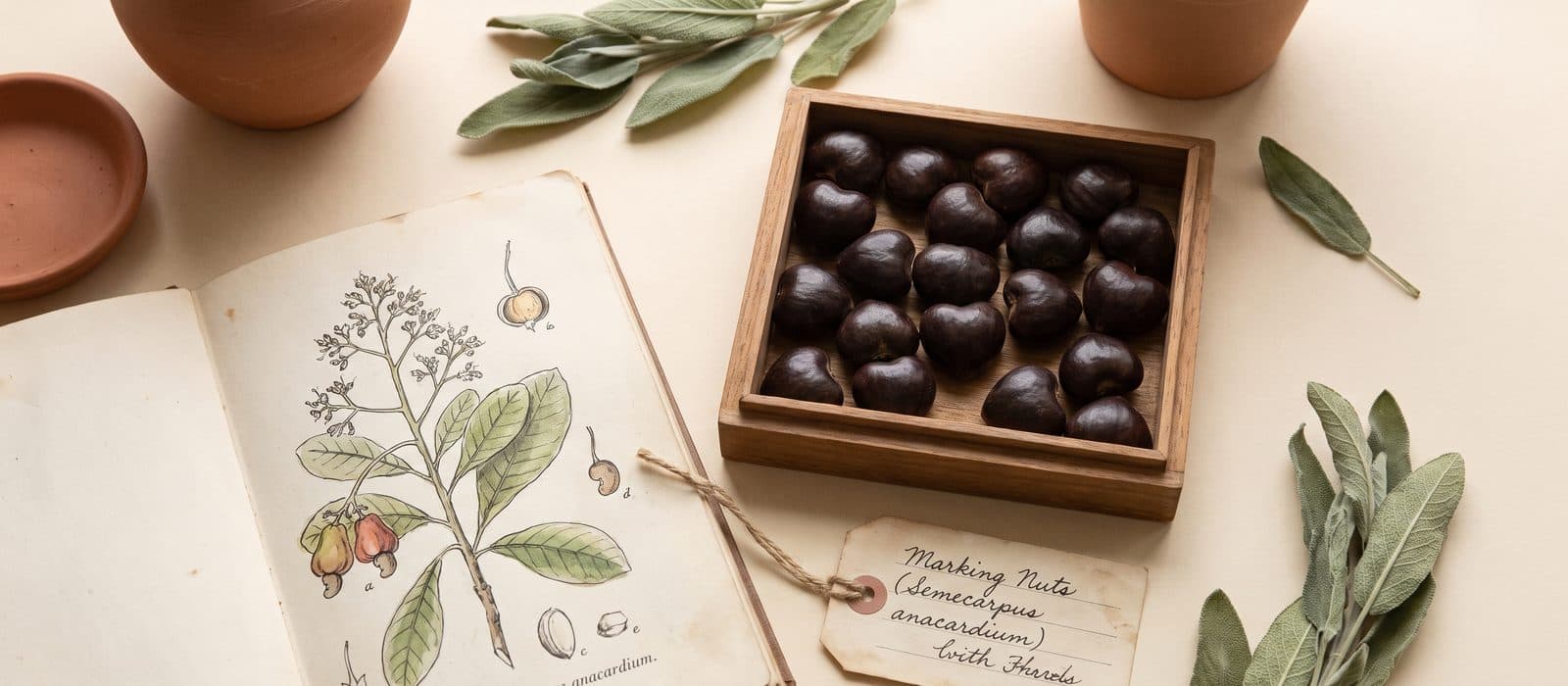
Homeopathic Anacardium is prepared from the marking nut, the fruit of Semecarpus anacardium, a deciduous tree of the hot, dry forests of India and the Himalayan foothills. The nut is heart-shaped and black, sitting on a swollen, fleshy, orange stalk. Between the hard shell and the kernel there is a black, oily juice that turns indelible on cloth, which is how the tree got its name: it was used for centuries in India to mark laundry. Older pharmacy called the nut the Malacca bean.
That juice is the reason for caution. It contains phenolic compounds related to the urushiol of poison ivy, and it blisters skin on contact, raising burning, weeping, itching eruptions. The tree belongs to the Anacardiaceae, the same family as poison ivy, poison oak, the mango and the cashew, whose shell holds a similar irritant oil. The raw marking nut and its juice are never something to handle, prepare or use at home. Homeopathic Anacardium is triturated or made into a tincture, then diluted and succussed step by step to the labelled potency. At the common potencies the arithmetic says no molecule of the nut remains; our potencies guide explains that honestly, along with why it is also the reason science is sceptical.
The name can mislead. Anacardium is the genus of the cashew, not of the marking nut, and the label name is a historical one; our guide to reading Latin remedy names explains why remedy names often preserve older botany.
What is the Anacardium orientale picture?
The Anacardium picture has two halves that rarely appear in remedy lists together. The skin half is the one most people meet. Imagine someone a day after clearing brambles and vines from a garden: patches of small blisters along the forearms that itch intensely and burn, edges that have gone raw and cracked from scratching, and an itch that hot water briefly satisfies and then makes worse. Classic texts describe vesicular eruptions, intense itching and a raw, burning quality, very like the effects of the nut's own juice.
The mental half is what Hahnemann and Kent wrote most about. Kent's Lectures (1905) describe a person whose memory is failing, who lacks confidence in themselves, and who feels as though they had two wills, one urging them to do something and another forbidding it. The conflict can make them irritable and sharp-tongued, out of character, and the old texts record a tendency to swear or speak harshly that the person then regrets. Homeopaths read this as a picture of inner division and weakened self-trust, typically seen in someone under prolonged mental strain such as exam study.
The physical keynote that ties it together is the stomach. Boericke (1927) describes an empty, gnawing feeling that is better while eating and returns a couple of hours later, and a sensation of a plug or blunt object pressing, in the bowel and elsewhere.
What makes it better or worse?
The traditional modalities centre on eating, heat and pressure. Anacardium is worse from hot applications and on an empty stomach, and better while eating.
| Modality | Worse | Better |
|---|---|---|
| Food | Empty stomach; about two hours after eating | While eating (Boericke) |
| Skin and heat | Hot water, hot applications; scratching | Rubbing (some texts) |
| Position | Lying on the back | Lying on the side |
| Mind | Mental strain, study | Rest and food |
The modalities are what separate one blistering rash from another; our guide to modalities, better and worse explains why a homeopath reads them before any remedy name.
What is Anacardium orientale traditionally discussed for?
In homeopathic literature, Anacardium is traditionally discussed for blistering, burning skin eruptions and for a mental picture of failing memory and inner conflict. On this site it appears on one acute page, where the pattern sits beside its neighbours and the red flags come first.
Skin
- A poison ivy rash: the burning, cracked, irritated pattern, sometimes discussed for plant-related rashes with rawness and cracked edges, a fitting place for a remedy whose source comes from the same plant family.
Mind and digestion (classic texts)
- Older materia medica describes forgetfulness and low confidence under strain, the sense of two conflicting wills, and an empty stomach eased by eating. These have no acute page here; low mood, confusion or memory loss that is new or persistent is a medical question first.
What is Anacardium orientale not?
Anacardium is not "the poison ivy remedy", and the plant-family connection is a reason for interest, not a shortcut. Plant rashes follow several traditional pictures: the restless one whose itch is soothed by very hot water, the puffy, stinging one soothed by cold, the cracked, oozing one. Anacardium's version is burning, raw and cracked, worse from heat, in a person who may also mention the forgetful, divided state. A rash on the face, around the eyes, mouth or genitals, a rash covering a large area, blisters that weep heavily, swelling of the face or throat, any difficulty breathing (including after smoke from burning plants), fever, pus or spreading redness all need medical assessment first. Our red flags first guide explains why.
It is also not a description of anyone's character. The mental picture in the old texts is a clinical sketch from the nineteenth century, not a label for people who are irritable or forgetful.
Homeopaths separate it from its neighbours like this:
| Picture | Where it sits | Defining feature | Key modality |
|---|---|---|---|
| Anacardium orientale | Burning, raw, cracked plant rash | Intense itch, rawness; divided, forgetful mind; empty stomach | Worse hot water; better eating |
| Rhus toxicodendron | Blistering, restless itch | Fine blisters, maddening itch, cannot keep still | Better very hot water; worse cold and rest |
| Apis mellifica | Puffy, stinging swelling | Rosy, shiny, swollen; stinging; thirstless | Better cold applications; worse heat |
| Graphites | Cracked, oozing skin | Cracks that ooze a sticky, honey-like fluid | Worse warmth of bed; worse at night |
What potencies is Anacardium orientale sold in?
Anacardium is sold most often as 30C pellets, with 6C and 200C also widely available, usually through homeopathic pharmacies. Potency describes the preparation process, not an amount of nut: 30C means thirty successive 1:100 dilutions with succussion between them. Our potencies guide explains the scale and what remains in the vial.
This page deliberately gives no frequency or instructions for taking Anacardium. That depends on a whole case, not a remedy name. Read the product label, and talk to a qualified practitioner about an individual situation.
What remedy lists don't tell you
Two things the "remedies for poison ivy" lists leave out:
- Hot water sorts the case. Two people with the same blistering plant rash can react opposite ways to a hot shower: one finds it the only relief, the other finds it makes the burning worse. Classic texts place them in different pictures, and lists sorted by "poison ivy" never ask which one you are.
- The rest of the person is part of the rash. Homeopaths took the forgetful, conflicted, empty-stomached state as seriously as the skin. Someone who mentions, while describing their rash, that they are exhausted from studying and keep eating to feel settled has said more about the picture than the rash did. Our guide to the symptoms alongside the symptom explains why.
Where the Anacardium orientale picture appears on this site
Acute pages that discuss this picture among their educational patterns, with the pattern name each page uses.
- What homeopathic remedy for a poison ivy rash?Anacardium-like burning, cracked, irritated pattern
Not sure whether a picture fits?
A remedy profile describes a picture; it cannot tell you whether that picture matches what you are seeing. An acute consultation starts from the case itself: onset, sensations, what changes it, and the red flags.
Acute consultation · $45Frequently asked questions
- What is Anacardium orientale?
- Anacardium orientale is a homeopathic remedy prepared from the marking nut, Semecarpus anacardium, a tree of India whose nut contains a black, blistering juice. In homeopathy it names a traditional picture: burning, raw, cracked, intensely itchy skin, and a mind that feels divided and unsure of itself, with an empty stomach that feels better for eating. It is a description homeopaths use to compare cases, not a finding that it works for any condition.
- What is Anacardium used for in homeopathy?
- Homeopathic literature traditionally discusses Anacardium for blistering, burning, itching skin with raw, cracked edges, including rashes from plants of the same family as poison ivy, and for a mental picture of poor memory and inner conflict. A rash near the eyes, mouth or genitals, a widespread rash, swelling of the face, trouble breathing, or signs of infection needs medical care first.
- What is Anacardium 30C used for?
- 30C is a commonly sold potency of Anacardium, along with 6C and 200C, mostly through homeopathic pharmacies. In the tradition the potency does not change the picture; 30C is discussed for the same burning, raw-skin and divided-mind picture as any other potency. Our potencies guide explains what 30C means as a dilution.
- How is Anacardium taken?
- This page does not give instructions on how or how often to take any remedy, because that depends on a whole case rather than on a remedy name. The product label carries the manufacturer's directions, and a qualified practitioner can advise on an individual situation. A plant rash affecting the face, eyes or breathing belongs with a clinician first.
- Where can I buy Anacardium?
- Homeopathic pharmacies and manufacturers sell Anacardium orientale as single-remedy pellets, most often in 30C, with 6C and 200C also available. This site also prepares custom single remedies to order: you name the remedy and potency, and the details are confirmed by email before anything is made. The order form does not give advice on which remedy to choose.
- What is Anacardium made from?
- Homeopathic Anacardium is prepared from the marking nut of Semecarpus anacardium, a tree of India. Between the shell and the kernel the nut holds a black, oily, acrid juice that blisters skin on contact. The prepared nut is triturated or made into a tincture, then diluted and succussed to the labelled potency, far past the point where any of the juice remains. The raw nut and its juice are never something to handle or use at home.
This guide is educational only and is not medical advice or a personalized remedy recommendation. Acute symptoms can become urgent; when in doubt, seek professional evaluation.